Bench Degree·PLASMAchapter

Chapter 9: Light
Every gas glows its own colour, and the colour is a fingerprint you can read with a scrap of a compact disc. Then the honest part: the lamps in this chapter are being replaced by a device with no gas in it at all, and there are good reasons.
Find a compact disc you do not care about and take it out to a car park with a streetlight.
Hold the disc so it catches the light and tilt it until the reflection spreads into colours. Now look at what the colours actually are.
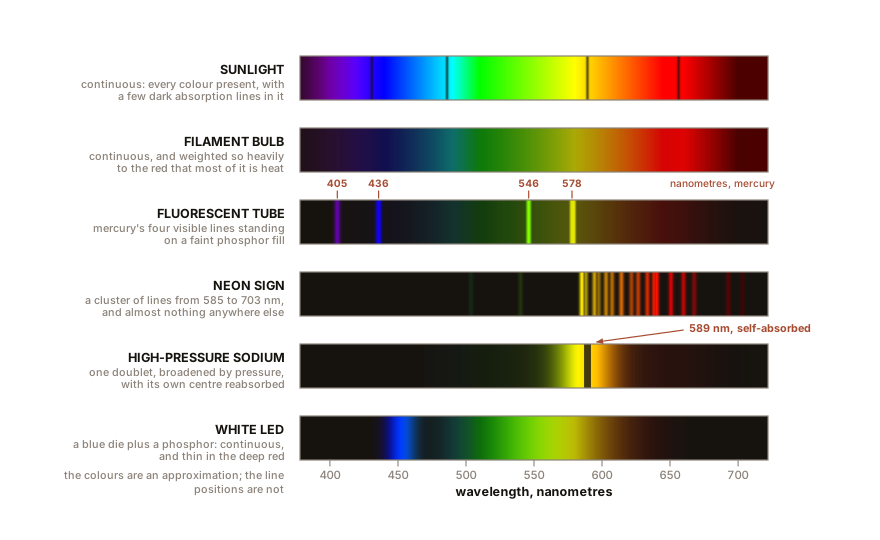
Under a streetlight, they are not a rainbow. They are a few separate bars with darkness between them. Under a filament bulb, or under the sun, the same disc gives a continuous smear from red to violet with nothing missing.
That difference is the whole of this chapter. A hot solid emits every colour. A glowing gas emits a short list of colours and no others, and the list belongs to that gas and to no other gas in the universe.
ON THE BENCH: A spectroscope from rubbish
Parts: one CD or DVD you can destroy; a cereal box or mailing tube; a craft knife; black tape; a phone. Cost: nothing. Time: 30 minutes, then a walk. Hazards: the knife, and cutting a disc makes sharp flakes. Cut on a board, wear glasses. Method: cut a piece about 25 mm (1 in) square from the disc, away from the centre hole. A DVD beats a CD because its track spacing is finer and spreads the colours further. Tape it inside one end of the tube at about 45 degrees. At the other end cut a slit 0.5 mm (0.02 in) wide and 15 mm (0.6 in) long, using two razor blades taped edge to edge to get it straight. Cut a viewing hole in the side aimed at the disc, and seal every other light leak. What you should see: a filament bulb gives an unbroken band. A fluorescent tube gives a band with several bright lines standing on top of it. A neon sign gives a fistful of red and orange lines and almost nothing else. A high-pressure sodium streetlight gives a broad orange smear with a dark notch in the middle, and Section 4 explains that notch. Better, if you have one: photograph each spectrum through the viewing hole. Side by side on a screen the differences are obvious in a way they are not to the eye. If it does not work: your slit is too wide. Narrow it until the lines separate.
Section 1: Why Each Gas Has Its Own Colour
An electron bound to an atom cannot have any energy it likes. It can occupy one of a fixed set of levels, like the rungs of a ladder, and nothing in between. In a discharge, a fast free electron knocks one of an atom’s electrons up a rung or several, and within about ten nanoseconds it falls back down and the energy leaves as a single photon.
The colour of that photon is set by the size of the step. A big step gives a short wavelength toward the blue; a small step gives a long one toward the red.
And here is the point. Every element has a different ladder, because the ladder is set by how many protons are in the nucleus and how the other electrons are arranged around it. Neon’s rungs are not argon’s rungs, so neon’s colours are not argon’s colours, and no engineering will change either.
| Gas | What the eye calls it | What is actually there |
|---|---|---|
| Neon | red-orange | a cluster of lines from 585 to 703 nm, little elsewhere |
| Argon | violet, dim | deep blue lines and a great deal of ultraviolet |
| Helium | pale pink-white | lines spread across the visible, hence the near-white |
| Xenon | blue-white | dense line structure that fills in and looks continuous |
| Sodium | intense yellow | essentially one doublet, 589.0 and 589.6 nm |
| Mercury | blue-green cast | 253.7 nm ultraviolet dominates, plus 405, 436, 546, 578 nm |
Look at the mercury row, because it is the row that built the twentieth century. Most of what a mercury discharge emits is invisible.
IN PLAIN ENGLISH: An atom is a set of steps, and each step has one size. Knock an electron up a step and it falls back, releasing one flash of light whose colour is that step’s size. Different elements have differently spaced steps, so they make different colours, always. A discharge does not have a colour because of what it is made of in bulk. It has a colour because of the shape of one atom.
ON THE BENCH: Read your own discharge
Parts: the jar, hand pump, current-limited supply and ballast resistor from Chapter 6. The spectroscope you just built. A phone. Cost: nothing beyond Chapter 6. Time: an hour. Hazards: high voltage, Chapter 16 in full, ballast not optional. Do not stare into a bright discharge for minutes: a low-pressure discharge in air emits at 337 nm, which is ultraviolet. Method: strike at a few Torr and photograph the spectrum through the slit. Pump down and photograph again. Then let air back in a step at a time, photographing each. What you should see: at low pressure, distinct bands, which are nitrogen, because your jar holds air. Nitrogen gives bands rather than single lines because it is a molecule and a molecule can rotate and vibrate as well as jump rungs, so each electronic step splits into a picket fence. Then, as the pressure comes up, watch the bands broaden and the gaps fill in. That is Section 4’s argument happening in front of you. If you can get argon, from a welding supplier or a can sold for wine preservation, flush the jar and try again. The colour goes from the pink-violet of air to a cleaner blue-violet, it strikes at a lower voltage, and the spectrum changes completely. Chapter 3’s ionisation table and this chapter’s ladder in one observation.
Section 2: The Neon Sign, and What Is Not In It
Georges Claude showed the first neon tube at the Paris Motor Show in 1910, and the technology is essentially unchanged, because it was right the first time. A glass tube 8 to 15 mm (0.3 to 0.6 in) across, bent by hand over a flame. Cold electrodes working by ion bombardment, as in Chapter 6. Pumped to around 10 Torr (0.19 psi), filled with a noble gas, sealed, then a few kilovolts at 20 to 60 mA. A glow discharge and nothing more exotic.
Now the part that surprises people. Almost no neon sign is neon. Neon gives red-orange and only red-orange. Every other colour is argon with a drop of mercury, which runs mostly on mercury, emits heavily in the ultraviolet, and drives a phosphor coating chosen for whatever colour is wanted. Every blue, green, pink and white tube in a sign shop is that.
Section 3: The Fluorescent Tube, Where the Phosphor Does the Work
This is the lamp Chapter 4 kept promising to finish, and it finishes in one chain.
Mercury vapour at a hundredth of a Torr, about a hundred-thousandth of atmospheric, with argon at a few Torr as a buffer. Hot electrons at about 11,600 K in a gas at about 47 °C (117 °F). Emission at 253.7 nm, hard ultraviolet, invisible and largely unable to escape the glass. And a phosphor coating that absorbs the ultraviolet and re-emits visible light, which is the same process as a highlighter pen under a black light. The lamp is named after the coating, not the gas.
There is an unavoidable loss in that last step, and it caps the whole technology. A 253.7 nm photon carries 4.88 eV. A green photon at 550 nm carries 2.25 eV. Even if the phosphor converted every ultraviolet photon into exactly one visible photon, 54 per cent of the energy is left behind as heat in the coating. Nothing can be done about it. It is arithmetic.
Add up the losses and a good triphosphor T5 tube reaches about 100 lumens per watt against a filament bulb’s 14. That was a revolution, and it lit every office on earth for seventy years.
Section 4: High Pressure, and the Orange Decades
Raise the pressure and Chapter 4’s single knob turns. Collisions become frequent, electrons and gas come to a common temperature, and the discharge becomes thermal. The lines broaden, because the atoms are jostled and fast. New lines appear, because hotter gas populates states a cool gas never reaches. And the envelope gets genuinely hot, so it must be quartz or ceramic, and it takes minutes to warm up and minutes to restrike after a power blink.
That family is high-intensity discharge, and it lit every road and stadium of the late twentieth century.
Metal halide. Mercury plus iodides of scandium, sodium, thallium and rare earths, each contributing its own lines, so the designer builds a spectrum by choosing a recipe. About 90 lumens per watt with good colour: stadiums, shop windows and film sets.
High-pressure sodium. About 120 lumens per watt, and the orange that meant “city at night” for two generations. Sodium at high pressure attacks silica, so the arc tube is translucent polycrystalline alumina, a ceramic developed around 1960 to make this lamp possible. And the dark notch you saw is self-absorption: the 589 nm doublet is emitted in the hot core and absorbed again by cooler sodium nearer the wall, so the middle of the line never escapes.
Low-pressure sodium. At up to about 200 lumens per watt it is the most efficient lamp ever manufactured, and it has been torn out of nearly every street it once lit.
SLOW DOWN. Check Your Understanding: Low-pressure sodium reaches roughly 200 lumens per watt. A good LED street lantern reaches about 150. So the lamp being removed is more efficient than the lamp replacing it. Why did it lose? There are three reasons and only one is about colour. Think before reading on.
First, its colour rendering is nil. It emits one wavelength, so a red car and a brown car are the same car, and a bloodstain and a puddle are the same puddle.
Second, and this is the reason nobody mentions, the lumen is a rigged unit. A lumen is not a measure of energy. It is energy weighted by how sensitive the human eye is at that wavelength, and human sensitivity peaks at 555 nm. Sodium’s 589 nm sits almost on that peak, so a sodium lamp is scored on the one wavelength the scoring system likes best. In raw radiant terms it converts about 38 per cent of its electricity into light. A white source with good colour rendering cannot exceed roughly 350 lumens per watt however perfect it is, because it must spend output in the deep red and blue where the eye scores it poorly. The comparison was never like for like.
Third, a lamp is not an installation. A sodium lamp radiates in all directions from a long tube, so a fixture must catch that light with mirrors and throws a good deal of it at the sky. An LED is flat and emits into a hemisphere. Measure light on the road per watt from the wall, which is the only number that matters, and the LED wins even where the lamp does not.
Section 5: Why the Gas Lost
The light-emitting diode has displaced discharge lighting almost completely, and the reasons are mostly not about efficiency.
It is directional by nature, which is the third point above and probably the largest single win. It starts and restrikes instantly, where a metal halide lamp needs ten minutes to warm and up to fifteen to restrike after a flicker, which for a street is a safety argument. It dims and switches without penalty, where every strike sputters a discharge lamp’s electrodes, which is why lit car parks stayed lit all night; the saving from controlling the light is often larger than the saving from the lamp. It lasts 50,000 hours against 10,000 to 20,000, and it fails by fading. And it contains no mercury, where every fluorescent and HID lamp is 3 to 100 mg of a neurotoxin in a fragile envelope.
Where discharge still wins, and the list is shorter than it was:
Ultraviolet germicidal irradiation. A low-pressure mercury lamp at 253.7 nm is still the cheapest high-power source of hard ultraviolet, and it disinfects water and air worldwide. Ultraviolet LEDs are improving fast and are not there yet at high power.
Very high brightness from a very small point. A xenon short-arc lamp puts its whole output out of an arc 1 mm (0.04 in) long. Optics can only concentrate light that comes from a small source, so a cinema projector or a searchlight wants a point, and an array of LEDs spread over a square centimetre (about 0.16 square inches) cannot be squeezed back down to one by any lens. That limit has a name, etendue, and it is conserved.
And neon as a craft. Hand-bent tubing with a glow discharge in it looks like nothing else, and a strip of orange LEDs pretending to be it looks like a strip of orange LEDs.
Section 6: What This Chapter Established
A glowing gas emits a list of wavelengths set by the structure of its atoms, which is why colour identifies a gas and why a scrap of a CD is a chemical analyser. And most of a mercury discharge’s output is ultraviolet, so the lamp built from it is really a phosphor with a discharge behind it, carrying a 54 per cent loss that no engineering removes.
Pressure decides everything again. Low pressure gives narrow lines and a cool tube; high pressure gives broadened lines, a hot envelope and a warm-up time. Chapter 4’s knob, turned in a lamp factory.
And a technology can be beaten while holding the efficiency record, because efficiency is measured in a unit that flatters some spectra, and because a lamp is only part of a system.
Next: the same low-pressure glow, put to the most economically important use any plasma has ever had. Not light. Cutting. There is no chip in any device you own that was not shaped by a plasma, and there is no other process that can do it.

Bench Degree
Get the degree without the diploma.
Learn the material, not how to pass the exam.