Bench Degree·PLASMAchapter
Chapter 17: What You Now Know
The ledger. What Chapter 1 promised, whether it was delivered, what you can now do that you could not before, and what this volume left out, named rather than quietly omitted.
Chapter 1 put three experiments in your hands and then made a specific claim about them.
It said that three facts had been established. That a gas with a small population of free charges in it conducts electricity. That fields strong enough to make that population appear can be produced easily, by a kitchen appliance and by a twenty-dollar module. And that charged particles being pushed can carry the neutral gas around them along.
Then it made the promise. It said that the welding arc, the fluorescent tube above your desk, the plasma cutter, the etching machine that made every chip in your house, the aurora, the sun and the reactors people are trying to get fusion out of are all the same three facts at different pressures, temperatures and scales.
And it said one more thing, which was a warning rather than a promise. It said the definition it had just given you, a gas with free charges in it, would mislead you badly by Chapter 11.
Here is all of that, checked line by line.
Section 1: The Promise, Tested
A gas with free charges conducts. Chapters 2 and 3, and the second did something the promise did not prepare you for: it made the threshold ridiculous. A candle flame is ionised at about one part in ten billion and conducts, and Chapter 13 found that the visible surface of the sun is ionised at about one part in ten thousand, so the most convincing plasma most people will ever look at is, by composition, almost entirely neutral gas.
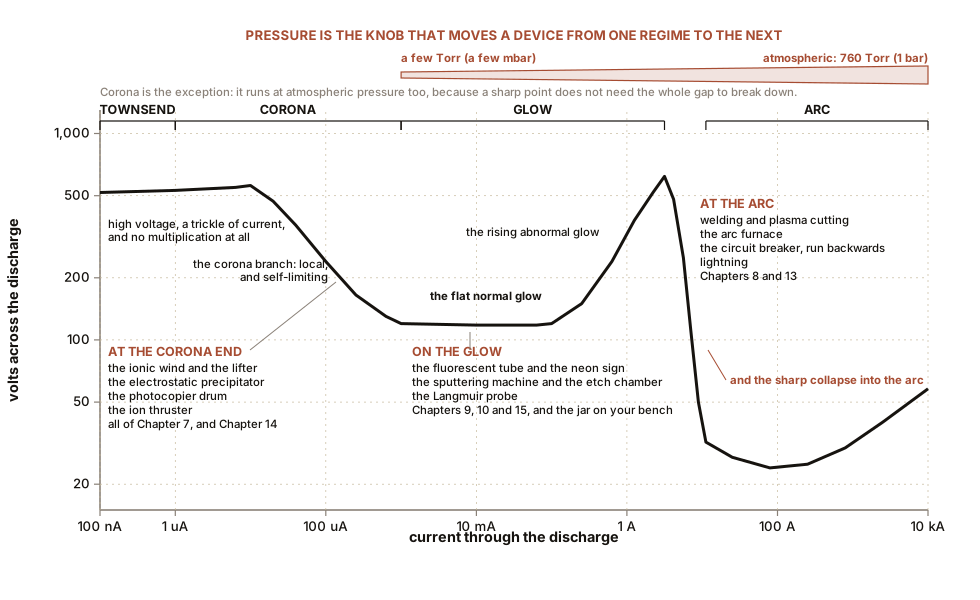
Fields that make the charges appear are easy to produce. Chapters 5 and 6, where the volume paid its way as a bench book. You measured a Paschen curve and found its minimum at around 330 V, and you walked a discharge up through Townsend, corona, glow and arc and saw the transitions be abrupt rather than gradual. The claim was that fields are easy. The finding was that in a soft vacuum they are nearly unavoidable, which is why aircraft wiring arcs at altitude.
Charged particles drag the neutral gas along. Chapter 7, measured on a kitchen scale, with the thrust tracking the current and not the voltage exactly as the equation says. And then twice more: Chapter 10, where the dragging is replaced by aiming and becomes the semiconductor industry, and Chapter 14, where the neutrals are removed altogether and the same device stops working, which is a stronger confirmation of the mechanism than any successful demonstration.
And the list. Every item on it, and here is where each one went.
The fluorescent tube, Chapters 4 and 9, cool to the touch with electrons in it at twice the temperature of the sun’s surface, losing 54 per cent of its energy in the phosphor as an unavoidable matter of arithmetic, and now being replaced by something with no gas in it for reasons that are mostly not about efficiency.
The etching machine, Chapter 10, and this is the item most readers will not have expected to be true. A third of the several hundred process steps that make a modern chip involve a plasma, the directionality that makes them work comes from a sheath a millimetre or two thick, and there is no alternative process, which is a claim this volume made and then defended.
The aurora, Chapter 13, and the promise here was under-sold rather than over-sold. The aurora is not solar particles arriving. It is Earth’s own magnetotail snapping back, and the colours are a spectroscopic reading of altitude, with red above green because a red-emitting oxygen atom needs 110 undisturbed seconds and only gets them above 200 km (120 miles).
And the fusion reactors, Chapter 12, where the honest answer turned out to be that temperature was never the hard part, and the difficulty lives in turbulence that cannot be calculated, wall materials that cannot be tested because the neutron source to test them does not exist, and a fuel that must be manufactured inside the machine by a component nobody has yet built.
Now the warning, which is the interesting one to check. Chapter 1 said the definition it gave you would fail by Chapter 11. It did, and the failure is precise. If a plasma is a gas with some charges in it, there is no reason whatever that a magnetic field should do anything to it, and there is no reason a field should have a pressure, and no reason a plasma should arrange itself into threads and loops and curtains. All of that follows from Chapter 2’s replacement: a plasma is a material whose charged particles are numerous and free enough to behave as a crowd. A crowd can be pushed as a body. A collection of individuals cannot. The warning was accurate and the fix was in Chapter 2, exactly where it said.
Section 2: What You Can Actually Do Now
Not what you have read about. What you can do, having read this, with the kit this volume specified.
Strike a glow discharge and put it in whichever regime you want, deliberately, by choosing pressure and ballast rather than by fiddling.
Measure a Paschen curve and find its minimum, and then predict a breakdown voltage for a gap and pressure you have not tried, and be roughly right.
Measure the sheath with a ruler, and know that you are looking at the mechanism that shapes every transistor you own.
Build an ionic wind thruster and measure its thrust, and predict that thrust from current times gap over ion mobility before you measure it.
Predict which radio band will be open tonight, and explain to somebody else why the answer is about a layer that absorbs rather than a layer that reflects.
Look at any lamp and say what is in it, what it costs to run, why it is that colour, and whether it is being replaced and why.
Read a fusion announcement and ask the right question, which is where the measurement was taken: at the plasma, at the target, or at the meter.
Read a thruster datasheet and say whether the mission is propellant-limited or power-limited, and know that the best specific impulse is not the highest one.
Discharge a capacitor properly, and know why a meter reading of zero is not the end of the job.
And decline to be sold things. The ionic air purifier that adds a lung irritant to a bedroom. The “plasma” device whose claimed effect requires a dose it cannot deliver. The fusion timeline that quotes a target gain and calls it break-even. In each case you now have the specific number that settles it, which is a different and better position than scepticism.
ON THE BENCH: If you do one thing, do this one
Parts: the jar, the hand pump, the current-limited supply, the ballast resistor, a fixed electrode gap, graph paper. Cost: about $70 if you already own the pump, and the pump is the same brake bleeder as Refrigeration’s. Time: an afternoon. Hazards: Chapter 16, in full, and the ceiling of 20 kV. Method: Chapter 5’s method, unchanged. A dozen pressures from atmospheric to the lowest your pump reaches, recording the voltage at which the gap strikes, and then plot it. Why this one, out of everything in the volume: because it is the only experiment here that produces a curve with a minimum in it that you did not know was there. Everything else in this book confirms something. This one measures a shape. And the shape explains a hard vacuum being an excellent insulator, a soft vacuum being the easiest thing in the world to arc across, a spark plug needing 30 kV for a gap you could jump on a bench with three, an aircraft harness arcing at altitude, and a vacuum interrupter in every substation in your country. Do it with the additions this volume gave you. Put the spectroscope of Chapter 9 on it and watch the bands broaden as the pressure comes up. Put the probe of Chapter 15 in it and watch the electron temperature climb as the pressure falls. Put the magnet of Chapter 11 beside it and watch the column move. Five chapters, one jar, one afternoon.
Section 3: The Ideas Worth Keeping
Seven, and they will outlast every number in the book.
A plasma is defined by collective behaviour, not by being ionised. In a gas, particles affect each other only when they collide. In a plasma each charged particle is being pushed a little by thousands of others, continuously, at a distance, so the material responds as a body. It screens, oscillates, carries waves, forms layers and can be pushed by a magnetic field. None of that follows from “there are some ions in it”, and all of it follows from the crowd.
A plasma has two temperatures, and pressure is the knob. Low pressure means an electron flies far between collisions, gains a lot from the field and can hand almost none of it to a gas atom a thousand times its mass, so the electrons run hot and the gas stays cool. High pressure means the opposite. That single sentence sorts the fluorescent tube from the welding arc, and it is why cold plasma can do ferocious chemistry to a wafer, a wound or a food wrapper without cooking any of them.
The answer is usually a product, and products have shapes. Breakdown depends on pressure times gap, and that product has a minimum. Fusion depends on density times temperature times time, and that product can be satisfied eleven orders of magnitude apart. Thrust depends on current times gap. When you find yourself asking whether a single variable is high or low, check whether the physics actually cares about it alone. Usually it does not, and the product is where the surprises live.
The tail does the work. A population of 2 eV electrons sustains a discharge in a gas that costs 15.8 eV to ionise, because a distribution has a fast minority and the process has a threshold. Wherever a threshold exists, the average is the wrong number to reason with. This is not a fact about plasma.
The interesting part of a plasma is its edge. Every single thing a plasma does to a solid, it does through a sheath a few Debye lengths thick: the trench in a transistor, the black stain on an old tube’s ends, the reading on a probe, the eroded wall of a thruster, the sputtered film on a window. Chapter 2’s screening and Chapter 10’s manufacturing process are the same object, once measured and once used.
Direction has to come from a field. Chemistry is isotropic because thermal motion is random, and you cannot aim a reaction. You can aim a charge. That is the whole of anisotropic etching and the whole of electric propulsion, and it is why the semiconductor industry needed plasma rather than merely preferring it.
And measurement is an interaction, not an observation. Insert something and you get a local reading and a plasma that has rearranged itself around your instrument. Send in a wave and you disturb nothing and get an average along a line. There is no third option, and in this subject the disturbance is not an instrumental defect: it is the material’s most characteristic behaviour, being aimed at your probe.
IN PLAIN ENGLISH: If somebody asks you what a plasma is, and you have three sentences, say this. It is a material with enough loose electric charge in it that every particle feels every other one all the time, so the whole mass behaves as a crowd rather than as a bag of individuals. That is why it glows in colours belonging to whatever it is made of, why it can be steered and squeezed by a magnet, why it forms a skin around anything you put into it, and why it carries radio waves at some frequencies and throws them back at others. And it needs almost no ionisation to start doing all of that: a candle flame manages it at one part in ten billion. Everything else in this book is those two sentences at some particular pressure.
SLOW DOWN. Check Your Understanding: Here is a design problem that crosses five chapters, and it is the sort of question this volume was written to make answerable. You want ions to strike a target harder and more nearly perpendicular, while keeping the gas cool enough to touch. Name the knob you turn, say which way, and say what it costs you. Two things go wrong if you overdo it, and one of them is not about performance at all. Answer before reading on.
Lower the pressure. That is the knob, and it does four things you want at once. Fewer collisions means the electrons gain more energy from the field, so the electron temperature rises. A higher electron temperature and a lower density means a longer Debye length, so the sheath gets thicker and holds more voltage. A longer mean free path means an ion crosses that sheath without being deflected, so it arrives perpendicular. And the gas stays cool, because Chapter 4’s mass ratio means the hot electrons still cannot warm it.
The first cost is rate. Fewer collisions also means fewer ionisations, so there is less current, fewer ions, and everything happens more slowly. A chip factory buys anisotropy with throughput, deliberately, and that trade is what a process engineer spends their career on.
And the second cost is the one that is not about performance. Chapter 16. A better vacuum and a higher voltage is the recipe for an X-ray tube, and it is the same recipe as a better glow discharge. Röntgen was not doing anything unusual. The two things you would naturally do to improve this experiment are the two things that turn it into a radiation source, and knowing that is the difference between a hobby and an injury.
Section 4: What This Volume Did Not Cover
Named plainly, so you know the shape of your own remaining ignorance rather than mistaking the edge of the book for the edge of the subject.
Dusty and complex plasmas. What happens when solid grains are suspended in a plasma and charge up. They arrange themselves into crystals, levitate, and behave like a strongly interacting fluid you can watch particle by particle. It explains features of Saturn’s rings, the levitation of lunar dust, and a real contamination problem in etch tools, and it is a substantial field this volume did not enter.
Plasma chemistry beyond etching. Nitrogen fixation, carbon dioxide conversion, plasma-catalysis, methane pyrolysis for hydrogen, and the arc processes that made acetylene industrially for decades. Chapter 10 took one application because it is the largest by value, and the chemistry is a discipline of its own.
Laser-plasma acceleration and high-energy-density physics, meaning driving a plasma wave with an intense laser pulse and accelerating electrons to gigaelectronvolt energies in centimetres rather than kilometres. The Lasers volume, recommended and never required, touches the laser side in its Chapter 13.
Kinetic theory properly. The Vlasov equation, Landau damping, and the full taxonomy of plasma waves and instabilities, of which this volume named perhaps four out of dozens. Be clear about what learning that costs: it is a mathematics problem rather than a concepts problem, and the concepts are already in this book.
And magnetohydrodynamics in earnest, meaning dynamo theory, accretion discs, astrophysical jets and cosmic ray acceleration, plus the practice of high-voltage engineering: insulation coordination, creepage and clearance, partial discharge testing. That last is what you would study next to build bigger versions of anything here.
And a loose end worth knowing about, because it closes a circle. Chapter 10 covered how a chip is etched and said nothing about how the pattern gets there. The light that prints the finest features today is extreme ultraviolet at 13.5 nm, and it is produced by firing a laser at droplets of molten tin to make a plasma, thirty thousand times a second, because nothing else emits usefully at that wavelength. The machine that patterns a chip and the machine that etches it are both plasma devices, and the first one is a subject this volume did not have room for.
Section 5: Where to Go, and the Thing to Carry
ON THE BENCH: The inventory
Parts: a notebook. Your eyes. Cost: nothing. Time: an afternoon, and then the rest of your life, involuntarily. Hazards: none, unless you go looking in a substation. Method: walk through your house, then a hardware store, then a supermarket car park after dark. Write down every plasma you can find and, for each one, its approximate pressure, whether it is thermal or non-thermal, and which chapter covers it. What you should find, and this is the answer key: every fluorescent tube and compact fluorescent. Any remaining orange streetlight. The neon indicator in an old power strip or kettle switch. Every spark plug in the car park. The arc inside every switch as it opens. The corona wire in the photocopier, identifiable by smell. The welding gear and plasma cutter in the tool aisle. The ozone generator sold as an air purifier, and you now know why not to buy it. Any camera flash. The magnetron in the microwave. Lightning, if you are lucky. The sun. And every single chip in every device on every shelf, which is the one that is invisible and the one that could not exist without any of this. What it proves: Chapter 1 claimed the subject was everywhere and nobody sees it. This is the experiment that tests that claim, and it is the only one in the volume you cannot get a wrong answer to.
Do the Paschen curve. If you do nothing else from this book, do that, because it is the one measurement here that finds a shape rather than confirming a fact.
And one thing to carry out of here that is not about plasma at all.
The deepest idea in this volume is that two populations which exchange energy badly can be held at wildly different states, and that the gap between them is where the useful engineering lives.
An electron cannot warm a gas atom, so a fluorescent tube is cool and a wafer is not destroyed and a wound can be sterilised without heat. That is this book’s version. But the shape is general. A laser’s population inversion is a non-equilibrium held open by a slow exchange rate, which is what the Lasers volume’s Chapter 4 is about. A solar cell works because a photon can excite an electron far faster than the crystal lattice can take the energy back. A thermoelectric device, a catalytic surface, a heat pump: in each case somebody found two things that equilibrate slowly and got work out of the interval before they did.
Equilibrium is where nothing more can be extracted. So the useful question, when you meet any system at all, is not what temperature it is. It is which parts of it are not yet at the same temperature, and how long they will stay that way.
That is what the fourth state of matter turned out to be about. And it is why the phrase was never any use.
Bench Degree
Get the degree without the diploma.
Learn the material, not how to pass the exam.