Bench Degree·PLASMAchapter

Chapter 16: How It Bites You
Every other volume in this series risks a burn or a bruise. This one has mains-derived high voltage, stored capacitor energy, ultraviolet, X-rays and asphyxiants in it. The hazards worth the most words here are the four you cannot feel coming.
In November 1895 Wilhelm Röntgen was running a discharge in an evacuated glass tube, at a few kilovolts, with metal electrodes. He noticed that a coated screen across the room fluoresced when the tube was on, even with the tube wrapped in black card.
He had a jar, a vacuum pump and a high-voltage supply. That is your bench.
The tube he was using was a Crookes tube, which is a glass vessel at low pressure with two electrodes in it, energised at a few kilovolts. It is, in every respect that matters, the apparatus in front of you. He was not looking for X-rays. They arrived anyway, and within a decade a good number of the people working with them had radiation injuries, because nobody knew and there was nothing to feel.
That is the shape of this whole chapter. Some of what follows will hurt you the moment you get it wrong, and you will know. The dangerous ones are the four that give you no signal at all: X-rays, stored capacitor energy, deep radio-frequency burns, and inert gas.
Section 1: High Voltage Into Metal Makes X-Rays
An electron that hits a metal target and stops suddenly emits an X-ray photon, and the maximum photon energy in kiloelectronvolts equals the accelerating voltage in kilovolts. There is no threshold to cross, no special apparatus required, and no way to switch the effect off. It is called bremsstrahlung, and it is why an X-ray tube is a glass envelope, a vacuum, a voltage and a piece of metal, and nothing more.
So above roughly 5 kV into a metal target, you are producing X-rays. Below about 10 kV they are so soft that a few millimetres of ordinary glass absorbs essentially all of them, which is why nobody worries about a neon sign. The situation changes with voltage far faster than intuition suggests, for two reasons at once.
The efficiency of X-ray production rises roughly in proportion to voltage, and the photons also get harder, meaning they penetrate further. At 10 kV, half a millimetre of glass halves the intensity. At 20 kV it takes about 3 mm (0.12 in), which is the whole wall of your jar. At 30 kV and above, ordinary glass is not a shield. It is a slight inconvenience to the beam.
Your pump does not reach a good vacuum. At a few Torr an electron collides many times crossing the gap and never arrives at the target with the full accelerating energy. The better your vacuum gets, the more this protection disappears. A turbomolecular pump and 30 kV is a working X-ray tube.
The rule this volume adopts, and it is a number rather than an exhortation: keep the jar experiments at or below 20 kV, and if you go above that, or if you improve your vacuum, measure the dose rather than reasoning about it. The reason to draw a line at all is that the practices that make a better glow discharge, which are higher voltage and better vacuum, are exactly the practices that make a better X-ray source.
This is not a theoretical worry with no precedent. In 1967 General Electric had to modify around a hundred thousand colour television sets whose high-voltage regulator tubes emitted measurable X-rays through the cabinet, and the United States passed federal radiation control legislation the following year substantially because of it. Colour televisions ran at 25 to 30 kV. A flyback module from a scrapped television, which is the cheapest high-voltage source available and a common first purchase, is a device that was designed with an X-ray specification.
ON THE BENCH: Put a meter on it rather than an opinion
Parts: a Geiger-Müller counter with a thin end-window tube, sometimes sold as a pancake probe, from about $100 used. Or an electronic personal dosimeter, from about $40. Your jar and supply. Cost: $40 to $150, and this is the one piece of test equipment in this volume that is about you rather than about the experiment. Time: an hour. Hazards: the ones being measured. Take the readings from the far side of the bench with the probe on a stand, not with your hand next to the jar. Method: record background for five minutes with the supply off. Then energise at your lowest working voltage and record with the probe against the glass, then at 300 mm (12 in), then at 1 m (3.3 ft). Repeat at each voltage step you use. Log everything. What you should see: at 10 kV in a soft vacuum, most likely nothing above background, and that is a real result worth having in writing. As you raise the voltage, watch for the point at which the count rate starts to climb, and treat that voltage as your ceiling regardless of what this book says. And the critical caveat, which most safety advice omits. A standard cylindrical Geiger tube with a metal wall is nearly blind below about 30 keV. Point it at a 20 kV source and it may read background while a real dose is present. A null reading on the wrong instrument is not evidence of safety. This is why the end-window tube is specified, and why a reading of zero from a device whose low-energy response you have not checked should be discarded rather than trusted.
Section 2: A Discharged Capacitor Is Not Discharged
The energy stored in a capacitor is half the capacitance times the voltage squared, and the square is what catches people.
| Where you meet it | Capacitance and voltage | Stored energy |
|---|---|---|
| Camera flash | 200 µF at 330 V | about 11 J |
| Microwave oven capacitor | 1 µF at 4 kV in the doubler | about 8 J |
| CRT final anode, the tube itself | 1.5 nF at 25 kV | about 0.5 J |
| A modest bench bank | 1 µF at 10 kV | 50 J |
Published thresholds vary, and the useful summary is blunt. A fraction of a joule will hurt and will make you jerk. A few joules will injure. Ten joules across your chest can stop your heart. A camera flash capacitor has killed people. A microwave oven capacitor kills hobbyists regularly, and it does it after the oven has been unplugged for a week.
Which brings us to the mechanism nobody explains.
Short a high-voltage capacitor, watch the voltage go to zero on a meter, remove the short, and wait five minutes. The voltage comes back, typically to somewhere between one and ten per cent of what it was. On a 10 kV capacitor that is hundreds of volts, arriving quietly while you work.
The cause is dielectric absorption, sometimes called soakback. Charge is not held only on the plates; some of it is bound up in the polarisation of the dielectric itself, and that polarisation relaxes over seconds and minutes, releasing its charge back onto the plates. The quick short empties the plates and leaves the dielectric loaded.
So the rule is procedural rather than electrical, and it is not negotiable: a capacitor is not discharged until you have shorted it through a resistor, then shorted it with a bar, and left the bar in place while you work. Not measured and found to be zero. Shorted, and left shorted, mechanically, by a piece of metal you can see.
ON THE BENCH: Build the discharge stick, then prove why you need it
Parts: a length of dry hardwood dowel or acrylic rod, 500 mm (20 in) long. A 47 kΩ resistor rated for at least the voltage you use, ideally a purpose-made high-voltage type or a series string of five 10 kΩ units spaced apart. An earth lead with a crocodile clip. A copper hook or spike at the tip. Cable ties. A separate solid shorting bar: a length of bare copper wire with clips at each end. A high-voltage capacitor of about 1 µF, or the capacitor bank you already have. A multimeter with a 10 MΩ input. Cost: about $20. Time: an hour. Hazards: this box is entirely about the hazard. Do the build with everything de-energised and the supply unplugged, not merely switched off. Method: build the stick: resistor in series between the tip and the earth lead, everything cable-tied to the rod, no conductor within 200 mm (8 in) of where your hand goes. Then the demonstration. Charge the capacitor to a few kilovolts. Discharge it fully with the stick and confirm zero on the meter. Remove everything and wait. Measure again at one minute, five minutes and fifteen minutes. What you should see: the voltage climbing back up out of nothing. Hundreds of volts, on a capacitor you watched go to zero. Do it once and you will never again trust a meter reading over a shorting bar. Then fit the shorting bar and leave it on. Measure again after an hour with the bar in place: nothing, because the charge now has somewhere to go as fast as it relaxes out of the dielectric. That is the entire argument for leaving the bar in.
Section 3: Shock, Without the Folklore
Voltage does not injure you. Current through tissue does, and the path matters more than either.
The numbers for alternating current at mains frequency, hand to hand, are worth memorising because they are much smaller than people assume:
1 mA is the threshold of perception. 5 mA is painful. 10 to 20 mA is the let-go threshold: your flexors contract harder than your extensors and you cannot release your grip. This is the one that kills people who would otherwise have walked away. 30 mA brings a real risk of respiratory arrest. 50 to 100 mA through the chest can produce ventricular fibrillation.
Your resistance is nearly all skin. Dry, hand to hand, it may be 10 to 100 kΩ. Wet, or with a cut, it can be 1 kΩ. And the internal path, once you get past the skin, is only a few hundred ohms. Above roughly 500 V the skin breaks down and stops protecting you at all, which is why every voltage in this volume should be treated as though your resistance were 1 kΩ.
SLOW DOWN. Check Your Understanding: People routinely draw sparks from a Tesla coil to a fingertip at hundreds of thousands of volts, and survive it every time, and it is a staple of science demonstrations. Meanwhile a 240 V socket kills people every year. Why is the enormously higher voltage the survivable one, and what does that tell you about where the danger in that machine actually is? Answer before reading on.
Two things, and only one of them is about current.
The frequency has removed the mechanism of death. Above roughly 100 kHz, alternating current no longer causes sustained muscular contraction, so there is no let-go effect, and the threshold for triggering ventricular fibrillation rises by more than an order of magnitude. The heart simply cannot respond to something oscillating that fast. A coil output at 200 kHz cannot electrocute you in the way a mains socket can, because the pathway that mains uses is not available to it.
And the terminal current is small, because the coil’s output is a high impedance source. Voltage is enormous, available current is modest.
But the injury did not go away. It changed. Radio-frequency current still deposits energy in tissue, and that energy still goes somewhere. What you get instead of a cardiac event is a burn, and Section 4 explains why that is worse than it sounds.
And here is the answer that matters. The dangerous part of a Tesla coil is the primary side: a capacitor bank at kilovolts, charged from a mains transformer, at mains frequency, with real stored energy behind it. That is Sections 2 and 3, in full, with nothing exotic about it. The part that kills is the part nobody photographs, and the same is true of every device in this book: the flyback’s output is dramatic and the flyback’s supply is what will hurt you.
Section 4: RF Burns, Which Go Deep and Do Not Show
Above about 100 kHz, current entering your body flows through tissue and heats it directly.
And the injury is deep, while the sensation is not. Your temperature and pain receptors are in the skin. The heating is distributed through the volume of tissue that the current passed through, which can include muscle and tendon well below the surface. So a radio-frequency burn commonly presents as a small pale or white mark on the skin, a fraction of the size of the actual wound, over a deep lesion that is slow to heal, prone to infection, and sometimes needs surgical debridement.
A burn that looks trivial and is not is a bad kind of burn to have, because the natural response is to ignore it.
Where you will meet it in this subject: any radio-frequency plasma source, including the 13.56 MHz supplies of Chapter 10; Tesla coils; amateur radio transmitters and their antennas; induction heaters; and the cheap flyback and cold-cathode inverter drivers this volume recommends, which typically run at tens to hundreds of kilohertz.
And a specific trap. An ungrounded piece of metal near a strong radio-frequency source picks up energy and re-radiates it, and touching it completes a circuit you did not know existed. Ground the metalwork on your bench, including the things that are not part of the experiment.
Section 5: Ultraviolet, and the Eye Injury You Get Tomorrow
An electric arc emits strongly in ultraviolet, including the short ultraviolet that ordinary sunlight never reaches the ground with.
Photokeratitis, called arc eye or welder’s flash, is sunburn of the cornea. The characteristic feature is the delay: you feel nothing at the time, and six to twelve hours later, usually in the middle of the night, both eyes feel full of grit, light is unbearable, and they stream. It resolves in a day or two and rarely leaves damage. Seconds of unprotected viewing of a welding arc at a few metres is enough to cause it.
The traps are all about indirect exposure:
Watching somebody else weld from across a workshop. The arc does not care that you are not the welder.
And a broken high-intensity discharge lamp. A mercury or metal halide lamp’s outer envelope is what absorbs the ultraviolet; the inner arc tube is quartz and passes it freely. Break the outer envelope and leave the lamp running and you have an unshielded ultraviolet source in an occupied room. This has caused mass eye and skin injuries in gymnasiums and sports halls, which is why enclosed fixtures and self-extinguishing lamps are specified for those spaces.
The protection is a shade number, not a tint. Arc welding needs shade 10 to 13 depending on current, gas welding 4 to 8. Sunglasses are not protection and are worse than nothing, because they darken the scene, your pupil opens, and more ultraviolet enters than would have without them. Clear polycarbonate safety glasses, on the other hand, block essentially everything below 380 nm as an inherent property of the plastic, so they are a genuine second layer under a hood and are worth wearing at the bench for that reason alone. Ordinary window glass blocks the short ultraviolet and passes the long.
On your own bench, a low-pressure discharge in air emits mostly in the near ultraviolet at 337 nm and is not going to injure you in seconds. Do not stare into a bright discharge for extended periods, and if you introduce mercury, or run a hydrogen or short-wave source of any kind, wear the polycarbonate glasses.
Section 6: What You Breathe
Ozone. Every corona and every discharge in air makes it. The eight-hour occupational limit is around 0.1 ppm and short-term limits around 0.3 ppm, and the odour threshold is 0.01 to 0.05 ppm, so you can smell it at a tenth of the limit. That is a genuine gift and it comes with a catch that is more important than the gift: olfactory fatigue sets in within ten to twenty minutes. After that you cannot smell it at all, at any concentration. “I can’t smell it any more” is not evidence of anything. Ventilate mechanically, out of a window, and put a timer on the session rather than relying on your nose.
And one rule that is short, specific, and has killed people who did not know it. Never use a chlorinated solvent anywhere near an arc or an ultraviolet source. Trichloroethylene, perchloroethylene and some brake cleaners decompose under ultraviolet or in an arc into phosgene, which is a chemical warfare agent. Degrease with something else, check the label rather than the smell, and buy the brake cleaner that says non-chlorinated on the can.
Section 7: The Gas That Does Not Warn You
If you buy argon for Chapter 9’s spectra or follow Chapter 8 to a welder, this section is the one that could actually kill you, and the reason is that the failure mode is not the one anybody expects.
Argon is not toxic. It displaces oxygen, and that is all it does. Which sounds mild until you understand what the body does and does not detect.
Your urge to breathe is driven by carbon dioxide, not by oxygen. In an argon-rich atmosphere you exhale carbon dioxide perfectly normally, so no alarm is raised. There is no choking, no gasping, no air hunger and no smell. What happens instead is that you become confused, then unconscious, without ever feeling short of breath. At severely reduced oxygen it can happen within a breath or two, and people collapse forward, downward, further into it.
And argon is denser than air, about 1.4 times, so it pools in exactly the low places a person would put their head into: pits, tank bottoms, sumps, ship holds, manholes, and the floor of a basement workshop with no ventilation.
The oxygen numbers, since they are the only measurement that matters:
20.9 per cent is normal air. 19.5 per cent is the usual regulatory floor for entering a space. Below 16 per cent, judgement and coordination are impaired, which means the person affected is not able to assess their own situation. Below 10 per cent, unconsciousness in a minute or two. Below 6 per cent, collapse in seconds.
This kills people in industry every year, and a large fraction of the dead are the rescuers, who see somebody down in a pit and go in after them. Nitrogen and helium behave identically. Carbon dioxide is different and in one respect safer, because it does trigger air hunger and you will know.
The rules are absolute. A gas cylinder does not live in a small unventilated room and never in a closed vehicle. Close the cylinder valve, not just the torch, because a slow overnight leak in a small shop is exactly how this happens to somebody who did nothing dramatic. Ventilate, mechanically if you are in a basement or any low space. And if somebody is down in a confined space, do not go in. Call, ventilate, and get a breathing apparatus, because going in is the commonest way this accident doubles its death toll.
IN PLAIN ENGLISH: Four of the hazards in this chapter give you no warning at all. X-rays cannot be seen, heard, felt or smelled, and the injury shows up years later. A capacitor charges itself back up after you have proved it empty. A radio-frequency burn hides a deep wound under a small mark. And an inert gas suffocates you without ever making you feel short of breath. Everything else in this book announces itself: an arc is blinding, a shock hurts, ozone smells, hot metal is hot. The four silent ones are why this chapter is a chapter and not an appendix, and they are the four to build habits around rather than to remember.
Section 8: The Rest, and the Rules
The jar can implode. Use a jar rated for vacuum, which the vacuum-chamber lids sold for degassing resin are. A vacuum failure is limited to one atmosphere, so it is far less violent than a pressure failure, and the hazard is glass rather than blast. Wrap the jar in clear packing tape so that fragments stay together, work behind a polycarbonate sheet, and wear glasses.
A gas cylinder is a pressure vessel. A 200 bar (2,900 psi) cylinder with its valve knocked off becomes a projectile that goes through walls. Chain it upright, cap it for transport, never lay it on a car seat.
Broken lamps contain mercury. A fluorescent tube holds 3 to 5 mg and a large discharge lamp up to 100 mg. If one breaks: get people out, ventilate for fifteen minutes, do not vacuum, because a vacuum cleaner aerosolises it and then blows it around the room. Pick the pieces up with stiff card and sticky tape, seal them in a jar, and take it to a proper disposal point.
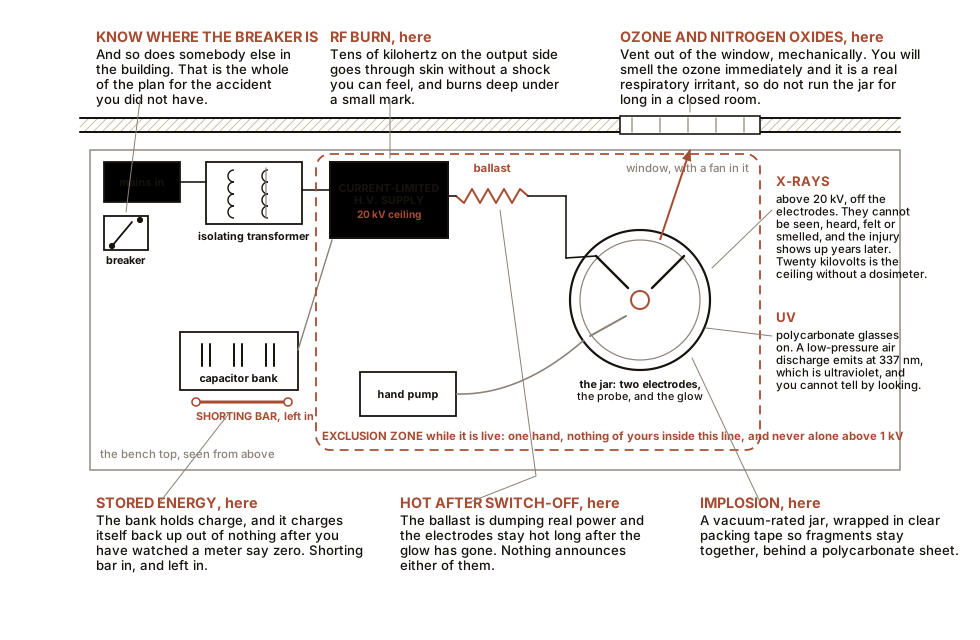
The list, short enough to pin up
One hand. Enclose the high voltage. Ballast every discharge. Short it and leave the bar in. Never alone above 1 kV. Ventilate mechanically. Polycarbonate glasses on. Twenty kilovolts is the ceiling without a dosimeter. Close the cylinder valve. Discharge stick with a resistor, never a screwdriver. Know where the breaker is, and so does somebody else.
And the one that is not on any manufacturer’s sheet: plan for the failure that happens when you are tired. Every rule above is written to still work when you are rushing at the end of an evening, which is when the accidents in this subject actually occur. That is why they are habits and geometry and pieces of metal left in place, rather than things to remember.
Next, and last: the ledger. What Chapter 1 promised, whether this volume delivered it, and what it deliberately left out.

Bench Degree
Get the degree without the diploma.
Learn the material, not how to pass the exam.