Bench Degree·PLASMAchapter

Chapter 15: Measuring a Plasma
A wire, a variable voltage and a meter will tell you the temperature and the density of a plasma. The same wire will also change the plasma it is measuring, and in this subject that is not a small correction to apologise for. It is the central fact of the whole practice.
Put a third wire through the lid of your jar, insulated along its length, with 5 mm (0.2 in) of bare metal exposed at the end and nothing else connected to it. Strike the discharge. Now measure the voltage on that wire with respect to the grounded electrode.
It reads negative. Somewhere between about 5 and 30 volts below ground, depending on the pressure and the current, and it is steady enough to read.
Nothing is driving it. You connected one end to a meter and left it. The plasma put that voltage there, and the number is not arbitrary: it is a direct measurement of how hot the electrons in your jar are, if you know how to read it.
ON THE BENCH: Read the floating potential
Parts: the jar, hand pump, current-limited supply and ballast from Chapter 6. A length of stiff wire, ideally tungsten from a broken TIG welding electrode or the support wire from a dead halogen bulb, otherwise stainless steel. A glass or ceramic sleeve, which can be the barrel of a cheap ballpoint pen or a length of glass tubing. High-temperature epoxy. A multimeter with at least 10 MΩ input impedance, which is nearly all of them. Cost: about $10. Time: an hour to build the probe, 20 minutes to use it. Hazards: high voltage. The probe wire sits at plasma potential, which means it is at kilovolts with respect to your bench if anything shifts. Route the meter lead away from your body, clip it on before energising, and never touch either while the supply is on. Chapter 16 in full. Method: make the probe by threading the wire down the sleeve so that only 5 mm (0.2 in) protrudes, and sealing it at the top. Pass it through the lid on a rubber grommet or an epoxied fitting. Then measure the probe voltage against the grounded electrode at half a dozen pressures and at two or three discharge currents. What you should see: a steady negative reading of perhaps 5 to 30 V. It becomes more negative when the electrons get hotter, which happens as you lower the pressure, and this is exactly the trend Chapter 4 predicts. What it means: the floating potential sits below the plasma’s own potential by roughly five times the electron temperature expressed in volts. So a reading 10 V below the plasma implies an electron temperature of about 2 eV, or 23,000 K by Chapter 4’s conversion. You have just measured a temperature of tens of thousands of degrees with a $10 meter and a piece of wire, and you did it without touching anything hot. If it reads zero or wanders wildly: your probe is not making contact with the plasma, or your meter’s input impedance is loading it. Move the tip further into the glow and check that the exposed length really is exposed.
Section 1: Irving Langmuir’s Wire
Irving Langmuir worked out how to read that wire properly in the 1920s at General Electric, while trying to understand why light bulbs failed. He is also the man who named the subject: the word plasma, in this sense, is his, from 1928.
The idea is to stop letting the wire float and instead drive it deliberately, sweeping its voltage from well below the plasma to well above it, and recording the current at every step. The resulting curve has three distinct regions and each one gives you a number.
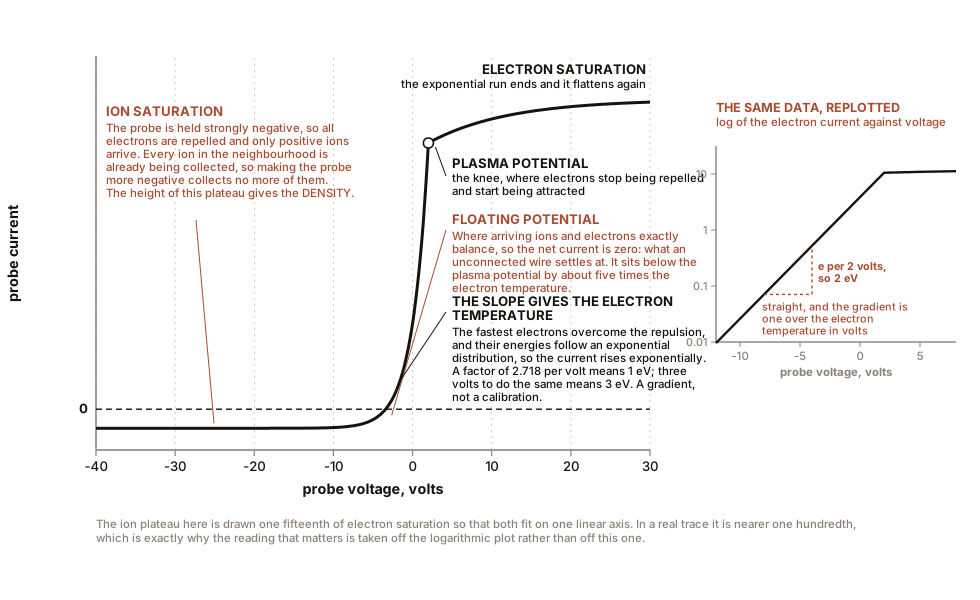
Region one: the probe held strongly negative. All electrons are repelled and cannot reach it. Only positive ions arrive, drawn in by the field. And because every ion in the neighbourhood is already being collected, making the probe more negative collects no more of them. The current flattens out, and that plateau is called the ion saturation current. Its size tells you the plasma’s density.
Region two: the probe brought up toward the plasma potential. Now the fastest electrons begin to overcome the repulsion and arrive. Raise the voltage a little and rather more of them make it, because the electron energies follow an exponential distribution. So the current rises exponentially, and the steepness of that rise is set by nothing except the electron temperature.
This is the part worth carrying, because it is a measurement made from a slope rather than from a calibration. Plot the logarithm of the electron current against the probe voltage and you get a straight line whose gradient is one over the electron temperature in volts. If the current climbs by a factor of 2.718 for every volt, the electron temperature is 1 eV. If it takes three volts to do the same, it is 3 eV. No reference standard, no calibrated instrument, no assumption about the probe’s area. Just a slope.
Region three: the probe above the plasma potential. Now electrons are being attracted rather than repelled, the exponential run ends, and the current flattens again into electron saturation. The knee between region two and region three marks the plasma potential itself.
And one more landmark, which is where the chapter started: the point where the curve crosses zero current is the floating potential, because that is the voltage at which arriving ions and electrons exactly balance, which is what an unconnected wire settles at.
ON THE BENCH: Sweep the probe and get an electron temperature
Parts: the probe you just built. A bench power supply that can be set from about minus 40 V to plus 40 V, or two 30 V supplies back to back, or a stack of nine-volt batteries with a potentiometer if that is what you have. A 10 kΩ resistor as a current sense. A second multimeter. Graph paper or a spreadsheet. Cost: about $40 if you need the supply. Time: an afternoon. Hazards: as above, plus this: the sweep supply is now galvanically connected to a plasma that is at kilovolts. Its case must be treated as live. Use a supply you are willing to lose, keep it in an insulated enclosure, and do not touch it while the discharge is running. Method: connect the sweep supply between the probe and the grounded electrode, with the 10 kΩ resistor in series. Read the voltage across the resistor with the second meter and divide by 10,000 to get the current. Step the bias in one-volt increments from minus 40 to plus 20 and record current at each step. Then plot it. What you should see: the three regions above, unmistakably. Ion saturation of a few microamps up to a few tens of microamps, which across the 10 kΩ resistor is tens to hundreds of millivolts, comfortably readable. An exponential region spanning one or two decades of current. Take the logarithm of the electron current, plot it against bias, fit a straight line to the exponential part, and read off an electron temperature of somewhere between 1 and 5 eV. For a low-pressure glow discharge in air that is the right answer, and you obtained it yourself. Then get the density. The ion saturation current equals roughly 0.61 times the density, times the electron charge, times the probe area, times the speed of sound for ions in that plasma. For argon at 3 eV that ion speed is about 2,700 m/s (8,900 ft/s). Expect an answer in the region of 10¹⁵ to 10¹⁷ electrons per cubic metre, which sits neatly between the candle flame and the fluorescent tube in Chapter 2’s table. And now the honest part, which matters more than the numbers. For the simple theory above to be right, the probe must be large compared with the Debye length so that its collecting area is well defined, and small compared with the mean free path so that ions cross the sheath without colliding. In your jar at a few Torr, the Debye length is about 105 µm (0.004 in) and the mean free path is about 12 µm (0.0005 in). The Debye length is bigger than the mean free path, so both conditions cannot be met at once, by anyone, with any probe. Your electron temperature is good to a factor of perhaps two and your density to a factor of three. That is not a failure of your workmanship. It is the subject, and Section 3 is about it.
Section 2: Reading Temperature Off Colour
The second great family of diagnostic never touches the plasma at all. It looks at it.
You already built the instrument in Chapter 9. A grating and a slit gives you the plasma’s emission spectrum, and there is a great deal in it beyond identifying the gas.
Which lines are present tells you which species are present, including ionisation states: a singly ionised atom has a different ladder from a neutral one, so you can see how far the ionisation has gone.
The ratio of one line’s brightness to another’s tells you a temperature. How bright a line is depends on how many atoms are sitting in the upper state of that transition, and how many are sitting there depends on temperature. So compare two lines from different upper levels and the ratio gives you a number.
And here is the assumption that does all the work, which is the thing to take away. Converting a line ratio into a temperature requires a model of how the atomic states are populated. The simple model assumes the populations are thermal, which requires collisions to dominate, which requires a dense plasma. In the non-equilibrium plasmas of Chapter 4 that assumption is simply false, and the “temperature” you get from a line ratio is an excitation temperature that may match neither the electrons nor the gas. Getting a real electron temperature out of a low-pressure discharge spectroscopically requires a collisional-radiative model with dozens of rate coefficients in it, and the answer is only as good as the rates. When a paper quotes a spectroscopic temperature, the question to ask is which temperature and under what population model.
Three more things a spectrum carries, all from the shape of a line rather than its brightness:
Doppler width gives the temperature of the emitting atoms. Atoms moving toward you emit slightly bluer and atoms moving away slightly redder, so the line is smeared by an amount proportional to the square root of the temperature. It is a direct, model-free thermometer for the heavy particles, and it needs resolution far beyond a compact disc: for argon at a few hundred kelvin the smearing is about a thousandth of a nanometre.
Stark width gives the electron density, because nearby charged particles distort an atom’s energy levels and broaden its lines. The hydrogen Balmer lines are the standard workhorse for this.
IN PLAIN ENGLISH: There are only two ways to find out what is going on inside a plasma. Put something in, or look at what comes out. Putting something in gives you a reading at one exact point and changes the plasma while you do it. Looking at what comes out changes nothing and gives you an average along a whole line of sight, so you cannot tell where in the plasma your answer came from. Every diagnostic ever built is one of those two, and pays the matching price.
Section 3: Why Every Diagnostic Disturbs
Now the chapter’s real subject, and it is worse here than anywhere else in this series.
A probe is a sink. It absorbs every particle that reaches it. So the region immediately around it is depleted of the very particles you were counting, and depleted over a distance of several Debye lengths.
A probe builds a sheath, and Chapter 10 explained why. The plasma responds to the intruder by organising a structure whose entire purpose is to screen it from the bulk. So the field, the density and the potential in the region you are sampling are all different from what they would be with no probe there. You never measure the plasma. You measure the sheath, and infer the plasma from a model of the sheath.
A probe in a magnetic field does something far worse than any of that. Charged particles travel freely along field lines and hardly at all across them, so a probe absorbs everything on the field lines that touch it, all the way along them. A wire 1 mm (0.04 in) across can empty a flux tube several metres long. In a tokamak this rules probes out of the hot core entirely; they are used only at the edge, and only on reciprocating arms that dip in and retract before they melt.
And the wave diagnostics have their own bill. They perturb nothing, and they give you a quantity integrated along the whole path through the plasma, so a single measurement cannot tell a hot centre from a hot edge. Getting a spatial profile means many viewing angles and a tomographic reconstruction, which needs many ports in the vessel wall, and every port is a hole in the thing you were trying to keep sealed and shielded. Windows also coat over, so the calibration drifts and has to be tracked.
The industrial version of this argument is decided by money. A semiconductor etch chamber can never have a probe in it, because a probe sheds particles onto a wafer worth more than the probe. So a chamber costing millions of dollars is diagnosed entirely through a window, by the optical emission monitoring of Chapter 10, and the physics choice was made by the accounts department. That is not a criticism. It is how the constraint usually arrives.
SLOW DOWN. Check Your Understanding: The wire you put in the jar settled at a negative voltage. Both electrons and positive ions were available to it in equal numbers, since the plasma is quasi-neutral. So why negative rather than positive, and why by that particular amount? Answer before reading on.
Because the two species arrive at wildly different rates, even though they are equally numerous. How often a particle strikes a surface depends on how fast it is moving, and at the same temperature a light particle moves faster than a heavy one by the square root of the mass ratio. Chapter 4 gave that ratio for argon as about 73,000, and its square root is 270. So electrons hit the wire roughly 270 times more often than argon ions do, and in a real discharge where the electrons are also much hotter, the factor is larger still.
The wire therefore charges negative, and keeps charging until it is negative enough to turn most of the arriving electrons back. Balance is reached when it has repelled all but one electron in 270. Since the fraction of electrons able to climb a voltage hill falls off exponentially with the height of the hill, turning back 269 out of 270 needs a hill of roughly five times the electron temperature. Which is where the rule of thumb in the first bench box comes from, and it is why the reading is a thermometer.
And now the point. That is the same calculation, in the same words, that Chapter 10 used to explain why a silicon wafer in an etch tool goes negative and gets bombarded perpendicular to its surface. A floating multimeter probe in a jam jar and a $10 million etch chamber are the same physics, differing only in what is done with the resulting sheath: one measures it, the other cuts with it.
Section 4: The Instruments You Will Meet in a Paper
Named briefly, so that a technical article stops being opaque.
Microwave interferometry and reflectometry. Send microwaves through the plasma and measure the phase shift, which depends on electron density; or find the frequency at which they are reflected, which is Chapter 2’s plasma frequency used directly as a measuring instrument. Line-integrated, robust, and standard on every large machine.
Thomson scattering. Fire a powerful laser pulse through the plasma and collect the tiny fraction of light scattered off free electrons. The scattered light’s spectral width gives the electron temperature and its brightness gives the density, locally, at the point where you aimed, with no model of a sheath in between. It is the gold standard, and it is expensive: the Lasers volume, recommended and never required, covers the machine it requires. This is also the instrument that settled a historical argument, because it was a British Thomson scattering team taking their equipment to Moscow in 1969 that confirmed the tokamak result Chapter 12 described, and turned the whole field.
Magnetic loops and coils. A Rogowski coil around the plasma gives the total current. Flux loops on the vessel give the field configuration. A diamagnetic loop gives the stored energy. Cheap, reliable, non-perturbing, and they measure integrals rather than local values.
Section 5: What This Chapter Established
A wire and a voltage sweep is a complete plasma diagnostic, giving electron temperature from the slope of a logarithm and density from a plateau, and it costs about fifty dollars including the meter.
The electron temperature comes off a gradient rather than a calibration, which is why it is trustworthy and why it does not need a reference standard.
Every instrument is either inserted or radiated, and the trade is fixed: local and perturbing, or undisturbed and averaged along a line.
And the disturbance is not incidental here, it is the defining behaviour of the material. A plasma responds collectively, which means it responds to your probe by building a structure around it whose function is to hide the rest of itself from that probe. Chapter 2 called that screening and described it as the thing that makes a plasma a plasma. The most characteristic property of the substance is the thing that makes it hard to measure, and no amount of better instrumentation removes it, because it is not an instrumental defect.
Next: the chapter this volume genuinely needs, unlike the safety appendix of any other book in this series. High voltage into a metal target makes X-rays. A discharged capacitor charges itself back up. Argon kills without warning you. None of that is a formality, and a reader who skips it can be seriously hurt.

Bench Degree
Get the degree without the diploma.
Learn the material, not how to pass the exam.