Bench Degree·PLASMAchapter

Chapter 14: Propulsion
The engine that took a spacecraft to two different asteroids pushed with the weight of two sheets of paper. That was not a compromise forced by budget. It was the correct engine, and this chapter is the arithmetic that says so.
There is no bench experiment in this chapter, and there is an instructive reason why.
You already built a plasma thruster. Chapter 7’s needle and ring produced measurable thrust with no moving part, and you weighed it on a kitchen scale. It would produce exactly nothing in space.
Both halves of that device depend on air. The corona needs neutral gas to ionise, so with no air there are no ions. And the thrust came from ions dragging neutral molecules along with them, so with no neutrals there is nothing to drag. An electrohydrodynamic thruster is an air-breathing engine that happens to have no moving parts, and in vacuum it is an ornament.
Everything in this chapter therefore carries its own propellant, ionises it deliberately, and throws the ions themselves out of the back. That needs a vacuum chamber large enough that the exhaust does not come back, a turbomolecular pump, kilowatts of conditioned power, and xenon at several thousand dollars a kilogram. So this chapter explains and does not attempt, and what it gives you instead is the ability to look at any thruster specification and say whether the mission is limited by propellant or by power, which is the only question that matters.
ON THE BENCH: Weigh the push
Parts: a kitchen scale reading to 0.1 g (0.004 oz). A few sheets of ordinary printer paper. Your Chapter 7 thrust measurements. Cost: nothing. Time: ten minutes, and it is worth it. Hazards: none. Method: weigh one sheet of printer paper. Then set the scale to read out 9.4 g (0.33 oz) by piling on sheets, coins or rice until it does. What you should see: one sheet of A4 or US letter paper weighs about 5 g (0.18 oz). Two sheets weigh about as much as the maximum thrust of the engine that flew NASA’s Dawn spacecraft to Vesta and then to Ceres. Ninety-two millinewtons. Hold the two sheets in your palm and that is the entire force that moved a 1,240 kg (2,730 lb) spacecraft between two worlds. Then compare your own device. Chapter 7’s needle and ring gave a few tenths of a gram, which is a few millinewtons, at a few hundred microamps and a few watts. You were within a factor of thirty of a flight-qualified deep space engine, on a $40 bench. The difference between your device and Dawn’s is not the size of the push. It is that Dawn’s push worked in a vacuum and ran for 5.9 years.
ON THE BENCH: Run the rocket equation on two real missions
Parts: paper, pencil, and a calculator with a natural logarithm key. Every number below is published. Cost: nothing. Time: 40 minutes. Hazards: none. Method: the equation is: velocity change equals exhaust velocity multiplied by the natural logarithm of starting mass divided by final mass. Exhaust velocity is specific impulse times 9.81 m/s² (32.2 ft/s²). Rearranged for what you actually want to know, the propellant fraction of the vehicle is one minus the reciprocal of that mass ratio.
Mission one, station-keeping. A geostationary communications satellite needs about 50 m/s (164 ft/s) of velocity change per year for fifteen years, so 750 m/s (2,460 ft/s) total. Do it with hydrazine at 230 seconds, then with a Hall thruster at 1,600 seconds. You should get a propellant fraction of about 28 per cent against about 4.6 per cent. On a 3,000 kg (6,600 lb) satellite that is 840 kg (1,850 lb) of hydrazine against 140 kg (310 lb) of xenon, and the 700 kg (1,540 lb) difference is payload the operator now sells.
Mission two, the one that cannot be done chemically. Dawn needed more than 11 km/s (6.8 miles/s) and carried 425 kg (937 lb) of xenon at 3,100 seconds. Now ask what chemical propulsion at 340 seconds would have needed for the same velocity change on the same dry mass. The mass ratio comes out above 27, meaning more than 96 per cent of the launched vehicle would have to be propellant. What you should see: the second case does not merely cost more. It does not close, because a vehicle that is 96 per cent propellant has no room for tanks, structure or instruments. That is what “electric propulsion enabled this mission” means, stated as arithmetic rather than as a slogan.
Section 1: Why Small Thrust Is the Right Answer
To change a spacecraft’s speed, you throw mass out of the back, and how much speed you gain depends on how fast you throw it and on what fraction of the vehicle you are willing to throw away.
The relationship is logarithmic, which is the cruel part. Doubling your propellant does not double your speed change; it adds one more fixed increment. So the way to get a large speed change is not to carry more propellant. It is to throw the propellant faster.
The engineering convention for exhaust speed is specific impulse, quoted in seconds. Multiply it by 9.81 m/s² (32.2 ft/s²) and you get the exhaust velocity, so a specific impulse of 300 seconds means an exhaust leaving at about 2.9 km/s (1.8 miles/s).
| Engine | Specific impulse | Exhaust velocity |
|---|---|---|
| Hydrazine monopropellant | 230 s | 2.3 km/s (1.4 miles/s) |
| Kerosene and oxygen | 340 s | 3.3 km/s (2.1 miles/s) |
| Hydrogen and oxygen, the best chemical | 450 s | 4.4 km/s (2.7 miles/s) |
| Arcjet, electrothermal | 500 to 1,000 s | 5 to 10 km/s (3 to 6 miles/s) |
| Hall effect thruster | 1,600 to 2,700 s | 16 to 26 km/s (10 to 16 miles/s) |
| Gridded ion thruster | 3,000 to 4,500 s | 29 to 44 km/s (18 to 27 miles/s) |
| Magnetoplasmadynamic | 2,000 to 7,000 s | 20 to 69 km/s (12 to 43 miles/s) |
Chemical propulsion is stuck at the top of that table and cannot escape, and the reason is not engineering. The exhaust velocity of a chemical rocket is set by how much energy a chemical bond releases per unit mass, and hydrogen burning in oxygen is close to the best that chemistry offers. There is nowhere to go.
An electric thruster is not limited that way at all, because the energy does not come from the propellant. It comes from a solar array or a reactor, and the propellant is only the thing being thrown. So the exhaust velocity is set by how much voltage you care to accelerate an ion through, and voltage is cheap.
Now the worked example that makes the whole case. Take a mission needing a velocity change of 4 km/s (2.5 miles/s), which is a modest interplanetary manoeuvre.
With a chemical engine at 300 seconds, you need a mass ratio of 3.9, which means 74 per cent of everything you launch is propellant. One quarter of the vehicle is spacecraft.
With an ion engine at 3,000 seconds, you need a mass ratio of 1.15, which means 13 per cent of what you launch is propellant. Six sevenths of it is spacecraft.
That is not an incremental improvement. It is the difference between a mission being possible and being unaffordable, and it is why every deep space mission with a large velocity budget is now electric.
Dawn is the case to keep. It carried 425 kg (937 lb) of xenon, and over 5.9 years of cumulative thrusting it accumulated more than 11 km/s (6.8 miles/s) of velocity change, which is more than any spacecraft before it. To deliver the same total impulse chemically would have needed roughly ten times the propellant mass, about 4,300 kg (9,500 lb), which no launcher of that class could have lifted. Dawn entered orbit around one asteroid, left, and entered orbit around another. Nothing chemical could have done that at that budget, and it was not a matter of degree.
IN PLAIN ENGLISH: You can throw a lot of stuff slowly or a little stuff very fast, and either will push you along. Throwing it fast means you need to carry far less of it. On a journey lasting years, the stuff you did not have to launch is the whole game, and the fact that the push is feeble hardly matters because you have years to apply it.
Section 2: The Trade Nobody Mentions
So why not simply use the highest specific impulse available and be done?
Because of power, and the relationship is exact and unforgiving.
The power in a jet is half the thrust times the exhaust velocity. Rearrange it and you get the sentence that governs the whole field:
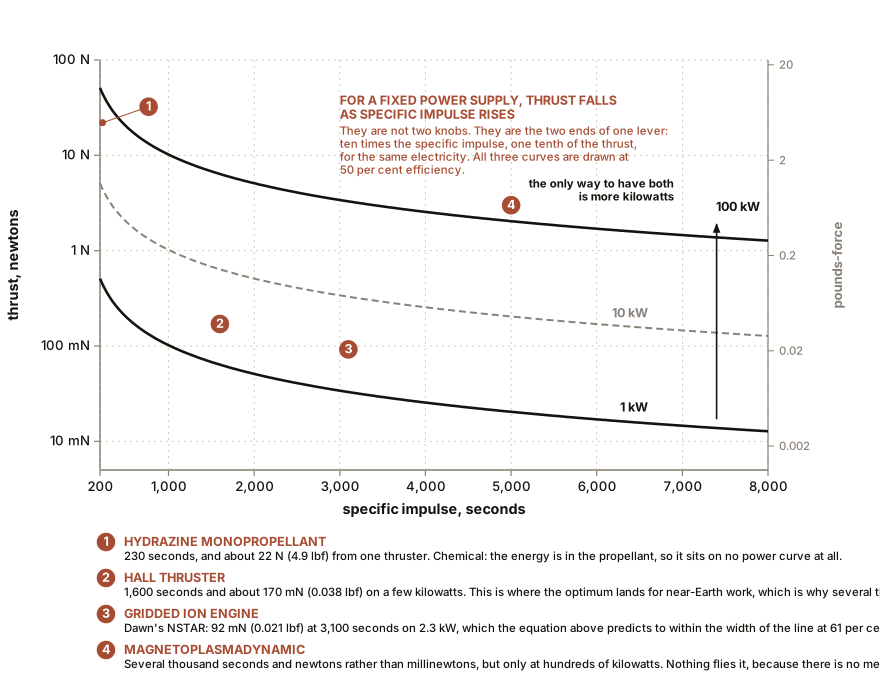
thrust = 2 × efficiency × power / exhaust velocityFor a fixed power supply, thrust falls as specific impulse rises. They are not independent knobs. They are the two ends of the same lever.
Put numbers in. One kilowatt at 50 per cent efficiency gives 33 mN at an exhaust velocity of 30 km/s (19 miles/s), and 333 mN at 3 km/s (1.9 miles/s). Ten times the specific impulse, one tenth of the thrust, for the same electricity.
So an electric thruster is a millinewton device by arithmetic, not by lack of ambition. Check it against the real machine: Dawn’s engine drew 2.3 kW and produced 92 mN at 3,100 seconds, which the formula above puts at 61 per cent efficiency. That is what a flight thruster achieves, and it agrees with the equation to within the width of the line.
SLOW DOWN. Check Your Understanding: If specific impulse is what saves propellant, and voltage is cheap, why does anybody fly a Hall thruster at 1,600 seconds when a gridded ion engine offers 4,000? Higher is better, so why not always take the higher number? There are two reasons, and the second one is genuinely surprising. Think before reading on.
The first is thrust, and therefore time. From Section 2, tripling the specific impulse at fixed power cuts the thrust to a third, so the same manoeuvre takes three times as long. A commercial satellite operator raising a new satellite to geostationary orbit is losing revenue every day it is not on station, so eight months of transfer instead of three is a direct cost. Time is not free.
The second is that there is an optimum, not a maximum, and this is the part that catches people out. Your power supply has mass. A solar array and its power processing weigh something like 20 to 50 kg per kilowatt (44 to 110 lb per kilowatt). Raise the specific impulse and you save propellant mass, but to keep the trip time the same you need more power, and more power means more array mass.
So the mass you save on propellant is paid for in powerplant, and past a certain point you are paying more than you save. For any given mission duration and power system, there is a specific impulse that minimises total launched mass, and going above it makes the spacecraft heavier rather than lighter. For typical near-Earth missions that optimum lands somewhere between 1,500 and 2,500 seconds, which is exactly where Hall thrusters sit. They are not a cheap compromise. They are the answer to the sum.
Section 3: The Gridded Ion Thruster
The oldest and the most efficient of the three, and conceptually the simplest.
Ionise the propellant, then pull the ions out through a pair of charged screens.
A chamber of xenon gas. Electrons from a hollow cathode are made to circulate through it, ionising atoms by collision, exactly as in a fluorescent tube. At the downstream end sit two closely spaced grids drilled with thousands of matching holes. The inner grid is held at around a thousand volts positive and the outer one a couple of hundred volts negative. An ion that wanders near a hole is accelerated through it and out, arriving in space with about a kilovolt of energy, which is an exhaust velocity in the tens of kilometres per second.
Three details are the whole engineering of the device.
It must neutralise its own beam. The thruster is throwing positive charge away, so the spacecraft is charging negative, and a spacecraft charged to a few kilovolts negative will simply pull its own exhaust back. So a second hollow cathode downstream sprays electrons into the departing beam. The neutraliser is not a refinement, it is load-bearing, and without it the engine produces no net thrust at all.
Its thrust density is limited by the ions already in flight. The ions in the gap between the grids are all positive, and their own charge partly cancels the field that is accelerating them. Push more current through and the effect worsens until the flow chokes itself. That ceiling is why a gridded engine needs a large grid area for a small push, and Dawn’s 92 mN came out of a grid 300 mm (12 in) across.
Section 4: The Hall Effect Thruster, Which Cheats the Space Charge Limit
And here Chapter 11 pays for itself.
A Hall thruster has no grids. An annular channel, an anode at the far end, a cathode outside, and a radial magnetic field of about 0.02 T across the channel.
Now recall the factor of sixty from Chapter 11: at a given field and energy, an ion’s gyration radius is tens of times larger than an electron’s. Choose the field so that the electrons are firmly magnetised and the ions are effectively not.
What follows is elegant. The electrons cannot cross the field to reach the anode, so instead they drift round and round the annulus in a closed circular current, which is the Hall current the device is named for. Trapped there, they collide with neutral xenon and ionise it efficiently. And because they cannot leave, they hold up a region of steep electric potential in the middle of the channel with no electrode present at all.
The ions, unmagnetised, simply fall through that potential and out of the back.
The advantage is direct. Inside the channel there are as many electrons as ions, so the plasma is quasi-neutral and there is no space charge limit. A Hall thruster therefore produces roughly ten times the thrust per unit of area of a gridded engine at similar power, at the cost of a lower specific impulse.
The history is worth a sentence. Hall thrusters were developed in the Soviet Union by Alexey Morozov’s group and flown from December 1971 onward. Roughly two hundred were operating on Soviet spacecraft while the West regarded the concept as a dead end, and only after 1991 did Western engineers test the hardware and discover it worked better than their own. The dominant electric propulsion technology on Earth spent twenty years as a national secret nobody was trying to steal.
Two current problems, both live. Wall erosion: the ion beam clips the channel walls and sputters them away, which used to set the life at around ten thousand hours, until engineers at NASA’s Jet Propulsion Laboratory worked out around 2010 how to reshape the field so the acceleration region sits away from the wall. That technique, magnetic shielding, extended demonstrated life by roughly an order of magnitude, and it is why constellations of thousands of satellites became practical.
And the propellant supply. Xenon is ideal: heavy, easy to ionise, inert, storable as a liquid. It is also only a trace by-product of separating air for industrial oxygen, at a world output of a few tens of tonnes a year and thousands of dollars a kilogram, so a single large constellation can consume a noticeable share of world production. Which is why the industry moved to krypton, roughly ten times cheaper for slightly worse performance, and then to argon, cheaper still by orders of magnitude and needing higher voltages. SpaceX’s second-generation satellites fly argon Hall thrusters at roughly 170 mN. Chapter 3’s ionisation table decides which gases are candidates, and the commodity market decides which one flies.
Section 5: Magnetoplasmadynamic, and the Rest
The magnetoplasmadynamic thruster is Chapter 11’s pinch used as a nozzle.
Drive a very large current, kiloamps, radially outward through a plasma from a central cathode to a surrounding anode. That current generates its own magnetic field circling the cathode. The current crossed with its own field produces a force, and the geometry is such that the force points out of the back. The plasma pushes itself out with no grids, no applied magnets and no electrodes in the exhaust.
The thrust rises with the square of the current, which means the device gets better as it gets bigger, unlike almost everything else in this chapter. It scales to hundreds of kilowatts and megawatts naturally, and at those powers it would deliver newtons rather than millinewtons at a specific impulse of several thousand seconds. It is the right engine for a crewed transfer to Mars, on paper.
And nothing flies it, for one reason: there is no megawatt-class power supply in space. Solar arrays of that size are impractical; the alternative is a nuclear reactor, which is the Nuclear Power volume’s subject and is recommended and never required here. The thruster is waiting for the power source, not the other way round. There are also two real technical problems, cathode erosion at those currents and an instability called onset that appears above a certain current density and wrecks performance, and both are tractable in a way that “build a space reactor” is not.
Section 6: What Actually Flies
Stated plainly, because this is a field where the demonstration and the deployment are often confused.
Electric propulsion is routine and it is almost all Hall thrusters doing station-keeping. Several thousand are in orbit, mostly on constellations and communications satellites holding position and raising their orbits, trading three to eight months of transfer time for roughly half the launch mass. In deep space it is the enabling technology for a specific class of mission: Deep Space 1 in 1998, the first to use it as primary propulsion; SMART-1 to the Moon; Hayabusa and Hayabusa 2, which returned asteroid samples; Dawn; BepiColombo; and Psyche.
And it flies nothing off a surface, ever. A Dawn-class thruster weighs about 8 kg (18 lb) and pushes with 92 mN, so it would need a hundredfold improvement merely to hold itself up against Earth gravity. This is not a temporary limitation. Thrust per kilowatt is bounded, and kilowatts per kilogram of power supply are bounded, so thrust per kilogram of vehicle is bounded well below the level needed to lift.
Which is the honest summary of the whole chapter. Electric propulsion is a power supply problem wearing a thruster’s clothes. The thrusters work, have worked for fifty years, and are limited by the kilowatts anyone can put in orbit and by what the propellant costs on a commodity market.
Section 7: What This Chapter Established
Throwing propellant faster saves propellant, logarithmically, and electric thrusters can throw it ten times faster than chemistry because the energy comes from outside the propellant. Thrust and specific impulse are one lever, not two knobs: for fixed power, one falls as the other rises, which is why every electric thruster produces millinewtons and why that is correct rather than disappointing.
And there is an optimum specific impulse rather than a maximum, because the power supply has mass, and above the optimum the array you added weighs more than the propellant you saved.
Next: how anyone knows any of the numbers in the last thirteen chapters. Two wires and a voltage sweep, a diffraction grating, and the uncomfortable fact that in this subject more than any other, the instrument changes what it came to measure.

Bench Degree
Get the degree without the diploma.
Learn the material, not how to pass the exam.