Bench Degree·REFRIGERATIONchapter

Chapter 14: Air and Water
Relative humidity is a ratio, not an amount, and that single confusion is why an oversized air conditioner leaves a room cold and clammy. It is also the chapter most often skipped, and skipping it is why so many machines are sized wrongly.
An air conditioner does two jobs at once and nobody tells you about the second one.
The first is obvious: it makes air colder. The second is that it takes water out of the air, and on a humid day that second job consumes a large fraction of the machine’s capacity. Every drop running out of the drain pipe was paid for in electricity.
Until you can separate those two jobs and put numbers on each, several everyday experiences remain inexplicable. Why a bigger unit can make a room less comfortable. Why a basement dehumidifier is warm. Why the ancient Persians of Chapter 2 could not cool below a certain floor no matter how clever they were.
This chapter is about air holding water, and it will close the loop opened twelve chapters ago.
Section 1: Air Is Two Gases and One of Them Is Water
The air in the room is a mixture. Mostly nitrogen and oxygen, which for this chapter behave as one inert substance called dry air, plus a variable amount of water vapour.
That water is a genuine gas, invisible, mixed molecule by molecule with the rest. It is not mist and it is not steam you can see. Fog and cloud are liquid droplets, which means water that has already come out of the air.
And the crucial property: air can only hold so much water vapour, and how much depends entirely on temperature.
| Air temperature | Maximum water it can hold | |
|---|---|---|
| 0 °C | 32 °F | 3.8 g per kg of dry air |
| 10 °C | 50 °F | 7.6 g/kg |
| 20 °C | 68 °F | 14.7 g/kg |
| 30 °C | 86 °F | 27.2 g/kg |
| 40 °C | 104 °F | 49.0 g/kg |
Read the ends of that table. Warm air at 40 °C (104 °F) holds thirteen times more water than cold air at 0 °C (32 °F). The capacity roughly doubles for every 11 °C (20 °F) of warming.
That doubling is the engine of everything in this chapter.
IN PLAIN ENGLISH: Think of air as a sponge whose size depends on its temperature. Warm the sponge and it can hold more water. Cool it and it shrinks, and if it was already full, water has to come out.
Section 2: Why Relative Humidity Confuses Everyone
Now the definition that causes all the trouble.
Relative humidity is the water actually present divided by the maximum the air could hold at that temperature, expressed as a percentage.
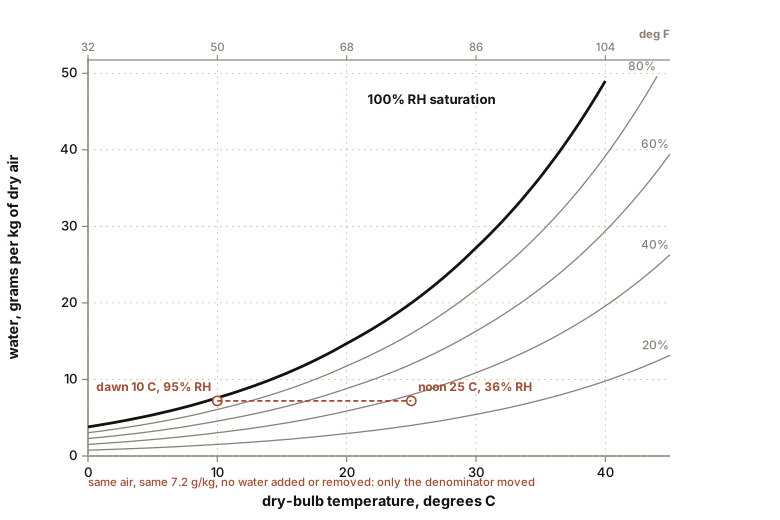
RH = (water present) / (maximum at this temperature) × 100%It is a ratio. It is not an amount. And because the denominator changes with temperature, the same air can report wildly different relative humidities without a single molecule of water entering or leaving.
Worked example, and this is the whole confusion in one calculation.
A parcel of air at dawn: 10 °C (50 °F), holding 7.2 g of water per kg of dry air. Maximum at 10 °C is 7.6 g/kg.
RH = 7.2 / 7.6 = 95%
The sun comes up. The same air warms to 25 °C (77 °F). No water was added and none removed. But the maximum at 25 °C is about 20.0 g/kg.
RH = 7.2 / 20.0 = 36%
Ninety-five percent at dawn and thirty-six percent at noon, with identical air. Nothing evaporated, nothing condensed, nobody opened a window. Only the denominator moved.
This is why relative humidity alone is nearly useless for engineering. It tells you how full the air is, which matters for comfort and for condensation, but it tells you nothing about how much water is actually there, which is what a machine has to remove.
Section 3: The Two Numbers That Do Not Lie
Two better measures, both absolute.
Humidity ratio, sometimes called absolute humidity or mixing ratio: grams of water per kilogram of dry air, or grains per pound in the older imperial convention. This is a straight count of the water. Heat the air and it does not change. Cool the air and it does not change, until condensation starts.
Dew point: the temperature to which you would have to cool the air for it to reach 100 percent relative humidity and begin dropping water. It is a temperature used as a measure of moisture content, which sounds odd but is enormously practical, because it answers the question a machine actually asks: how cold can a surface get before water forms on it?
In the worked example above, both parcels of air have the same humidity ratio of 7.2 g/kg and the same dew point of about 9 °C (48 °F), at dawn and at noon. The absolute measures stayed put while the relative one swung by 59 points.
SLOW DOWN. Check Your Understanding: A glass of iced water in a room at 24 °C (75 °F) sweats heavily. The same glass in a desert at 38 °C (100 °F) stays dry. The desert is hotter. Why does the cooler room condense water and the hot desert not? Think before reading on.
Because condensation depends on the dew point, not the temperature. The room might have a dew point of 17 °C (63 °F), and a glass at 2 °C (36 °F) is well below that, so water forms. The desert air is hot but nearly dry, with a dew point of perhaps −1 °C (30 °F), and the glass at 2 °C never gets below it. A surface sweats when it is colder than the dew point of the air around it, and nothing else about the air matters.
Section 4: Wet Bulb, and the Ancient World’s Ceiling
Now the measurement that closes Chapter 2.
Take two thermometers. Leave one alone: it reads the ordinary air temperature, called the dry-bulb temperature. Wrap the other’s bulb in wet cloth and blow air across it. Water evaporates from the cloth, evaporation removes heat, and that thermometer settles at a lower reading. That is the wet-bulb temperature.
How much lower depends entirely on how dry the air is. Dry air is thirsty, so evaporation is rapid and the wet bulb reads far below the dry bulb. Saturated air can accept nothing more, so the two read the same.
The gap between them is called the wet-bulb depression, and it is a direct measurement of how far from saturated the air is.
| Conditions | Dry bulb | RH | Wet bulb |
|---|---|---|---|
| Desert afternoon | 40 °C (104 °F) | 10 % | 19 °C (66 °F) |
| Dry summer day | 32 °C (90 °F) | 20 % | 18 °C (64 °F) |
| Temperate summer | 27 °C (81 °F) | 50 % | 19 °C (66 °F) |
| Humid coastal | 32 °C (90 °F) | 80 % | 29 °C (84 °F) |
| Saturated monsoon | 30 °C (86 °F) | 100 % | 30 °C (86 °F) |
And here is the payoff twelve chapters in the making. The wet-bulb temperature is the coldest that evaporation alone can ever achieve. Not a practical limit, a hard one. Perfect equipment, unlimited water, unlimited airflow: you stop at the wet bulb.
Which means the yakhchāl, the wind catcher, the wet pot and the khus screen of Chapter 2 were all bounded by that number. In Yazd’s dry desert air the wet bulb sits 21 °C (38 °F) below the air temperature, which is the difference between unbearable and pleasant, and that is why those technologies are Persian. In saturated monsoon air the wet bulb is the air temperature, evaporation buys nothing, and no amount of Persian ingenuity would have helped.
Two thousand years of cooling technology had a ceiling, and the ceiling was a number you can measure with two thermometers and a shoelace.
ON THE BENCH: Build a sling psychrometer
Parts: two identical thermometers; a cotton shoelace or gauze; string or tape; water. Or a proper sling psychrometer, about $40. Cost: under $10 to build. Time: 30 minutes. Method: tape the two thermometers side by side to a stick, wrap the bulb of one in wet cotton, and whirl the assembly around your head for thirty seconds. Read both immediately. Repeat until the wet reading stops falling. What you should see: the wet bulb settling several degrees below the dry bulb and then refusing to go lower however long you whirl. That floor is the wet-bulb temperature and it is the wall Chapter 2 described. Then do it in four places: outdoors, in a kitchen while a pan boils, in a bathroom after a shower, and in a basement. Record both numbers each time. Then look up the dew point and relative humidity from any psychrometric chart or online calculator using your two readings. Two thermometers and a shoelace have told you the complete moisture state of the air. Keep this table; Section 7 uses it.
Section 5: The Chart That Holds All of It
Six quantities describe moist air: dry-bulb temperature, wet-bulb temperature, dew point, relative humidity, humidity ratio, and enthalpy. Fix any two and the other four are determined.
That relationship is drawn on the psychrometric chart, which looks forbidding and is simply six families of lines on one sheet.
- Dry-bulb temperature: vertical lines, left to right.
- Humidity ratio: horizontal lines, bottom to top.
- Relative humidity: curves sweeping up to the right. The topmost curve, the boundary of the chart, is 100 percent RH, called the saturation line.
- Wet-bulb temperature: lines sloping gently down to the right.
- Dew point: read horizontally leftward to the saturation line.
- Enthalpy: lines nearly parallel to wet bulb, because for moist air the two are closely related.
To use it, plot one point. Take your two thermometer readings, find where the vertical dry-bulb line crosses the sloping wet-bulb line, and mark it. Everything else about that air is now readable by following lines from that dot.
And the reason an engineer cares: a process done to air is a line on this chart. Heating is a horizontal line to the right. Cooling without dehumidifying is a horizontal line to the left. Evaporative cooling runs down a wet-bulb line, and it cannot pass the saturation curve, which is the ceiling of Section 4 drawn as a wall.
Section 6: What an Air Conditioner Actually Draws On the Chart
Now the machine, and the reason this chapter exists.
Room air at 24 °C (75 °F) and 50 percent RH enters the evaporator. From Chapter 10, that coil is at about 4 to 7 °C (40 to 45 °F).
The dew point of that room air is about 13 °C (55 °F). The coil is at 5 °C. The coil is well below the dew point, so as air touches the fins it is cooled past saturation and cannot hold its water. Water condenses on the metal, runs down the fins, collects in the pan and goes out the drain.
So the process line goes left and downward: left because the air is getting cooler, downward because it is losing water.
That splits the machine’s work in two:
Sensible cooling is the leftward component: making
the air colder. This is Q = m c ΔT from Chapter 4.
Latent cooling is the downward component: condensing water out. This is the latent heat of Chapter 5, about 2,450 kJ per kilogram (1,050 Btu per pound) of water removed, and it is expensive.
The ratio of the two has a name, the sensible heat ratio:
SHR = sensible cooling / total cooling| Situation | Typical SHR |
|---|---|
| Humid climate, occupied house | 0.65 to 0.75 |
| Temperate, normal occupancy | 0.75 to 0.85 |
| Dry climate | 0.85 to 0.95 |
| Server room, no people | 0.95 to 1.00 |
An SHR of 0.70 means thirty percent of the machine’s capacity is being spent removing water, not cooling air. A nominally three-ton unit is delivering just over two tons of temperature change and the rest is going into the drain pan.
IN PLAIN ENGLISH: An air conditioner is a dehumidifier that also happens to make things colder. On a humid day about a third of what you pay for goes into wringing water out of the air. That water is invisible on a thermostat and unmistakable in the drain.
Section 7: Why Bigger Is Worse
Here is the payoff that makes this chapter worth its length, and the answer to a question almost every homeowner has asked.
Dehumidification only happens while the coil is cold and air is moving across it. Water needs time to condense, collect and run off. A coil that has just started is not yet cold enough; a coil that has just stopped gives its collected water back to the air as the fan coasts.
So consider two machines in the same humid house.
A correctly sized unit runs for long stretches, perhaps twenty minutes at a time. The coil gets properly cold, water streams off it continuously, and the room ends up cool and dry.
An oversized unit blasts the room to setpoint in six minutes and shuts off. The thermostat is satisfied. But the coil barely had time to get down to temperature, very little water condensed, and what did condense partly re-evaporates into the room from the wet coil during the off cycle.
The result is a room that is cold and clammy at the same time, which feels far worse than a room two degrees warmer and properly dry. The occupant, reasonably, concludes the unit is too small and turns it down further, which makes it cycle even shorter.
Bigger is not better. Bigger is measurably worse. And the reason is not a machine defect: it is that dehumidification is a function of runtime, and oversizing destroys runtime.
Three real consequences:
Sizing must be calculated, not guessed, which is Chapter 15.
Variable-speed equipment fixes this properly, because a compressor that can run at thirty percent capacity for an hour dehumidifies far better than one that runs at a hundred percent for ten minutes. This is the strongest comfort argument for inverter-driven machines and it has nothing to do with efficiency.
And in a very dry climate the opposite problem appears. With almost no latent load, the coil never gets wet, SHR approaches 1.0, and the machine delivers pure temperature change. Which is exactly the situation in the room at the end of this book.
Section 8: The Server Room, Where the Water Runs Out
The server room of Chapter 21 has no people breathing, no kettles, no showers, no cooking and no open doors. The only moisture sources are infiltration from outside and whatever walks in with a technician.
So the latent load is close to zero and SHR approaches 1.0. Essentially all of the machine’s capacity goes into temperature change, which is the good news: a three-ton unit delivers very nearly three tons of cooling instead of two.
Three consequences worth carrying into Chapter 21.
Sizing calculations for a server room must not use residential rules of thumb. Those assume an SHR near 0.75 and will undersize the sensible capacity badly.
The coil can run warmer, which is more efficient. There is no reason to hold a coil at 5 °C (41 °F) to wring out water that is not there; a higher evaporator temperature raises COP directly, for the reason Chapter 13 gave about narrowing the gap between coil temperatures.
And too dry is its own problem. Below about 25 percent RH, static electricity becomes a genuine risk to electronics, and some data centres humidify deliberately. A machine so effective at drying that it creates an electrostatic hazard has solved one problem and bought another.
ON THE BENCH: Weigh the water
Parts: a running air conditioner or dehumidifier with an accessible drain; a bucket or measuring jug; a scale; a thermometer and your psychrometer from Section 4. Cost: nothing. Time: two hours, mostly unattended. Method: collect the condensate for a measured period, ideally an hour or more. Weigh or measure it. Meanwhile record indoor dry-bulb and wet-bulb. Then compute the latent load you paid for: every kilogram of water collected represents about 2,450 kJ (2,320 Btu) of latent heat the machine removed. Divide by the collection time to get watts. What you should find: a domestic unit in humid weather producing 1 to 4 litres per hour (0.25 to 1 gal/h), which is 680 to 2,700 W of latent cooling, a substantial fraction of the machine’s total output. The point: you have just measured, in a bucket, capacity that never once appeared on a thermostat.
Section 9: What This Chapter Bought You
Relative humidity is a ratio and it moves when temperature moves, even though nothing was added or removed. Dew point and humidity ratio are the honest measures.
A surface sweats when it is colder than the dew point, which is the whole explanation of condensation and of why an air conditioner has a drain.
Wet-bulb temperature is the floor of evaporative cooling, and it is the wall that bounded two thousand years of pre-mechanical technology in Chapter 2.
An air conditioner does two jobs, and the sensible heat ratio tells you the split. On a humid day a third of the bill is water.
Oversizing destroys dehumidification, because drying is a function of runtime, and that is why a too-large machine leaves a room cold and clammy.
And a server room is the opposite case: almost no latent load, SHR near 1.0, so the coil can run warmer and the machine delivers more than it would in a house.
Two thermometers and a shoelace get you all of it.
Chapter 15 turns this into arithmetic and calculates how big a machine a real room actually needs.

Bench Degree
Get the degree without the diploma.
Learn the material, not how to pass the exam.