Bench Degree·REFRIGERATIONchapter

Chapter 19: The Heat Pump
A heat pump delivers three or four units of heat for every one unit of electricity it consumes. That is not a marketing claim, it is not a violation of anything, and it is the reason the machine exists. This chapter is about why it is true.
Start with the sentence that makes heat pumps sound like a swindle.
A good air-source heat pump, running on a mild day, will put about 4 kW of heat into your house for every 1 kW of electricity it draws from the meter. Four hundred percent. Efficiency well past one hundred.
Everyone’s first reaction to that number is the correct engineering reaction, which is suspicion. Nothing is more than one hundred percent efficient. A kettle cannot boil more water than its element can heat. So either the number is a lie, or something is being counted dishonestly.
The number is true, and nothing dishonest is happening. What is wrong is the word efficiency, which does not mean what it appears to mean here, and once you see why, heat pumps stop being mysterious permanently.
Section 1: The Difference Between Making Heat and Moving It
Put two machines side by side in the same cold room.
Machine A is an electric heater. A resistance element, glowing, exactly like a toaster or a kettle or a hair dryer. Feed it 1 kW of electricity and it produces 1 kW of heat. Every single watt of electrical energy becomes heat in the room, because there is nowhere else for it to go.
That machine is 100 percent efficient, and 100 percent is its absolute ceiling. No electric heater has ever done better and none ever will. A £2,000 designer radiator and a £15 fan heater produce exactly the same heat per unit of electricity. There is nothing to improve.
Machine B is a heat pump. Feed it 1 kW of electricity and it puts 4 kW of heat into the room.
The extra 3 kW is not created. It is carried in from outside.
That is the whole answer. The heat pump is not an unusually good heater. It is not a heater at all. It is a pump, and what it pumps is heat, and the electricity is not the source of the heat but the cost of the pumping.
IN PLAIN ENGLISH: An electric heater makes heat out of electricity, and one watt in gets you one watt out, always. A heat pump fetches heat from outdoors and carries it in, and the electricity pays for the fetching rather than for the heat. Asking why a heat pump exceeds 100 percent is like asking how a wheelbarrow can move more soil than it weighs.
The bucket analogy, which is exact rather than loose
You want water in a tank on a hill. Two options.
Option A: a machine that makes water. Some hypothetical device that converts electricity into water. Whatever it produces is limited absolutely by the energy you put in.
Option B: a pump and a river at the bottom of the hill. Now the electricity is not creating water. It is lifting water that already existed. How much you get per kilowatt-hour depends on how far up the hill you have to lift it, and not at all on how much water there is in the river.
A heat pump is option B. The river is the outdoor air, which contains a colossal quantity of heat, and the hill is the temperature difference you are pumping across.
This immediately predicts the two most important facts about heat pumps, before any hardware is discussed. Pumping heat a short way uphill is cheap, so a heat pump is very efficient on a mild day. Pumping heat a long way uphill is expensive, so a heat pump is much less efficient on a bitter one. Everything else in this chapter is detail on top of that.
Section 2: Where the Heat in Cold Air Actually Is
The objection that comes next is always the same. If it is 0 °C (32 °F) outside, there is no heat out there to fetch. The air is cold.
That objection is Chapter 1’s mistake wearing a coat, and it is worth demolishing carefully because it is the single commonest reason people do not believe heat pumps work.
There is no such thing as cold. There is only more heat and less heat. Air at 0 °C (32 °F) is not at zero heat. It is at 273 kelvin, which is 273 degrees above the point where heat genuinely runs out. Absolute zero is minus 273.15 °C, or minus 459.67 °F, and that is where there is nothing left to fetch.
So a winter day is not the bottom of the scale. It is about 93 percent of the way up from the bottom, measured properly.
| Kelvin | °C | °F | |
|---|---|---|---|
| Absolute zero, genuinely no heat | 0 K | −273.15 | −459.67 |
| Liquid nitrogen | 77 K | −196 | −321 |
| A cold winter night | 263 K | −10 | 14 |
| A freezing day | 273 K | 0 | 32 |
| Comfortable room | 293 K | 20 | 68 |
Look at the gap between the freezing day and the comfortable room. It is 20 kelvin out of 273. You are not creating warmth out of nothing. You are moving heat across a gap of 20 kelvin, from a reservoir that sits 273 kelvin above true empty. The reservoir is enormous and the lift is small, which is exactly why the arithmetic comes out so well.
SLOW DOWN. Check Your Understanding: A heat pump is asked to keep a house at 20 °C (68 °F). On Monday it is 10 °C (50 °F) outside. On Tuesday it is minus 10 °C (14 °F). On which day does it work harder per unit of heat delivered, and roughly by what factor? Think before reading.
Tuesday, and by about a factor of three. Monday’s lift is 10 kelvin, Tuesday’s is 30. The ideal limit on how much heat you can move per unit of work is set by the ratio of the room’s absolute temperature to the lift, so tripling the lift roughly divides the performance by three. Real machines do worse than the ideal, but the shape of the answer is right, and it is the whole reason cold-climate performance is the industry’s central engineering problem.
Section 3: It Is Your Refrigerator, Facing the Other Way
Here is the part that surprises people who have read the rest of this book: you already know how a heat pump works, in complete detail, because it is the machine from Chapter 10 with nothing changed.
Your refrigerator takes heat out of a box and dumps it into your kitchen. The evaporator is inside the box, drinking heat. The condenser is on the back, releasing it. You care about the box, so you call it a refrigerator, and the warm coils behind it are waste.
Now imagine putting the box outdoors and standing inside the kitchen. Same machine. The evaporator is outside drinking heat from the winter air. The condenser is indoors releasing it. Nothing has been re-engineered. You have simply decided that the coils on the back are the product.
That is a heat pump. The waste heat from a refrigerator, aimed on purpose.
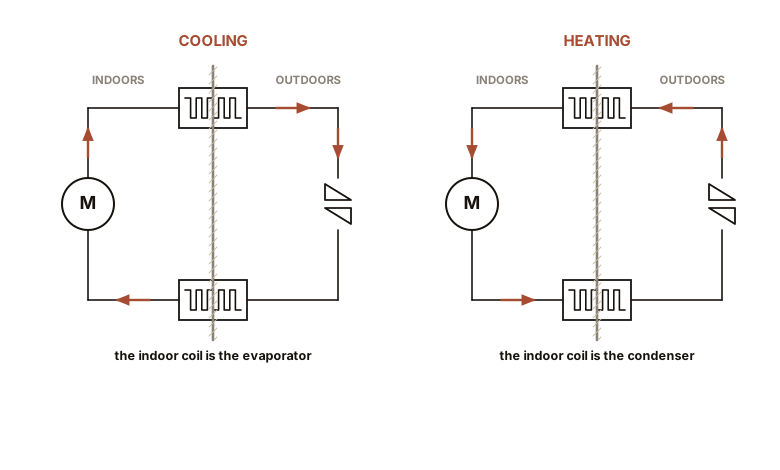
An air conditioner is the same object again, with the evaporator indoors and the condenser outdoors, and you have decided the indoor end is the product. Three appliances, one machine, three opinions.
The reversing valve
Which raises the obvious question. If an air conditioner and a heat pump are the same machine facing opposite ways, could one box do both jobs?
Yes, and that is what a reversing valve is: a four-port valve, usually solenoid-operated, that swaps which coil receives high-pressure vapour from the compressor and which receives low-pressure liquid from the metering device.
In cooling mode, hot vapour goes to the outdoor coil, which becomes the condenser. The indoor coil becomes the evaporator, gets cold, and the fan blows house air across it.
In heating mode, the valve throws. Hot vapour now goes to the indoor coil, which becomes the condenser and warms the house. The outdoor coil becomes the evaporator, gets cold, and drinks heat from the winter air.
The compressor never reverses. It always pumps the same direction. Only the plumbing downstream of it is swapped. This is why a heat pump costs slightly more than an air conditioner and not twice as much: it is one extra valve, some extra controls, and a metering device that can work in both directions.
ON THE BENCH: Find the reversing valve
Parts: access to any heat pump outdoor unit. Millions of houses have one, and every commercial building with a rooftop unit is a candidate. Cost: nothing. Time: 15 minutes. Hazards: do not open an electrical panel. Everything here is visible with the top grille off, or often through it. What to look for: a brass cylinder roughly 150 to 250 mm (6 to 10 in) long lying horizontally near the compressor, with four copper tubes entering it, one on one side and three on the other, and a small electrical solenoid coil clipped to one end. That is the valve, and it is the entire difference between an air conditioner and a heat pump. Then, with the unit running in heating mode: feel the two large lines going into the house. One is hot, one is cool. Switch the thermostat to cooling and wait for the compressor to restart. The hot one is now the cool one. You have just watched the machine change its mind about which end matters.
Section 4: Why It Gets Worse When You Need It Most
The measure of a heat pump’s performance is the coefficient of performance, or COP, and it is defined as bluntly as it sounds:
COP = heat delivered / electricity consumedA COP of 4 means four units out for one in. An electric resistance heater has a COP of exactly 1, always, which is the cleanest way to see that COP is not efficiency and that a heat pump’s 4 is not a violation of anything.
There is a hard ceiling on COP, and it comes from the same thermodynamics that limits every heat engine, run backwards:
COP(max) = T(hot) / (T(hot) − T(cold))with both temperatures in kelvin. That is an ideal nobody reaches, but it tells you the shape of reality:
| Outdoor temp | Indoor temp | Lift | Ideal COP | Realistic COP |
|---|---|---|---|---|
| 15 °C (59 °F) | 20 °C (68 °F) | 5 K | 58.6 | 5.0 to 6.0 |
| 7 °C (45 °F) | 20 °C (68 °F) | 13 K | 22.5 | 3.5 to 4.5 |
| 0 °C (32 °F) | 20 °C (68 °F) | 20 K | 14.7 | 2.8 to 3.5 |
| −10 °C (14 °F) | 20 °C (68 °F) | 30 K | 9.8 | 2.0 to 2.8 |
| −20 °C (−4 °F) | 20 °C (68 °F) | 40 K | 7.3 | 1.5 to 2.2 |
| −30 °C (−22 °F) | 20 °C (68 °F) | 50 K | 5.9 | 1.0 to 1.7 |
Read the two right-hand columns together and two things stand out.
The ideal is wildly better than reality, by a factor of five to ten. Real machines lose to compressor inefficiency, to the fact that the coils must run hotter and colder than the air they exchange with, and to fan and defrost losses.
And performance falls exactly as demand rises. The coldest night of the year is the night the house needs the most heat and the night the heat pump delivers the least per kilowatt. That single fact is the entire engineering history of the technology.
Notice also the bottom row. At around minus 30 °C (minus 22 °F) a mediocre machine’s COP approaches 1, which is the point where it has become an expensive electric resistance heater. Good modern machines stay well above that, but the trend is unavoidable.
Section 5: The Defrost Cycle, or Why You Think It Is Broken
This is the behaviour that generates more service calls and more distrust than anything else a heat pump does, and it is entirely deliberate.
Work through the logic. In heating mode the outdoor coil is the evaporator, and to pull heat out of outdoor air it must be colder than the outdoor air, typically by 5 to 10 kelvin. So on a day when it is 2 °C (36 °F) outside, the outdoor coil is running at perhaps minus 5 °C (23 °F).
Outdoor air contains moisture. Moisture touching a surface below freezing does not merely condense, it frosts. So the outdoor coil ices up, and an iced coil cannot exchange heat with air, and a heat pump with a blocked outdoor coil stops working entirely.
The machine’s solution is startling. It throws the reversing valve and runs in cooling mode for a few minutes. Hot vapour goes to the outdoor coil, melts the ice off it, and the water runs away. Then it throws back and resumes heating.
While that is happening, the indoor coil has become the evaporator, so the machine is briefly air-conditioning your house in the middle of winter. Steam pours off the outdoor unit as the ice melts and, from a distance, it looks exactly like a fire. Indoors, cold air comes out of the registers.
Which is why the homeowner calls somebody.
Three things a well-designed system does to hide this. It energises electric resistance strips during defrost so the air coming indoors is not actually cold. It shuts the indoor fan off entirely. And it decides when to defrost intelligently, on measured coil conditions rather than on a fixed timer, because a fixed timer defrosts when there is no ice and wastes the energy.
ON THE BENCH: Catch a defrost cycle
Parts: any air-source heat pump, and a cold damp day near freezing. Near 0 to 4 °C (32 to 40 °F) with high humidity is ideal, because that is the frosting sweet spot. Cost: nothing. Time: an hour of intermittent watching, or set a chair outside. What to watch for: first, frost building on the outdoor coil fins as white rime. Then a distinct change in the machine’s sound as the reversing valve throws, sometimes a clear thump. The outdoor fan stops. Steam rises off the unit. Two to ten minutes later it thumps back and the fan restarts. Then: feel the indoor supply air during the defrost. On a system with no auxiliary heat, it is genuinely cool. That is the answer to a question thousands of homeowners ask their contractors every winter. The insight worth taking away: the machine is deliberately doing the opposite of its job for a few minutes in order to keep doing its job at all. Almost nothing else in this book does that.
Section 6: Balance Point, and the Bad Reputation
A heat pump’s output falls as it gets colder, for the reasons in Section 4. A house’s demand for heat rises as it gets colder, obviously. Plot both against outdoor temperature and the two lines cross.
That crossing point is called the balance point, and it is where a heat pump stops being able to keep up on its own.
Below the balance point something else has to make up the difference. Traditionally that something was electric resistance strips, and this is where the technology earned a bad name in the 1970s and 1980s in the United States. Those strips have a COP of 1. So on the coldest week of the year, precisely when the bill matters most, the efficient machine steps aside and an electric furnace takes over. Householders in Ohio and Tennessee got January bills that destroyed the technology’s reputation for a generation.
Three modern answers, and they are genuinely different rather than incremental.
Variable-speed compressors. An old heat pump had one speed: on. It was sized for the worst case, so on a mild day it short-cycled. A modern inverter-driven compressor runs anywhere from 20 to 120 percent of nominal, so it can run slowly and continuously in mild weather, which is both more comfortable and more efficient, and can be oversized for cold weather without penalty in mild.
Vapour injection. A second injection port on the compressor, fed with intermediate-pressure refrigerant, which improves capacity at high lift. This is the main reason a cold-climate machine can hold a useful COP at minus 25 °C (minus 13 °F) where a 1980s unit was finished at minus 5 °C (23 °F).
Honest sizing and a proper backup. Sometimes the right answer is a heat pump sized for the ninety-fifth percentile of the heating season plus a gas or oil backup for the ten worst nights, which is called a dual-fuel or hybrid system. Chapter 15’s load calculation is what tells you where that line sits for a given house.
IN PLAIN ENGLISH: A heat pump’s reputation was destroyed by machines sized wrongly and backed up badly, not by the physics. The physics is the same as it was in 1975. The compressors and controls are not.
Section 7: Ground Source, and a Callback to Chapter 2
Everything above concerns air-source heat pumps, which fetch heat from outdoor air. Their entire difficulty is that outdoor air is coldest exactly when you need the most heat.
So fetch it from somewhere that does not get cold.
Dig down a few metres and the ground sits close to the local annual mean temperature, all year, regardless of the weather at the surface. In most of the northern United States and northern Europe that is somewhere around 8 to 12 °C (46 to 54 °F) in the depths of January, when the air above it is at minus 10 °C (14 °F).
A ground-source heat pump circulates fluid through buried pipe, either in long horizontal trenches or in vertical boreholes a hundred metres or more deep, and uses that as its river instead of the air. The lift is smaller, and it is smaller precisely on the worst days. COPs of 4 to 5 in midwinter are ordinary, the machine never frosts, and there is no defrost cycle at all because the evaporator is not exposed to humid air.
The catch is entirely economic. Drilling boreholes or excavating trenches can cost more than the machine, and it cannot be retrofitted to a small urban site with no ground to dig.
And you have met this idea before. In Chapter 2 the Persians dug their ice pits 5 metres (16 ft) down, because earth at depth stays at the annual mean temperature no matter what the desert surface is doing. Five hundred years later a ground-source heat pump exploits exactly the same fact about soil, for exactly the same reason, with a compressor added. The yakhchāl used it passively to keep cold. The heat pump uses it actively to fetch warmth. Same reservoir, opposite direction.
Section 8: The Numbers on the Nameplate
Four figures you will meet, and what each actually means, because the marketing versions are not interchangeable.
COP. Heat out divided by electricity in, at one stated operating condition. Honest and specific. Always ask at what temperatures.
HSPF, Heating Seasonal Performance Factor. Total heat delivered over a heating season divided by total electricity used, in Btu per watt-hour. A single number rolling up a whole winter including defrost and auxiliary heat. Divide HSPF by 3.412 to get a rough seasonal average COP: an HSPF of 10 is a seasonal COP of about 2.9.
SEER and SEER2, the cooling equivalent. The same machine has both a heating and a cooling rating because it does both jobs.
Capacity at 47 °F (8 °C) and at 17 °F (minus 8 °C). North American data sheets quote this pair at those two Fahrenheit points by convention, so the odd-looking numbers are a standard rather than a choice. It is the most useful line on the sheet, and it is where the Section 4 table becomes concrete. A machine rated 36,000 Btu/h (10.5 kW) at 47 °F (8 °C) might deliver only 22,000 Btu/h (6.4 kW) at 17 °F (minus 8 °C). That is the real answer to “how big is it”, and the single number on the box is not.
SLOW DOWN. Check Your Understanding: A heat pump is rated 36,000 Btu/h (10.5 kW) at 47 °F (8 °C) and 22,000 Btu/h (6.4 kW) at 17 °F (minus 8 °C). A house needs 30,000 Btu/h (8.8 kW) at that same 17 °F (minus 8 °C). Is this machine adequate, and if not, by how much?
Not adequate. On the cold-rating line it delivers 22,000 Btu/h (6.4 kW) against a demand of 30,000 Btu/h (8.8 kW), so it is 8,000 Btu/h (2.3 kW) short, and that shortfall must come from auxiliary heat. Sizing from the 36,000 Btu/h (10.5 kW) figure on the box would have looked comfortable and been wrong by a quarter. This is the arithmetic that ruined the technology’s reputation, done properly.
Section 9: What to Take Away
Six sentences, and if only these survive the chapter it has done its job.
A heat pump does not make heat. It moves heat, and the electricity pays for the moving. That is why the ratio of heat out to electricity in can be 3 or 4, and why calling that “400 percent efficient” is a category error rather than a miracle.
Cold air is full of heat. Zero degrees Celsius is 273 kelvin above the point where heat runs out. The reservoir is huge; only the lift is hard.
It is your refrigerator with the wall moved. Identical hardware, different opinion about which coil is the product. A reversing valve lets one box hold both opinions.
Performance falls as the lift rises, which means it falls exactly when demand peaks. Every difficulty the technology has ever had comes from that one sentence.
The defrost cycle really does run the machine backwards in midwinter, deliberately, and the cold air from the vents during it is not a fault.
Ground source solves the hard part by digging, which is the same trick the Persians used in Chapter 2 and for the same reason.
The next chapter goes back to the commercial equipment of Chapter 21, which is a cooling-only machine, and asks what changes when you scale all of this up to three-phase power and twenty tonnes of capacity.

Bench Degree
Get the degree without the diploma.
Learn the material, not how to pass the exam.