Bench Degree·REFRIGERATIONchapter

Chapter 1: The Hot Pump and the Cold Can
You are about to hold both halves of a refrigerator, one in each hand, using things already in your house.
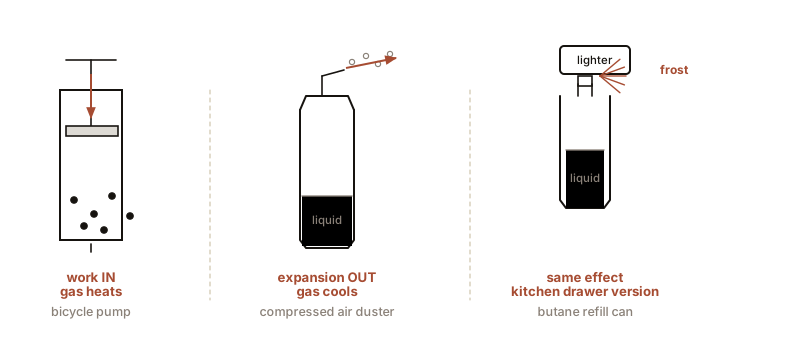
Find a bicycle pump. Any hand pump will do, floor or frame.
Put your thumb firmly over the outlet so no air can escape, and pump hard twenty times. Then feel the barrel near the bottom.
It is hot. Not warm. Uncomfortably hot, in twenty strokes, from a device that was at room temperature a minute ago.
Nothing heated it. There was no flame, no element, no friction worth mentioning, because the piston seal barely touches the wall. You squeezed some air, and squeezing it made it hot.
Now find a can of compressed air, the kind sold for blowing dust out of a keyboard. Hold the trigger down for ten or fifteen seconds continuously, and then feel the can.
It is cold. Cold enough to hurt if you hold it, sometimes cold enough to frost on the outside in humid weather.
Nothing cooled it either. You did not put it in a freezer. The contents rushed out through a nozzle and expanded, and expanding made them cold.
If you do not have a can of duster, you almost certainly have the other version of this experiment in a drawer. Take a refillable butane lighter and a can of lighter gas. Press the can onto the fill valve for a few seconds, and some of the butane will escape past the seal instead of going in, which always happens. Put a finger in that escaping gas. It is bitterly cold, cold enough to sting, and if you keep filling, frost forms on the nozzle of the can. Same effect, same reason, and no computer shop required.
That is worth pausing on, because the butane in that can is a liquid, sitting under its own pressure. Squeeze the can and you can hear it slosh. The moment it escapes it boils, and the boiling is what makes it cold. You have just watched a refrigerant do its job in the open air, which is exactly what happens inside the evaporator coil of every machine in this book. R-290, one of the common modern refrigerants in Chapter 8, is propane. Its neighbour on the shelf is butane. These are not exotic substances.
Stop and look at what you are holding.
Compression makes things hot. Expansion makes things cold. Those two facts, in your two hands, ninety seconds apart, are the entire working principle of every refrigerator, freezer, air conditioner and heat pump ever built. The rest of this book is about arranging them into a loop that never stops, and choosing a fluid that does it at a useful temperature.
ON THE BENCH: The pump and the can
Parts: any bicycle pump; and either a can of compressed air (about $6) or a refillable butane lighter and a can of lighter gas (about $5, and more likely to be in the house already). Everything else: every part this book asks for is listed once, at the back, in Appendix A: The Bench. Nothing is specified by brand, so it can be ordered from anyone. You do not need any of it yet. Cost: under $10, likely zero. Time: 2 minutes. Hazards: the pump barrel gets genuinely hot, so feel it with a fingertip rather than gripping it. Compressed-air cans get cold enough to cause a cold burn if held against skin for a long time. Do not inhale the contents, which are not air but a liquefied refrigerant, usually difluoroethane, and are dangerous to breathe. What you should see: a barrel too hot to hold comfortably after twenty blocked strokes. A can cold enough to condense moisture from the air after fifteen seconds of continuous discharge, or frost on the nozzle of a lighter-gas can while it is filling.
Hazard, for the butane version: butane is flammable and heavier than air, so it pools. Do this outdoors or by an open window, with nothing lit anywhere near you, and do not do it in a basement. The quantity escaping past a lighter valve is small, but the habit of respecting it is the point. Better, if you have one: point an infrared thermometer at both. A pump barrel will commonly go from 22 °C to 45 °C (72 °F to 113 °F). A duster can will commonly drop to around minus 15 °C (5 °F). Why the can gets cold, briefly: the propellant inside is a liquid under pressure. On the way out it boils. Chapter 5 is about why boiling is the most powerful cooling mechanism available, and Chapter 7 is about why the pressure decides the temperature at which it happens.
Section 1: The Second Demonstration, Which Is the Stranger One
The first pair of experiments shows you the machine. This one shows you the trick that makes it useful, and it is genuinely startling the first time.
You need a hand vacuum pump, the kind sold as an automotive brake bleeder for about twenty-five dollars, and a small sealed jar with a fitting through the lid. Half fill the jar with tap water at room temperature. Seal it. Start pumping the air out.
Somewhere along the way, the water begins to boil.
Not simmer. Boil, vigorously, with bubbles rising off the bottom and breaking at the surface, exactly as it would on a stove. And the jar in your hand is cool. You can hold it against your cheek.
Water boiling at room temperature. Nothing was heated. All you did was take away the pressure.
IN PLAIN ENGLISH: Boiling has almost nothing to do with being hot. It has to do with pressure. Water boils at 100 °C (212 °F) only because there happens to be an atmosphere of air sitting on it. Take some of that air away and it boils cooler. Take enough away and it boils at room temperature, or below.
Hold on to that, because it is the lever this whole subject pulls. If you get to choose the pressure, you get to choose the temperature at which your liquid boils. Choose a low enough pressure and you can make a liquid boil at 4 °C (40 °F), which is colder than the inside of your refrigerator. And a boiling liquid, as Chapter 5 will show in detail, is an extraordinarily hungry absorber of heat.
That is the machine. Make a liquid boil somewhere cold, so it drinks heat out of that place. Then squeeze the vapour, which makes it hot, and let it dump that heat somewhere warm. Then let it expand and start again.
ON THE BENCH: Boiling water you can hold
Parts: hand vacuum pump or brake bleeder (about $25); a small jar with a sealed fitting, or a purpose-made vacuum chamber; room-temperature water. Cost: about $30 total. Time: 15 minutes including setup. Hazards: use a jar rated for vacuum or a proper chamber. A thin-walled decorative jar can implode. Wear eye protection. Do not use hot water, because there is no need and it spoils the point. What you should see: vigorous boiling at a pressure of roughly 20 to 25 mm Hg (about 3 kPa) with the water near 22 °C (72 °F), and the jar cool to the touch throughout. Then: put a cheap dial thermometer in the water and keep pumping. The water temperature falls as it boils, because boiling is carrying heat away. You are watching refrigeration happen in a jar.
Section 2: You Cannot Make Cold
Now some vocabulary, and the first idea that has to be dismantled.
There is no such thing as cold. There is no cold substance, no cold particle, nothing that gets added to a room to chill it. There is only heat, and its absence.
Heat is energy held in the random jiggling of atoms. In a hot object the atoms jiggle violently. In a cold one they jiggle less. Nothing else distinguishes the two. “Cold” is simply a word for having less heat than something else, and it is entirely relative: a winter afternoon at 0 °C (32 °F) is bitterly cold to you and blisteringly hot compared with the surface of Pluto.
This matters because of what it implies about machines. A refrigerator does not make cold. It moves heat. It takes heat out of the inside and puts it outside, and the inside gets colder as a consequence, the same way a room gets emptier because people left rather than because emptiness was pumped in.
You can verify this with your hand in about ten seconds. Reach around behind your refrigerator and feel the coils, or the grille at the bottom. They are warm. That warmth is the heat that used to be in your milk. It did not vanish; it was carried out and released into your kitchen. A refrigerator running with its door open does not cool a room. It heats it, slightly, because the motor’s own energy is added to the pile.
IN PLAIN ENGLISH: A refrigerator is a pump, and what it pumps is heat. It moves heat from a place you want cool to a place you do not care about. The cooling is a side effect of the moving.
The one rule heat obeys on its own
Left alone, heat only ever flows in one direction: from hotter to colder. Always. A hot cup of coffee cools to room temperature; a room-temperature cup has never once spontaneously heated itself by chilling the air around it.
This is not a tendency or a probability. It is one of the most reliably confirmed statements in physics, and it is the reason a refrigerator needs a motor. Moving heat downhill is free and happens by itself. Moving heat uphill, from cold to hot, requires work put in from outside. That is what you are paying the electricity company for, and it is what the compressor is doing.
ON THE BENCH: The wrong-way test
Parts: two mugs, a thermometer, hot and cold water. Cost: nothing. Time: 20 minutes of occasional checking. Method: fill one mug with hot water and one with cold, stand them touching, and log both temperatures every two minutes. What you should see: they converge. Always. The hot one falls faster at first, the cold one rises, and they meet somewhere in between and then fall together toward room temperature. What you will never see, not once, in any experiment ever performed, is the hot one getting hotter while the cold one gets colder.
Section 3: Stone, Wood, and Why Your Hand Is a Bad Thermometer
One more piece of unlearning, because it will otherwise cause confusion for the rest of the book.
Find a stone countertop or a metal table leg, and a wooden chair, both of which have been sitting in the same room for hours. Touch each.
The stone feels cold. The wood does not. They are at exactly the same temperature. A thermometer on each will read the same number.
What differs is not their temperature but how fast they take heat out of your finger. Stone and metal conduct heat quickly, so they pull warmth from your skin at a great rate, and your nerves report that as cold. Wood conducts poorly, so it takes very little, and your nerves report nothing much.
IN PLAIN ENGLISH: Your skin does not measure temperature. It measures how fast heat is leaving it. Those are different things, and confusing them is why a tiled bathroom floor feels freezing and a rug in the same room feels fine.
This is worth two paragraphs because it explains a great deal of everyday confusion about heat, and because the distinction between how hot something is and how much heat it contains is the subject of Chapter 4 and is the single most common place readers get stuck.
ON THE BENCH: Same temperature, different feel
Parts: an infrared thermometer or any two-probe kitchen thermometer; a stone or metal surface and a wooden one in the same room. Cost: $20 for the thermometer, or borrow one. Time: 3 minutes. What you should see: both surfaces reading within a degree of one another, while your hand insists one is much colder. Trust the instrument.
Section 4: One Machine, Four Names
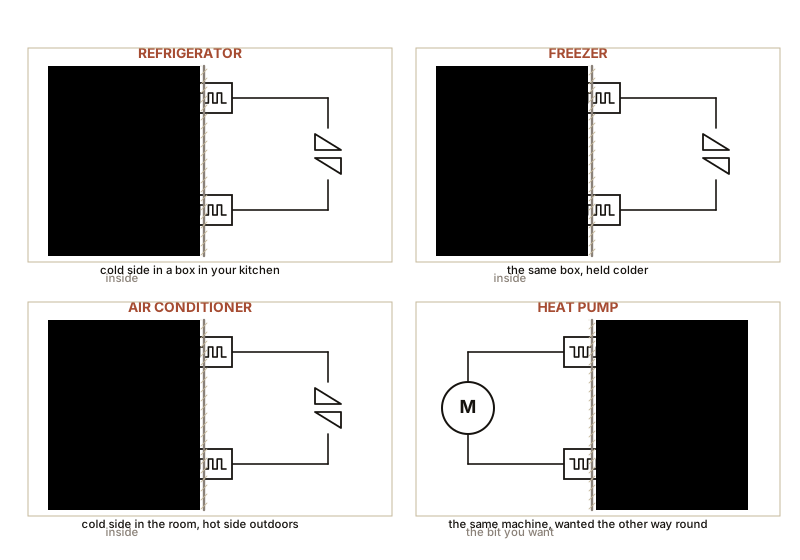
A refrigerator, a freezer, an air conditioner and a heat pump are the same machine. Not similar. The same. They differ in which side of a wall you have decided to care about.
- A refrigerator takes heat out of a box and dumps it into your kitchen. You care about the box.
- A freezer does the same thing, colder.
- An air conditioner takes heat out of a room and dumps it outdoors. You care about the room. It is a refrigerator whose cold box is your living room and whose warm coils are in the garden.
- A heat pump takes heat out of the outdoors and dumps it into a room. Identical hardware. You have simply decided that the warm end is the useful one. On many units a single valve reverses which end is which, which is why one machine can both heat and cool a house.
That last one deserves a moment, because it surprises people. A heat pump extracts heat from cold outdoor air. Not warm air. Cold air, at 0 °C (32 °F) or below. This sounds impossible until you remember Section 2: there is no such thing as cold, only less heat. Air at 0 °C (32 °F) is absolutely stuffed with heat by the standards of anything genuinely cold, and a machine willing to boil a liquid at minus 20 °C (minus 4 °F) can happily drink from it.
Section 5: Where This Book Is Going
There is a room in an office building in Massachusetts with three air conditioners in it, cooling a rack of servers. Two of them are identical Trane Odyssey split systems. The third is a much older York unit running on a plain mechanical thermostat.
By the last page of this book you will be able to stand in front of those machines and do all of the following.
- Read the nameplate and say what the unit will actually deliver on a 35 °C (95 °F) afternoon, and why that is less than the number printed on it.
- Explain why it will refuse to run at 4 °C (40 °F) outdoor temperature, and what kit would be needed to change that.
- Say why there is no fault contact to wire an alarm to, and what to monitor instead.
- Explain why there are two identical units rather than one larger one, and how a controller decides which of them runs first.
- Say why the elderly York on a mechanical thermostat is a defensible engineering choice and not neglect.
And along the way you will be able to put a set of gauges on any air conditioner, take two temperature readings, and tell whether it is undercharged, overcharged, restricted, or perfectly fine. That is a genuinely useful skill and it takes about four hundred pages of groundwork to make it obvious rather than magical.
Everything is built in order. Nothing arrives that has not been assembled from something earlier. If a chapter loses you, the fault is upstream of where you noticed, and the remedy is to go back one section rather than to push forward.
Keep the pump and the can. They come back in Chapter 6.

Bench Degree
Get the degree without the diploma.
Learn the material, not how to pass the exam.