Bench Degree·REFRIGERATIONchapter

Chapter 2: Cooling Without Machines
For two thousand years people made ice in deserts and kept it through summer, with no machinery at all. Then they hit a wall that no amount of cleverness could get past, and the wall has a number.
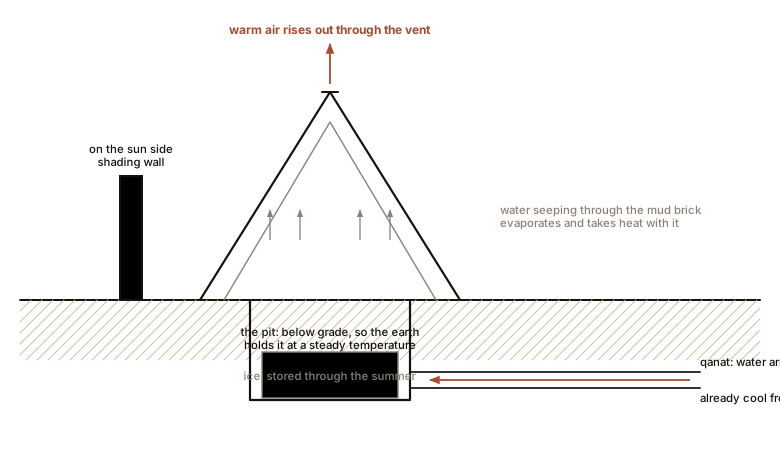
There is a building in Yazd, in central Iran, that looks like a mud-brick artillery shell. It is perhaps 18 metres (60 ft) tall, conical, windowless, sitting over a pit. It was built to store ice, in a place where summer afternoons reach 40 °C (104 °F), and it worked.
It is called a yakhchāl, from the Persian for ice pit, and there are dozens of them still standing. Some are more than five hundred years old. The oldest documented ice storage in Persia goes back to around 400 BC.
Before the chapter explains how they worked, it is worth being clear about the size of the claim. These people had no compressor, no refrigerant, no motor, no electricity and no thermodynamics. Carnot would not be born for two millennia. And they made ice, in a desert, and sold it in July.
Section 1: How to Make Ice in a Desert
The yakhchāl is only the storage. The making happened outside it.
On the north side of the structure, a long wall was built, running east to west and standing perhaps 6 metres (20 ft) high. That wall casts a shadow, and in the shadow a shallow channel was dug and filled with water from a qanat, which is an underground aqueduct that brings mountain groundwater tens of kilometres across the desert by gravity alone.
On a clear winter night the water in that shaded channel freezes. And here is the part that surprises engineers: it freezes even on nights when the air temperature stays above freezing.
The mechanism is radiative cooling. A pool of water with a clear sky above it is exchanging heat with deep space, which is at about 3 K, or minus 270 °C (minus 454 °F). Water radiates infrared upward, and on a dry, still, cloudless night with no water vapour to absorb it and send it back, that radiation escapes to the sky and does not return. The pool can drop several degrees below the surrounding air. The shading wall matters because it keeps the sun off the ice that formed the night before, and the still air matters because wind would bring warmth back by convection.
In the morning the ice was broken up, carried into the pit, and packed down. The pit was deep, often 5 metres (16 ft) or more below grade, because earth at that depth stays near the local annual average temperature all year round regardless of what the surface is doing. The conical superstructure above shaded the entrance and, crucially, worked as a chimney: air warmed by the sun rose out of the top, drawing cooler air in at the base and constantly flushing warmth away from the ice below.
The walls were built of a mortar the Persians called sarooj, made from sand, clay, egg white, lime, goat hair and ash. It is waterproof and it is a poor conductor of heat, which is exactly the specification you would write today. Some of these structures still hold their shape after five centuries in a climate that destroys concrete.
IN PLAIN ENGLISH: A yakhchāl is three ideas stacked. Freeze water at night by letting it radiate to the sky. Keep it underground where the earth’s temperature is steady. Wrap it in a material that does not conduct heat, with a chimney to carry away what does get in. None of it moves. None of it needs power.
ON THE BENCH: Radiative cooling to the sky
Parts: two shallow trays; a thermometer or two; a sheet of cardboard or a shaded spot; a clear dry night. Cost: nothing. Time: overnight, plus five minutes at each end. Method: put a shallow tray of water outside with a completely clear view of the sky. Put an identical tray a metre away, but under a board held 300 mm (12 in) above it so it can see no sky at all. Both are exposed to the same air. Measure both water temperatures in the morning before sunrise, and the air temperature too. What you should see: the tray open to the sky will be colder than the air, often by 3 to 6 °C (5 to 11 °F). The covered tray will be at roughly air temperature. On a genuinely dry, still, cloudless night the open tray may show ice around the edges while the thermometer reads above freezing. Why it fails: clouds, humidity, or any wind. Cloud radiates back down at you, water vapour absorbs the infrared and re-emits it, and wind delivers warm air faster than radiation can remove heat. The Persians built in a dry climate for exactly this reason.
Section 2: The Wind Catchers
Beside many yakhchāls, and on ordinary houses throughout Persia, Egypt and the Gulf, stands a second structure: a tall tower, open at the top, called a bâdgir in Persian and a malqaf in Arabic. The name means wind catcher, and that is what it does.
The physics is worth walking through because it combines two separate effects and most descriptions muddle them.
Effect one, when there is wind. The tower’s openings face the prevailing breeze. Air is caught high up, where it is moving faster and is cleaner, and directed down a shaft into the living space below. This is simple ducting, and it works because wind speed increases with height above the ground, a fact this book’s companion volume on wind power spends an entire chapter on.
Effect two, when there is no wind. The tower still works, in reverse. The tower itself is heated by the sun, the air inside it warms, warm air rises, and the tower becomes a chimney pulling air up and out of the house. Fresh air is drawn in through doors and low windows to replace it. A structure that ventilates when the wind blows and also ventilates when it does not is a genuinely elegant piece of engineering.
Now combine it with water. Route the incoming air over the surface of a qanat channel, or through a room with wet mats hung in it, or past a porous jar, and the air arrives cooler than the outdoor air, not merely fresher. Some houses in Yazd achieved a drop of 10 °C (18 °F) or more this way in the hottest part of the day.
That cooling is not magic and it is not radiative. It is evaporation, and it is the same effect that is making you cold when you climb out of a swimming pool on a breezy day. It is also the effect that will turn out, in Section 4, to be the wall these civilisations could not climb.
Section 3: Ice Was a Commodity Long Before It Was a Utility
Persia was not alone, and the pattern of exploiting cold rather than creating it shows up independently almost everywhere people had a mountain and a summer.
China. The Shi Jing, the Book of Songs, includes verses on cutting winter ice and storing it, dating from roughly the eleventh to seventh centuries BC. By the Tang dynasty there was an organised ice trade with government ice houses, and by the Song dynasty ice was being sold to the public in Kaifeng.
Rome. Snow was carried down from the Apennines, packed in straw, and stored in pits. Seneca complains about the fashion for snow-chilled drinks, which tells us two things: that it existed, and that it was expensive enough to be worth sneering at. Nero is reported to have had snow brought to Rome and used to chill wine, and although the anecdote may be embroidered, the snow pits themselves are archaeologically attested across the empire.
India. The matka, an unglazed earthenware water pot, works by letting a small amount of water seep through the porous clay and evaporate from the outside surface, cooling what remains inside. It is still in daily use. The khus screen is the same principle scaled up: a curtain of woven vetiver roots hung in a doorway and kept wet, so incoming air is cooled and scented as it passes through.
Egypt. Tomb paintings show slaves fanning porous water jars, which is exactly the right thing to do: evaporation is limited by how fast the humid air at the surface is carried away, so moving air makes the cooling faster.
The Mediterranean snow trade. By the sixteenth and seventeenth centuries this was a substantial industry, with snow harvested from mountains in Spain, Italy and the Levant, stored in neveras and neviere, and shipped to cities. It survived into the nineteenth century, when it was killed not by refrigeration but by the New England ice trade, which cut lake ice in Massachusetts and sailed it to Calcutta.
ON THE BENCH: The porous pot
Parts: an unglazed terracotta plant pot with the drainage hole plugged, or a clay cooler if you can find one; a glazed or plastic pot of the same size for comparison; two thermometers; water. Cost: under $15. Time: 2 hours of occasional checking. Method: fill both pots with water at the same starting temperature. Stand both in the same place, out of direct sun, and log both temperatures every fifteen minutes. What you should see: the unglazed pot’s water dropping 4 to 8 °C (7 to 14 °F) below the glazed one and below the ambient air. The glazed pot will simply sit at room temperature. Then, and this is the important part: set a small fan blowing across both pots and watch what happens. The unglazed pot gets colder still. The glazed one does not change. You have just discovered that evaporative cooling is limited by air movement, which is what the Egyptian fan-bearers were for.
Section 4: The Wall, and Its Number
Every technique in this chapter is one of two things. Insulation, which slows heat from getting in, and evaporation, which actively removes heat. Neither one pumps heat uphill. Neither one can make something colder than a limit set by the surrounding air, and for evaporation that limit has a name and a number.
It is called the wet-bulb temperature.
Here is what it means. Take two identical thermometers. Leave one alone; it reads the ordinary air temperature, which is called the dry-bulb temperature. Wrap the bulb of the second one in wet cloth and blow air across it. Water evaporates from the cloth, evaporation takes heat, and that thermometer reads lower. How much lower depends entirely on how much water vapour the air is already carrying.
If the air is bone dry, the wet thermometer reads far lower, because the air is thirsty and evaporation is rapid. If the air is already saturated, at 100 percent relative humidity, the wet thermometer reads exactly the same as the dry one, because no more water can evaporate into air that is already full.
The wet-bulb temperature is the coldest that evaporation can ever get you. Not a practical limit. A hard one. Perfect equipment, unlimited water, unlimited airflow, infinite patience: you stop at the wet-bulb temperature and no further.
Some real figures, to show why this mattered so much in Persia and so little in Bengal:
| Conditions | Dry bulb | Relative humidity | Wet bulb, roughly |
|---|---|---|---|
| Desert afternoon, Yazd | 40 °C (104 °F) | 10 % | 19 °C (66 °F) |
| Dry summer day | 32 °C (90 °F) | 20 % | 18 °C (64 °F) |
| Temperate summer day | 27 °C (81 °F) | 50 % | 19 °C (66 °F) |
| Humid coastal afternoon | 32 °C (90 °F) | 80 % | 29 °C (84 °F) |
| Monsoon, saturated air | 30 °C (86 °F) | 100 % | 30 °C (86 °F) |
Read the first and last rows against each other. In the Iranian desert, evaporation buys you a drop of 21 °C (38 °F), which is the difference between unbearable and pleasant. In saturated monsoon air it buys you nothing at all. This is why the wind catcher and the wet screen are Persian and Egyptian technologies rather than Bengali ones, and it is why a swamp cooler works splendidly in Arizona and is useless in Florida.
IN PLAIN ENGLISH: Evaporation can only cool you down to the wet-bulb temperature, and how low that is depends on how dry the air is. In dry air it is a great deal lower than the air temperature. In humid air it is barely lower at all. No cleverness gets past it, because the limit is set by the air rather than by the machine.
And now the crucial observation, the one that makes the next four hundred pages necessary.
Nothing in this chapter can make anything colder than the wet-bulb temperature of the surrounding air. Nothing here can make ice on a summer afternoon, anywhere, ever.
The Persians made ice at night in winter and then spent enormous effort hoarding it, because making it on demand was impossible. That is the wall. Every technique in this chapter is a way of exploiting a cold that already exists somewhere, in the night sky, in the deep earth, in the mountains, or in dry air’s appetite for water.
To make cold on demand, in July, in Florida, you need a machine that pumps heat uphill against its natural direction. And to build that you need the two facts you already hold in your hands from Chapter 1: that compressing a gas heats it, and that expanding a gas cools it.
That is Chapter 3, and it took people about a century to get it working without killing anybody.
ON THE BENCH: Finding the wall yourself
Parts: two identical thermometers; a shoelace or a strip of cotton; water; a small fan. Cost: under $10. Time: 20 minutes. Method: wrap the bulb of one thermometer in wet cloth. Set the fan blowing across both. Wait until the wet one stops falling, which takes two or three minutes, and record both readings. What you should see: the wet one settling at a temperature well below the dry one, and then refusing to go lower no matter how long you wait or how hard the fan blows. That floor is the wet-bulb temperature, and you have just measured the limit that bounded two thousand years of cooling technology. Then: do it again on a dry day and on a humid one and compare the gap. Then do it in a bathroom after a hot shower, where the gap will nearly vanish. Keep the readings. You have built a sling psychrometer, which is the instrument Chapter 14 is about, and those two numbers are enough to find the humidity, the dew point and the moisture content of the air you are standing in.

Bench Degree
Get the degree without the diploma.
Learn the material, not how to pass the exam.