Bench Degree·REFRIGERATIONchapter

Chapter 3: A Century of Wrong Turns
Everything needed to build a refrigerator was known by 1755. It took another hundred and twenty years to build a good one, and most of the fluids tried along the way were capable of killing everyone in the building.
The wrong turns are the point of this chapter. It would be shorter and less useful to jump from Chapter 2 straight to a working machine, but you would not understand why the machine has the shape it has. Every odd feature of a modern air conditioner is an answer to something that went badly wrong first.
Four things had to be discovered, and they were discovered in this order: that a boiling liquid gets cold, that you could do it in a closed loop, that the loop needed a pump, and that the choice of fluid was a life-or-death decision.
Section 1: 1755, Edinburgh. The First Cold Made On Purpose
William Cullen was a physician and chemist lecturing at Glasgow and then Edinburgh. In 1755 he put a dish of ether under a bell jar, connected a pump, and drew the pressure down.
The ether boiled. And as it boiled, it took heat out of everything nearby, so effectively that a thin film of frost formed on the outside of the dish and a small amount of the surrounding water froze.
This is exactly the experiment you performed in Chapter 1 with a jar of water and a hand vacuum pump. Same physics, same result, two hundred and seventy years apart. Cullen chose ether rather than water because ether boils at 35 °C (95 °F) at ordinary pressure, so it needs far less vacuum to boil at room temperature. Your brake bleeder had to work considerably harder than his pump did.
Cullen published, and then nothing happened for fifty years.
It is worth asking why, because the answer is instructive. Cullen’s apparatus made a little frost, once, and then stopped. The ether was gone: boiled away into the pump and lost. To make more cold he had to fetch more ether. He had built a machine that consumed its working fluid, which makes it a demonstration rather than an appliance.
The missing idea was the loop. Catch the vapour, put it back into liquid form, and use it again. Nobody attempted that for half a century.
ON THE BENCH: Cullen’s experiment, 1755 edition
Parts: a syringe, 20 mL or larger, with the needle removed and the tip blocked; a few drops of isopropyl alcohol, or better, a volatile solvent; your finger. Cost: under $5. Time: 5 minutes. Hazards: volatile solvents are flammable and their vapour should not be inhaled. Work with ventilation and no flame. Do not use ether, which is genuinely dangerous to handle and forms explosive peroxides on storage. Method: put three or four drops of alcohol into the syringe, block the tip firmly with a finger or a cap, and pull the plunger back hard. Hold it there. What you should see: the alcohol visibly boiling inside the syringe at room temperature, and the barrel becoming noticeably cool against your hand. Release the plunger and the boiling stops. Pull again and it resumes. What you have just done: the exact experiment that begins the history of refrigeration, with a $2 syringe. Note also what you have not done, which is anything useful, because the moment you stop pulling the plunger you stop making cold.
Section 2: 1834, London. Jacob Perkins Closes the Loop
Oliver Evans, an American engineer, proposed a closed cycle in 1805 but never built it. It fell to Jacob Perkins, an American living in London, to build the first machine that actually worked, and he patented it in 1834 as British patent 6662.
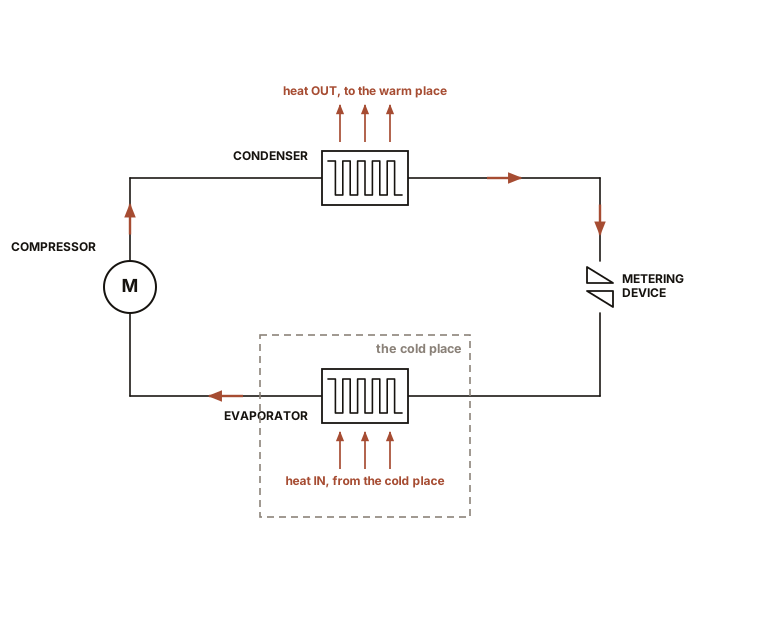
Perkins’s machine has the four components that every vapour-compression refrigerator has had ever since. Read this list and then notice that it is the list from your own Chapter 1 experiments.
- An evaporator, where the liquid boils at low pressure and drinks heat from its surroundings. This is Cullen’s dish, and it is your syringe.
- A compressor, which squeezes the resulting vapour to a high pressure and in doing so makes it hot. This is your bicycle pump.
- A condenser, where the hot high-pressure vapour is cooled by outside air or water until it turns back into a liquid, dumping its heat outward.
- A metering device, a deliberate restriction that lets the high-pressure liquid trickle back into the low-pressure evaporator, where it expands and boils again. This is your duster can nozzle.
And then it repeats, forever, with the same fluid going round and round. Nothing is consumed. The fluid is not fuel; it is a bucket, and all it does is carry heat from one place to another.
IN PLAIN ENGLISH: A refrigerator is a bucket brigade with one bucket. The refrigerant picks up heat where you want cold, carries it to where you do not care, tips it out, and comes back for more. The compressor is what makes it go round, and it is the only part that consumes energy.
Perkins’s machine used ether, and it made ice. It was never a commercial success, partly because his ether leaked and partly because the ice trade was already cheap and well organised. But the architecture was right, and it has not fundamentally changed in a hundred and ninety years. The unit in the server room of Chapter 21 is Perkins’s machine with better metallurgy.
Section 3: 1851, Florida. The Doctor Who Was Laughed At
John Gorrie was a physician in Apalachicola, Florida, treating malaria and yellow fever. He believed, wrongly, that the diseases came from hot damp air, and correctly that his patients did better when they were cooler. He had been hanging basins of ice from the ceiling, which required ice, which came by ship from New England and was expensive and unreliable.
So he built a machine. His approach was different from Perkins’s: rather than boiling a liquid, he compressed air, let it cool back to ambient in a water-cooled coil, and then let it expand rapidly, which chilled it far below ambient. Cold air, made on demand, from nothing but air. He received US Patent 8080 in 1851, the first American patent for mechanical refrigeration.
It worked. He made ice with it publicly.
He was mocked comprehensively. The northern ice industry, which was large and had a great deal to lose, treated him as a crank, and one newspaper reportedly wrote that there was a man in Florida who thought he could make ice as good as God Almighty. He failed to raise money, his partner died, and he died in 1855 poor and largely dismissed.
His machine was also, genuinely, not very good. Air-cycle refrigeration is inefficient compared with the vapour-compression cycle, for a reason worth stating now and proving in Chapter 5: air stays a gas the whole way round, so all it can carry is sensible heat, and sensible heat is a feeble way to move energy compared with the latent heat of a fluid that boils. Gorrie’s approach was sound engineering aimed at the wrong physics. Air-cycle machines survive today in exactly one niche, which is aircraft cabin cooling, where you are already carrying compressed air for other reasons and weight matters more than efficiency.
So Gorrie is a wrong turn twice over. He was right about the goal, right that a machine was possible, wrong about the disease, and wrong about the fluid. And he was treated abominably for it.
Section 4: 1859, France. The Machine With No Moving Parts
Ferdinand Carré took a genuinely different road, and unlike Gorrie’s it is still with us.
His machine has no compressor at all. Instead of squeezing vapour mechanically, it exploits the fact that ammonia dissolves eagerly in water. Boil an ammonia-water solution with a flame and ammonia vapour comes off at high pressure. Condense it, let it expand and boil in an evaporator to make cold, then let the resulting low-pressure vapour be absorbed back into water, which pulls it out of the evaporator as effectively as a pump would.
The absorption does the compressor’s job. The energy comes from a flame instead of a motor.
This is the absorption cycle, and it is not a historical curiosity. It is what runs the refrigerator in a caravan or a recreational vehicle on propane, it is what runs the silent minibar in a hotel room, and it is used industrially wherever there is waste heat going spare and electricity is expensive. Carré’s machines were sold commercially and used, among other things, to make ice for the Confederacy during the American Civil War when the northern ice trade was cut off.
It is less efficient than vapour compression per unit of energy in. But it accepts heat as its input instead of electricity, which is sometimes exactly what you want.
ON THE BENCH: A refrigerator with nothing moving in it
Parts: access to a propane or three-way absorption refrigerator, the kind in caravans, camper vans and hotel minibars. Many people have one, and any RV dealer will show you one running. Cost: nothing if you can borrow the look. Time: 20 minutes. Hazards: none if you only look. Do not open a sealed absorption unit; the charge is ammonia under pressure. What to observe: put your hand on the box and listen. There is no sound, and nothing vibrates, because there is no compressor. Then trace the pipework at the back and find the generator, which will be warm or hot, the condenser fins, and the absorber. You are looking at Carré’s 1859 machine, in production, in the twenty-first century. Then ask why: it makes cold from a flame. If that seems paradoxical, note that a flame is exactly what Carré used, and Chapter 8 explains the trick properly.
Section 5: 1876, Munich. Linde Makes It Industrial
Carl von Linde is the man on the cover of this book, and he is there because he is the point at which refrigeration stopped being an invention and became an industry.
Linde was a professor of engineering in Munich, and his route in was commercial: brewers wanted to make lager, lager requires cold fermentation, and cold in summer required ice they could not reliably buy. He built his first ammonia vapour-compression machine in 1873 and a much better one in 1876, and by 1890 he had sold hundreds of them to breweries across Europe.
What Linde did that his predecessors had not was treat the thermodynamics as an engineering discipline rather than a curiosity. He measured. He published efficiency figures. He worked out where the losses were and designed them out. He chose ammonia deliberately, on the numbers, because it carries an enormous amount of latent heat per kilogram and therefore needs a smaller machine for a given duty. Chapter 8 gives those numbers, and they are startling: ammonia carries roughly eight times the latent heat per unit mass that a modern household refrigerant does.
He then went further and liquefied air in 1895, which opened up industrial oxygen and nitrogen, and the company he founded is still one of the largest industrial gas businesses in the world.
If you want one date for when the world stopped waiting for winter, 1876 is a defensible choice.
Section 6: The Fluids That Killed People
Here is the part of the history that is genuinely dark, and it explains more about modern equipment than anything else in this chapter.
The four components were settled by 1834. The remaining problem was what to put inside them, and for ninety years every available answer was dangerous.
Ether, used by Cullen and Perkins, boils at 35 °C (95 °F), is extremely flammable, and forms explosive peroxides when stored. Perkins’s machines leaked.
Ammonia (NH3), Linde’s choice and still the best refrigerant on the numbers, is toxic. It is intensely irritating, so it announces itself long before it reaches a lethal concentration, which is a genuine safety feature. But a large leak in an enclosed space kills, and ammonia plants have killed workers.
Sulphur dioxide (SO2) was widely used in domestic refrigerators into the 1930s. It is highly toxic and it forms sulphurous acid on contact with moisture, including the moisture in your lungs.
Methyl chloride was the worst. It is toxic, flammable, and it was in domestic and institutional refrigerators. In 1929, a methyl chloride leak from the refrigeration plant at the Cleveland Clinic in Ohio caused a fire and released toxic gases through the building. One hundred and twenty-three people died, including doctors and patients. It remains one of the deadliest single incidents in the history of American hospitals.
That disaster, and others like it, made the problem impossible to ignore. Refrigeration worked. Refrigeration was becoming domestic. And the fluid inside the machine in your kitchen might kill your family if a joint failed.
Section 7: 1930. The Solution That Became the Next Problem
General Motors and DuPont set Thomas Midgley Jr. to find a refrigerant that was non-toxic, non-flammable, chemically stable, and boiled at a useful temperature. In 1930 he presented dichlorodifluoromethane, trade name Freon-12, at a meeting of the American Chemical Society.
His demonstration was theatrical and it is worth recounting because it made the case perfectly. He inhaled a lungful of the gas and then exhaled it over a lit candle. He did not choke, which showed it was not toxic. The candle went out, which showed it was not flammable. Nobody had ever been able to do both.
It was a spectacular success. Freon and its relatives were non-toxic, non-flammable, remarkably stable, and available in a family of variants with different boiling points to suit different applications. Domestic refrigeration became genuinely safe, and it spread into every home in the developed world in a generation. Midgley’s compound is a substantial reason your grandparents’ generation stopped getting food poisoning.
And then, forty years later, its greatest virtue turned out to be the problem.
Freon’s chemical stability is what made it safe. It also meant that when it leaked, it did not break down. It drifted, intact, for decades, until it reached the stratosphere, where ultraviolet light finally had enough energy to crack it apart and release chlorine atoms. In 1974 Mario Molina and Sherwood Rowland published a paper working out that a single chlorine atom could catalytically destroy tens of thousands of ozone molecules before being removed. In 1985 Joe Farman and colleagues at the British Antarctic Survey reported the ozone hole, which was so severe that satellite data had been discarding the readings as instrument error.
The Montreal Protocol was signed in 1987 and is generally regarded as the most successful environmental treaty ever concluded. CFCs were phased out. Molina, Rowland and Paul Crutzen received the Nobel Prize in Chemistry in 1995.
Midgley, who died in 1944, had no idea. He is also the man who put tetraethyl lead in petrol. He is a genuinely tragic figure in the history of engineering, and he is the strongest argument in this book for a habit of mind worth carrying into every chapter: a solution’s most attractive property is often the one that will cause the next problem, and the timescale on which that becomes apparent can be longer than a career.
And it has happened again
The CFC replacements were HFCs, which contain no chlorine and therefore do not touch the ozone layer. R-134a in car air conditioning, R-410A in domestic and commercial systems. Problem solved.
Except that HFCs are extremely potent greenhouse gases. R-410A has a global warming potential roughly 2,088 times that of carbon dioxide, kilogram for kilogram. The Kigali Amendment of 2016 began phasing them down in turn, and the industry is now moving to R-32, to R-454B, to propane, to CO2, and in industrial settings back to ammonia, which Linde chose in 1876 and which has a global warming potential of zero.
IN PLAIN ENGLISH: The history of refrigerants is four rounds of the same story. Something works, it turns out to have a serious problem, it gets replaced, and the replacement has a different serious problem. Toxic, then ozone-destroying, then climate-forcing. The current answers, including ammonia, are the ones from a century ago, made safe by better engineering rather than by better chemistry.
Chapter 8 works through what actually makes a good refrigerant, with the numbers, so that you can look at any of these choices and see the trade rather than the slogan.
Section 8: What You Should Take From This
Four things, and they all pay off later in the book.
The four components were settled in 1834 and have not changed. When you look at any refrigeration machine, from a minibar to a 20-tonne rooftop unit, you are looking at Perkins’s loop. Learn the four parts once and you can read every machine.
The fluid is a bucket, not a fuel. It is not consumed. If a system needs recharging, it has a leak, and the correct response is to find the leak rather than to add more refrigerant. This single idea prevents a great deal of bad service work, and Chapter 21 comes back to it.
Absorption is a real alternative, not a dead end. No compressor, heat as the input. If a machine is silent and has nothing moving in it, that is what it is.
Choosing the working fluid is the hardest decision in the field, and it has been got wrong every time so far. Not through carelessness. Through the fact that the consequences arrived decades after the choice.
The next chapter starts building the physics properly, beginning with the difference between how hot something is and how much heat it contains. That distinction sounds pedantic. It is the single place where most readers of most books on this subject get quietly lost, and Chapter 5 cannot work without it.

Bench Degree
Get the degree without the diploma.
Learn the material, not how to pass the exam.