Bench Degree·REFRIGERATIONchapter

Chapter 4: Heat, Temperature, and the Btu
A bathtub of warm water contains far more heat than a cup of boiling water. If that sentence feels slightly wrong, this chapter is the most important one you will read for a while.
Here is the distinction that everything else in this book stands on, and it is the single place where most readers of most books on refrigeration quietly get lost.
Temperature is intensity. Heat is quantity.
They are not the same kind of thing, they are not measured in the same units, and confusing them makes the rest of the subject impossible.
Consider two objects.
A teacup holding 250 g (about 8.8 oz) of water at 95 °C (203 °F). Very hot. It will scald you.
A bathtub holding 150 kg (about 330 lb) of water at 40 °C (104 °F). Pleasantly warm. You would happily sit in it.
The teacup is at a much higher temperature. The bathtub contains roughly two hundred and twenty times as much heat. Tip the teacup into the bath and the bath temperature rises by about a hundredth of a degree. Tip the bath into a cold room and you have heated the room.
Temperature tells you how hard the heat is pushing. Heat tells you how much of it there is. A refrigeration engineer cares almost entirely about the second one, because a machine has to move a quantity, and the quantity is what determines how big the machine must be.
IN PLAIN ENGLISH: Temperature is like the pitch of a note. Heat is like how loud it is. A piccolo plays higher than a bass drum and moves far less air. Asking “how hot is it” and “how much heat is in it” are two different questions with two different answers.
Section 1: What Heat Physically Is
Heat is the energy held in the random motion of atoms and molecules.
In a hot object the particles are moving violently: vibrating in place if it is a solid, careering about and colliding if it is a gas. In a cold object they are doing the same thing less energetically. That is the entire difference. There is no separate substance called heat that flows in and out; what flows is energy, transferred by particles jostling their neighbours.
Temperature is a measure of the average energy per particle. Heat is the total energy of all of them added together. Which is why the bathtub wins: each of its molecules is carrying less energy than each of the teacup’s, but there are 600 times as many of them.
This also explains something you observed in Chapter 1. When you blocked the bicycle pump and pushed, you did mechanical work on the air. That work went into making the air molecules move faster. Faster molecules means higher temperature, so the barrel got hot. You did not add heat to the air. You added work, and the air turned it into heat. Those are different inputs with the same result, and Chapter 6 comes back to the distinction.
Section 2: The Btu, the Joule, and Why Both Are In This Book
Heat needs a unit, and unfortunately there are two families of them in daily use. This book gives both every time, because a refrigeration nameplate in Ohio and one in Osaka do not agree on which to print.
The British thermal unit, the Btu, is defined as the heat needed to raise one pound of water by one degree Fahrenheit. That is it. It was chosen because water and pounds and Fahrenheit were what an English-speaking engineer had to hand, and it survives because the entire North American heating and cooling industry is built on it.
The joule is the SI unit of energy of every kind, mechanical, electrical or thermal, which is a genuine advantage. A kilojoule (kJ) is a thousand of them. The heat needed to raise one kilogram of water by one degree Celsius is 4.186 kJ, a number worth remembering because it turns up constantly.
The conversion, for when you need it:
1 Btu = 1.055 kJ
1 kJ  = 0.948 Btu
Two derived units you will meet everywhere:
Btu per hour (Btu/h) is a rate, which is power rather than energy. This is what air conditioners are rated in. A 24,000 Btu/h unit removes 24,000 Btu (25,320 kJ) of heat every hour it runs.
The watt is the SI rate: one joule per second. And so:
1 W = 3.412 Btu/h
1,000 Btu/h = 293 W
12,000 Btu/h = 3,517 W (3.517 kW)
That last line is worth flagging now. 12,000 Btu/h (3.517 kW) is one “ton” of refrigeration, a unit with a genuinely odd history that Chapter 15 unpicks, and it is why air conditioners come in sizes like 24,000 Btu/h (7.0 kW) and 36,000 Btu/h (10.5 kW). Those are two-ton and three-ton machines.
SLOW DOWN. Check Your Understanding: A window air conditioner is labelled 8,000 Btu/h. Roughly how many watts of heat is it removing per second of running, and roughly what fraction of a ton is it? Work it out before reading on.
8,000 ÷ 3.412 = 2,345 W, so about 2.3 kW of heat removal. And8,000 ÷ 12,000 = 0.67, so two thirds of a ton. Note that this is the heat it removes, not the electricity it consumes, which will be far less. The relationship between those two numbers is the whole of Chapter 13.
Section 3: Specific Heat, and Why Water Is Strange
Different substances need different amounts of heat to warm by the same amount. The number that captures this is called specific heat: the heat required to raise one unit of mass by one degree.
The table is worth studying rather than glancing at.
| Substance | Btu/lb·°F | kJ/kg·°C |
|---|---|---|
| Water (liquid) | 1.00 | 4.186 |
| Ice | 0.50 | 2.09 |
| Steam | 0.48 | 2.01 |
| Ammonia (liquid) | 1.10 | 4.60 |
| Air | 0.24 | 1.00 |
| Wood | 0.42 | 1.76 |
| Aluminium | 0.22 | 0.90 |
| Steel | 0.11 | 0.46 |
| Copper | 0.09 | 0.39 |
| Lead | 0.03 | 0.13 |
Two things stand out.
Water is extraordinary. Almost nothing common has a higher specific heat. It takes ten times as much heat to warm a pound of water as a pound of copper. This is why water is the universal coolant, why the ocean moderates the climate of every coastal city, why a hot water bottle works so well, and why boiling a kettle takes so long compared with heating a saucepan.
Metals are cheap to heat. A pound of lead takes one thirtieth the heat of a pound of water. This is also why a metal spoon in hot soup burns your mouth: it reached soup temperature almost instantly.
Notice too that ice and steam have about half the specific heat of liquid water. The same substance behaves differently in different states, and that fact becomes important in the next chapter.
The one equation for this chapter
Q = m × c × ΔTHeat added equals mass times specific heat times temperature change. In imperial units, Q in Btu, m in pounds, c from the table’s first column, ΔT in °F. In SI, Q in kJ, m in kg, c from the second column, ΔT in °C.
Worked example. How much heat to warm a full bathtub from cold to comfortable? Take 150 kg (330 lb) of water and a rise of 25 °C (45 °F).
SI: Q = 150 × 4.186 × 25 = 15,698 kJ Imperial:
Q = 330 × 1.00 × 45 = 14,850 Btu
Check them against each other:
14,850 Btu × 1.055 = 15,667 kJ. Agreement to within
rounding. Do this check on your own arithmetic; a factor-of-two
error in unit conversion is the commonest mistake in this field and it
is always caught by working the problem twice.
ON THE BENCH: Predict the mixture before you make it
Parts: kitchen scale; two thermometers; two jugs; hot and cold water; insulated container such as a vacuum flask or a foam cup. Cost: under $20, most of it likely owned. Time: 20 minutes. Method: weigh out 300 g (10.6 oz) of hot water and measure its temperature exactly. Weigh out 500 g (17.6 oz) of cold water and measure that. Now predict the final temperature before you mix them. The heat lost by the hot water equals the heat gained by the cold, so
m₁ c (T₁ − Tf) = m₂ c (Tf − T₂), and because both are water the c cancels:Tf = (m₁T₁ + m₂T₂) / (m₁ + m₂)Then mix them and measure. You should land within a degree. When you do not: you lost heat to the container and the air. Repeat in a vacuum flask and the agreement improves markedly. That gap between prediction and measurement is the insulation problem, and quantifying it here means Chapter 15’s load calculation will not feel arbitrary. Then the harder version: repeat with 300 g of hot water and 500 g of cooking oil, which has a specific heat around 0.5 Btu/lb·°F (2.0 kJ/kg·°C), and the c no longer cancels. Predict, then measure.
Section 4: Measuring Temperature Is Not Measuring Heat
You cannot buy a heat meter. You can buy a thermometer, and everything you know about how much heat is in something is inferred from temperature plus mass plus specific heat. That is worth stating plainly because it shapes every diagnostic technique in Part V of this book.
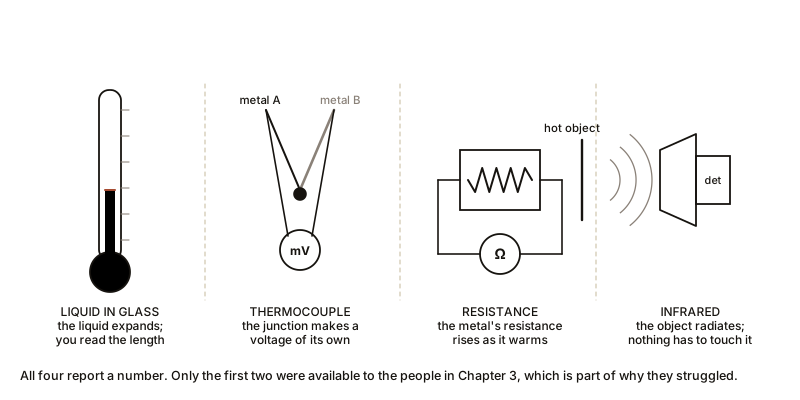
Four ways temperature is actually measured, and what each is good for.
Expansion. A liquid in a glass tube, or a bimetallic strip in a dial gauge. Cheap, needs no power, slow to respond, and hard to read remotely. The mercury thermometer is the ancestor of the whole field and is now largely gone for toxicity reasons.
Thermocouples. Two dissimilar metals joined at a point produce a small voltage that varies with the temperature of the junction. Tens of microvolts per degree, so they need amplification, but they are tiny, tough, fast, cheap, and work over an enormous range. This is what the clamp-on probes in your kit list in The Bench are.
Worth noticing now, because it comes back: the effect a thermocouple relies on is called the Seebeck effect, and it is a genuine conversion of a temperature difference into electricity. In Chapter 11 you will take that same effect, scale it up, and use it to generate usable power from a temperature difference. You are about to spend the next seven chapters using a tiny electrical generator as a thermometer.
Thermistors and RTDs. A resistor whose resistance changes predictably with temperature. More accurate than a thermocouple over a narrow range, and what most digital thermometers and most equipment sensors actually use.
Infrared. Every object radiates according to its temperature, and an infrared thermometer reads that radiation. Non-contact, instant, and superb for finding hot and cold spots on a machine. It has one significant trap: it reads what a surface emits, and shiny surfaces emit poorly. Point one at bare polished copper pipe and it will read low, sometimes by a great deal. The fix is a dab of matt paint or a strip of electrical tape on the spot you want to measure, then read the tape.
ON THE BENCH: Calibrate your instruments against physics
Parts: every thermometer you own; crushed ice; a pan of boiling water. Cost: nothing. Time: 15 minutes. Method: make a slush of crushed ice and a little water, stir it, and let it sit two minutes. That is 0 °C (32 °F) to within a small fraction of a degree, guaranteed by the physics of the next chapter and not by anybody’s factory. Read every thermometer in it and write down the errors. Then do the same in boiling water, which is 100 °C (212 °F) at sea level, correcting downward if you live at altitude, roughly 1 °C per 285 m (1 °F per 500 ft). What you should find: cheap thermometers commonly read 1 to 2 degrees out, and they are often out by different amounts at the two ends, which tells you the scale is wrong as well as the offset. Why this matters more than it sounds: in Chapter 12 you will diagnose an entire refrigeration system from temperature differences of 5 to 10 degrees. An instrument with a 2-degree error will make a healthy machine look broken. Write your corrections on tape and stick it to each instrument. The infrared trap: point your infrared thermometer at a shiny pan of boiling water and then at a strip of matt tape stuck to the same pan. Note the difference. That is emissivity, and it will bite you in Chapter 17 if you forget it here.
Section 5: Where the Scale Actually Starts
One more piece, briefly, because the next chapter and Chapter 19 both need it.
Fahrenheit and Celsius are both arbitrary at the bottom. Zero degrees Celsius is the freezing point of water, which is a fact about water rather than about heat. Zero Fahrenheit is roughly the freezing point of brine, which is a fact about a particular seventeenth-century laboratory. Neither zero means “no heat”.
There is a real bottom, and it is called absolute zero: the point at which particle motion stops and there is genuinely no thermal energy left to remove. It sits at minus 273.15 °C, or minus 459.67 °F.
Two scales start there.
Kelvin (K) counts up from absolute zero in Celsius-sized degrees. Water freezes at 273.15 K and boils at 373.15 K. Room temperature is about 293 K.
Rankine (°R) counts up from absolute zero in Fahrenheit-sized degrees. Water freezes at 491.67 °R.
You will not use these often, but you must have them for two arguments in this book. Chapter 13’s efficiency ceiling only works in absolute temperature. And Chapter 19’s answer to “how can a heat pump find heat in freezing air” is entirely this: 0 °C (32 °F) is 273 kelvin above the point where heat actually runs out. A freezing day is not the bottom of anything. It is 93 percent of the way up.
IN PLAIN ENGLISH: Celsius and Fahrenheit are like measuring altitude from your own front door. Kelvin and Rankine measure it from the centre of the earth. For everyday purposes the front door is fine. For working out how much room there is below you, it is useless.
Section 6: What This Chapter Bought You
Four things, all of which the next chapter needs.
Heat and temperature are different quantities. Temperature is intensity, heat is amount. A machine moves amounts.
Heat is measured in Btu or kJ, and rates of heat in Btu/h or watts. 12,000 Btu/h is one ton is 3.517 kW, and those three expressions will be used interchangeably from here on.
Q = m c ΔT tells you the heat needed to
change something’s temperature, and water’s specific heat of 1 Btu/lb·°F
(4.186 kJ/kg·°C) is the highest of anything common.
Your instruments lie a little, and you now know by how much.
And now the question this chapter has carefully not answered.
Everything above concerns heat that changes the
temperature of something. Q = m c ΔT has a ΔT in
it, and if ΔT is zero then Q is zero.
So what happens when you add heat to something and its temperature does not change at all?
That is not a trick question, it happens constantly, it is where nearly all the useful energy in refrigeration hides, and it is the next chapter.

Bench Degree
Get the degree without the diploma.
Learn the material, not how to pass the exam.