Bench Degree·REFRIGERATIONchapter

Chapter 5: Sensible Heat and Latent Heat
Warming water by one degree costs almost nothing. Boiling it costs hundreds of times more, and the temperature never moves while you pay. That ratio is the engine of every refrigerator on earth.
This is the most important chapter in the book. If only one chapter survives your reading of it, this is the one to keep.
Chapter 4 left a question hanging. The equation
Q = m c ΔT says the heat needed depends on the temperature
change. So what happens if you add heat and the temperature does
not change?
It is not a paradox and it is not rare. It is happening in your kettle right now.
Put a pan of water on a hot ring and watch a thermometer in it. The temperature climbs steadily: 20, 40, 60, 80 °C (68, 104, 140, 176 °F). Perfectly sensible behaviour, in the ordinary meaning of the word.
Then it reaches 100 °C (212 °F) and stops.
The ring is still on. Heat is still pouring in at exactly the same rate. The water is boiling furiously. And the thermometer sits at 100 °C (212 °F) and refuses to budge, for as long as there is any liquid water left in the pan. Ten minutes, twenty minutes, an hour if the pan is big enough. Same reading.
Where is all that heat going?
Section 1: The Two Kinds of Heat
Heat added to a substance does one of exactly two things.
Sensible heat changes the temperature. You can sense
it, which is where the name comes from. A thermometer reports it. This
is the Q = m c ΔT of Chapter 4, and it is the kind of heat
everybody already understands intuitively.
Latent heat changes the state and leaves the temperature alone. Latent means hidden, and it is well named: the energy goes in, the thermometer shows nothing, and the heat is hidden in the substance’s new arrangement. Solid becomes liquid, or liquid becomes vapour, at constant temperature, while enormous amounts of energy pour in.
What is that energy doing? Breaking bonds. In ice, the molecules are locked in a lattice, held to their neighbours. To melt it you must pay to break those bonds, and until you have broken all of them, nothing you add makes anything hotter. To boil water you must pay to separate the molecules from each other entirely, against their mutual attraction, and that costs far more again.
IN PLAIN ENGLISH: Sensible heat makes molecules move faster. Latent heat pulls molecules apart. A thermometer only reports how fast they are moving, so it sees the first kind and is completely blind to the second.
Section 2: The Numbers, Which Are Not Close
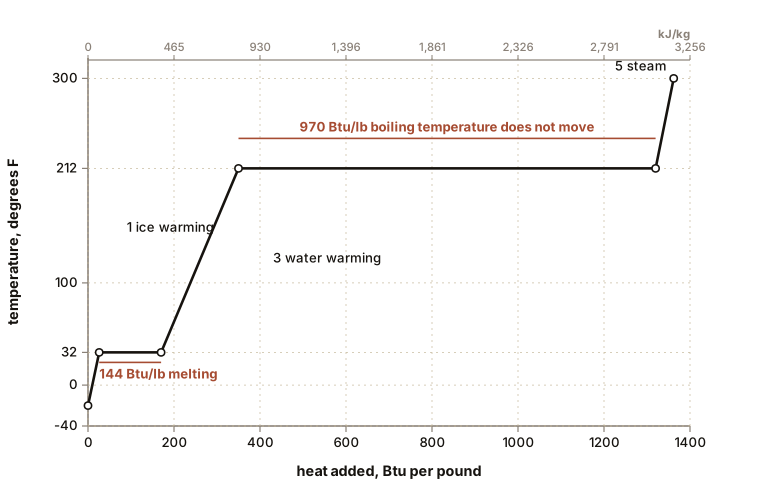
Here is water, all the way from deep-frozen ice to superheated steam, per unit mass. Read the right-hand column and look at the difference between the shaded steps and the rest.
| Step | What is happening | Btu per lb | kJ per kg |
|---|---|---|---|
| Ice, −20 °F to 32 °F (−29 °C to 0 °C) | sensible, warming ice | 26 | 61 |
| Ice → water at 32 °F (0 °C) | latent, melting | 144 | 334 |
| Water, 32 °F to 212 °F (0 °C to 100 °C) | sensible, warming water | 180 | 419 |
| Water → steam at 212 °F (100 °C) | latent, boiling | 970 | 2,257 |
| Steam, 212 °F to 300 °F (100 °C to 149 °C) | sensible, superheating | 42 | 98 |
| total | 1,362 | 3,169 |
Now add up the two latent rows: 144 + 970 = 1,114 out of a total of 1,362.
Eighty-two percent of the energy needed to take ice to steam goes into the two phase changes, where the thermometer shows nothing at all. All the temperature change you can actually see and feel accounts for less than a fifth of it.
And the single comparison that matters most:
Imperial. Raising a pound of water from 211 °F to 212 °F: 1 Btu. Boiling that same pound at 212 °F: 970 Btu. A ratio of 970 to 1.
SI. Raising a kilogram of water from 99 °C to 100 °C: 4.186 kJ. Boiling that same kilogram at 100 °C: 2,257 kJ. A ratio of 539 to 1.
Those two ratios disagree, and neither is wrong. A
Celsius degree is 1.8 times larger than a Fahrenheit degree, so one
degree of Celsius warming buys you 1.8 times as much temperature and the
ratio comes out 1.8 times smaller. 970 ÷ 1.8 = 539.
This is worth pausing on, because it is the clearest possible demonstration of why this book gives both unit systems everywhere. A reader handed only the figure “970 times” who then worked it out in SI would get 539, conclude the book had made an error, and be right to. The number depends on the size of your degree. The conclusion does not.
Either way the answer is the same: hundreds of times more energy to change state than to change temperature by one degree. Which is why, if you want a fluid to absorb a great deal of heat, you do not warm it up. You boil it.
Section 3: Watching It Happen
The curve above is the single most important picture in this book, and you should not take it on trust. It takes forty minutes and a bag of ice to draw it yourself.
ON THE BENCH: The plateau
Parts: crushed ice, about 500 g (1.1 lb); an insulated cup or small vacuum flask; a thermometer with 0.1 degree resolution; a timer; graph paper; a small heat source such as a mug warmer, or simply a warm room. Cost: under $10. Time: 40 to 60 minutes of readings every 30 seconds. Genuinely worth the time. Method: put crushed ice and a splash of water in the insulated cup, stir, and put the thermometer in. Record the temperature every 30 seconds without stopping, from the moment there is ice until several minutes after the last of it has melted. Stir gently and continuously; unstirred ice water reads whatever happens to be next to the probe. What you should see, and it is worth predicting first: the temperature sits at 0 °C (32 °F) and stays there for a long time, wandering by only a few tenths, while the ice visibly shrinks. The moment the last piece of ice disappears the reading begins to climb, and it then climbs steadily. What that flat line means: heat has been flowing into the cup from the room the entire time, at a roughly constant rate. Every joule of it went into melting ice, and none of it into raising temperature. You have watched latent heat go in. The length of that plateau, multiplied by the rate heat was arriving, is the latent heat of fusion, and you can estimate it: if the plateau lasted 30 minutes and the temperature then rose 1 °C per minute afterwards with the same heat input, then melting the ice absorbed as much heat as would have raised the water by 30 °C, which for water is
30 × 4.186 = 126 kJ/kg. The book value is 334 kJ/kg, and the gap is your insulation and the mass of the cup, which is Chapter 4’s mixing experiment showing up again. Then, the harder and more spectacular half. Weigh a pan of water, boil it hard on a measured hotplate for exactly ten minutes, and weigh it again. The mass lost is the water that turned to steam. Divide the heat the hotplate delivered by that mass and you have measured the latent heat of vaporisation yourself. A 1,500 W hotplate running 10 minutes delivers 900 kJ. If you lost 400 g, that is 2,250 kJ/kg. The book value is 2,257. Almost nothing else in physics comes out this well with kitchen equipment.
Section 4: The Calculation That Explains the Whole Machine
Now the payoff, and it settles two things that were left open in Chapter 3.
Suppose you must remove 12,000 Btu/h (3.517 kW), which is one ton of refrigeration, from a room. You have two ways to carry that heat away.
Option A: carry it as sensible heat in air
This is John Gorrie’s 1851 machine. Blow cold air in, let it warm up, take it away.
Air’s specific heat is 0.24 Btu/lb·°F (1.00 kJ/kg·°C). Suppose the air enters at 55 °F and leaves at 75 °F, a rise of 20 °F (11 °C), which is about the most you can use before the supply air feels unpleasant.
mass flow = 12,000 / (0.24 × 20) = 2,500 lb of air per hourThat is 1,134 kg of air every hour. Air is not dense, about 0.075 lb per cubic foot (1.2 kg/m³), so that is roughly 33,000 cubic feet per hour, or 550 cubic feet per minute of air, moving continuously.
Option B: carry it as latent heat in a boiling refrigerant
Boil a liquid in the cold place, let it absorb its latent heat, and carry the vapour away. R-410A at typical evaporator conditions absorbs roughly 75 Btu/lb (174 kJ/kg) as it boils.
mass flow = 12,000 / 75 = 160 lb of refrigerant per hourThat is 73 kg (160 lb) per hour, and being a dense liquid on the way in, it travels through a copper pipe you can encircle with a finger and thumb.
Read those two answers side by side
| Mass flow per hour | ||
|---|---|---|
| Sensible heat in air | 2,500 lb | 1,134 kg |
| Latent heat in R-410A | 160 lb | 73 kg |
A factor of about sixteen, and the air version needs a duct the size of a dinner plate while the refrigerant version needs a pipe the size of a pencil.
This is why Gorrie failed and Perkins succeeded. Both men built working machines. Gorrie’s carried heat as sensible heat in a gas that stayed a gas the whole way round, which is a feeble way to move energy. Perkins’s boiled a liquid, and the boiling did the work. It is not that Gorrie was a worse engineer. He picked the wrong physics, and the penalty is that factor of sixteen.
It is also why air-cycle refrigeration survives in exactly one place, aircraft cabins, where you already have compressed air for other reasons and where weight matters more than efficiency.
SLOW DOWN. Check Your Understanding: Water has a latent heat of 970 Btu/lb (2,257 kJ/kg), thirteen times R-410A’s 75 Btu/lb (174 kJ/kg). So why is water not used as the refrigerant in your air conditioner? Think before reading on.
Because of Chapter 1’s second demonstration. To make water boil at a useful cold temperature, say 4 °C (40 °F), you would need to hold the evaporator at a very deep vacuum, around 0.8 kPa (0.12 psia). Maintaining that against any leak is difficult, the vapour is enormously bulky at such low pressure so the compressor would have to be huge, and the whole thing freezes solid at 0 °C (32 °F). Water is a magnificent heat carrier at atmospheric pressure and an impossible one at refrigeration pressures. Chapter 8 is entirely about this trade, and water does in fact get used in large chillers, where the engineering to handle the vacuum pays for itself.
Section 5: Latent Heat Runs Both Ways
Everything above is about heat going in. The same amounts come out in reverse, and this produces several effects that look like magic until you see them as this chapter’s arithmetic.
Condensation releases the latent heat of vaporisation. When vapour turns back to liquid, all 970 Btu/lb (2,257 kJ/kg) comes back out. This is why steam burns are so much worse than hot water burns: steam at 100 °C (212 °F) touching your skin dumps its enormous latent heat into you before it has even begun to cool. It is also, mechanically, exactly what the condenser in Chapter 9 is for.
Freezing releases the latent heat of fusion, and this one has a wonderful practical consequence. Citrus growers spray their trees with water when a frost is forecast. It sounds insane, and it works: as the water freezes it releases 144 Btu/lb (334 kJ/kg), and that released heat holds the fruit at 0 °C (32 °F) rather than letting it fall to the air temperature, which might be several degrees lower and would destroy the crop. The ice is not insulating the fruit. The act of freezing is heating it.
Evaporation absorbs it, which is the whole of Chapter 2 restated with a number attached. When you sweat, evaporating water takes about 1,050 Btu/lb (2,440 kJ/kg) out of your skin. That is why a breeze on damp skin is so effective and why the wet-bulb temperature of Chapter 2 is a hard floor: evaporation is a heat pump powered by the air’s appetite for moisture, and when the air is saturated the pump stops.
Sublimation skips the middle. Some substances go straight from solid to vapour with no liquid stage. Dry ice, solid carbon dioxide, sublimates at minus 78.5 °C (minus 109.3 °F) and absorbs about 245 Btu/lb (571 kJ/kg) doing it. This is why the cloud chamber in the companion nuclear volume works, why dry ice makes fog rather than puddles, and why it is the right thing to ship frozen goods with.
ON THE BENCH: The freezing that warms
Parts: two identical small containers; water; a freezer; two thermometers, ideally logging. Cost: nothing. Time: a couple of hours, mostly waiting. Method: put one container of water and one empty container, both at room temperature, in the freezer with a thermometer in each. Log both every five minutes. What you should see: the empty container’s air falls steadily to freezer temperature. The water falls to 0 °C (32 °F) and then sits there for a long time while it freezes, exactly as the ice plateau did in Section 3 but running the other way. It only continues downward once it is solid ice. The point: for that whole plateau the water was giving off heat into the freezer at 334 kJ/kg (144 Btu/lb) while holding its own temperature constant. That is what protects the oranges.
Section 6: This Is Now the Machine
You are five chapters in and you can already state how a refrigerator works, in terms you have measured yourself.
Boil a liquid in the place you want cold. Boiling absorbs latent heat, and latent heat is a huge quantity for a small mass. The liquid drinks heat out of the room and becomes vapour, all at constant low temperature.
Take the vapour somewhere else and condense it. Condensing releases exactly the latent heat that boiling absorbed, so the heat comes back out, in the place you do not care about.
Then get the liquid back to the cold place and do it again.
The only remaining questions are practical ones, and each has a chapter waiting for it. What makes the vapour go where you want, and what pushes it? Chapter 9. How do you arrange for the same fluid to boil cold in one place and condense warm in another, when boiling and condensing are the same temperature for a given pressure? Chapter 7, and the answer is that you change the pressure between the two, which you already did by hand with a vacuum pump in Chapter 1. What fluid should it be? Chapter 8.
But the engine is this chapter. Nine hundred and seventy against one. Everything else is plumbing.
Section 7: Two Traps
Before moving on, two mistakes this chapter’s material invites.
Latent heat is not a fixed number for a substance. Water’s latent heat of vaporisation is 970 Btu/lb (2,257 kJ/kg) at atmospheric pressure. At higher pressure it is less; at lower pressure it is more. This matters because a refrigerant in a real machine is boiling at whatever pressure the machine holds, and its latent heat there is not the number on a generic table. The tables in Chapter 8 are indexed by pressure for this reason.
A phase change is not instant, and this is a design constraint rather than a detail. The plateau in your ice experiment lasted half an hour because heat could only arrive as fast as the insulation allowed. In a refrigeration evaporator the same limit applies: refrigerant can only boil as fast as heat can get to it through the coil wall and the air film. An evaporator is not sized by how much refrigerant it holds but by how much surface area it has, which is why coils have fins on them and why a blocked filter or a dirty coil cripples a system that is otherwise perfect. Chapter 22 is largely about that.
Next chapter goes back to the bicycle pump, and works out properly why squeezing a gas makes it hot.

Bench Degree
Get the degree without the diploma.
Learn the material, not how to pass the exam.