Bench Degree·REFRIGERATIONchapter

Chapter 6: The Gas Laws
Boyle’s law cannot explain why your bicycle pump got hot. It holds the temperature constant, and the whole point was that the temperature changed. This chapter fixes that.
In Chapter 1 you blocked a bicycle pump and pushed, and the barrel became too hot to hold comfortably. You have been carrying that observation for five chapters without an explanation. Here it is.
Along the way, a piece of common shorthand needs taking apart. It is
frequently said that “Boyle’s law is PV = nRT”. That is not
right, and the difference matters here more than in most places, because
Boyle’s law by itself predicts that your pump barrel should have
stayed cold.
Three men, working eighty years apart, each held one thing constant and varied the other two. Their three results combine into one, and only the combination can explain a compressor.
Section 1: Boyle, 1662. Squeeze It and the Pressure Rises
Robert Boyle, working in Oxford with an assistant named Robert Hooke, trapped air in the short closed end of a J-shaped glass tube using a column of mercury, then added more mercury and measured how much the air shrank.
His result, published in 1662:
P × V = constant (at constant temperature)Halve the volume and the pressure doubles. Double the volume and the pressure halves. The product stays put.
Notice the clause in brackets, because it is the whole issue in this chapter. Boyle’s experiment worked because he did it slowly, in a glass tube, in a room. Any heat generated by squeezing the air had plenty of time to leak away through the glass, so the air stayed at room temperature throughout. He held temperature constant by not being in a hurry.
ON THE BENCH: Boyle in a syringe
Parts: a 60 mL syringe; a small pressure gauge, or a tyre gauge and a bit of ingenuity; tubing; a cap or a blocked fitting. Cost: about $20. Time: 20 minutes. Method: draw the plunger to 60 mL, seal the tip, and record the gauge reading. Push slowly to 50, 40, 30, 20 mL, pausing at each mark for fifteen seconds before reading, and record pressure each time. What you should see: absolute pressure multiplied by volume coming out roughly constant. Remember to work in absolute pressure, which is gauge pressure plus atmospheric, about 101 kPa or 14.7 psi. A gauge reading zero means 101 kPa absolute, not zero. Why the pause matters: if you push fast and read immediately, your numbers will be too high, because the air is momentarily hot. Wait fifteen seconds and it cools back to room temperature and the product settles. That discrepancy is the subject of Section 4, so write down both the immediate and the settled reading at each mark.
Section 2: Charles and Gay-Lussac. Heat It and It Pushes Back
Jacques Charles established around 1787, and Joseph Louis Gay-Lussac published in 1802, the two companions to Boyle’s result.
Charles’s law. At constant pressure, volume is proportional to absolute temperature.
V / T = constant (at constant pressure)Heat a balloon and it expands. Put it in the freezer and it shrinks. Everyone has seen this.
Gay-Lussac’s law. At constant volume, pressure is proportional to absolute temperature.
P / T = constant (at constant volume)Heat a sealed rigid container and the pressure inside rises. This is why an aerosol can carries a warning about heat, and why a car tyre reads several psi higher after a motorway run than it did cold in the driveway.
The word “absolute” in both is not decoration. These laws only work in kelvin or Rankine, counting from the true zero of Chapter 4, not in Celsius or Fahrenheit. Double the Celsius reading from 10 to 20 and the pressure does not double; the absolute temperature only went from 283 K to 293 K, a rise of 3.5 percent, so the pressure rises 3.5 percent. Using the wrong scale here produces answers that are wrong by factors, not by percentages.
SLOW DOWN. Check Your Understanding: A tyre is inflated to 220 kPa gauge (32 psi) on a morning at 5 °C (41 °F). By afternoon the tyre has warmed to 45 °C (113 °F). What does the gauge read now? Work it out before reading on.
Convert everything to absolute. Pressure: 220 + 101 = 321 kPa absolute. Temperature: 5 °C = 278 K, 45 °C = 318 K.
P₂ = P₁ × T₂/T₁ = 321 × 318/278 = 367 kPa absolute, which is367 − 101 = 266 kPa gauge, about 39 psi. A rise of about 7 psi from a warm afternoon. If you had worked in Celsius and reasoned that 45 is nine times 5, you would have predicted nine times the pressure and been absurdly wrong. Always absolute.
Section 3: Putting Them Together
Three laws, each holding one quantity fixed. Combine them and you get the relationship that covers all cases at once:
P V = n R TPressure times volume equals the amount of gas, times a constant, times absolute temperature. This is the ideal gas law, and it is the thing people usually mean when they say Boyle’s law, which is like calling a car an axle.
nis the quantity of gas, in moles, which is just a way of counting molecules.Ris the universal gas constant, 8.314 J per mole per kelvin. It is the same number for every gas, which is a genuinely remarkable fact and the reason the law is called universal.
The more useful form for a fixed lump of gas, where n
and R never change, is the one to actually remember:
P₁ V₁ / T₁ = P₂ V₂ / T₂Any two states of the same gas, related. Set T₁ = T₂ and
it collapses back to Boyle. Set P₁ = P₂ and you get
Charles. Set V₁ = V₂ and you get Gay-Lussac. Three
laws are one law with something held still.
IN PLAIN ENGLISH: For a fixed amount of gas, pressure times volume divided by absolute temperature is always the same number. If you change two of them, the third has to move to keep the books balanced.
Section 4: Why Your Pump Got Hot, and Boyle Cannot Tell You
Now the point of the chapter.
Boyle’s law says nothing about temperature changing, because Boyle deliberately kept it from changing. So we need to distinguish two ways of compressing a gas, and the difference between them is entirely how fast.
Isothermal compression. Squeeze slowly. Heat generated inside has time to escape through the cylinder walls. The gas stays at ambient temperature. This is Boyle’s tube, and it is why his numbers came out so cleanly. It is also almost impossible to achieve in real machinery, because real machinery is fast.
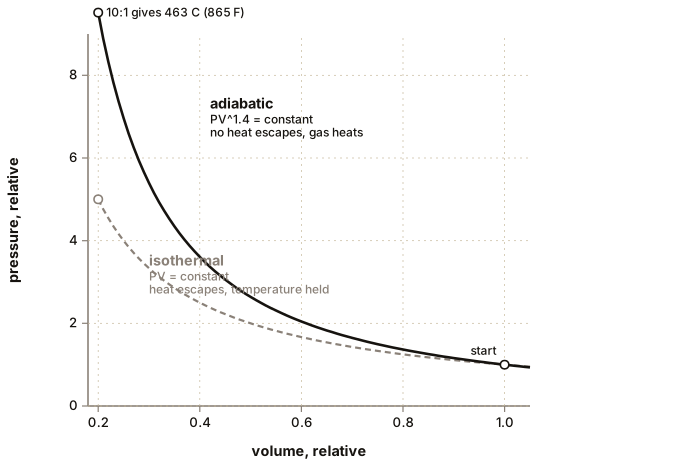
Adiabatic compression. Squeeze fast. Heat has no time to escape, so all the work you did stays in the gas as internal energy, and internal energy is temperature. The gas gets hot.
That is your bicycle pump. Twenty vigorous strokes into a blocked outlet is adiabatic compression: work in, nowhere for the heat to go, temperature up.
For adiabatic compression the relationship changes shape:
P V^γ = constantwhere γ (gamma) is the ratio of the gas’s two specific heats, and for air it is about 1.4. The exponent is why adiabatic compression raises pressure faster than Boyle would predict: you are fighting both the shrinking volume and the rising temperature at once.
The temperature form is the one worth having:
T₂ / T₁ = (V₁ / V₂)^(γ−1)Worked example, and the answer is startling. Compress air to one tenth of its volume, quickly, starting from room temperature.
T₁ = 20 °C = 293 K
T₂ = 293 × 10^0.4 = 293 × 2.512 = 736 K
736 K is 463 °C, or 865 °F.
Room-temperature air, compressed ten to one with nothing added but mechanical work, arrives at 463 °C (865 °F). Hot enough to set paper alight. Hot enough, in fact, to ignite diesel fuel, which is exactly how a diesel engine works: it has no spark plug because it does not need one. Compression alone does the job, and Rudolf Diesel’s whole patent rests on this equation.
It also explains something in your own kit. A bicycle pump barrel reaching 45 °C (113 °F) after twenty blocked strokes is this effect at a compression ratio of only two or three. Take it to ten and you have a diesel.
ON THE BENCH: The fire piston
Parts: a fire piston, sold for bushcraft use, about $20. A clear acrylic one is worth the extra because you can watch it happen. Cost: about $20. Time: 10 minutes. Hazards: it makes fire, which is the point. Do it over a hard surface, away from anything flammable, and expect the tube to get warm. Method: put a pinch of char cloth or tinder fungus in the recess at the end of the piston, insert it, and strike the top sharply with the heel of your hand. What you should see: the tinder glowing red when you withdraw the piston. You have just lit a fire with nothing but a fast push. No flint, no match, no chemistry. The number: a typical fire piston has a compression ratio around 25:1, which by the equation above takes 293 K to
293 × 25^0.4 = 1,076 K, or about 803 °C (1,477 °F). Comfortably enough to ignite char cloth at around 250 °C (480 °F). Then do it slowly. Push the piston down over five seconds instead of striking it. Nothing happens. Same compression ratio, same final pressure, no fire, because the heat had time to leave through the tube walls. That is the difference between adiabatic and isothermal, demonstrated with your own hand, and it is the single best experiment in this chapter.
Section 5: And Running It Backwards Makes Cold
Everything above works in reverse, and this is the other half of your Chapter 1 experiment.
Adiabatic expansion. Let a compressed gas expand quickly, with no time to draw heat in from its surroundings. The gas does work on whatever it is pushing against, that work has to come out of its internal energy, and internal energy is temperature. The gas gets cold.
T₂ / T₁ = (V₁ / V₂)^(γ−1)Same equation, ratio the other way up.
That is the can of compressed air that frosted in your hand. Two effects are actually at work in that can and it is worth separating them now, because a great many explanations of it are half right.
Effect one, adiabatic expansion. The propellant rushes out through the nozzle from high pressure to atmospheric, expanding fast, and cools.
Effect two, which is bigger, and which is Chapter 5’s material. The contents of that can are not compressed gas. They are a liquefied propellant, sitting as liquid at the bottom with vapour above it. As vapour leaves, more liquid boils to replace it, and boiling absorbs latent heat at 970-Btu-per-pound sorts of magnitudes. The can gets cold mostly because a liquid inside it is boiling.
Shake a duster can and you can hear the liquid. That sound is the reason it gets so cold, and it is why the can gets colder the longer you hold the trigger: you are boiling off its contents.
IN PLAIN ENGLISH: Squeezing a gas quickly makes it hot. Letting it expand quickly makes it cold. Both because work is being done, and work has to come from or go into the gas’s own energy. On top of that, if the substance changes state while it does so, the latent heat of Chapter 5 dwarfs both effects.
Section 6: The Bathtub at the Dive Shop
Here is the industrial version of your bicycle pump, and it corrects a belief almost everybody holds about it.
Walk into a shop that fills scuba tanks and you will often find the tanks standing in a bathtub of water while they fill. Ask why and most people, including a good many divers, will tell you it is a safety measure: if a cylinder let go, the water would contain it.
It would not. A cylinder failing at 200 bar (3,000 psi) releases the energy of a small explosive charge, and a tub of water is not containment in any meaningful sense. The water is there for a different reason, and it is Section 4’s reason.
Compressing air to 200 bar (3,000 psi) makes it hot. The compressor is multi-stage with coolers between the stages, but the last stage delivers hot gas into the cylinder, and the cylinder itself warms as it fills. A fast fill can leave an aluminium cylinder at 50 °C (122 °F) or more.
Now put that through Section 2’s arithmetic. A cylinder is a fixed volume, so pressure and absolute temperature move together. Fill to a gauge-indicated 200 bar (3,000 psi) while the contents are at 50 °C (122 °F, or 323 K), then let it cool to a 20 °C (68 °F, or 293 K) shop:
200 bar × 293 / 323 = 181 bar
The diver paid for 200 bar and walks out with about 181, which is 2,630 psi against the 3,000 on the label. Nine percent of the dive, gone, and it went nowhere: it was never in the cylinder in the first place, because the gauge was reading hot gas.
The water bath is there to take the heat away as fast as it arrives, so the fill happens closer to constant temperature. That is Section 4’s isothermal compression, bought with a bathtub. Fill slowly into cold water and the cylinder reads its full 200 bar (3,000 psi) cold, which is a genuinely full cylinder.
IN PLAIN ENGLISH: The water is not there in case the tank bursts. It is there so the tank is actually full. A hot cylinder reading 200 bar (3,000 psi) is a cold cylinder reading 181 bar (2,630 psi), and the difference is the heat of compression you felt in the bicycle pump.
There is a real safety element as well, and it is worth stating properly rather than dismissing. Aluminium loses strength when hot, and repeated fast hot fills are hard on a cylinder over its life. So keeping the fill cool is good practice for the metal as well as for the customer. But that is a different argument from containment, and containment is the one people believe.
ON THE BENCH: Watch a cylinder shrink
Parts: any cylinder filled at a shop, and its own gauge or a hand gauge. A car tyre and a garage air line will do just as well and cost nothing. Cost: nothing. Time: an hour of waiting. Hazards: none beyond ordinary care with compressed air. Do not exceed a tyre’s rated pressure. Method: inflate a cold tyre hard and quickly from a compressor, and read the pressure immediately. Feel the valve stem and the sidewall; both will be noticeably warm. Read it again an hour later, in the same place, in the shade. What you should see: a drop of several percent with nothing leaking. On a tyre taken from 15 °C to 35 °C (59 °F to 95 °F) by the fill itself, expect about 7 percent, which on a 2.2 bar (32 psi) tyre is around 0.15 bar (2 psi). Why it matters beyond the dive shop: this is also why tyre pressures are specified cold, and why the reading you take after driving is not the reading the manufacturer meant.
Section 7: What This Means for the Machine
You now have enough to see the shape of the thing you are building toward.
A compressor takes low-pressure vapour and squeezes it quickly, so the vapour comes out hot as well as high-pressure. That is not a side effect to be engineered away; it is the mechanism. The whole point is to raise the refrigerant’s temperature above the outdoor air, because heat only flows downhill on its own and you need it to flow out of the machine into the outdoors.
A metering device lets high-pressure liquid expand into a low-pressure region, so it comes out cold, and then it boils, which makes it colder still and absorbs the room’s heat.
And so:
| Where | What happens | Result |
|---|---|---|
| Compressor | fast compression, adiabatic | vapour hot and high pressure |
| Condenser | heat rejected to outdoors | vapour condenses to liquid |
| Metering device | fast expansion | liquid cold and low pressure |
| Evaporator | liquid boils, absorbing latent heat | vapour cold, room cooled |
Four components, and you can now say why each one does what it does from first principles rather than from a diagram.
One question remains, and it is the last piece of physics before the machine is fully explained. The table says the refrigerant boils in the evaporator at a cold temperature and condenses in the condenser at a hot one. But boiling and condensing are the same transition run in opposite directions, and for a given substance they happen at the same temperature.
So how can one fluid boil at 4 °C (40 °F) in one part of the loop and condense at 49 °C (120 °F) in another?
You already know the answer, because you did it by hand with a vacuum pump in Chapter 1. That is the next chapter, and it is the last lever this book needs.
ON THE BENCH: Feel both halves at once
Parts: any refrigerator, freezer or air conditioner that is running. Cost: nothing. Time: 5 minutes. Hazards: hot surfaces. Touch lightly. Method: find the compressor, which on a domestic refrigerator is the black dome at the back near the bottom. Two pipes leave it. Touch both. What you should find: one is hot, sometimes uncomfortably so, and one is cool or cold. The hot one is the discharge line, carrying vapour that has just been adiabatically compressed. The cool one is the suction line, returning vapour that has just finished boiling. Then follow them. The hot line goes to the condenser coils, and along its length it cools as heat leaves. The cool line comes from inside the cold space. You have just traced Sections 4 and 5 in your own kitchen.

Bench Degree
Get the degree without the diploma.
Learn the material, not how to pass the exam.