Bench Degree·REFRIGERATIONchapter

Chapter 7: Pressure Chooses the Boiling Point
This is the lever. Everything so far has been assembling the parts; this chapter is the one that makes a refrigerator possible, and you already pulled it by hand in Chapter 1.
Chapter 6 ended on a genuine problem, and it is worth restating before solving it.
Chapter 5 established that boiling a liquid absorbs enormous heat, and that a refrigerator works by boiling a liquid in the cold place and condensing it in the warm place.
But boiling and condensing are the same transition in opposite directions. A substance boils and condenses at the same temperature. Water boils at 100 °C (212 °F) and steam condenses back to water at 100 °C (212 °F). One temperature, one substance.
So how can a single fluid, going round a single closed loop, boil at 4 °C (40 °F) inside your refrigerator and condense at 49 °C (120 °F) on the coils behind it?
The answer is the most useful fact in this book, and it is in three words: pressure changes it.
Section 1: Water Does Not Have a Boiling Point
That heading is not a provocation. It is literally true, and the belief that it is false is the main obstacle in this chapter.
“Water boils at 100 °C (212 °F)” is an incomplete sentence. The complete one is “water boils at 100 °C (212 °F) at one atmosphere of pressure”, and the second half is doing as much work as the first.
Change the pressure and the number changes:
| Pressure | Water boils at | ||
|---|---|---|---|
| 3.4 kPa | 0.5 psia | 26 °C | 79 °F |
| 12.3 kPa | 1.8 psia | 50 °C | 122 °F |
| 47.4 kPa | 6.9 psia | 80 °C | 176 °F |
| 84 kPa | 12.2 psia | 95 °C | 203 °F |
| 101.3 kPa | 14.7 psia | 100 °C | 212 °F |
| 143 kPa | 20.7 psia | 110 °C | 230 °F |
| 476 kPa | 69 psia | 150 °C | 302 °F |
| 1,555 kPa | 226 psia | 200 °C | 392 °F |
Two everyday confirmations of that table, both of which most people have met without connecting them.
Denver. At 1,600 m (5,280 ft) the atmosphere is thinner, about 84 kPa (12.2 psi), and water boils at roughly 95 °C (203 °F). Recipes there specify longer cooking times, not because the altitude slows chemistry but because the water is genuinely cooler. On the summit of Everest, at about 34 kPa (4.9 psi), water boils at 71 °C (160 °F) and you cannot make a decent cup of tea at any price.
The pressure cooker. Seal the pot so pressure rises to about 200 kPa absolute (29 psia) and water boils at 120 °C (248 °F) instead of 100. Twenty degrees hotter, so food cooks in a third of the time. The lid does not trap heat. It raises the boiling point, which is a completely different mechanism and the reason a pressure cooker works where a tightly lidded saucepan does not.
And in the other direction, the thing you did yourself with a $25 brake bleeder in Chapter 1: pull the pressure down far enough and water boils at room temperature, in a jar you can hold against your cheek.
IN PLAIN ENGLISH: A liquid does not have a boiling temperature. It has a boiling temperature for each pressure. Give it a pressure and it will tell you its temperature. Give it a temperature and it will tell you its pressure. The two are locked together, and you get to choose which one you set.
Section 2: The Saturation Curve
Plot that table and you get a single curved line rising to the right. It is called the saturation curve, and it is the most important graph in refrigeration after Chapter 5’s heating curve.
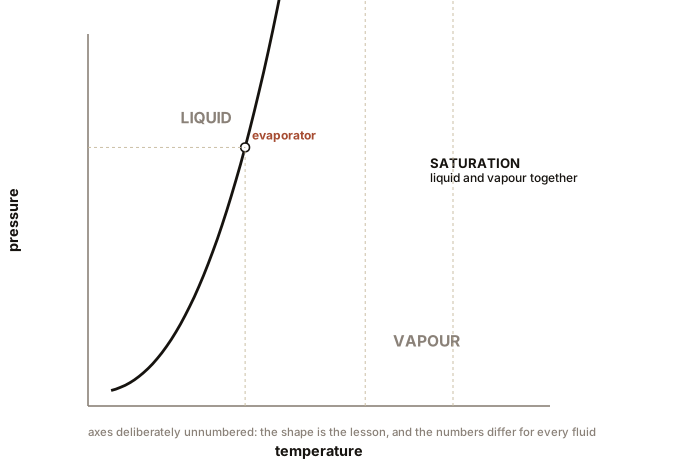
The curve divides the world into three states.
Above and left of the curve: liquid. The pressure is too high, or the temperature too low, for vapour to exist. Everything is liquid.
Below and right of the curve: vapour. Too hot, or too little pressure, for liquid to hold together. Everything is vapour.
On the curve itself: both at once. This is the interesting place, and it has a name. A fluid sitting exactly on its saturation curve is called saturated, and it is a mixture of liquid and vapour in equilibrium, boiling or condensing, at one definite temperature that its pressure has chosen for it.
Three terms follow immediately, and they are the vocabulary of every diagnosis in Part V of this book.
Saturated means on the curve. Liquid and vapour together, and temperature is determined entirely by pressure. If you know one, you know the other, without measuring it.
Superheated means vapour that has been heated past the curve, to the right. All liquid is gone, and further heat now raises temperature in the ordinary sensible way.
Subcooled means liquid that has been cooled below the curve, to the left. All vapour is gone, and it is colder than it strictly needs to be to stay liquid.
That third pair of definitions is not academic. Superheat and subcooling are the two numbers every refrigeration technician measures, they are how you tell what is happening inside a sealed steel loop from entirely outside it, and Chapter 12 is devoted to them. They are meaningful only because of the curve in this section.
Section 3: The Pressure-Temperature Card
Because pressure and temperature are locked together for a saturated fluid, one number tells you the other. Which means that a pressure gauge on a refrigeration system is also a thermometer, reading the temperature inside a sealed pipe you cannot reach.
That is why every refrigeration technician carries a pressure-temperature chart, on a card, in an app, or printed on the gauge face itself. Here is R-410A, the refrigerant in most equipment installed since about 2010.
| Temperature | Pressure | ||
|---|---|---|---|
| −18 °C | 0 °F | 320 kPa | 46 psig |
| −7 °C | 20 °F | 480 kPa | 70 psig |
| 4 °C | 40 °F | 820 kPa | 119 psig |
| 10 °C | 50 °F | 990 kPa | 143 psig |
| 24 °C | 75 °F | 1,530 kPa | 222 psig |
| 38 °C | 100 °F | 2,290 kPa | 332 psig |
| 49 °C | 120 °F | 2,930 kPa | 425 psig |
| 60 °C | 140 °F | 3,690 kPa | 535 psig |
Read the last two rows and then the middle one, and the machine appears.
In the evaporator, hold the pressure at about 820 kPa (119 psig) and the refrigerant boils at 4 °C (40 °F). Room air at 24 °C (75 °F) blows across that coil, and heat flows downhill from the room into the boiling refrigerant, exactly as it must.
In the condenser, hold the pressure at about 2,930 kPa (425 psig) and the same refrigerant condenses at 49 °C (120 °F). Outdoor air at 35 °C (95 °F) blows across that coil, and heat flows downhill from the refrigerant into the outdoors, exactly as it must.
One fluid. One loop. Boiling cold at one end and condensing hot at the other, because the pressure is different in the two halves.
IN PLAIN ENGLISH: The compressor and the metering device are not there to move the fluid around. They are there to maintain two different pressures in the two halves of the loop. Everything else follows. The low-pressure half is cold because low pressure means a low boiling point. The high-pressure half is hot because high pressure means a high one.
That is why Chapter 9 will call the compressor and the metering device the two borders of the system rather than merely two of its four parts. They are what hold the pressure difference up, and the pressure difference is the machine.
SLOW DOWN. Check Your Understanding: A technician puts gauges on a running air conditioner. The low side reads 990 kPa (143 psig) and the high side reads 2,290 kPa (332 psig). Using the table above, what temperature is the refrigerant boiling at, and what temperature is it condensing at? And is this machine cooling a room to a comfortable temperature?
Boiling at 10 °C (50 °F), condensing at 38 °C (100 °F). And yes, comfortably: a coil at 10 °C will cool room air at 24 °C without difficulty, and a coil at 38 °C will reject heat to outdoor air on any day below about 32 °C (90 °F). Notice what you just did. You stated the temperature inside a sealed pipe, in two places, without touching a thermometer, from two pressure readings and a card. That is the single most useful trick in this field.
Section 4: Doing It Yourself
Two experiments. The first you have already done once; do it again with a thermometer in the jar this time, because the number is the point.
ON THE BENCH: Boil water at room temperature and watch it get colder
Parts: hand vacuum pump with gauge, about $25; vacuum-rated chamber or heavy jar with a sealed fitting; a thermometer that fits inside, ideally a probe on a lead; room-temperature water. Cost: about $35. Time: 20 minutes. Hazards: use a vessel rated for vacuum. A thin decorative jar can implode inward with glass. Eye protection. Method: half fill with water, put the thermometer in, seal, and pump while watching both the pressure gauge and the thermometer. What you should see: at somewhere around 3 kPa absolute (0.4 psia), the water starts to boil, at room temperature. Then keep pumping and watch the thermometer fall. The water cools as it boils, because boiling is carrying latent heat away with the escaping vapour. If your pump is good enough you can drive it toward 0 °C (32 °F) and see ice begin to form in water that is boiling. Boiling and freezing at once, in the same jar, which is a sight worth the $35. Record both numbers together at four or five points and plot pressure against temperature. You have drawn the saturation curve for water, by hand, from your own measurements.
ON THE BENCH: Verify a real machine against the card
Parts: a refrigeration gauge manifold matched to the refrigerant, $60 to $140; a pipe clamp thermometer; a working window air conditioner, ideally a scrap one. Cost: the manifold is the big item and it lasts a career. Time: 30 minutes. Hazards, and these are real. Wear gloves and eye protection. Liquid refrigerant on skin causes instant frostbite and in an eye causes permanent damage. In most jurisdictions deliberately venting refrigerant is illegal, and every hose connection loses a little, so practise on a scrap unit. Never open the high side to atmosphere. Method: with the unit running, connect the low-side gauge to the suction service port. Read the pressure. Look up the corresponding saturation temperature on the card. Then clamp a thermometer to the suction line near the evaporator and read the actual metal temperature. What you should see: the two numbers close but not identical, with the measured line temperature a few degrees higher than the card says. That gap is not an error. It is superheat, and it means the refrigerant finished boiling slightly before the end of the coil and then warmed up as vapour. A gap of 4 to 8 °C (8 to 15 °F) is healthy. Zero means liquid is reaching the compressor, which destroys compressors. Twenty means the machine is starved. You have just performed the fundamental diagnostic of the entire trade, and Chapter 12 is about nothing else.
Section 5: The Lever, Stated Plainly
Everything in this chapter reduces to one sentence, and it is worth reading twice.
You cannot choose what temperature a liquid boils at. You can choose what pressure it is under, and that chooses the temperature for you.
A refrigeration machine is therefore a machine for maintaining two pressures. Not for moving fluid, not for making cold, not for pumping refrigerant. For holding a low pressure in one half of a loop and a high pressure in the other, so that the same substance boils cold in one place and condenses hot in another.
Once that is in place, the rest is a consequence:
- Low pressure means a low boiling point, so the fluid boils in the cold place and absorbs the enormous latent heat of Chapter 5.
- High pressure means a high condensing point, so the fluid condenses in the warm place and releases exactly that same latent heat.
- Heat flows downhill at both ends, which is all it will ever do unaided, and the pressure difference is what arranged for downhill to point the right way in both places.
- The compressor pays for the pressure difference, in electricity, and that payment is the entire operating cost of the machine.
You now have every piece of physics this book requires. Chapter 8 chooses the fluid, and then Chapter 9 finally builds the thing, and by then it should feel less like learning a machine and more like recognising one.
IN PLAIN ENGLISH: The whole trick is that boiling temperature follows pressure. Squeeze the vapour and it will condense somewhere hot. Let the liquid loose into a low-pressure space and it will boil somewhere cold. That is a refrigerator, and everything else is copper, sheet metal and control wiring.

Bench Degree
Get the degree without the diploma.
Learn the material, not how to pass the exam.