Bench Degree·REFRIGERATIONchapter

Chapter 8: What Makes a Good Refrigerant
Water carries thirteen times more latent heat than the fluid in your air conditioner, and would be a disaster in it. This chapter is about why, and about the four rounds of getting the answer wrong.
Chapter 7 gave you the lever: choose a pressure and you choose a boiling temperature. But that only works if there is a fluid whose saturation curve happens to pass through the two points you need, at pressures a machine can actually build and hold.
That is the whole of refrigerant selection, and it is a genuinely hard optimisation with about nine competing requirements, several of which are in direct conflict.
Section 1: The Nine Requirements
A refrigerant must satisfy all of these at once. No fluid ever has.
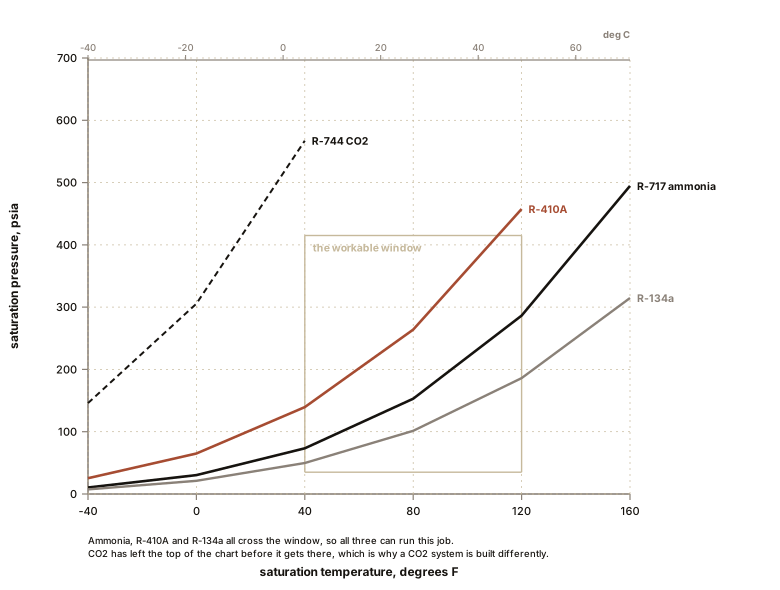
1. Boil at the right temperature, at a convenient pressure. For air conditioning you want boiling around 4 °C (40 °F) at a pressure comfortably above atmospheric, so a small leak pushes refrigerant out rather than sucking air and moisture in. And condensing around 49 °C (120 °F) at a pressure the tubing can hold. That pins the saturation curve at two points.
2. Carry a lot of latent heat per unit mass, so the machine can be small. Chapter 5 showed why: mass flow is duty divided by latent heat.
3. Not be toxic.
4. Not be flammable.
5. Be chemically stable inside the machine so it does not decompose in a hot compressor.
6. Not be stable in the atmosphere, which directly contradicts requirement 5 and is the trap that caught Freon.
7. Be compatible with the materials it touches: copper, steel, brass, elastomer seals, and the compressor’s lubricating oil.
8. Be detectable when it leaks.
9. Be cheap.
IN PLAIN ENGLISH: You need a fluid that boils cold at a friendly pressure, carries plenty of heat, will not poison you or catch fire, survives being cooked in a compressor for twenty years, and yet falls apart quickly if it escapes. Requirements five and six are opposites. The history in Chapter 3 is what happens when you optimise for one and forget the other.
Section 2: Why Not Water
Water looks superb on requirement 2. Its latent heat of vaporisation is 970 Btu/lb (2,257 kJ/kg), roughly thirteen times R-410A’s 75 Btu/lb (174 kJ/kg). By that measure alone a water machine could be a thirteenth of the size.
It fails on requirement 1, catastrophically.
To make water boil at 4 °C (40 °F) you must hold the evaporator at about 0.8 kPa absolute (0.12 psia), which is a hard vacuum, about one hundred and twenty-fifth of atmospheric pressure. Three consequences, each fatal for a small machine.
Any leak lets air in, not refrigerant out. Air in a refrigeration system is a non-condensable gas and it wrecks performance, as Chapter 22 explains.
The vapour is enormously bulky at that pressure. Water vapour at 0.8 kPa occupies about 160 m³ per kilogram (2,560 ft³ per lb). A compressor swallowing that volume per unit of duty would be gigantic. This is the killer: latent heat per mass is wonderful, latent heat per volume of vapour handled is dreadful, and a compressor is a volume machine.
And it freezes at 0 °C (32 °F), which is well inside the range any refrigerator needs to reach. A frozen evaporator is a burst evaporator.
So water is used exactly where those problems can be engineered around, and it is: large centrifugal chillers in commercial buildings sometimes use water, R-718, where the machine is big enough that a huge compressor is acceptable and a permanent vacuum system pays for itself. For anything domestic it is hopeless.
SLOW DOWN. Check Your Understanding: Ammonia has a latent heat of about 589 Btu/lb (1,370 kJ/kg), nearly eight times R-410A’s. Why does that not make ammonia machines eight times smaller? Think before reading on.
Because the compressor is sized by the volume of vapour it must move, not the mass. Ammonia’s vapour is less dense than R-410A’s at comparable conditions, so a kilogram of it occupies more space, and much of the mass advantage is given back at the compressor inlet. Ammonia machines are meaningfully smaller and more efficient than the equivalent, which is why industry uses it, but not by a factor of eight. Latent heat per unit mass sells the fluid. Latent heat per unit swept volume sizes the compressor.
Section 3: The Families, With Numbers
| Refrigerant | Name | Boils at 1 atm | Latent heat | ODP | GWP | Safety |
|---|---|---|---|---|---|---|
| R-717 | Ammonia | −33 °C (−28 °F) | 589 Btu/lb (1,370 kJ/kg) | 0 | 0 | B2L: toxic, mildly flammable |
| R-744 | Carbon dioxide | −78 °C (−109 °F) sublimes | 100 Btu/lb (232 kJ/kg) | 0 | 1 | A1: safe |
| R-290 | Propane | −42 °C (−44 °F) | 165 Btu/lb (384 kJ/kg) | 0 | 3 | A3: highly flammable |
| R-12 | CFC, banned | −30 °C (−22 °F) | 71 Btu/lb (165 kJ/kg) | 1.0 | 10,900 | A1 |
| R-22 | HCFC, phased out | −41 °C (−41 °F) | 100 Btu/lb (233 kJ/kg) | 0.055 | 1,810 | A1 |
| R-134a | HFC, automotive | −26 °C (−15 °F) | 93 Btu/lb (217 kJ/kg) | 0 | 1,430 | A1 |
| R-410A | HFC blend | −51 °C (−60 °F) | 75 Btu/lb (174 kJ/kg) | 0 | 2,088 | A1 |
| R-32 | HFC, current | −52 °C (−62 °F) | informally similar to R-410A | 0 | 675 | A2L: mildly flammable |
| R-454B | HFC/HFO blend | −51 °C (−60 °F) | similar to R-410A | 0 | 466 | A2L |
Three things to read out of that table.
Ozone depletion potential went to zero and stayed there. The Montreal Protocol worked. R-12 at 1.0 and R-22 at 0.055 are gone; everything current is 0.
Global warming potential is the current fight. R-410A at 2,088 means one kilogram leaked is equivalent to two tonnes of CO2. That is why R-32 at 675 and R-454B at 466 are replacing it, and why the industrial world is returning to ammonia and CO2, which are 0 and 1.
And notice the safety column moving the wrong way. The A1 class, non-toxic and non-flammable, is exactly what Midgley delivered in 1930 and it is what the low-GWP replacements are giving up. R-32 and R-454B are A2L, mildly flammable. Propane is A3, properly flammable. The industry is trading the safety Freon bought back for the climate performance Freon cost.
That trade is the fifth round of Chapter 3’s story, and it is happening now.
Section 4: Ammonia, Which Is Still the Best
Ammonia, R-717, deserves its own section because on the numbers it beats everything, and because understanding why it is not in your house teaches more than any other single comparison.
The formula is NH3. Ammonium, NH4, is a positively charged ion that does not exist as a free substance, and the two get confused constantly.
What is superb about it:
- Latent heat of 589 Btu/lb (1,370 kJ/kg), roughly eight times R-410A’s, so a given duty needs far less mass flow.
- Zero ODP and zero GWP. Not low. Zero.
- Cheap, because it is made by the millions of tonnes for fertiliser.
- Excellent heat transfer, so coils can be smaller.
- It announces itself. A leak is intensely irritating long before it is dangerous, which is a genuine safety feature that fluorinated refrigerants entirely lack. An R-410A leak is silent, odourless and invisible.
What rules it out of a server room:
- Toxic. The IDLH is 300 ppm. A large leak in an occupied enclosed space is an evacuation and can kill.
- Flammable between roughly 15 and 28 percent in air, which is a narrow band but a real one.
- It attacks copper and copper alloys. So ammonia systems are steel and iron throughout, with steel pipe, steel valves and no brass anywhere.
That last point is the most useful diagnostic in this chapter. You can identify an ammonia plant from across the room by the absence of copper. Every other refrigeration system you will ever see is plumbed in copper. Walk into a machine room and see black steel pipe with welded joints, and you are looking at ammonia.
Which is why it never left industry. Ice rinks, cold storage, food processing, breweries and abattoirs run on ammonia today, in ventilated plant rooms with trained operators and gas detection, exactly as Linde built them in 1876.
And on the bench: no. Not as a charge in anything you build. That is a plant room with steel piping, PPE and detection, not a garage. Ammonia belongs in this book twice, here and in Chapter 3’s absorption cycle, where a propane refrigerator lets you watch an ammonia-water machine run with nothing moving.
Section 5: Blends, and the Thing Called Glide
Several modern refrigerants are not single substances but mixtures, and this introduces a behaviour that single fluids do not have.
An azeotropic blend behaves as though it were one substance: it boils at one temperature and the vapour has the same composition as the liquid. R-410A is very nearly azeotropic, which is why it is easy to work with.
A zeotropic blend does not. Its components have different boiling points, so as the mixture boils the more volatile part leaves first, the remaining liquid becomes richer in the less volatile part, and the boiling temperature drifts upward as boiling proceeds. That drift is called temperature glide, and R-407C has about 7 °C (13 °F) of it.
Two practical consequences, both of which catch people out.
Glide means “the” saturation temperature is a range, not a number. A pressure-temperature card for a glide refrigerant has two columns, bubble point and dew point, and using the wrong one gives you a superheat calculation that is wrong by the whole glide.
And a glide blend must be charged as a liquid. If you charge vapour out of the cylinder you draw off the more volatile component preferentially and change the composition of what remains in the cylinder and what you put in the system. The machine ends up running on a fluid that is not what the nameplate says. This is why cylinders of blended refrigerant say liquid charge only and why that instruction is not optional.
IN PLAIN ENGLISH: A single-substance refrigerant boils at one temperature for a given pressure. A blend can boil across a range, drifting as it goes, because its ingredients boil at different temperatures. That range is called glide, and it means you have to be careful which number you look up and careful how you get the stuff out of the bottle.
Section 6: The Oil Nobody Mentions
Every compressor needs lubricating, and the oil lives inside the sealed system with the refrigerant. It circulates with it, dissolves in it, and has to come back to the compressor or the compressor dies.
Which means the oil and the refrigerant are a matched pair, and this is the reason you cannot simply pour a new refrigerant into an old machine.
- Mineral oil worked with CFCs and HCFCs like R-12 and R-22, which dissolve in it readily.
- HFCs like R-134a and R-410A do not dissolve in mineral oil. The oil separates, lies in the bottom of the evaporator, and never returns. The compressor starves and fails.
- So HFC systems use polyolester (POE) oil, which is compatible but is also violently hygroscopic: it absorbs water from the air far faster than mineral oil, and water in a refrigeration system forms acid.
That last point has a practical consequence in Chapter 22, and it is why a POE system must not be left open to atmosphere for long, and why the filter drier is replaced whenever the system is opened.
And it is why “retrofitting” an R-22 machine to a modern refrigerant is not a matter of changing the gas. It means changing the oil, usually the metering device, sometimes the compressor, and always the drier. The phrase “drop-in replacement” is nearly always marketing.
Section 7: Reading the Number
The R-numbers are not arbitrary. Briefly, so a label stops being opaque:
- R-1xx: single carbon atom. R-12, R-22, R-32, R-134a.
- R-2xx, R-3xx: two and three carbons.
- R-4xx: zeotropic blends, numbered in order of registration. R-404A, R-407C, R-410A, R-454B. The trailing letter distinguishes different proportions of the same ingredients.
- R-5xx: azeotropic blends.
- R-6xx: organic compounds. R-600a is isobutane, in many domestic fridges. R-290 is propane.
- R-7xx: inorganic, numbered by molecular mass. R-717 is ammonia (molecular mass 17), R-744 is CO2 (44), R-718 is water (18).
The safety classification is worth decoding too. The letter is toxicity, A for lower and B for higher. The number is flammability, 1 for none, 2L for mildly flammable, 2 for moderate, 3 for high. So R-410A is A1, ammonia is B2L, propane is A3, and R-32 is A2L.
ON THE BENCH: Decode a real cylinder
Parts: any refrigerant cylinder, or a clear photograph of one. Any supply house or HVAC contractor has them. Cost: nothing. Time: 15 minutes. Method: find and write down every number on the label: the R-number, the safety classification, the GWP if stated, the fill weight, the service pressure rating, and whether it says liquid charge only. Then predict, before looking anything up: is it a blend or a single substance? Does it have glide? What oil does the system it serves use? Is it flammable? What you should find: the R-number answers the first, the 4xx series answers the second, the era answers the third, and the safety class answers the fourth. A label you could not read an hour ago now tells you how to work on the machine.
ON THE BENCH: Two liquids, one pressure
Parts: small amounts of isopropyl alcohol and water; two identical shallow dishes; a thermometer; a fan. Cost: under $5. Time: 15 minutes. Hazards: alcohol is flammable. No flames. Method: put equal amounts in the two dishes, at the same temperature, with the fan blowing across both. Measure the temperature of each liquid every two minutes. What you should see: the alcohol cools faster and further, because it is more volatile: at any given temperature its saturation pressure is higher, so it evaporates more eagerly. You have just measured the difference between two points on two saturation curves, which is the entire content of refrigerant selection.
Section 8: What This Chapter Bought You
There is no good refrigerant, only trades. Nine requirements, several mutually exclusive, and every fluid ever chosen has failed at least one of them badly enough to be regulated out.
Latent heat per mass sells a fluid; latent heat per swept volume sizes the compressor. That is why water and ammonia are not thirteen and eight times better in practice.
Ammonia is still the best on the numbers, is still used industrially everywhere, and is identifiable across a room by the absence of copper.
The oil is part of the refrigerant decision, which is why a drop-in replacement usually is not one.
And the current round of the trade is giving back safety to buy climate performance. A2L mildly flammable refrigerants are being installed in houses now, because 2,088 GWP became unacceptable. Whether that is the right trade is a genuine open question, and Chapter 22 covers what it changes about servicing.
You now have the physics and the fluid. Chapter 9 lays the four components on the bench, one at a time, and Chapter 10 finally sends a pound of refrigerant round the loop with real numbers at every station.

Bench Degree
Get the degree without the diploma.
Learn the material, not how to pass the exam.