Bench Degree·SOLAR POWERchapter

Chapter 1: The Backwards LED
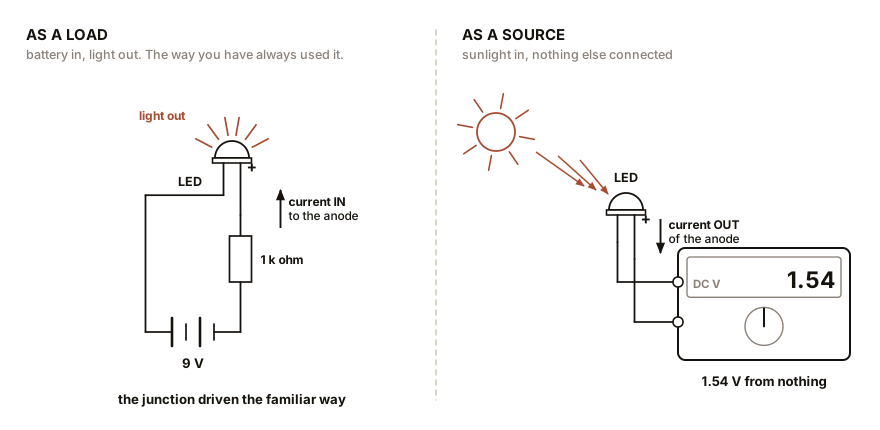
The component whose entire job is to make light will, pointed at the sun, make electricity instead. It is the same device either way, and that is the whole book.
Go and find an LED. Any colour, any size, from a drawer of spare parts or a dollar-store keyring flashlight you are willing to break. You also need a multimeter, which is the single most useful twenty dollars an engineering mind can spend.
Set the meter to DC volts, on its lowest range. Touch one probe to each leg of the LED. Indoors, in ordinary room light, you will read almost nothing, perhaps a few millivolts.
Now take it outside into direct sunlight, and point the dome of the LED straight at the sun.
The meter reads roughly 1.2 to 1.8 volts.
Read that again. An LED, with nothing connected to it, no battery anywhere, is producing more than a volt. The device you have used your whole life as a consumer of electricity is, when you shine light on it, a producer of electricity.
Cup your hand over it and the voltage collapses. Uncover it and it comes back. Tilt it away from the sun and it falls off. Point it at a bright lamp indoors and you get a fraction of the outdoor figure.
ON THE BENCH: The LED in reverse
Parts: one LED, any type; a multimeter; two clip leads or just steady hands. Everything else: every part this book asks for is listed once, at the back, in Appendix A: The Bench. Nothing is specified by brand, so it can be ordered from anyone. You do not need any of it yet. Cost: about $20 for the meter, pennies for the LED. Time: 2 minutes. Hazards: none. Do not stare at the sun while aiming. What you should see: near zero indoors, 1.2 to 1.8 V in direct sun, roughly proportional response as you shade it. Try this too: a red LED and a blue LED side by side in the same sunlight give different voltages, and the blue one gives more. Write both numbers down. That is not a defect and it is not a coincidence, and Chapter 4 explains it. It is one of the most important facts in the book and you have just measured it with a $20 meter. If you get nothing: check the meter is on DC volts and not AC, and that you have not chosen a range too coarse to show a volt. Clear-domed LEDs work better than diffused ones.
SLOW DOWN. Check Your Understanding: If an LED works as a solar cell, why is a solar panel not simply a sheet of LEDs glued together? They are cheap, they are already encapsulated in epoxy, and a panel made that way would survive being dropped off a roof. Work out what is wrong with it before reading on.
Because you would be buying two hundred times more package than junction. The light-emitting die inside an ordinary 5 mm (0.2 in) LED is something like 0.3 mm (0.012 in) square, which is 0.09 mm² (0.00014 in²) of active silicon. The epoxy dome it sits in is 5 mm (0.2 in) across, so it occupies about 19.6 mm² (0.030 in²) of your roof. Under 1,000 W/m² of sunlight, the roof area of that one LED intercepts about 20 mW, and its junction can only see the fraction of that light which lands on 0.09 mm². Less than one percent of the footprint is doing any work. A silicon solar cell is the opposite arrangement: essentially the entire footprint is junction. Add the lens, which concentrates light onto the die but cannot gather more than falls on the dome, and the narrow band of the spectrum a coloured LED can absorb at all, and you are two to three orders of magnitude off. At two cents each you would also be paying several thousand dollars a square metre.
But hold on to the instinct, because the physics underneath it is correct and it is used. A good light emitter really is a good solar cell, and that is not a coincidence or an analogy: it is a reciprocity that falls out of the same equations, and it is a live design principle. The way you tell whether a new photovoltaic material has any hope is to check how well it glows, because a material that re-emits its absorbed light cleanly is one that is not losing carriers to defects. The highest-efficiency single-junction cells ever made are gallium arsenide, built by people who came from making excellent gallium arsenide LEDs, and they got there by chasing exactly that. Chapter 8 uses it to explain why one cell beats another.
So the answer is that your idea is right about the material and wrong about the packaging, which is a good failure to have, and it is the difference between the physics of a cell and the engineering of a panel. This volume is about both.
Section 1: The Second Demonstration, Which Costs Someone Thirty Watts
The first experiment tells you what a solar cell is. This one tells you the single most consequential thing about how they are used, and it is the answer to most of the world’s complaints about underperforming solar arrays.
You need an actual panel. A small one is fine, 10 to 50 watts, the sort sold for trickle-charging a boat battery, and about thirty dollars. Put it in full sun. Connect your multimeter across it, set to DC volts, and note the reading. Then set the meter to DC current, wire it in series with a small load such as a 12 volt bulb, and note the current. Multiply them and you have roughly what the panel is delivering.
Now put your thumb over one single cell. Not the whole panel. One of the small rectangles.
The output of the entire panel collapses.
Not by one cell’s worth. Not by a twentieth or a thirty-sixth. Nearly to nothing. One thumb, covering perhaps three percent of the surface, takes down almost everything the panel was producing.
Take the thumb off, and it all comes back instantly.
This is not a fault. It is a direct and unavoidable consequence of how the cells are wired together, and it is why bypass diodes exist, why microinverters exist, and why a single overhanging branch or a badly placed vent stack can ruin an otherwise excellent installation. Chapter 7 and Chapter 9 explain it properly. For now, notice that you have found it yourself in ten seconds, with a thumb.
ON THE BENCH: One thumb, most of the output
Parts: a small PV panel, 10 to 50 W (about $30); multimeter; a 12 V bulb or a resistor as a load. Cost: about $50 including the meter. Time: 15 minutes. Hazards: small panels are harmless. Larger arrays wired in series produce hundreds of volts DC, which is genuinely dangerous and much harder to interrupt than AC. Do not experiment on a roof array. What you should see: shading one cell dropping total output by 50 to 90 percent, depending on whether the panel has bypass diodes and how the cells are grouped. Then: shade half of one cell, and then a whole cell, and record both. Then shade one entire column of cells. The pattern of which shading hurts most tells you exactly how the panel is wired internally, and you can sketch its circuit without opening it.
Section 2: What Sunlight Actually Is
Some vocabulary, now that you have seen the effect.
Sunlight is not a fluid, not a wind, and not heat, although it can produce heat when it lands. It arrives as photons, which are discrete packets of energy. Not a continuous stream you can subdivide indefinitely, but countable individual arrivals, like raindrops rather than like a river.
Two numbers matter, and they are worth committing to memory because almost every calculation in this book starts from one of them.
About 1,361 watts per square metre arrives at the top of the atmosphere. That figure is called the solar constant, and it is the total power crossing one square metre held face-on to the sun, out beyond the air.
About 1,000 watts per square metre reaches the ground on a clear day, near noon, at temperate latitudes. The atmosphere absorbs and scatters away the rest. That 1,000 figure is so useful that the entire solar industry has standardised on it, and it is the number a panel’s nameplate rating is measured against.
In more familiar units, 1,000 W/m² is about 93 watts per square foot, or roughly 317 Btu per hour per square foot. A panel of 2 square metres (about 21.5 square feet) intercepts about 2,000 watts of sunlight on a good day. If it converts twenty percent of that, it produces 400 watts. Hold that arithmetic; it is the whole industry in one line.
IN PLAIN ENGLISH: On a clear day, every square metre of ground gets about a kilowatt of sunlight, which is roughly the power of a household kettle. A solar panel’s job is to catch some fraction of that and turn it into electricity, and the fraction is smaller than most people guess.
Colour is energy, and brightness is not
Here is the fact your two LEDs already showed you, stated plainly.
The energy of a single photon is set by its colour, not by how bright the light is. A blue photon carries more energy than a red photon, always, regardless of how dim or intense the beam. Turning up the brightness sends more photons; it does not send stronger ones.
The relationship is
E = hc / λwhere λ is the wavelength, and h and c are constants. Short wavelength means blue and high energy. Long wavelength means red and low energy. Infrared, past the red end where your eye stops, carries less energy still, and there is a great deal of it in sunlight.
This single fact turns out to govern how efficient a solar cell can ever be, and Chapter 8 uses it to derive a hard ceiling that no single-junction cell has ever beaten or ever will. But you met it first on your driveway, with two LEDs and a meter, and the blue one read higher.
SLOW DOWN. Check Your Understanding: Two lamps shine on identical solar cells. Lamp A is deep red and very bright. Lamp B is blue and quite dim, delivering one tenth the total power. Which cell produces the higher voltage, and which produces the higher current? Think before reading on.
Lamp B, the dim blue one, produces the higher voltage, because voltage depends on the energy per photon. Lamp A, the bright red one, produces the higher current, because current depends on how many photons arrive. Voltage and current are set by different things, which is why Chapter 7 is entirely about the fact that a cell’s useful operating point is neither at maximum voltage nor at maximum current.
Section 3: Measuring Planck’s Constant With a Drawer of LEDs
Go back to the first experiment. You were told to put a red LED and a blue LED in the same sunlight and write down both voltages, and that the difference was not a defect. Now you have the vocabulary to see what you measured.
The voltage an LED produces is set by its colour, and its colour is set by the size of one energy step inside it. A photon of blue light carries more energy than a photon of red light, and a junction that can emit blue must have a bigger step across it than one that emits red. Run the junction backwards and that same step is what the arriving photon has to climb. A bigger step means a bigger voltage.
That gives you a relationship you can measure on a driveway. Photon energy and wavelength are tied together by
$$E = \frac{hc}{\lambda}$$
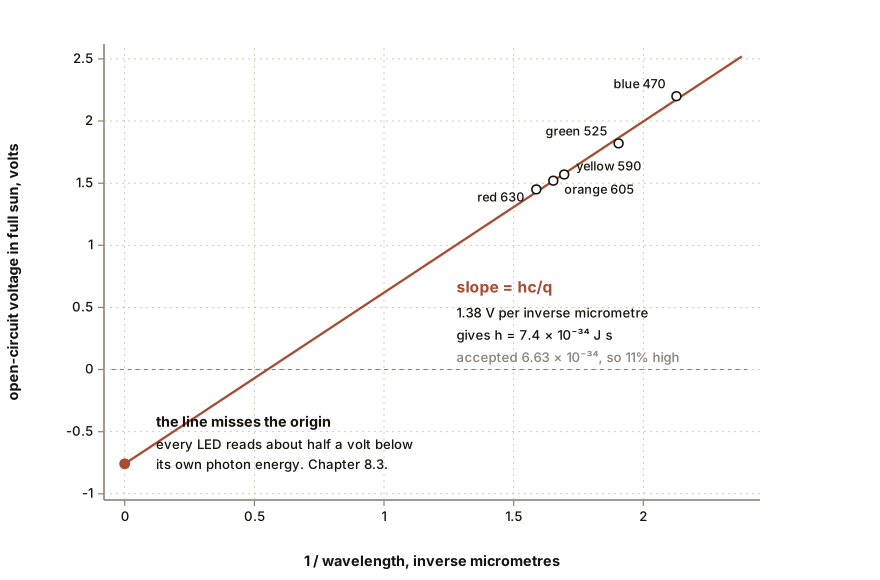
where c is the speed of light and h is Planck’s constant, the number that sets the scale of everything quantum. If voltage tracks photon energy, then plotting the voltage you measure against 1/λ should give you a straight line whose slope contains h.
So measure it. Not read it. Measure it, with a meter, in your own sunlight.
ON THE BENCH: Planck’s constant, from a junk drawer
Parts: four or more LEDs of different colours, ideally red, yellow, green and blue; a multimeter; a sunny day. Clear-domed LEDs read higher than diffused ones. Cost: pennies, if the LEDs are salvaged. Time: 20 minutes, plus ten with a pencil. Hazards: none. Do not stare at the sun while aiming. Method: in full sun, point each LED straight at it and record the open-circuit voltage. Same sun, same angle, same minute, because a passing cloud will ruin the set. Then look up each LED’s peak wavelength, which is printed in any supplier’s table and is roughly: red 630 nm, orange 605 nm, yellow 590 nm, green 525 nm, blue 470 nm. The arithmetic: plot voltage on the vertical axis against 1/λ in units of inverse metres on the horizontal. Draw the best straight line through your points. Take the slope, in volt-metres, and compute h = q × slope/c, where q is 1.602 × 10⁻¹⁹ coulombs and c is 3.00 × 10⁸ metres per second. What you should see: the points fall close to a line. A typical set, red at 1.45 V through blue at 2.20 V, gives a slope near 1.38 × 10⁻⁶ V·m and therefore h ≈ 7.4 × 10⁻³⁴ joule-seconds. The accepted value is 6.626 × 10⁻³⁴, so you are about eleven percent high, using a drawer of parts worth less than a coffee. If your line is poor: the usual culprit is an old green LED. Green made from gallium phosphide, the dim yellowish-green of 1980s equipment, sits at 565 nm and follows a different mechanism. Modern green is indium gallium nitride and behaves itself. Leave the old one out.
Stop and consider what just happened. You measured a fundamental constant of the universe, the one that separates quantum mechanics from everything that came before it, with parts from a drawer and a meter from a hardware shop. Millikan spent years on this class of measurement and won a Nobel Prize for it. You did it between lunch and the afternoon because you had the benefit of knowing what answer to expect and a supplier’s table of wavelengths.
Now the part that is more useful than the constant. Your line does not pass through the origin. Extend it back and it cuts the voltage axis well below zero, which says every LED gave you less voltage than its own energy step is worth. Red at 630 nm carries about 1.97 volts of photon energy and you measured perhaps 1.45; blue at 470 nm carries 2.64 and you measured 2.20.
Roughly half a volt went missing in every single case, and it went missing for a reason no amount of better engineering will fix. That gap is the largest single loss in every solar cell ever built, it is the subject of Chapter 8 Section 3, and you have just measured it without meaning to. Keep the plot.
Section 4: Why This Book Is About Electricity and Not Heat
There are two entirely separate ways to use sunlight, and confusing them causes a great deal of muddle. It is worth drawing the line now.
You can collect sunlight as heat. Paint something black, let the sun warm it, and use the warmth. That is a solar hot water panel on a roof, an evacuated tube array, a parabolic trough in a desert, or a field of mirrors aimed at a tower. These are excellent machines and a genuinely interesting subject, and they are not this book.
Or you can turn sunlight directly into electricity, with no heat step in between, no fluid, no turbine and no moving parts at all. A photon arrives, one electron gets moved, and that is the whole mechanism. That is photovoltaics, and it is what your LED just did.
Chapter 2 gives solar thermal a fair hearing so that you know what is being set aside and why. From Chapter 3 onward this book is about the second kind only.
Notice, though, what the LED demonstration already proved. No heat was involved. The LED did not need to get warm to produce voltage. It would work just as well, in fact slightly better, if it were cold. That is a genuinely unusual property in an energy-conversion device, and Chapter 9 is largely about what follows from it.
Section 5: Where This Book Is Going
By the last page you will be able to stand in front of any photovoltaic installation, from a single panel on a shed to a ground-mounted array, and do the following.
- Read the panel and inverter nameplates and say what the system will actually produce at noon in July and at noon in January, in kilowatt-hours, and explain why both figures are below the number printed on the panel.
- Explain why a panel produces less on a hot day than on a cold bright one, and put a number on it.
- Look at the layout and say what a given shadow will cost, and whether the array’s architecture makes that better or worse.
- Explain why the inverter is deliberately smaller than the array, and what that choice costs and saves.
- Trace an I-V curve, find the knee, and explain what a maximum power point tracker is doing and why a panel wired straight to a battery wastes a third of its output.
- Work out whether adding batteries would pay, and be willing to reach the answer no.
You will also be able to explain, from first principles, why no ordinary solar panel will ever exceed about a third efficiency, and why that is a statement about photons rather than about manufacturing.
Everything is built in order and nothing arrives unassembled. If a chapter loses you, the fault is upstream, and the fix is to go back one section rather than to push on.
Keep the LED. It is the cheapest solar cell you will ever own, and it comes back in Chapter 6 when we take the junction apart.

Bench Degree
Get the degree without the diploma.
Learn the material, not how to pass the exam.