Bench Degree·SOLAR POWERchapter

Chapter 2: The Other Way to Use the Sun
A garden hose painted black will deliver three times as many watts as a solar panel of the same size, for a tenth of the money. This chapter says why that is true, and why this book is not about it.
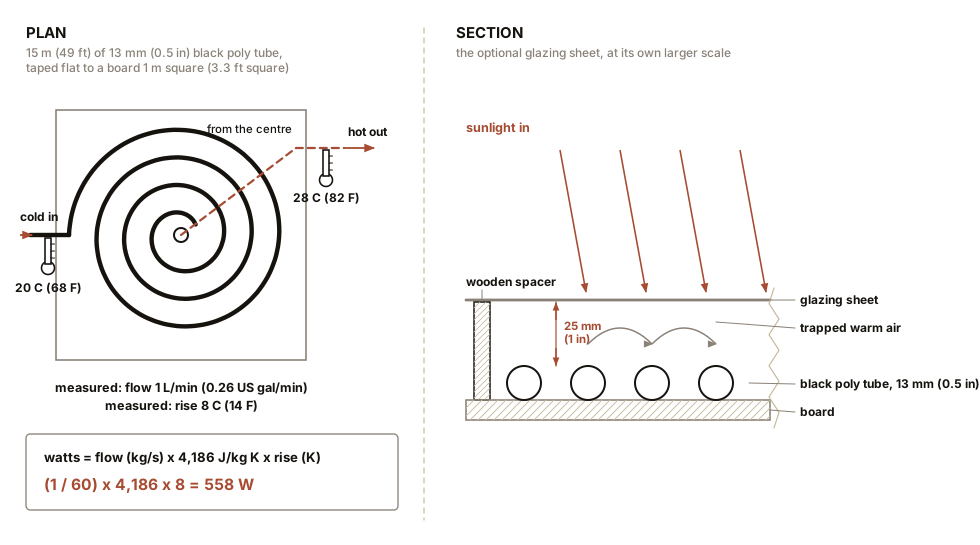
Get 15 m (49 ft) of black polyethylene irrigation tubing, the 13 mm (0.5 in) sort sold for drip watering, and coil it flat on a board about 1 m square (3.3 ft square). Put the board in full sun. Run a slow trickle of cold water in one end.
Put a thermometer in the water going in and another in the water coming out.
The water comes out hot. Not warm. On a clear day at noon, with the flow slowed to about a litre a minute (roughly a quarter of a US gallon a minute), the outlet will be 6 to 10 °C (11 to 18 °F) above the inlet, and it will stay there all afternoon.
Now put a number on it. Water carries 4,186 joules for every kilogram and every degree Celsius, so one litre a minute at 8 °C (14 °F) of rise is:
(1 kg / 60 s) x 4,186 J/kg·K x 8 K = 558 W
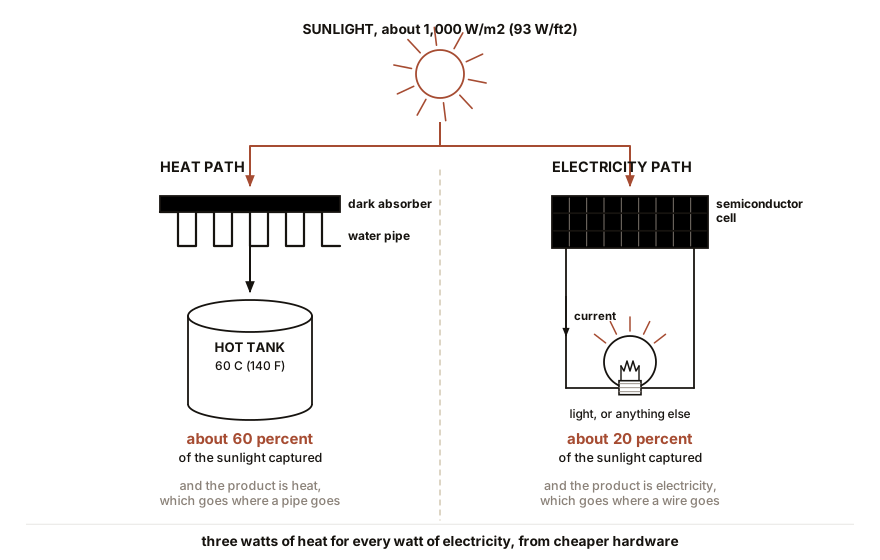
Five hundred and fifty-eight watts, from a hose. The board is about 1 m² (10.8 ft²), and sunlight was delivering perhaps 900 W/m² onto it. So the hose captured about 62 percent of the sunlight that fell on it.
Hold that figure against the panel from Chapter 1. A good modern module converts 22 percent of the sunlight it receives into electricity, and it does worse than that when hot, so the same 1 m² (10.8 ft²) of aperture would have produced about 180 W.
Three watts of heat for every watt of electricity, from cheaper hardware. That is not a rounding error and it is not a trick. It is the honest comparison, and any book about solar power that hides it is not worth reading.
ON THE BENCH: The hose collector, measured
Parts: 15 m (49 ft) of 13 mm (0.5 in) black poly tubing, about $12; a board or a sheet of plywood; two thermometers reading to 0.5 °C (1 °F), about $8 each; a measuring jug; a stopwatch. Cost: about $30, less if the hose is already in the shed. Time: an hour to build, an afternoon to measure. Hazards: none, beyond hot water. Do not cap both ends and leave it in the sun; a sealed loop can build real pressure. Method: coil the tubing in a flat spiral and tape it down so no coil shades another. Feed from a tap through a needle valve or just a barely open tap. Catch the outflow in the jug and time it to get the flow rate in litres per minute. Read both thermometers once the outlet reading has stopped climbing, which takes about ten minutes. What you should see: 400 to 700 W of captured heat per square metre of board on a clear day, which is 40 to 70 percent of the incident sunlight. Slower flow gives a bigger temperature rise and roughly the same total power. Better, if you have one: put a sheet of glass or clear polycarbonate 25 mm (1 in) above the coil on wooden spacers. The captured power rises, because the glass lets sunlight in and holds the warmed air against the tube. That single sheet is the difference between a garden hose and a real flat-plate collector.
Section 1: Two Machines, Two Products
Sunlight arriving on a surface can be turned into two entirely different things, and the whole of solar engineering divides along that line.
Turn it into heat. Absorb the sunlight in something dark, let that thing get warm, and move the warmth somewhere useful with water or air. Every part of the machine is plumbing. There is no electronics in it at all.
Turn it into electricity. A photon arrives at a semiconductor, one electron is knocked loose, and an electric field pushes it out of a wire. That is photovoltaics, and it is what the LED in Chapter 1 did.
The first is called solar thermal, and the family is large.
Flat-plate collectors are the hose experiment done properly: a dark absorber plate with water channels bonded to it, insulation behind, glass in front, in a shallow box. Typical working efficiency is 50 to 70 percent, delivering water at 50 to 70 °C (122 to 158 °F). On roofs worldwide these outnumber every other solar thermal device.
Evacuated tube collectors put the absorber inside a glass tube and pump the air out. With no air there is almost nothing to carry heat away by conduction or convection, so the absorber can run much hotter, 80 to 120 °C (176 to 248 °F), and it keeps working on cold days when a flat plate has given up. They cost more per square metre and they are what you install where winters are real.
Parabolic troughs bend a long mirror into a curve so that all the sunlight across its width lands on a single pipe along its focus. Concentration ratios of 30 to 80 times give oil or molten salt at 300 to 400 °C (572 to 752 °F), which is hot enough to boil water and run a steam turbine.
Power towers go further: a field of flat mirrors, each on its own motorised mount, all aiming at one receiver on a tower. Concentration of several hundred times, and molten salt leaving the receiver at about 565 °C (1,049 °F). Ivanpah in California is rated at 392 MW; Crescent Dunes in Nevada at 110 MW with ten hours of thermal storage.
IN PLAIN ENGLISH: There are two ways to use sunshine. You can let it warm something up and then use the warmth, which is what a black hose or a solar hot water panel does. Or you can turn it straight into electricity with no warming step, which is what a solar panel does. They are different machines with different plumbing, and this book is about the second one.
Section 2: Why the Bigger Number Loses Anyway
The hose won by three to one on watts. Solar thermal water heating is nonetheless a shrinking business in most of the world, and photovoltaics has taken over almost completely. Four reasons, and none of them is about efficiency.
Heat is a local product. The 558 W from the hose is 558 W of warm water, available at the hose, right now, at 40 °C (104 °F). It cannot run a fridge, charge a phone, or go anywhere except through a pipe. Electricity goes anywhere a wire goes and does anything.
Heat cannot be stored cheaply for long, and it cannot be sold. A hot water tank loses its heat over a few days. There is no meter that will buy your surplus warm water.
Solar thermal has fluid in it. Pumps, valves, expansion vessels, antifreeze, a controller, and a heat exchanger, all of which can leak, freeze, corrode, air-lock or stagnate. A photovoltaic panel has no moving parts and nothing inside it that flows. The maintenance difference over twenty years is large and it is the reason most installers stopped offering thermal.
And photovoltaic modules got absurdly cheap. This is the whole story, really. A module that cost about $100 per watt in the mid-1970s is now roughly $0.25 per watt at wholesale. Chapter 3 traces that collapse. Nothing similar happened to copper pipe, glass, pumps or plumbers’ time.
Put those together and the arithmetic flips. If you want hot water, you can install a thermal collector at 60 percent efficiency, or you can install two and a half times the area of photovoltaic panels and run a resistance heater, or better, run a heat pump water heater at a coefficient of performance of 3 and beat the thermal collector outright with less than a third of the panel area.
That last sentence is the one that killed the industry. Photovoltaic electricity into a heat pump delivers more heat per square metre of roof than a solar thermal collector does, using cheaper and simpler hardware, and the same panels also run the lights.
Section 3: Where Solar Thermal Still Wins
Say the fair thing. Solar thermal is not obsolete and there are places where it is plainly the right answer.
Where hot water is the entire demand and the sun is reliable. China has by far the largest installed solar thermal capacity in the world, most of it evacuated-tube water heaters on apartment roofs, and the reason is straightforward: the demand is hot water, the payback is short, and the device needs no grid connection, no inverter and no permit.
Where the temperature required is high and the alternative is fuel. Industrial process heat between 80 and 250 °C (176 and 482 °F) is a large fraction of world energy use and electricity is an expensive way to make it. Concentrating collectors delivering process steam to a factory compete against gas, not against photovoltaics.
Where a swimming pool needs to be a few degrees warmer. Unglazed black mats on a roof, water pumped straight through them, no heat exchanger and no antifreeze. Cheap, simple, and the highest return on investment in the entire solar catalogue, because the pool itself is the storage tank.
And in thermal storage at utility scale, the question is open. A power tower can store heat in molten salt for ten hours and generate at midnight from a tank rather than from a battery. Whether that is cheaper than photovoltaics plus lithium storage is genuinely contested, and it depends on the cost of batteries in the year you ask. What would settle it is the price curve: batteries have been falling faster than concentrating solar plants, which is why very few new power towers are being built, but that is an observation about the last decade rather than a law.
ON THE BENCH: Head to head, same sun, same area
Parts: the hose collector from the first box; a photovoltaic panel of known area, 50 to 100 W (about $40 to $70); a multimeter; a resistor or 12 V bulb as a load; a tape measure. Cost: about $70 on top of the first box. Time: two hours on one clear day. Hazards: none. Method: measure the aperture area of both, in m² and ft². Set them side by side, tilted the same way, within a few minutes of solar noon. For the hose, measure flow and temperature rise and compute watts as above. For the panel, measure voltage and current into the load and multiply. Divide each result by its own area to get watts per square metre. What you should see: the thermal collector between 400 and 700 W/m², the panel between 100 and 190 W/m². The ratio should be somewhere near three to one. What it does not tell you: which one you should buy. The thermal figure is watts of low-grade heat and the panel’s figure is watts of electricity, and those are not the same commodity. Resist the temptation to declare a winner. Write both numbers in your notebook and leave them as measurements, because the moment you turn them into a principle you will have proved something false. If the panel reads low: you are probably measuring open-circuit voltage times short-circuit current, which is not power. Chapter 7 is entirely about that mistake.
Section 4: The Boundary, Drawn Once
From here to the end of this book, “solar” means photovoltaic. Sunlight to electricity, no fluid, no turbine, no moving parts.
Two things carry forward from this chapter.
The heat did not go away. A photovoltaic panel absorbs roughly 80 percent of the sunlight that hits it and turns most of that into warmth in the glass and the silicon. The panel gets hot whether you want it to or not. That heat is not a product here, it is a problem, and Chapter 9 shows exactly what it costs you.
And the comparison you just made is the honest baseline. Photovoltaics is not the best converter of sunlight in the catalogue. It is not even close. It won because its output is universal and its price fell off a cliff, and a reader who understands that will never be surprised by an efficiency figure again.
SLOW DOWN. Check Your Understanding: A hybrid module exists that puts water channels on the back of a photovoltaic panel, harvesting electricity and hot water from the same aperture. It sounds like it should obviously beat either device alone. On the numbers so far, name the one thing that makes it work better than a plain panel, and the one thing that makes it awkward. Answer before reading on.
It works better because cooling the cells raises their electrical output. That is the counterintuitive fact this book keeps returning to: pulling heat out of the back of a panel with 20 °C (68 °F) water can recover several percent of the electricity that a hot panel was losing, so the electrical yield goes up rather than down.
It is awkward because the two products want different temperatures. Useful domestic hot water is 55 to 60 °C (131 to 140 °F), and a cell running at 55 °C has already given away about 10 percent of its output. To get good water you must run the cells hot; to get good electricity you must run them cool. Every hybrid module is a chosen compromise between the two, which is why they remain a niche rather than the obvious answer they appear to be. Notice also what the question smuggled in: you were told the cooling helps before this book has explained why, and you now have a fact you cannot yet account for. Chapter 9 owes you the reason, and Chapters 5 through 8 build the machinery to give it.
Chapter 3 goes back to 1839 and asks how anybody found this effect at all, given that nobody could explain it for the next sixty-six years.

Bench Degree
Get the degree without the diploma.
Learn the material, not how to pass the exam.