Bench Degree·SOLAR POWERchapter

Chapter 3: From Becquerel to Bell Labs
A nineteen-year-old found the effect in 1839. Nobody could explain it until 1905, and nobody could make it useful until 1954. That is a hundred and fifteen years of a phenomenon everybody could see and nobody could account for.
Take a clean piece of copper sheet, the sort sold for roof flashing, about 150 mm square (6 in square) and 0.5 mm (0.02 in) thick. Scour it bright. Put it on an electric stove ring or a gas burner and leave it on full heat for half an hour.
You will watch it go through a sequence of colours: straw, purple, blue, then a thick matt black scale over the whole surface. That black is cupric oxide, and it is not what you want. Turn the heat off and leave the plate on the ring to cool slowly for twenty minutes. As it cools and contracts, most of the black scale lifts and flakes away, and what is left underneath is a thin bright orange-red layer.
That red layer is cuprous oxide, and it is a semiconductor. Rinse the loose black off under a tap without scrubbing.
Now cut a second piece of bare copper the same size, bend both so they stand in a clear glass jar without touching, and fill the jar with warm water and two heaped tablespoons of table salt, leaving the top edges of both plates dry. Clip a multimeter across the two plates, set to DC microamps or millivolts.
Put the jar in the sun with the red plate facing it.
The meter moves. Perhaps 200 to 400 mV and 20 to 80 microamps in full sun, falling to almost nothing when you shade it. It is a solar cell, built on a stove, with a fraction of a percent efficiency, and it is roughly what Charles Fritts had in 1883.
ON THE BENCH: Build an 1883 solar cell
Parts: copper sheet 150 mm square (6 in square), about $8 for enough to make several; table salt; a clear glass jar; two clip leads; a multimeter that reads microamps. Cost: about $10 if you own the meter. Time: 90 minutes, most of it waiting. Hazards: the plate reaches perhaps 600 °C (1,112 °F). Use pliers, ventilate the room, and keep the salt water away from the hot plate. Do not use a non-stick pan or a ceramic hob you care about. Method: as above. The critical step is the slow cool: quench it and the red layer comes off with the black. What you should see: 200 to 400 mV open circuit in sun, tens of microamps short circuit, response following your hand as you shade and unshade it. Reverse the leads to find which way it drives current, and note that the red plate is the negative terminal. If you get nothing: the usual failure is scrubbing too hard and taking the red layer off with the black. Rinse gently. The second most common failure is a meter on a milliamp range too coarse to see 40 microamps. What it tells you: the effect is not delicate and it is not modern. Any competent nineteenth-century experimenter with a furnace and a galvanometer could have found it, and several did.
Section 1: 1839, and a Nineteen-Year-Old
Edmond Becquerel was nineteen and working in his father’s laboratory at the Muséum d’Histoire Naturelle in Paris. His subject was electrochemistry, and he was studying what happened in cells made of two metal electrodes in an acidic solution.
In 1839 he put two platinum electrodes into acid, coated one of them with a silver halide, and shone light on it. A current flowed that had not been flowing before, and it stopped when the light was blocked.
He had found the photovoltaic effect. He described it accurately, he understood that the effect depended on the colour of the light, and he could not explain it, because nothing in the physics of 1839 permitted light to do that.
The Becquerels were a remarkable three generations. Edmond’s father Antoine César worked on electrochemistry and on the earliest thermoelectric measurements. Edmond’s son Henri discovered radioactivity in 1896 and has the unit named after him. The middle Becquerel is the least famous of the three and found the thing this entire book is about.
Section 2: Selenium, and the First Real Device
Nothing much happened for thirty-four years.
Then in 1873 Willoughby Smith, an electrical engineer testing materials for submarine telegraph cables, noticed that bars of selenium he was using as high-resistance elements behaved erratically. Their resistance dropped when the light was on. He published it, and selenium became a curiosity that everyone in electrical work knew about.
In 1876 William Grylls Adams and his student Richard Evans Day, at King’s College London, went one step further and found that illuminated selenium did not merely change resistance. It produced a current with no battery in the circuit at all. Light in, electricity out, from a solid. They were careful about it, they were sceptical of their own result, and they were right.
Charles Fritts built the first thing anyone would recognise as a solar cell in 1883, in New York. He took a wafer of selenium, pressed a layer of gold leaf onto its front thin enough to see through, and made a flat plate that generated current in sunlight. Efficiency was around one percent, possibly less. He sent samples to Werner von Siemens in Berlin, who tested one and reported to the Royal Prussian Academy that it was scientifically of the most far-reaching importance.
Siemens was right and it did not matter. A one percent device is not a power source, it is a light meter, and that is exactly what selenium cells became: the photocell in every photographic exposure meter for the next seventy years. Millions were made. None of them powered anything.
ON THE BENCH: Hold Adams and Day’s result in your hand
Parts: an old selenium photographic exposure meter, the sort with a grille of small windows on the front and a moving needle and no battery compartment. Weston, Sekonic and Gossen made them by the million and they turn up at flea markets and in camera-shop junk boxes. A multimeter. Cost: $10 to $25. Buy the cheapest one whose needle still moves. Time: 20 minutes. Hazards: none. Method: first confirm there is nowhere to put a battery, because that is the whole point. Point it at a window and watch the needle. Then open the case, find the two wires from the cell to the meter movement, and put your multimeter across the cell instead: short-circuit current on the microamp range, then open-circuit voltage. What you should see: hundreds of microamps in bright daylight from a cell of a few square centimetres, and open-circuit voltage of perhaps 300 to 500 mV. Notice how well the current tracks the brightness and how poorly the voltage does. That is not a defect of selenium; it is a property of every photovoltaic device, including the one on your roof, and Chapter 7 explains it. What it tells you: a device from the 1876 lineage, in an unbroken commercial line down to the 1970s, generating measurable power on your kitchen table without a battery. The reason it never powered a house is efficiency, not principle.
IN PLAIN ENGLISH: By 1883 people could build something that turned light into electricity, sell it, and put it in a box. What they could not do was say why it worked or make it work better, and those two failures are the same failure. You cannot improve a machine whose mechanism you cannot describe.
Section 3: The Thing That Should Not Have Been Possible
Here is the problem that stopped everything, and it is worth understanding because it is the reason Chapter 4 exists.
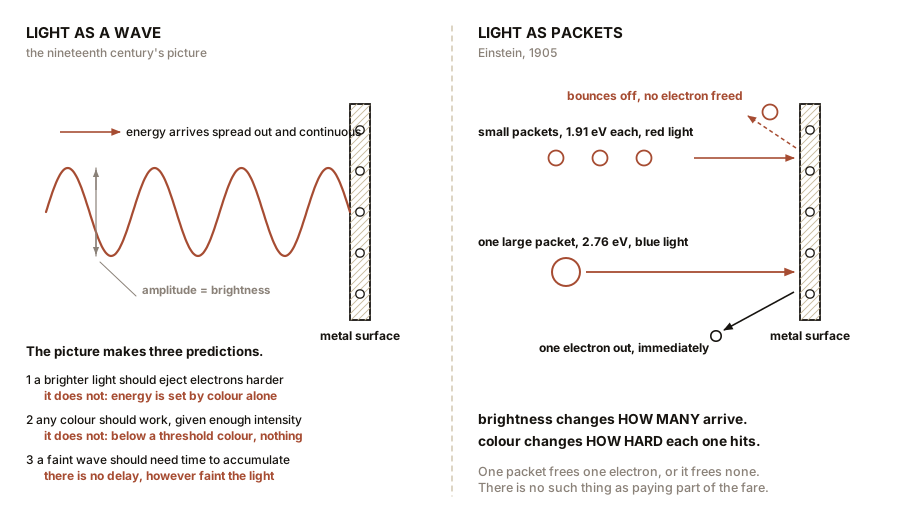
In the physics of the nineteenth century, light was a wave. A brighter light was a wave of larger amplitude, carrying more energy. That picture explained reflection, refraction, interference and diffraction, beautifully and completely.
Now apply it to a metal plate that emits electrons when light falls on it, an effect Heinrich Hertz stumbled onto in 1887 and Wilhelm Hallwachs pinned down in 1888. The wave picture makes three clear predictions.
One: a brighter light should knock the electrons out harder, since it carries more energy. Two: any colour of light should work eventually, given enough intensity or enough time to accumulate energy. Three: there should be a delay while a weak wave slowly pumps enough energy into an electron to free it.
All three predictions are wrong. Philipp Lenard established that carefully by 1902. The energy of the ejected electrons depends on the colour of the light and not at all on its brightness. Below a threshold colour, nothing happens no matter how intense the light. And there is no delay, even with light so faint that the wave picture says it should take hours.
That is not a small discrepancy. It is a flat contradiction of a theory that worked everywhere else.
Albert Einstein resolved it in 1905, in one of four papers he published that year. His proposal was that light is not delivered as a continuous wave when it interacts with matter, but in discrete lumps, each carrying an energy fixed by the light’s frequency. One lump, one electron. A lump too small cannot free an electron however many of them arrive. A lump big enough frees one immediately.
Every one of Lenard’s awkward results falls out of that in a line, and Chapter 4 does the arithmetic.
This is what Einstein’s Nobel Prize was for. Not relativity. The 1921 prize citation names his services to theoretical physics and specifically his discovery of the law of the photoelectric effect. Robert Millikan spent a decade trying to disprove it experimentally and, by 1916, had confirmed it precisely instead, which is the most useful kind of failure in science.
Section 4: Silicon, and an Accident in 1940
The explanation existed from 1905. A useful device took another forty-nine years, and the missing piece was not physics but materials.
Russell Ohl worked at Bell Telephone Laboratories on silicon for radar detectors. Around 1940 he was testing a silicon ingot that had an accidental crack running through it, and found that when light fell on the region near the crack, the sample produced a substantial voltage. What he had, without knowing it yet, was a boundary between two regions of silicon with different impurities: a p-n junction, the object Chapter 6 takes apart. He filed a patent in 1941 for a light-sensitive electric device.
Then the war, then the transistor in 1947, and a decade in which Bell Labs learned to purify and dope silicon deliberately rather than by accident.
1954 is the year. Three men, working on two different problems that turned out to be one problem.
Daryl Chapin had been given a practical assignment: find a power source for telephone equipment in remote places, where dry cells corroded in the heat and humidity of the tropics and nobody wanted to drive out to change them. He tried selenium cells and measured about half a percent. Not useful.
Calvin Fuller was a chemist who had worked out how to introduce controlled amounts of impurity into silicon by diffusing them in from a gas at high temperature. Gerald Pearson was a physicist who used Fuller’s material to build silicon devices, and who found that one of his doped silicon samples produced a large photocurrent.
Pearson told Chapin to stop working on selenium.
The three of them together reached six percent efficiency, twelve times Chapin’s selenium and six times Fritts’s cell of seventy-one years earlier. Bell announced it on 25 April 1954, demonstrating a small array driving a toy Ferris wheel and, more to the point, a radio transmitter. The New York Times put it on the front page the next morning and called it the beginning of a new era leading to the harnessing of the almost limitless energy of the sun.
For once the newspaper was right, and it was right about forty years early.
Chapin is the face on the cover of this volume. Not Becquerel, who found the effect, and not Einstein, who explained it, but the engineer who was handed a mundane problem about telephone batteries in the tropics and who, in solving it, produced the first device that could seriously be called a power source.
Section 5: Why Space Paid Any Price
Bell ran a field trial in Americus, Georgia, in 1955, powering a rural telephone carrier system from solar cells. It worked. It was also hopeless commercially: cells cost somewhere around $250 to $300 per watt in 1956 money, which is roughly $3,000 per watt in today’s terms.
At that price there is exactly one customer, and it is the one for whom fuel weight is worse than any price.
Vanguard 1 launched on 17 March 1958. It carried two radio transmitters. One ran from chemical batteries and stopped after about twenty days. The other ran from six small silicon solar cells producing under a watt, and it kept transmitting until May 1964. Six years against twenty days, for a few grams of silicon.
That settled it. Within about fifteen years essentially every satellite ran on photovoltaics, and it remains the only power source with no moving parts, no fuel and no maintenance, which is a specification nothing else meets. Vanguard 1 is still up there, the oldest human object in orbit, its cells long dead.
Space bought the industry twenty years of production volume at prices nobody on the ground would pay. That turned out to matter enormously, and Section 6 is why.
Section 6: Swanson’s Law, and the Price Collapse
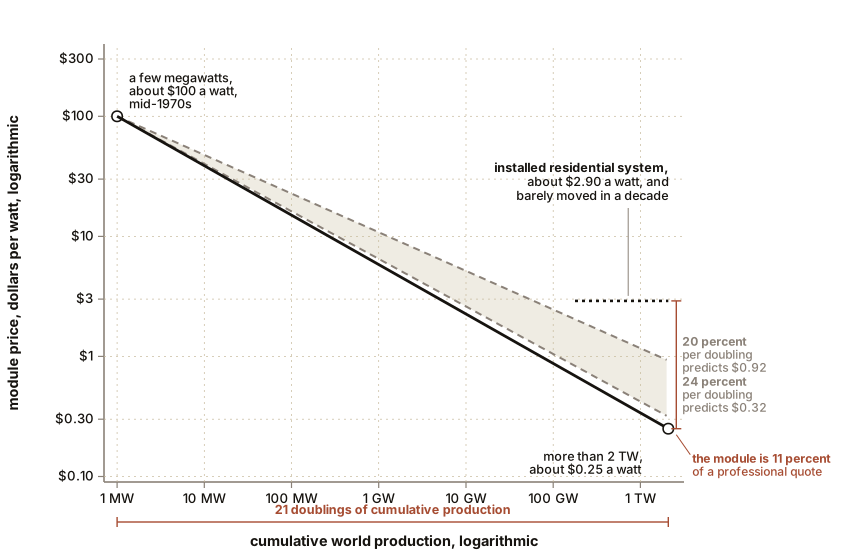
Modules cost roughly $100 per watt in the mid-1970s. Today a module leaves a factory at something like $0.25 per watt at wholesale, and the figure keeps moving.
That is a factor of about four hundred, and it did not happen through a single invention. It happened through the mechanism that governs manufactured goods generally, and which in photovoltaics is called Swanson’s law, after Richard Swanson, who founded SunPower and noticed the pattern in his own industry’s price history.
The claim is this: every time the total number of modules ever manufactured doubles, the price per watt falls by about twenty percent. Not per year. Per doubling of cumulative production. Learning has to be paid for with volume, and the volume is what buys it.
Do the arithmetic and see whether it holds, because that is more instructive than accepting it.
Cumulative world production went from a few megawatts in the
mid-1970s to more than two terawatts by the mid-2020s. That is a factor
of roughly two million, which is about 2^21, so twenty-one
doublings.
At a twenty percent reduction per doubling, price should have fallen
by 0.8^21 = 0.0092, a factor of 109. From $100/W that
predicts about $0.92/W.
The observed price is well under a dollar a watt, so twenty percent per doubling under-predicts what actually happened. Fit the same data with a twenty-four percent learning rate and you get a factor of 317, which lands near $0.32/W and matches much better.
Say the honest thing about that. The learning rate is a fitted number, not a law, and the value you get depends on which years you fit and whether you are pricing modules or whole installed systems. Published estimates cluster between twenty and twenty-four percent for modules. Installed system prices have fallen much more slowly, because scaffolding, wiring, permits and labour do not learn at anything like the same rate, and Chapter 13 shows what that does to the economics of a real roof.
SLOW DOWN. Check Your Understanding: If the learning rate really is around twenty percent per doubling, and cumulative world production doubles roughly every three years at the moment, then module prices should be falling by about twenty percent every three years indefinitely. Yet an installer’s quote for a roof has barely moved in a decade in many markets. Both statements can be true at once. Why? Answer before reading on.
Because the module stopped being the expensive part. On a typical residential installation the modules are now something like ten to fifteen percent of the total price. The rest is racking, wiring, an inverter, a roof crew, an electrician, a permit, an inspection and a sales commission, and none of those is on a manufacturing learning curve. A twenty percent cut on twelve percent of the cost is a two percent cut on the quote.
This has a consequence worth carrying into Chapter 13. The cheapest remaining lever on a residential system is not the technology, it is the labour and paperwork, which is why self-installation changes the payback arithmetic more than any component choice, and why the same hardware pays back in four years in one country and twelve in another. It also means that adding a few more modules to a planned array costs almost nothing per watt, and that is a genuinely useful piece of advice that falls straight out of a price curve.
Chapter 4 goes back to 1905 and does Einstein’s arithmetic with real numbers, because the energy of a single photon is about to decide everything.

Bench Degree
Get the degree without the diploma.
Learn the material, not how to pass the exam.