Bench Degree·SOLAR POWERchapter

Chapter 15: What You Now Know
Chapter 1 made six promises and one boast. This chapter tests all seven against what the book actually delivered, says plainly what it left out, and hands you the one afternoon of measurements that contains the whole subject.
The first chapter ended with a list of things you would be able to do by the last page. A book that makes a list like that owes the reader an audit rather than a summary, so here is the audit, item by item, with the answer and where it came from.
Section 1: The Promise, Line by Line
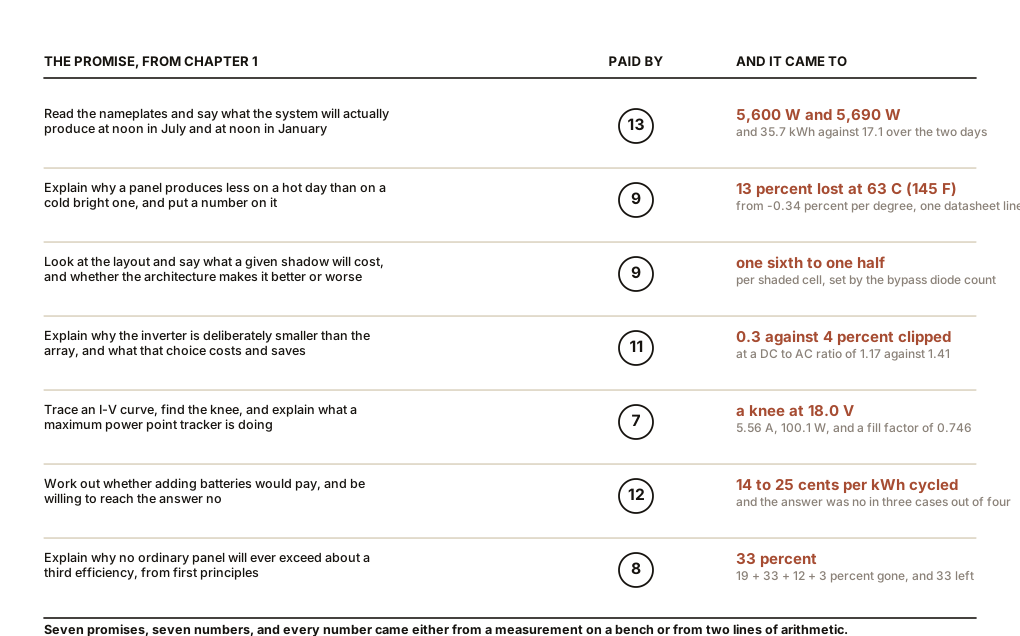
“Read the panel and inverter nameplates and say what the system will actually produce at noon in July and at noon in January, and explain why both figures are below the number printed on the panel.”
Delivered. Chapter 13 does it for the reference array: 7.04 kW of nameplate producing 5,600 W of AC at noon in July and 5,690 W at noon in January, with the arithmetic shown in six lines. The reason both are below nameplate is threefold: the cells are hotter than the 25 °C (77 °F) the nameplate assumed, the array loses about 6 percent to soiling, mismatch and wiring before the inverter sees it, and the inverter itself keeps 3 percent.
One correction to Chapter 1’s own wording, which promised those figures “in kilowatt-hours”. Noon output is a power, in watts, and it was sloppy of the first chapter to ask for it in energy. The energy figures for the two days are 35.7 kWh in July and 17.1 kWh in January, and the distinction between the two questions turned out to matter enormously, because January wins the first and loses the second by a factor of two. The book is better for the promise having been slightly wrong.
“Explain why a panel produces less on a hot day than on a cold bright one, and put a number on it.”
Delivered. Chapter 6 gave the mechanism: the cell’s
reverse saturation current roughly doubles for every 10 °C (18 °F),
which shrinks the logarithm that sets open-circuit voltage, so a hot
junction holds less voltage. Chapter 9 gave the numbers:
−0.34 percent of power per °C for a good module, which is
0.19 percent per °F, and a panel at 63 °C (145 °F) has therefore given
away 13 percent. The number was also measurable at home with a freezer
and a hairdryer, and the bench measurement agreed with the datasheet to
about ten percent.
“Look at the layout and say what a given shadow will cost, and whether the array’s architecture makes that better or worse.”
Delivered. Chapter 9: shade one cell of a full-cell module and lose a third or a half depending on the bypass diode count, or nearly everything if there are no diodes. Shade one cell of a half-cut module and lose a sixth. Then the architecture table: module-level electronics buy 0 to 2 percent on an unshaded plane and 8 to 25 percent on a genuinely shaded one, so the same $1,000 is either a sixty-six year payback or a five year one depending entirely on the tree.
“Explain why the inverter is deliberately smaller than the array, and what that choice costs and saves.”
Delivered. Chapter 11. The array’s nameplate never appears at the inverter’s input, because peak irradiance and peak cell temperature arrive together, so 7.04 kW of modules presents 5,770 W at the sunniest moment of the year. And an oversized inverter runs at the poor end of its efficiency curve. Clipping cost 0.3 percent at a ratio of 1.17 and about 4 percent at 1.41, and whether the larger inverter is worth $250 depends on the export tariff, coming out at a 4.5 year payback at retail value and 14.7 years at a low export credit.
“Trace an I-V curve, find the knee, and explain what a maximum power point tracker is doing and why a panel wired straight to a battery wastes a third of its output.”
Delivered, with one honest revision. Chapter 7 traced the curve with a rheostat and thirteen data points, found the knee at 18.0 V and 5.56 A, and computed a fill factor of 0.746. On the battery claim, the book had to correct the received wisdom: the loss is a third only when the battery is deeply discharged and the panel is cold. At a battery near full charge it is 17 percent, and on a hot day less again, because a hot panel’s maximum power point voltage falls toward the battery voltage and the mismatch shrinks. The “thirty percent” on the box is the best case.
“Work out whether adding batteries would pay, and be willing to reach the answer no.”
Delivered, and the answer was no in three cases out of four. Chapter 12 reduced it to one rule: a battery pays only if the daily price spread it can exploit exceeds its cost per kilowatt-hour cycled, which is 14 to 25 cents for lithium iron phosphate and about a dollar for lead-acid. Under one-for-one net metering the spread is zero and the answer is never. Under net billing at a $0.11 spread it is twenty-eight years, so no. Under a time-of-use tariff with a $0.28 spread it is under eight years, so yes. And for backup, the honest comparison is a $900 generator against a $10,000 battery, which is a preference rather than an investment.
“Explain, from first principles, why no ordinary solar panel will ever exceed about a third efficiency, and why that is a statement about photons rather than about manufacturing.”
Delivered. Chapter 4 established that a photon’s
energy is set by its colour, E = 1,240 / λ in electron
volts and nanometres. Chapter 5 established that silicon charges a flat
fare of 1.12 eV. Chapter 8 added it up: 19 percent of sunlight is too
weak to pay, 33 percent is change that is never given, and 15 percent
more goes in voltage the cell cannot reach and fill factor it cannot
achieve, leaving about 33 percent. The best silicon cell ever
measured is about 27 percent, within two and a half points of a
ceiling that no manufacturing improvement can move, because the argument
used nothing about manufacturing.
Section 2: What You Can Now Do on a Bench
Not what you know. What you can measure, with a list of tools that comes to about $400 in total and rather less if you borrow the thermal camera.
Prove a solar cell and an LED are one device, with an LED, two clip leads and a meter, in two minutes, for nothing.
Measure the energy of a photon, indirectly but honestly, by comparing a red and a blue LED in the same sunlight and finding that the blue one reads higher.
Find the edge of a band gap, with a television remote, a solar cell and a dark room.
Distinguish a semiconductor from a metal, by warming a thermistor and a copper coil and watching them disagree.
Confirm a solar cell is a diode, and then watch its whole I-V curve slide downward by a constant when you illuminate it, which is the entire physical model of the device on one sheet of graph paper.
Trace a full I-V curve and find the maximum power point, with a rheostat, two meters and a clear afternoon, and compute a fill factor from it.
Measure a temperature coefficient, with a freezer and a hairdryer, to within about ten percent of the datasheet.
Separate the temperature effect from the irradiance effect on a single day, by dividing output by irradiance and watching the result slope downhill from dawn to mid-afternoon.
Map a panel’s internal wiring without opening it, by shading one cell at a time and noting which shadows cost most.
Measure the true efficiency of your own panel and confirm that the nameplate was honest and that fifteen percent is what a cheap panel is.
Prove that wiring loss goes as the square of current, with four small panels, three configurations and a long thin wire.
Measure an inverter’s efficiency curve on a real installation, with a clamp meter, without touching anything live.
Measure a battery’s real round-trip efficiency and its real capacity, and discover that both are worse than the label.
Predict a week’s output and then check your own prediction, and know the size of your own error.
And find a deliberately introduced fault in a string, using a clamp meter, a voltmeter and a procedure.
ON THE BENCH: The final exam, on somebody else’s array
Parts: a notepad; a phone; a tape measure; a DC clamp meter if you have one; permission. Cost: nothing. Time: an hour on site, an hour of arithmetic. Hazards: none, because you are not going to touch it. Ask the owner for photographs of the nameplates rather than climbing anything. Method: find an array. A neighbour’s, an employer’s, a farm shed’s, a bus shelter’s. Get four things: the module nameplate, the inverter nameplate, the module count, and the orientation and tilt, which you can estimate from the ground with a phone inclinometer and a compass. Then, before asking the owner for any production data, predict. Work Chapter 13’s five steps: local peak sun hours from published data; nameplate kilowatts from the module count; the derate chain with the temperature term adjusted for the local climate; annual kilowatt-hours; and the noon figures for July and January using Chapter 9’s cell temperature formula. Write all of it down and date it. Then ask for the monitoring data. What you should find: agreement within 10 to 15 percent on the annual figure. If you are further out than that, the discrepancy is the interesting part, and it will usually be one of four things: shading you did not account for, an orientation you misjudged, a soiling problem, or a real fault. The test you are actually taking: whether you can produce a defensible number from four photographs and a published sunshine figure. That is the entire skill this book set out to transfer, and if the answer comes out close, you have it.
IN PLAIN ENGLISH: You started this book able to point an LED at the sun. You can now stand in front of a stranger’s roof, take four photographs, spend an hour with a calculator, and say what that array will make in July, what it will make in January, why both numbers are lower than the sticker, and roughly what it is worth per year. That is not a summary of what you read. It is a thing you can do.
Section 3: The Ideas Worth Keeping
Seven ideas from this book transfer to subjects that have nothing to do with sunlight.
A device that emits can usually absorb, and the same part runs both ways. The LED in Chapter 1 was the demonstration. It is a general property of energy converters and it is worth looking for in every machine you meet, because finding it halves the number of things you have to learn.
Count the particles. Chapter 4 predicted a cell’s short-circuit current to within a couple of percent by counting photons and giving each one an electron. When a process is one-thing-in, one-thing-out, counting beats modelling.
Voltage and current are set by different things, and the useful point is neither extreme. A cell’s voltage is a material property and its current is a geometry property, and the power is maximum where neither is. Any system with a load-dependent source has a maximum power point somewhere in the middle, and hunting for it is a real engineering activity: batteries, wind turbines, thermoelectric generators, antennas.
The two largest losses usually happen before the design starts. Nineteen percent of sunlight was the wrong colour and thirty-three percent was change that could not be given, and neither depended on any choice a manufacturer made. Find the losses that are fixed by the problem statement before optimising the ones that are not.
A series chain is limited by its worst member, and the fix is a bypass rather than an improvement. One shaded cell in thirty-six, and the diode that saves the panel does so by writing off a third of it. That pattern recurs wherever things are chained: pipelines, production lines, redundant power supplies.
Percentage losses multiply, and the honest way to present them is a chain rather than a total. Chapter 13’s eight-term derate chain is more useful than the 0.816 it produces, because it tells you which term to attack.
And the arithmetic gives you kilowatt-hours; only the tariff gives you an answer. The same array, the same roof and the same sunshine paid back in 2.2 years or 16.2 years depending on regulatory decisions made elsewhere. A technical calculation that stops before the price is an incomplete calculation, and the most valuable half hour in a solar decision is often spent reading a tariff schedule.
Section 4: What This Book Did Not Cover
Named plainly, because a closing ledger that only lists achievements is not a ledger.
Manufacturing. How a wafer is grown from a melt, sawn, textured, doped by diffusion, coated with silicon nitride, printed with silver paste and fired. This is the one part of the subject the bench genuinely cannot reach: it is a fabrication plant, it costs hundreds of millions, and no experiment in this book approximates it. The book said so at the start and it was true.
Concentrated photovoltaics. Lenses and mirrors focusing sunlight onto small high-efficiency cells, with tracking, cooling and a great deal of precision. Chapter 8 gave it two paragraphs and its record figure of 47.6 percent. It lost the cost race to plain silicon and very little is being built, which is why it got two paragraphs rather than a chapter.
Perovskites, beyond a mention. The most active research area in the field, with tandem cells on silicon at about 34.6 percent in the laboratory, and an unresolved question about outdoor lifetime. Any treatment written now would be obsolete before the book was printed, which is a good reason to name it and stop.
Thin film, beyond a mention. Cadmium telluride and copper indium gallium selenide are real commercial technologies, and cadmium telluride in particular holds a substantial share of utility-scale installation. The physics is the same physics; the manufacturing and the temperature coefficients differ. It deserved more than the row it got in Chapter 5’s band gap table.
Bifacial modules and tracking mounts. Bifacial modules collect light on both faces and gain 5 to 20 percent from ground reflection, depending entirely on what is under them. Single-axis trackers follow the sun east to west and gain 15 to 25 percent for a moving part and a maintenance schedule. Both are standard at utility scale and rare on houses, and both were left out for the same reason: they change the numbers without changing the physics.
Utility-scale plant design. Row spacing and self-shading, central against string inverters, medium-voltage collection, transformers, substations, land, and the fact that a hundred-megawatt plant is a civil engineering project with some silicon in it.
Grid stability at high penetration. What happens to a network when a large fraction of its generation has no rotating mass, no inertia, and switches off in unison when the frequency moves. This is genuinely one of the most important open problems in the field and it is a book of its own, involving synthetic inertia, grid-forming inverters, curtailment and the economics of negative prices at midday.
Three-phase and commercial systems. Everything here assumed a single-phase domestic supply. The physics is unchanged and the wiring, protection and metering are not.
Financing instruments. Leases, power purchase agreements and third-party ownership. Chapter 13 costed hardware and labour and stopped, because these arrangements are contractual rather than technical and they vary by jurisdiction and by year.
Recycling and end of life. Twenty-five years of modules installed in the 2000s are now reaching retirement, glass and aluminium recover well, silver and silicon do not yet recover economically at scale, and the regulatory position differs everywhere.
And the code that applies to your roof. This book named a few requirements to explain why hardware looks the way it does, and it cannot tell you what applies where you live. What it can do, and did, is tell you which questions to ask an inspector, which is more durable than any figure, because the code changes and the question does not.
ON THE BENCH: The whole book in one afternoon
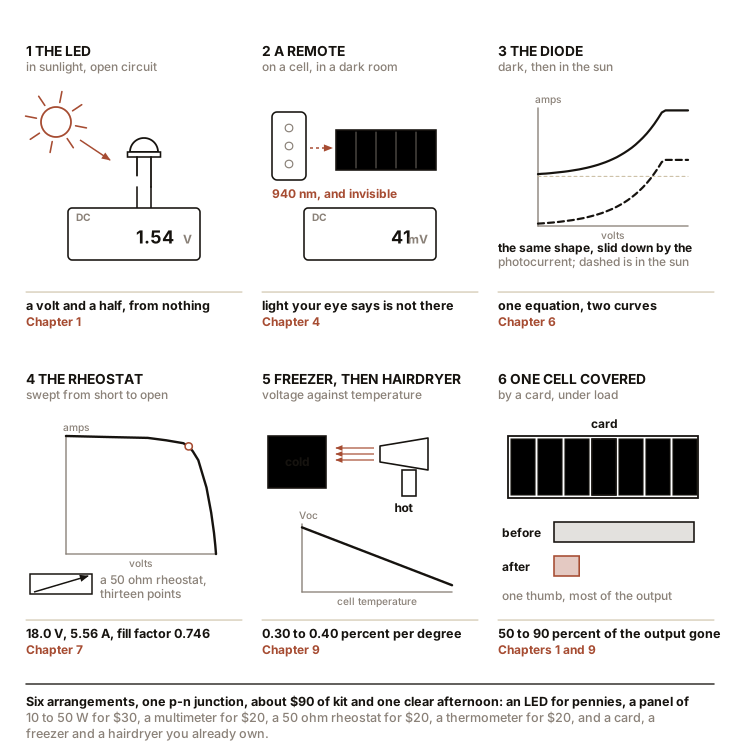
Parts: one LED; one small solar cell or panel, 10 to 50 W, about $30; a multimeter, about $20; a 50 Ω rheostat, about $20; a thermocouple or infrared thermometer, about $20; a card; a hairdryer; a freezer; a television remote. Cost: about $90, assuming you own the hairdryer. Time: one clear afternoon. Hazards: none. Do not stare at the sun and do not overheat the panel. Method: six measurements, in this order, and each one is the load-bearing experiment of a chapter. 1. LED in sunlight. Read its open-circuit voltage. Chapter 1. 2. The remote in a dark room, on the cell. Read millivolts from light you cannot see. Chapter 4. 3. The cell, forward biased in the dark, then in the sun. Two curves, same shape, offset. Chapter 6. 4. The rheostat sweep. Thirteen points, a knee, a fill factor. Chapter 7. 5. Freezer, then hairdryer. A temperature coefficient. Chapter 9. 6. One cell covered with card, under load. Most of the output gone. Chapter 9 again, and Chapter 1 answered. What you should have at the end: two graphs, one coefficient, one fill factor, and six numbers, all measured by you, which between them contain the argument of this entire book. Why it is worth doing as a set rather than as it arises: because doing them in one sitting makes visible the thing that fifteen chapters can only assert, which is that it is all one device. The LED, the diode curve, the knee, the temperature coefficient and the shading collapse are five faces of one p-n junction, and an afternoon is enough to meet all five. And it is the afternoon to give to somebody else. If you want to hand this subject to a curious teenager in three hours, this is the list.
SLOW DOWN. Check Your Understanding: Here is the last one, and it has no arithmetic in it. Given everything in this book, a friend asks whether they should put solar on their house. You know their roof faces southwest at a shallow pitch, they have no shading, and their electricity costs $0.16 a kilowatt-hour. What is the one further thing you most need to know before answering, and why is it not any of the things they will expect you to ask about? Answer before reading on.
What their utility pays for exported energy, and what fraction of their consumption happens in daylight.
Everything else they will offer you is already good enough. Southwest at a shallow pitch is 95 percent of optimum by Chapter 13’s table, which is nothing. No shading removes the entire subject of Chapter 9’s architecture question and makes the cheapest string inverter the right choice. Sixteen cents is a workable retail rate. Their roof is fine and they will want to talk about their roof.
The number that decides the answer is the one they have almost certainly never looked up, because it is on page four of a tariff schedule. At one-for-one net metering, this system pays back professionally in about 9.5 years and self-installed in 4.3, and it is a straightforward yes. At a five cent export credit with only a quarter of their usage in daylight, the value per kilowatt-hour falls to about eight cents, the professional payback goes past eighteen years, and it becomes a genuinely marginal decision that depends on how long they intend to stay in the house.
That is the shape of the honest answer, and it is the shape this book has tried to teach. The physics was settled by 1961 and the hardware is a commodity. What remains contested, and what actually decides whether a roof is worth covering, is a regulatory number and a household’s daily habits. A reader who ends this book asking about tariffs and daytime load rather than about panel brands has understood it, and a reader who can also derive 5,690 watts at noon in January from a datasheet and a temperature has more than understood it.
Keep the LED from Chapter 1. It is still the cheapest solar cell you will ever own, it still reads over a volt in sunlight, and it is still the whole book in one gesture.

Bench Degree
Get the degree without the diploma.
Learn the material, not how to pass the exam.