Bench Degree·ELECTROMAGNETISMchapter

Chapter 2: AC and DC, What They Are and Where They Come From
A battery pushes one way and never stops. A spinning generator cannot help pushing both ways, and engineers spent fifty years fighting that before they learned to use it.
Get the tube from Chapter 1 and a multimeter. Any multimeter, including the $12 one at the hardware store. Take the LED off and twist the two coil ends to the meter probes.
Set the meter to DC volts on its most sensitive range. Shake the tube. The reading jumps around zero, positive then negative then positive, and if your meter has an analogue needle you can watch it sweep both ways. A digital meter shows a minus sign appearing and vanishing.
Now set the meter to AC volts and shake it the same way. Now you get a steady number, something like 0.3 or 0.8 volts depending on how hard you shake.
The same coil, the same magnet, the same hand. Two different readings, because the meter was asked two different questions.
ON THE BENCH: The two questions a meter asks
Parts: the Chapter 1 coil and magnet; any multimeter. Cost: nothing beyond a meter, and a usable one is $12 to $20. Time: 5 minutes. Hazards: none. Method: shake the tube at a steady rate. Read DC volts, then AC volts, then DC volts again. What you should see: DC volts wanders either side of zero and will not settle. AC volts gives a stable positive number that rises when you shake harder. What it means: the DC range reports the instantaneous push and its direction. The AC range ignores direction and reports size. Your coil is producing a push that reverses, so only the second question has a stable answer. If your meter reads zero on AC: many cheap meters cannot measure below about 1 volt AC, and their AC range is also tuned for 50 or 60 Hz rather than the 3 or 4 Hz of a shaking hand. Shake faster and add turns.
Section 1: Direct Current Is a One-Way Push
A battery has a chemical reaction inside it that piles electrons up at one terminal and strips them from the other. That imbalance does not oscillate. It sits there, hour after hour, until the chemicals are spent.
Direct current is current that flows in one direction, driven by a push that does not reverse. Every battery, every solar cell, every phone once its charger has done its work, every car electrical system: direct current, DC.
DC is easy to think about and easy to store. A battery is a tank of it. That is not a small advantage, and it is why DC never went away.
Section 2: Alternating Current Is a Push That Reverses
Alternating current is current that reverses direction at a steady rate, driven by a push that swings from positive to negative and back. In North America it reverses 120 times a second, which is 60 complete cycles, which is 60 hertz. In most of the world it is 50 Hz, 100 reversals per second.
Sixty times a second, the current in the wire feeding your lamp stops, turns around, and goes the other way. The lamp does not care. A filament heats whichever way the current runs, and so does a toaster and so does a motor built for the job.
IN PLAIN ENGLISH: DC is a river. AC is a tide. The river delivers water in one direction; the tide sloshes the same water back and forth. Both can turn a wheel, and the tide turns out to be far easier to make in quantity.
Section 3: Why a Generator Makes AC Whether You Want It or Not
Go back to Rule Two. Current appears in a coil when the magnetic field through it changes, and the direction of that current depends on which way the field is changing.
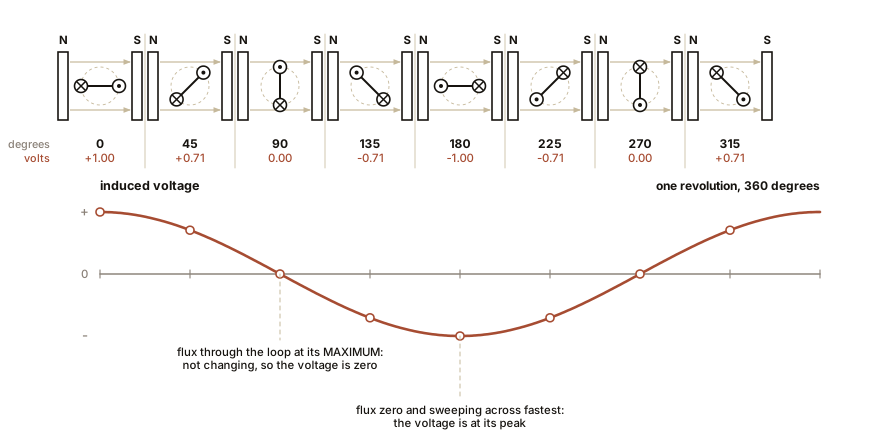
Now build the simplest possible generator. Put a coil on a shaft and spin it between the poles of a magnet, or hold the coil still and spin the magnet. Either way, follow one turn of wire through one revolution.
As the coil comes around, the field through it grows. Current flows one way. The coil passes the point of maximum field and the field through it starts to shrink. The change has reversed sign, so the current reverses. Half a revolution later the coil is presenting its other face to the magnet, and everything happens again with the sign flipped.
One revolution, one full cycle of current out and back. Spin the shaft at 3,600 revolutions per minute, which is 60 revolutions per second, and you get 60 Hz.
Alternating current is not a design choice. It is what rotation does. Anything that spins past a magnet produces a push that reverses, because the geometry reverses. A generator has to be actively modified to produce anything else.
Section 4: The Commutator, or How to Get DC out of an AC Machine
If rotation gives AC and you want DC, you have to catch the current and turn every second half-cycle around. That device is a commutator, and it is one of the great pieces of nineteenth-century mechanical cunning.
The coil’s two ends terminate on a split copper ring that turns with the shaft. Two carbon blocks, the brushes, press against it and carry current out to the world. The split is positioned so that at the exact instant the coil’s voltage reverses, each brush changes which half of the ring it is touching. The reversal inside the machine is cancelled by a reversal in the connection, and what leaves the brushes always flows the same way.
It works. Every hand drill, every car starter, every cheap toy motor for a century ran on it. It also means the machine has two blocks of carbon rubbing on spinning copper, sparking, wearing away, and needing replacement.
So the honest description of a DC generator is a machine that makes alternating current internally and then rectifies it with a mechanical switch that wears out. Hold on to that sentence. It is Chapter 6, and it is the reason Chapter 7 mattered so much.
Section 5: RMS, or Why the Label Says 120 When the Wire Reaches 170
Here is a fact that surprises most people who meet it: the sine wave at a North American outlet peaks at about 170 volts, not 120.
The number on the label is the RMS voltage, root mean square. It is the answer to a specific and useful question: what steady DC voltage would heat a resistor at the same rate this AC waveform does? For a sine wave the answer is the peak divided by the square root of two.
V_RMS = V_peak / 1.414 V_peak = V_RMS x 1.414So a 120 V outlet swings between +170 V and -170 V, sixty times a second, passing through zero 120 times a second. A 230 V outlet in Europe swings between +325 V and -325 V.
Both numbers matter and they matter for different
things. The RMS value is what you use for power arithmetic: a
1,500 W kettle on a 120 V RMS supply draws 12.5 A, and Chapter 1’s
P = V x I works exactly as written. The peak value is what
the insulation has to survive, and what a capacitor has to be rated for,
and what will jump a gap.
SLOW DOWN. Check Your Understanding: A 60 Hz sine wave passes through zero volts 120 times every second. So for 120 brief instants a second, an incandescent lamp on that circuit is receiving no power at all. Why does it not flicker? Answer before reading on.
Two reasons, and the second is the interesting one. The filament has thermal mass: it is a hot wire, it cools slowly, and 8 milliseconds is not long enough for it to dim noticeably. That is the answer most people find. But an LED lamp has no thermal mass at all, and a cheap one genuinely does flicker at 120 Hz. Wave your hand fast in front of one and you may see the fingers stroboscope into separate images. Point a phone camera at it and you may see bands roll across the screen. Better lamps put a capacitor and a current regulator after the rectifier so the LED runs on something closer to DC. This is a real difference in lamp quality that you can test on the shelf.
Section 6: Skin Effect, and Where Physics Stops and Marketing Starts
In a DC circuit, current spreads evenly across the whole cross-section of the wire. In an AC circuit it crowds toward the surface, and it crowds harder as the frequency rises. The reason is Rule One and Rule Two acting inside the metal itself: the changing current makes a changing field, and that changing field drives eddy currents that oppose current in the middle of the conductor.
The depth at which the current density has fallen to about 37% of its surface value is the skin depth. For copper:
| Frequency | Skin depth in copper | Does it matter? |
|---|---|---|
| 60 Hz | 8.5 mm (0.33 in) | No. Almost every conductor is thinner than this. |
| 20 kHz | 0.47 mm (0.019 in) | Marginally, in very heavy cable. |
| 200 kHz | 0.15 mm (0.006 in) | Yes. This is Chapter 10. |
| 10 MHz | 0.021 mm (0.0008 in) | Enormously. RF conductors are plated, not solid. |
Read the first row carefully, because a whole retail category rests on misreading it. At 60 Hz the skin depth in copper is 8.5 mm (0.33 in). The radius of a heavy 1/0 AWG cable is about 4.1 mm (0.16 in). The conductor is thinner than the skin depth, so the current fills it completely and the skin effect does nothing. At the top of the audible range, 20 kHz, the skin depth is 0.47 mm (0.019 in) and 12 AWG speaker wire has a radius of 1.03 mm (0.041 in), so there is a real effect, and it is worth a fraction of a milliohm over a 3 m (10 ft) run into an 8 ohm load.
Above a megahertz the skin effect governs everything, which is why Chapter 10’s coils are wound with many fine strands instead of one thick one. The physics is entirely real. The claim that it is audible in a living room is the part with no measurement behind it.
ON THE BENCH: Watch a waveform without touching mains
Parts: a doorbell or thermostat transformer, 16 V AC, about $14 at any hardware store; a 9 V battery; two 10:1 resistor dividers built from 100 kilohm and 10 kilohm resistors, under $2; a computer with a sound card and free oscilloscope software, or a DSO138 kit scope for about $25. Cost: $16 to $45. Time: 45 minutes. Hazards: the transformer primary side is line voltage and must stay inside its enclosure. Never connect a sound card to mains, to a mains-referenced circuit, or to anything above about 5 volts without a divider. The 16 V AC secondary is isolated from the line by the transformer’s own core, which is the only reason this is safe. Method: feed the transformer’s 16 V AC secondary through the divider into the sound card input. Capture. Then do the same with the 9 V battery. What you should see: the transformer gives a clean sine wave crossing zero 120 times a second, and you can count the cycles in a tenth of a second and confirm 60 Hz. The battery gives a flat horizontal line. Two lines on a screen, and the whole of this chapter is in the difference between them. Then: measure the sine wave’s peak on screen, divide by 1.414, and compare with what an AC voltmeter says across the same terminals. They should agree within a few percent. You have just verified RMS by hand.
Section 7: Lightning Is Not an Alternating Current
Since Chapter 1 mentioned the transmission tower, deal with the largest electrical event most people ever witness.
A lightning stroke is a one-way transfer of charge. Charge separates in a cloud, a conducting channel forms, and the accumulated charge dumps through it in roughly 200 microseconds with a peak current of 20,000 to 30,000 amperes. Large strokes have been measured above 300,000 A. It is direct current: enormous, brief, and going one way.
A household breaker trips at 15 or 20 A. A lightning stroke carries a thousand times that, for two ten-thousandths of a second.
That combination, huge current in a very short time, is a different animal from a 60 Hz sine wave, and it is why the two need different hardware. A fuse protects against sustained overcurrent. A surge protector has to swallow a spike that is over before a fuse could warm up, which is why it uses a metal oxide varistor: a component whose resistance collapses when the voltage across it exceeds a threshold, shunting the spike to ground in nanoseconds. A protector that has absorbed one large nearby strike may be finished even though its green light is still on.
ON THE BENCH: Find the voltage drop in an extension cord
Parts: a long extension cord, 30 m (100 ft) of 16 AWG if you have one; a 1,500 W space heater or kettle; a multimeter. Cost: nothing if you own the cord and the heater. Time: 15 minutes. Hazards: line voltage. Measure at the outlet face and at the cord’s far socket with the meter’s probes, hands dry, one hand behind your back. Do not open anything. Method: measure the voltage at the wall with nothing running. Plug the cord in, plug the heater into its far end, run it on full, and measure again at the far socket. What you should see: the far end reads several volts lower. A 1,500 W load on 120 V draws 12.5 A. A 30 m (100 ft) 16 AWG cord has about 0.8 ohms of copper in the round trip, so
V = I x R = 12.5 x 0.8, about 10 volts lost, andP = I² x R = 12.5² x 0.8, about 125 W heating the cord instead of the room. Then feel the cord. It is warm along its whole length. That warmth is 125 W, about eight percent of what you are paying for, and it is the entire argument of Chapter 3 sitting coiled on your floor.
Next chapter takes that warm extension cord and asks the obvious question: if losing power in a wire is a matter of current, and current is power divided by voltage, then what if you could simply raise the voltage?

Bench Degree
Get the degree without the diploma.
Learn the material, not how to pass the exam.