Bench Degree·ELECTROMAGNETISMchapter
Chapter 4: Magnetism, the Invisible Force
Michael Faraday had no mathematics. What he had instead was a habit of drawing what he saw, and the pictures he drew of iron filings turned out to be more useful than the equations nobody had written yet.
Buy a 300 mm (12 in) offcut of 15 mm (1/2 in) copper water pipe. Any hardware store, about $8. Find a neodymium magnet that drops through it without touching the walls, roughly 12 mm (0.5 in) across.
Hold the pipe vertically over a table. Drop a steel nut of about the same weight through it. It arrives immediately, in a quarter of a second, and it clatters.
Now drop the magnet.
It takes two seconds. Sometimes more. It does not stick, it does not rattle, it does not touch the sides. It sinks, smoothly and steadily, like a stone through honey, and when you tip the pipe up and look you can see nothing inside it at all.
Copper is not magnetic. Test it: hold the magnet against the outside of the pipe and it falls off. There is no attraction between these two objects. And yet the pipe has taken hold of the magnet and let it down gently, and this chapter is about what took hold of it.
ON THE BENCH: The magnet that falls slowly
Parts: 300 mm (12 in) of 15 mm (1/2 in) copper pipe, about $8; one neodymium magnet about 12 mm x 6 mm (0.5 in x 0.25 in), about $2; a steel nut of similar mass; a phone stopwatch. Cost: about $10, and it is the best ten dollars in this book. Time: 10 minutes. Hazards: none. Do not let two neodymium magnets snap together on a finger. Method: time the nut’s fall, then the magnet’s, over the same pipe. Then repeat with a length of aluminium pipe, and then with a plastic pipe as a control. What you should see: free fall through 300 mm (12 in) takes 0.25 seconds. The nut does that. The magnet takes 1.5 to 2.5 seconds, which is six to ten times longer. Aluminium slows it too, but less, because aluminium conducts less well than copper. The plastic pipe does nothing at all. Then, the measurement that turns a trick into physics: stack two magnets and drop them together. They fall slower still, not faster, even though they weigh twice as much. Try four. The braking grows faster than the weight does, and by the end of this chapter you will know exactly why. Better, if you have one: a 1 m (3.3 ft) length of pipe makes the effect impossible to argue with, and a piece of thick-walled pipe brakes harder than thin-walled at the same diameter.
Section 1: Every Magnetic Field Is Made by Something Moving
Chapter 1 said a current in a wire makes a field around it. Chapter 1 also said a lodestone is magnetic without any wire or battery. Those two facts look like two different phenomena, and for two thousand years everyone assumed they were.
They are the same phenomenon.
A magnetic field is what a moving electric charge produces. In a wire, the moving charges are the electrons you pushed into line with a battery. In a permanent magnet, the moving charges are electrons inside the atoms, each one both orbiting and spinning, each one a minute circulating current. In most materials those tiny currents point every which way and cancel to nothing. In iron, cobalt, nickel and a few alloys they line up over whole regions, and the regions can be persuaded to line up with each other, and the sum is a bar magnet.
So there is one rule underneath, not two. Charge in motion makes magnetism. A permanent magnet is a piece of matter with its own internal currents already sorted out and locked in place, which is why it needs no battery and why heating it past a certain temperature, 770 °C (1,418 °F) for iron, shakes the alignment apart and destroys it permanently.
Section 2: Two Numbers, and They Are Not the Same Number
Talking about fields requires distinguishing strength from amount, and confusing them causes more trouble in this subject than anything else.
B is the flux density: how strong the field is at one point. It is measured in tesla. It is what a compass needle feels and what a Hall-effect sensor reads.
| Where | B |
|---|---|
| Earth’s field at the ground | about 50 microtesla |
| A refrigerator magnet at its face | 5 millitesla |
| A neodymium disc at its face | 0.4 to 0.5 tesla |
| A hospital MRI bore | 1.5 to 3 tesla |
| A scrapyard lifting magnet | 1 to 2 tesla |
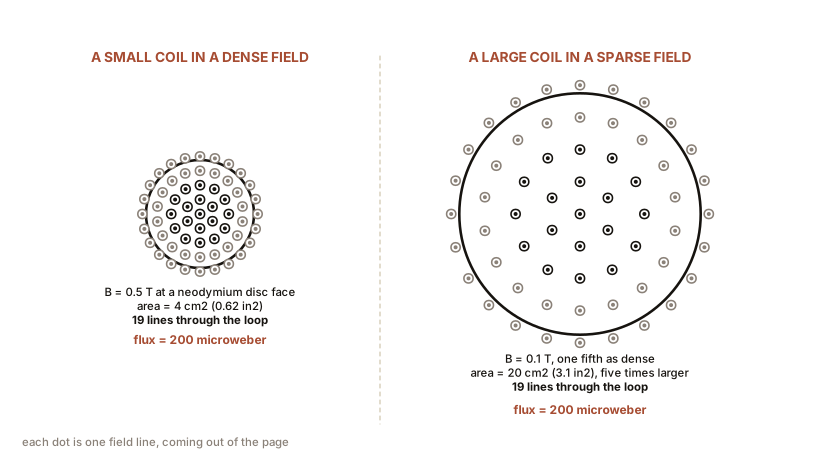
Flux, written Φ, is the total amount of field passing through a given area. Flux is B multiplied by the area it crosses, when the field is square-on to it.
Φ = B x A (field strength times the area it passes through)The difference matters because Rule Two cares about flux, not about B. A weak field through a large coil can carry the same flux as a strong field through a small one. This is why generator coils are wide and why the transformer in Chapter 3 got a core: the iron gathers field from a large volume and funnels it through the secondary’s small opening, raising the flux without raising the field anywhere.
IN PLAIN ENGLISH: B is how hard it is raining. Flux is how much water is landing in your bucket. A light rain into a wide bucket and a downpour into a teacup can both give you the same litre, and the coil is only ever counting litres.
Section 3: Faraday’s Law, One Word at a Time
Here is the law, and then here is what each piece of it is doing.
EMF = - N x (change in flux / time taken)EMF is electromotive force, which is an old-fashioned name for the voltage a changing field produces. It is what your shaking tube in Chapter 1 was making.
N is the number of turns. Every turn feels the same flux change and adds its own push, so the voltages add. This is why the transformer’s turns ratio works, and why 400 turns beat 40.
Change in flux is the numerator, and the word change is Rule Two doing all its work. Not the flux. The change in it.
Time taken is the denominator, and it is the part people skip. The same flux change delivered faster gives more voltage. Push a magnet into a coil in one second and you get a small pulse. Push the same magnet the same distance in a tenth of a second and you get ten times the voltage. Speed is not a detail of induction. Speed is a term in the equation.
The minus sign is the next section, and it is the most interesting character in the sentence.
ON THE BENCH: Prove that speed is in the equation
Parts: the Chapter 1 coil and magnet; a multimeter on its most sensitive DC millivolt range, ideally one with a peak-hold or min/max function. Cost: nothing new. Time: 10 minutes. Method: hold the magnet 50 mm (2 in) above the coil and lower it in slowly over about two seconds, watching the reading. Then do the same drop as a quick stab, taking about a fifth of a second. What you should see: the slow insertion gives a small reading held for a long time. The fast one gives a reading several times larger, held briefly. The flux change was identical both times, because the magnet started and finished in the same places. Only the clock changed. Then: insert the magnet and hold it still inside the coil. Zero. Withdraw it. The reading appears again with the opposite sign, because the flux is now falling instead of rising. If your meter is too slow to catch the fast stab: most cheap meters sample two or three times a second and will miss it. Use the LED instead and judge by brightness, which your eye integrates well enough to see the difference.
Section 4: Lenz’s Law, or Everything Pushes Back
The minus sign in Faraday’s law was named for Emil Lenz, who stated it in 1834, and it says this:
The current that a changing field induces flows in whatever direction opposes the change that caused it.
Bring a magnet’s north pole toward a coil and the coil responds by making its own north pole facing the magnet, pushing back. Pull the magnet away and the coil switches to a south pole facing it, pulling to hold it. The coil always resists what you are doing. Whichever way you move, you feel drag.
This is not a special rule bolted on to Faraday’s. It is required by conservation of energy, and the argument is airtight. Suppose the sign were the other way, so the induced current helped the change. Then nudging the magnet toward the coil would produce a force pulling it in harder, which would increase the flux faster, which would increase the current, which would pull harder still. The magnet would accelerate into the coil, and you would be generating electricity and gaining kinetic energy at the same time, from nothing. The universe does not do that, so the sign is negative.
IN PLAIN ENGLISH: Lenz’s law is the bill. Electricity out of a coil is not free. It is paid for in mechanical work by whatever is moving the magnet: your arm, a steam turbine, a river. The drag you feel is the price, and the harder you draw current the heavier the drag becomes. A generator with nothing plugged into it spins easily. Switch on the load and it fights you. That fight, exactly and to the watt, is the electricity you are selling.
Section 5: The Copper Pipe, Fully Explained
Now go back to the pipe.
As the magnet falls, the copper immediately around it sees a changing magnetic field: rising ahead of the magnet, falling behind it. The copper is a conductor, so Rule Two drives currents in it. There are no wires and no coil, so the current simply goes around in closed loops inside the metal wall. Those loops are called eddy currents.
By Lenz’s law each loop opposes the change that made it. The loops ahead of the magnet make a field that repels it and slows its approach. The loops behind make a field that attracts it and holds it back. The magnet is falling into a headwind and dragging an anchor, and both are made of nothing but current in copper.
Everything you measured now follows.
Why copper brakes harder than aluminium: copper conducts better, so for the same induced voltage more current flows, so the opposing field is stronger. Braking is set by conductivity.
Why a thicker wall brakes harder: more cross-section for the eddy loops to run in, less resistance, more current.
Why plastic does nothing: no free electrons, no current, no opposing field, nothing at all.
Why two magnets fall slower than one, though they weigh twice as much: the drag grows with the square of the field, because the field sets both the induced voltage and the force that voltage’s current then produces. Double the field and you roughly quadruple the drag while only doubling the weight. Stack four and the effect becomes absurd.
And the energy? It goes exactly where the arithmetic says it must. The magnet arrives at the bottom moving slowly, so it lost gravitational energy without gaining kinetic energy. That energy went into the eddy currents, and the eddy currents went into resistance, and the resistance went into heat. The pipe is very slightly warmer. Too slightly to feel with one magnet, but drop a large one down a thick copper tube fifty times and you can measure it with a cheap infrared thermometer.
SLOW DOWN. Check Your Understanding: Cut a long slot down the whole length of the copper pipe, from top to bottom, so it is still a pipe but no longer a closed ring in cross-section. Does the magnet still fall slowly? Predict before reading on.
It falls almost freely. The slot breaks the loop, so the eddy currents have nowhere to circulate, so there is no opposing field. This is a wonderful result, because it is not obvious and because it is the entire design principle of a transformer core. Chapter 5 does exactly this deliberately: it slices an iron core into hundreds of thin varnished sheets specifically to stop eddy currents from circulating, for the same reason and by the same mechanism. A slotted pipe is a laminated core. The magnetic field passes happily through both. The wasteful current cannot.
Section 6: Faraday’s Pictures
Faraday was a bookbinder’s apprentice who read the books he was sewing. He came to the Royal Institution as a bottle washer and stayed for half a century, and he never learned the mathematics that his contemporaries used to describe what he found. It has been called his great limitation. It may have been the reason he saw what he saw.
Unable to write down a field equation, he drew instead. He sprinkled filings and traced the curves. He called them lines of force, and he insisted, against considerable resistance from better-educated men, that the lines were physically real: that the space around a magnet was in a genuine state of strain, and that the strain, and not any action at a distance, was what pushed the compass needle.
He was right, and when James Clerk Maxwell came to build the mathematics twenty years later he said so plainly. Maxwell’s equations are Faraday’s drawings with the arithmetic filled in, and Maxwell said in his preface that he had begun by translating Faraday’s lines of force into symbols and had found nothing in them that needed correcting.
Every Christmas from 1825 Faraday taught this material to an audience of children, in the same lecture theatre where he had discovered most of it, and the series still runs. There is no better argument for the proposition that a subject you cannot demonstrate to a twelve-year-old is a subject you do not yet understand.
Next chapter takes the iron core seriously: why it helps enormously, why it eventually refuses to help at all, why a solid one wastes power, and how four equations that fit on a postcard turn all of this into light.

Bench Degree
Get the degree without the diploma.
Learn the material, not how to pass the exam.