Bench Degree·ELECTROMAGNETISMchapter

Chapter 11: Radio, the Fight Tesla Almost Won
A receiver with no battery, running on the energy of a broadcast fifty kilometres away, is the plainest demonstration in this book that a wave carries power. It is also the exact circuit that four men and one Supreme Court argued over for fifty years.
Take a barbecue lighter, the kind with a piezoelectric clicker. Turn on an AM radio and tune it to a gap between stations, where you get only hiss. Stand a couple of metres away and click the lighter.
A sharp crack comes out of the radio. Not the sound of the click travelling through the air, which you can check by muffling the lighter in a cloth: the crack still comes through the speaker. Tune the radio anywhere across the whole band and the crack is there at every frequency.
You have built a spark-gap transmitter for nothing, and the radio is receiving it. That is Heinrich Hertz’s 1887 apparatus, and the reason it fills the whole band at once is the reason spark transmitters had to be abandoned.
ON THE BENCH: Hertz with a barbecue lighter
Parts: a piezo barbecue lighter or a piezo igniter salvaged from a gas grill, about $3; any AM radio, about $12 new or free from a drawer; a metal biscuit tin. Cost: under $15. Time: 15 minutes. Hazards: none. Piezo igniters produce a few thousand volts at almost no current and feel like a static shock. Method: tune to a quiet spot on the AM band and click at various distances. Then tune to a strong station and click again. Then put the radio in the biscuit tin, lid on, and click from outside. What you should see: the crack reaches the radio through a wall, and it appears at every frequency you tune to, because a spark is a broadband event and radiates everything at once. Over a strong station it lands as interference on top of the programme, which is exactly the problem that made spark transmitters unusable once more than one existed. In the biscuit tin, nothing gets through at all, which is Chapter 5’s Faraday cage doing its job on a signal you generated yourself. Take the lid off and the crack returns. Then estimate the range. Walk away clicking until the radio stops hearing it, with a helper listening. A few tens of metres from a lighter is normal. Hertz got a few metres from a rather larger apparatus, which tells you how good a modern receiver is.
Section 1: Maxwell Predicts, Hertz Proves
Chapter 5 ended with Maxwell’s conclusion: a changing electric field makes a magnetic one, a changing magnetic field makes an electric one, so the pair can walk away across empty space at 2.998 x 10 to the eighth metres per second, and light is one example.
Maxwell published that in 1865 and died in 1879 without ever making a wave or detecting one.
Heinrich Hertz, twenty-nine years old and teaching at Karlsruhe, set out in 1886 to look for the effect and spent two years characterising it completely. His transmitter was two straight copper rods 1 m (3.3 ft) long, end to end, with a 7.5 mm (0.3 in) gap between them, driven by an induction coil. When the coil fired, the gap sparked and the rods rang at their own resonant frequency, about 50 MHz. His receiver was a loop of wire about 350 mm (14 in) across with an adjustable gap of a fraction of a millimetre, and when he aligned it properly, several metres away, a spark appeared in it.
Then he did the work that made it physics rather than an anecdote. He set the transmitter in a metal-walled room, found the standing waves between it and the far wall, and measured the spacing of the nodes to get a half-wavelength of about 2.8 m (9.2 ft). With the frequency from the rods’ geometry and the wavelength from the room, he computed the propagation speed and got about 3 x 10 to the eighth metres per second. He rotated his receiving loop through 90 degrees and the signal vanished, which established polarisation. He put a zinc sheet in the path and the wave reflected. He built a prism out of pitch and the wave refracted through it, bending exactly as light bends in glass.
Reflection, refraction, polarisation, standing waves, and the speed of light. Hertz’s waves were light, at a wavelength six million times longer, and after 1888 nobody serious argued about it.
Asked in 1889 what use it was, he is reported to have said it was of no use whatsoever, merely proof that Maxwell had been right. He died in 1894, aged 36.
Section 2: Four People, No Coordination
Between Hertz’s death and 1900, at least four people independently built working wireless telegraphs. Understanding that is necessary before the priority fight makes any sense, because the popular version has two men in it and there were more.
Oliver Lodge, in England, demonstrated Morse code sent 60 m (200 ft) without wires at a meeting of the British Association in August 1894, using a coherer: a glass tube of loose metal filings whose resistance collapses when a radio wave strikes it, and which then has to be tapped to reset. He did not commercialise it.
Aleksandr Popov, at the Russian Navy’s torpedo school, built what he called a lightning detector in 1895, demonstrated it in April of that year, and in 1896 sent the words “Heinrich Hertz” 250 m (820 ft) across the grounds of St Petersburg University. He filed no patents, which is why his documented priority carried no legal weight.
Guglielmo Marconi, aged 21 in 1895, combined Lodge’s coherer with two things of his own and got range nobody else had: an elevated vertical antenna and a good earth connection. He filed in June 1896 and had a company by 1897.
Nikola Tesla gave a lecture in St Louis in February 1893 that included a demonstration of a transmitter and receiver each tuned to the same resonant frequency, with the receiver responding to that transmitter and ignoring other disturbances. The apparatus descriptions are in the published record and the demonstration was witnessed and reported.
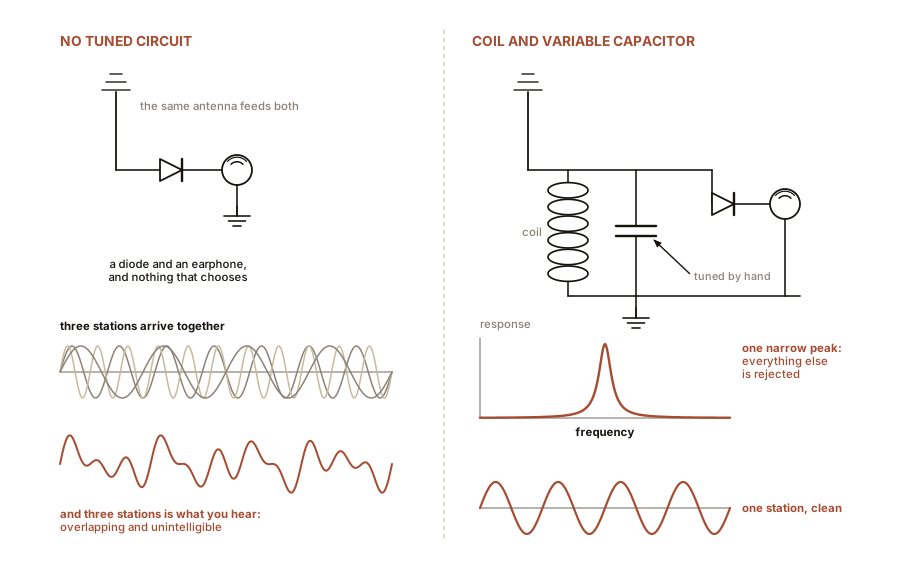
The technical difference is the whole case. Marconi’s original system was untuned: a spark, an antenna, a coherer. It worked, exactly as the barbecue lighter worked, and like the barbecue lighter it sprayed the entire band and heard the entire band. An untuned network cannot have two stations in it.
Section 3: The Tuned Circuit, and Why It Is the Invention
In September 1897 Tesla filed what became US Patent 645,576, “System of Transmission of Electrical Energy,” granted in March 1900, together with US Patent 649,621. It describes a four-circuit arrangement: two coupled resonant circuits at the transmitter and two more at the receiver, every one of them tuned to the same frequency.
Read that against Chapter 10 and it is the same machine. A high-Q resonant circuit is a good bell: it responds strongly to its own note and ignores every other note. Put one in the transmitter and you concentrate your energy in a narrow band instead of scattering it. Put one in the receiver and it hears that band and rejects everything else. Put two in series at each end and the selectivity sharpens again.
That is not an improvement to radio. It is the thing that makes radio a network rather than a single link. Without it there can be one transmitter within earshot. With it there can be a thousand, each on its own frequency, which is the entire broadcast band, the entire cellular system, and every wireless device in your house.
IN PLAIN ENGLISH: An untuned receiver is an ear in a room where everybody shouts. A tuned receiver is an ear that has decided in advance to hear only one voice, and can therefore pick it out of a crowd. The tuning is not a convenience. Without it there is no crowd, because only one person can be allowed to speak.
ON THE BENCH: A radio with no power supply
Parts: 80 to 100 turns of 26 AWG magnet wire on a 40 mm (1.5 in) tube, about $6; a germanium 1N34A diode, under $1; a 365 pF air variable capacitor, salvaged from an old AM radio or about $8 new; a high-impedance crystal earphone of 2,000 ohms or more, $4; 10 to 15 m (30 to 50 ft) of wire for an antenna; a copper ground stake or a cold water pipe. Cost: about $20. Time: two hours. Hazards: run the antenna nowhere near power lines, and take it down in a thunderstorm. Method: antenna to a tap about ten turns up the coil. The variable capacitor across the whole coil. From the top of the coil through the diode to one side of the earphone. The other side of the earphone, and the bottom of the coil, both to ground. Tune slowly across the capacitor’s range. What you should see: stations appear, one at a time, as distinct peaks. Voices and music, in your ear, from a circuit with no battery in it anywhere. Every milliwatt reaching your eardrum was radiated by a transmitter that may be 50 km (30 miles) away and picked out of the air by a coil of wire. If you hear nothing: the two usual culprits are the diode and the earphone. A silicon diode will not work, because its 0.6 V forward drop is far above the microvolts the antenna delivers, while germanium’s 0.2 to 0.3 V is low enough. And an 8 ohm speaker will not work, because its low impedance loads the circuit into silence. Both substitutions are the commonest failures and neither is your wiring. Then run the comparison that is the point of this chapter. Take the coil and capacitor out and wire the antenna straight to the diode. If you are near strong stations you will hear several at once, overlapping and unintelligible. Put the tuned circuit back and they separate into individual stations you can select. That difference is US Patent 645,576, and you just measured it with your ear.
Section 4: Marconi Fairly Assessed
Making Marconi the villain is easy and wrong, and getting him right matters for how you read the rest.
The elevated vertical antenna over a good earth was his. Hertz used horizontal dipoles in free space. Marconi found empirically, on his family’s estate in 1895, that a vertical wire over a solid ground connection reached vastly further. That configuration is still how every AM broadcast station on earth radiates, and in 1895 there was no theory to predict it.
He made the coherer usable. He improved its sensitivity and added an automatic tapper that reset it after each signal, converting a one-shot laboratory curiosity into something that could receive a continuous message and print it on paper tape.
He built the business, and nobody else did. He hired first-rate engineers, including John Ambrose Fleming, who went on to invent the vacuum tube diode. His Poldhu transmitter of 1901 ran 25 kW, which was hard electrical engineering. He opened the first commercial transatlantic wireless service that a paying customer could actually use, in 1907.
His December 1901 claim to have received the letter S across the Atlantic is a different matter and remains unproven. The signal was at the noise floor, heard by ear through a coherer, unrecorded, and unwitnessed by anyone independent. Hugh Aitken, the standard technical historian of the period, calls it plausible and unproven, and that is where it should be left.
Section 5: 1904, and Then 1943
In 1902 Tesla filed an interference against Marconi’s American patents, arguing that the four-circuit tuned system was anticipated by his own 645,576.
In 1904 the US Patent Office reversed its earlier position and awarded radio priority to Marconi, and it gave no detailed reasoning. What is documented about the surrounding circumstances is this: by 1904 Edison had publicly endorsed Marconi, Andrew Carnegie had invested, the British government was buying Marconi equipment for its navy, and Tesla had spent his capital and much of his investors’ patience on the tower in Chapter 12. The reversal has never been satisfactorily explained by any historian, and this book does not have an explanation either. It is a hole in the record, and the honest thing is to say so rather than to fill it.
During the First World War the United States government seized Marconi’s American patents and used them without licence. After the war the Marconi company sued for royalties, and the case reached the Supreme Court.
In Marconi Wireless Telegraph Co. of America v. United States, 320 U.S. 1, decided 21 June 1943, the Court held that Marconi’s key patent on the four-circuit tuned system was invalid because it was anticipated by prior art. The prior art it named was Tesla’s 645,576, Oliver Lodge’s US 609,154 of 1898, and John Stone Stone’s work on tuned circuits.
Tesla had died on 7 January 1943, five and a half months earlier.
Two caveats belong here, because they are usually deployed to dismiss the ruling and they do not.
Marconi’s patents had already expired, which limited the money at stake. True, and it does not affect what the Court held about who invented what.
The ruling credited Lodge and Stone as well as Tesla, so this was not a simple two-man contest. Also true, and it strengthens rather than weakens the point: Tesla’s work was one of several bodies of prior art that preceded Marconi’s claim, which is precisely the finding.
Section 6: What This Costs to Learn
There is a lesson in this chapter and it is not that the system cheated a genius.
Tesla demonstrated tuned wireless transmission in 1893, three years before Marconi filed anything. He then did not commercialise it, did not prosecute his own patents aggressively, and turned his attention to a much larger and much riskier project. He said repeatedly and in his own voice that sending dots and dashes across an ocean was a trivial application of his apparatus and that he intended to send power instead.
Patent law rewards reduction to practice and commercial pursuit, and it operated exactly as designed. The 1943 decision corrected a 1904 error, four decades after the market had been settled by the person who showed up every day.
SLOW DOWN. Check Your Understanding: Your crystal radio has no battery, and the power reaching your ear came from a transmitter tens of kilometres away. A 50 kW AM station radiates in all directions, so by the time it reaches you the power per square metre is minute. Roughly how much power is your earphone actually getting, and why can you hear it at all? Answer before reading on.
Microwatts, and often less than one. A crystal set typically delivers between a tenth of a microwatt and a few microwatts to a high-impedance earphone. For comparison, the LED in Chapter 1 wanted about 50,000 microwatts.
You can hear it because the human ear is an extraordinary instrument. At its most sensitive frequencies it responds to sound intensities around 10 to the minus 12 watts per square metre, which is why a quiet room is not silence but the limit of your hearing. A crystal earphone converts microwatts into a comfortably audible sound because a comfortably audible sound is a very small amount of power.
The lesson worth keeping is that this is why passive reception works at all. Radio does not need to deliver energy in useful quantities to carry information, because the receiver only has to detect a pattern. Chapter 12 is entirely about what happens when you ask the same wave to deliver power rather than a pattern, and the answer is that the arithmetic changes completely and not in your favour.

Bench Degree
Get the degree without the diploma.
Learn the material, not how to pass the exam.