Bench Degree·ELECTROMAGNETISMchapter
Chapter 9: The War of Currents, and What Was Actually at Stake
It is told as a fight between two men. It was settled by a number, and both men could compute the number. What the fight actually decided was who would be paid.
You can reproduce the whole argument on a kitchen table for about thirty dollars, and it is worth doing before reading a word of the history, because the history makes no sense until you have felt the number in your hands.
Take two identical 16 V AC doorbell transformers. Between them, string a deliberately bad transmission line: 6 m (20 ft) of 30 AWG magnet wire, out and back, which has about 7 ohms of resistance. At each end, a 12 V lamp.
Run it the low-voltage way first. Feed 16 V AC straight into the thin wire and hang the lamp on the far end. The lamp glows dimly or not at all. Feel the wire: it is warm along its whole length. You are heating 6 m (20 ft) of magnet wire and there is very little left for the lamp.
Now run it the other way. Wire the first transformer backwards, so it steps 16 V up to 240 V, and send that down the same thin wire. At the far end, wire the second transformer forwards to step 240 V back down to 16 V, and hang the lamp on that.
The lamp lights. Properly. Same power source, same
terrible wire, same load. The only difference is that the power
travelled down the wire as a high voltage at a small current instead of
as a low voltage at a large one, and I²R did not get its
hands on it.
ON THE BENCH: Great Barrington, on a table, for $30
Parts: two 16 V AC transformers, doorbell or thermostat type, about $14 each; 15 m (50 ft) of 30 AWG magnet wire, about $8; two 12 V 5 W lamps and holders, about $6; a multimeter. Cost: about $42, less if you have a transformer already. Time: 90 minutes. Hazards: the step-up configuration produces about 240 V AC, which will hurt you badly and can kill you. Insulate every joint with heatshrink before switching on, mount the whole thing on a board, and do not touch the line while it is live. If that sentence gives you pause, do the low-voltage half only and read the numbers for the rest. There is no shame in that and it is the correct instinct. Method: measure the thin wire’s resistance first. Build the low-voltage case, measure the voltage arriving at the lamp, and feel the wire. Then build the step-up and step-down case and measure again. What you should see: in the low-voltage case the lamp gets a fraction of the supply and the wire is warm. In the stepped-up case the lamp gets nearly the full 16 V and the wire is cool to the touch, because the current in it fell by a factor of fifteen and the heating fell by a factor of about two hundred. What you have just built: William Stanley’s January 1886 demonstration at Great Barrington, Massachusetts, at one thousandth of the scale, with the same components in the same order. That is not an analogy. It is the same machine.
Section 1: Pearl Street Was Very Good, and That Is the Point
Edison’s Pearl Street station in lower Manhattan began commercial operation on 4 September 1882: 59 customers, 400 lamps, six Jumbo dynamos of roughly 100 kW each, 110 volts direct current, conductors buried in the street. By January 1883 it served 508 customers and 10,164 lamps.
Edison had not built a generator. He had built a business. Generators, cables sized for an acceptable loss, meters that measured what each customer actually consumed, a billing department, a tariff, a maintenance crew. Every part of that had to be invented, and most of it was invented by him or under him. The lamp gets the credit and the meter deserves half of it.
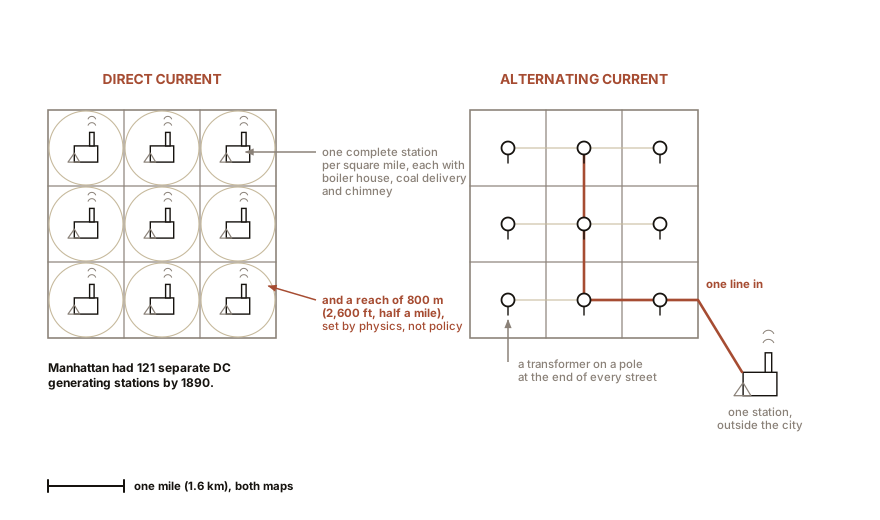
What the system could not do was reach. Pearl Street served a radius of about 800 m (2,600 ft, half a mile), and that number was not a business decision. It was the distance at which 110 V DC ran out of usable voltage in the copper Edison could afford to bury, which is Chapter 3’s arithmetic with a shovel in it. To light the next square mile you built another complete station. By 1890 Manhattan had 121 separate DC generating stations.
The capital cost of lighting a city scaled in direct proportion to the area lit. There was no leverage anywhere in the system.
Section 2: The Copper, Counted
Here is the calculation that decided it, and you should do it yourself rather than take it from a book, including this one.
ON THE BENCH: Weigh Edison’s copper
Parts: a calculator. Graph paper if you want to plot it. Cost: nothing. Time: 30 minutes. Method: deliver 10,000 W to a customer 5,280 ft (1.6 km) away, one mile, losing no more than 5 percent, which is 500 W, in the wires. Copper’s resistivity is 1.72 x 10 to the minus 8 ohm metres and its density is 8,960 kilograms per cubic metre. The out-and-back conductor length is 3,218 m (10,560 ft). Work out the copper mass needed at 120 volts, then at 12,000 volts. Use
I = P/V, thenR = loss/I², thenA = ρL/R, then mass isA x L x density. What you should get: at 120 V the current is 83.3 A, the allowed line resistance is 0.072 ohms, the cross-section needed is 769 mm², and the copper weighs 22,175 kg. At 12,000 V the current is 0.83 A, the allowed resistance is 720 ohms, the cross-section is 0.0769 mm², and the copper weighs 2.2 kg. The ratio is 10,000 to 1, and it is exactly the square of the hundredfold voltage step. In practice you cannot hang a hair between poles, so the high-voltage line is built at 14 AWG or heavier for mechanical reasons, and the honest field ratio is about 370 to 1. Then vary it. Change the distance, the power, the voltage step. The ratio always comes out near the square of the voltage ratio, becauseI²Ris the only term that matters. You have just derived, in half an hour, the fact that took the industry fourteen years and one public relations campaign to accept.
Thomas Hughes, working from contemporary records rather than from this idealisation, computed roughly a hundredfold copper saving for a comparable task under 1880s assumptions. The exact figure depends on what you hold constant. Nobody who did the arithmetic, Edison included, disagreed about the direction or the order of magnitude.
Section 3: Westinghouse Buys a Patent and Hires an Engineer
George Westinghouse was forty in 1886 and already rich, from a compressed-air railway brake he had patented in 1869 that made long passenger trains safe to stop. He was not a theorist. He was an industrialist with an instinct for which technology was about to matter.
In 1885 he paid $50,000 for the American rights to the Gaulard and Gibbs transformer patents, which was a substantial bet on hardware nobody had proved. He hired William Stanley, who spent 1885 redesigning the thing around a closed magnetic core, fixing the flux leakage that had crippled the original. In January 1886, Stanley ran a complete alternating-current distribution system through the town of Great Barrington, Massachusetts: one generator, step-up transformers, a distribution line, step-down transformers, lamps in shops. It worked.
It also had one limitation that mattered enormously. It could light lamps and it could not turn a motor. No practical alternating-current motor existed. Industrial power was DC motors, and if AC could not drive a motor then AC was permanently confined to illumination, which is a large market and not the whole one.
The missing piece arrived in the spring of 1888, in the form of Chapter 7 read aloud at Columbia University.
Within weeks of Tesla’s lecture, Westinghouse bought. The terms were $60,000 in cash and stock, 150 shares of Westinghouse Electric, and a royalty of $2.50 for every alternating-current horsepower sold. Tesla moved to Pittsburgh for about a year to help turn models into manufacturing drawings.
That deal ended the industrial-power argument on the spot. The case for keeping DC had rested on motors. Now there were AC motors, better ones, with nothing to wear out.
Section 4: Harold Brown, and the Campaign
Edison General Electric was formed in 1889 out of Edison’s various companies, and it had investors whose capital was sunk in direct-current plant. For those investors, the success of AC was not a competitive setback. It was the devaluation of everything they owned.
What followed was a campaign to make the public afraid of alternating current, and it is worth telling flatly, without relish, because the flat version is damning enough.
The instrument was an electrical engineer named Harold P. Brown, who from 1887 gave public demonstrations electrocuting animals obtained from the New York City pound, comparing direct and alternating current at various voltages, and publishing the results as an independent safety researcher. His June 1888 letter to the New York Evening Post claimed AC was several times more dangerous at equivalent voltage.
The demonstrations were rigged in the ordinary way: the voltages compared were not equivalent in their ability to drive current through a body. And Brown was not independent. Correspondence taken from his office and published in the New York Sun on 25 August 1889 showed that Edison’s West Orange laboratory had been supplying him with equipment, including Westinghouse generators, whose manufacturer would then be linked in the public mind with animal deaths.
New York State was at that time looking for a method of execution more humane than hanging. Brown lobbied for electrocution and for alternating current specifically. The first execution, of William Kemmler at Auburn Prison on 6 August 1890, used a Westinghouse generator bought under a false name through an intermediary, because Westinghouse had refused to sell equipment for the purpose. The first application of current, seventeen seconds, did not kill him. A second was required. Witnesses quoted in the New York Times the following day called it worse than hanging.
Westinghouse said publicly that direct current at comparable voltage was equally lethal and that the botched execution reflected the competence of its operators rather than a property of AC. He was right on the physics. Modern standards put the threshold for sustained ventricular fibrillation at roughly 75 to 400 milliamps through the chest at 60 Hz, depending on path and duration, with the DC threshold higher but not by the factor Brown was claiming. High-voltage anything is lethal. That was not the argument being made.
IN PLAIN ENGLISH: The safety objection was not invented from nothing. Alternating current at distribution voltage will kill you, and so will direct current at distribution voltage. What the campaign did was take a true general statement about high voltage and attach it to one of the two competitors, using demonstrations that were paid for by the other and presented as independent. The technique is not extinct.
Section 5: Chicago, Then Niagara
Two events finished it, and neither was a lawsuit.
The World’s Columbian Exposition opened in Chicago on 1 May 1893. It required lighting 200 buildings across a 279 hectare (690 acre) lakefront site, 200,000 incandescent lamps. General Electric bid $554,000 to do it with direct current. Westinghouse bid $399,000 to do it with Tesla’s polyphase system. The $155,000 gap decided it.
Tesla designed twelve two-phase generators for the fair, each about 500 kW at 60 Hz and 2,000 volts. The exposition ran to 30 October and recorded 27,529,400 paid admissions against a national population of 62,979,766. Something close to two Americans in five walked through the White City, and a great many of them saw electric light for the first time, and it was alternating.
The campaign had spent five years associating AC with death. The fair spent six months associating it with the future, in person, to twenty-seven million people.
Niagara Falls settled the engineering. The Niagara Falls Power Company, organised in 1889 with J. P. Morgan and John Jacob Astor among its investors, intended to deliver power to industry in Buffalo, 35 km (22 miles) away. An international commission was convened to choose the system, and it included Lord Kelvin, the most eminent physicist then living, who began by preferring direct current on the grounds that it was better understood.
Westinghouse won the generator contract. Three two-phase machines of 3.7 MW each, running at 25 Hz, a frequency chosen to suit the generators’ physical design and which persisted at Niagara for decades. The first went into commercial service on 16 November 1895, and the line to Buffalo was energised on 26 August 1896. Kelvin, who attended the opening, said publicly that he had changed his mind. Buffalo became the first large city on earth to run on power generated somewhere else.
The war inside AC
One thing was never settled, and you live with it whenever you travel. The Americas run at 60 Hz and most of the rest of the world at 50 Hz, and the reason is that nobody was in charge. Westinghouse’s first installation ran at 133 Hz. Niagara ran at 25 Hz. The Columbian Exposition ran at 60 Hz, General Electric standardised on 60, and American practice coalesced there by about 1900. In Europe the dominant builder was AEG, whose chief engineer Mikhail Dolivo-Dobrovolsky had built the first long three-phase line, Lauffen to Frankfurt in 1891, 175 km (109 miles) at 25,000 volts, at around 40 to 50 Hz. AEG standardised on 50 and built most of the continent.
By the time anyone asked whether the world should agree, too much iron was already in the ground. The practical consequences are now almost nil, because every switching power supply built in the last twenty years works on either, but the boundary is permanent.
Section 6: What Tesla Gave Away
By 1897 Westinghouse Electric was in trouble. It had expanded hard through the boom, fought the war on three fronts at once, and been caught by the Panic of 1893. The $2.50 per horsepower royalty on every AC motor sold was a claim on operating cash the company needed to survive.
Westinghouse went to Tesla and explained the position plainly: the royalty, if it continued, might put the company into receivership.
Tesla tore up the contract. He accepted a single payment of $216,000 in place of all future royalties.
The arithmetic of what that cost him is not difficult. By 1910 installed AC motor capacity in the United States was measured in millions of horsepower. At $2.50 per horsepower on a conservative ten million, the royalty would have been $25 million, at a time when the entire federal government spent about $700 million a year.
He wrote later that he had no regrets, and the reasoning he gave is coherent rather than sentimental: Westinghouse had bought the patents when the technical community was hostile to them, had paid a fair price in 1888, and had risked his own company on the system. It was not ignorance of the money. It was a decision, and the same indifference to personal wealth shows up in every subsequent choice he made, including the ones that left him destitute.
SLOW DOWN. Check Your Understanding: The last direct-current distribution circuit in New York City was not switched off until 14 November 2007, 125 years after Pearl Street opened. If AC won so completely by 1900, why did any DC survive for another century? Answer before reading on.
Because the elevators were on it. A building fitted with DC motors, DC elevators, DC lifts and DC fans in 1900 could convert to AC only by replacing all of that equipment at once, and until it failed there was no reason to. The utility kept generating DC for those customers because the customers’ capital, not the utility’s, was the obstacle. Con Edison ran DC in pockets of Manhattan for decades, converting from AC with rotary converters, purely to serve legacy equipment.
This is the general shape of infrastructure transitions and it is worth carrying out of this chapter. The engineering argument was settled in 1896. The installed base took 111 years to finish dying, and it died building by building as each one’s equipment wore out. The same pattern is visible in every current argument about replacing energy infrastructure, and anyone who expects a technically superior system to displace an installed one quickly has not read this footnote.
Two chapters have now been spent on machines that turn. The next four follow the other branch of the same physics, the one that leaves the wires entirely, and it begins with a coil that makes lightning in a room.

Bench Degree
Get the degree without the diploma.
Learn the material, not how to pass the exam.