Bench Degree·FLUID POWERchapter

Chapter 18: Brakes: The Fluid Power Everyone Owns
Your foot presses with less force than your own body weight. Two tons stops from motorway speed in about fifty metres. This chapter is the whole chain, multiplied three times, and you will measure your own car’s version of it with a tape measure.
This is the hydraulic system every reader already operates several times a day, the one they are most likely to work on themselves, and the one that contains almost every idea in this book arranged in a chain you can trace with your hands.
It is also the answer to this volume’s tagline, and the tagline is a claim, so it gets paid for with arithmetic.
One foot. Two tons. Here is how.
Section 1: The Chain, and the Numbers at Every Link
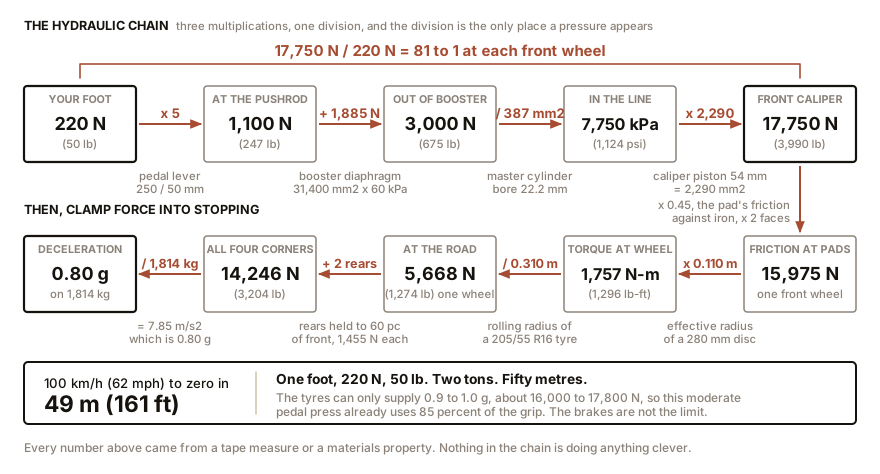
Take an ordinary car: 1,814 kg (4,000 lb), which is two short tons, with disc brakes at all four corners and a vacuum booster. Every number below is typical rather than universal, and Section 7 tells you how to measure your own.
Link one: the pedal is a lever, before it is anything hydraulic.
The pedal pivots near the top. Your foot presses near the bottom. The pushrod to the booster is attached partway up. Measure from the pivot to your foot, and from the pivot to the pushrod, and divide.
distance pivot to foot pad      250 mm  (9.8 in)
distance pivot to pushrod        50 mm  (2.0 in)
pedal ratio  =  250 / 50  =  5 to 1
A moderate pedal press of 220 N, which is 22 kg or 50 lb, becomes:
220 N x 5 = 1,100 N (247 lb) at the pushrodLink two: the vacuum booster multiplies again, and it does so using nothing but the engine’s own throttling losses.
A running petrol engine at part throttle has a partial vacuum in its intake manifold, typically 60 kPa (8.7 psi) below atmospheric. The booster is a large flat can behind the pedal containing a diaphragm, with that vacuum on the front side and, when you press the pedal, atmospheric air admitted to the back side. So the atmosphere pushes the diaphragm forward.
diaphragm diameter               200 mm  (7.9 in)
diaphragm area                31,400 mm2  (48.7 in2)
force  =  0.060 N per mm2  x  31,400  =  1,885 N   (424 lb)
Add the two together:
1,100 + 1,885 = 2,985 N, call it 3,000 N (675 lb)Boost ratio about 2.7, which is typical, and the number people mean when they say a car has “power brakes”. Note carefully what the booster is: it is a pneumatic actuator, working at a pressure below atmospheric, in the middle of a hydraulic system. Chapter 7 is being useful in a place nobody expects it.
Link three: the master cylinder turns force into pressure.
master cylinder bore           22.2 mm  (0.875 in)
area                              387 mm2  (0.600 in2)
pressure  =  3,000 N / 387 mm2  =  7.75 MPa  =  7,750 kPa   (1,124 psi)
Seven and three quarter megapascals, from a foot. That is a quarter of an excavator’s working pressure, in a family car, in a system you can open with a spanner.
Link four: the caliper pistons turn pressure back into force, and this is where the area ratio pays out.
front caliper piston           54 mm  (2.13 in)
area                        2,290 mm2  (3.55 in2)
clamp force  =  7.75 x 2,290  =  17,750 N   (3,990 lb)

rear caliper piston            38 mm  (1.50 in)
area                        1,134 mm2  (1.76 in2)
clamp force  =  7.75 x 1,134  =   8,790 N   (1,976 lb)
And now the headline number. From your foot to one front pad:
17,750 N / 220 N = 81 to 1Eighty-one to one, at each front wheel. Summed across all four corners the total clamp force is 53,080 N, which is 5,410 kg or 11,930 lb, or 241 times what your foot supplied. That larger figure is honest but slightly misleading, because it is four separate jobs rather than one, which is why 81 to 1 is the number to remember.
Section 2: From Clamp Force to Stopping, Which Is the Part Usually Left Out
Clamping the disc is not stopping the car. Three more steps, and they are where the tagline is actually settled.
Step one: friction at the pad. A modern pad’s coefficient of friction against cast iron is about 0.45, and a disc has a pad on each side, so:
front: 0.45 x 17,750 x 2 = 15,975 N of friction forceStep two: friction force times the radius it acts at gives torque. On a 280 mm (11 in) disc with the pad covering the outer part of the face, the effective radius is about 110 mm (4.3 in):
front torque per wheel = 15,975 N x 0.110 m = 1,757 N-m (1,296 lb-ft)Step three: torque divided by the tyre’s rolling radius gives force at the road. A 205/55 R16 tyre rolls at a radius of about 310 mm (12.2 in):
front force at the road, per wheel = 1,757 / 0.310 = 5,668 N (1,274 lb)The rears get less on purpose, for the reason in Section 6, so assume a proportioning valve holding the rear pressure to 60 percent of the front:
rear clamp    =  0.60 x 8,790   =   5,274 N
rear friction =  0.45 x 5,274 x 2  =  4,747 N
rear torque   =  4,747 x 0.095 m   =    451 N-m   (333 lb-ft)
rear force at the road, per wheel  =  451 / 0.310  =  1,455 N   (327 lb)
Total retarding force at the road:
2 x 5,668 + 2 x 1,455 = 14,246 N (3,204 lb)And the deceleration:
14,246 N / 1,814 kg = 7.85 m/s2 = 0.80 gStopping distance from 100 km/h (62 mph), which is 27.8 m/s:
distance  =  velocity squared / ( 2 x deceleration )
          =  771.6 / 15.7  =  49 m   (161 ft)
Two tons, from motorway speed, in fifty metres, on a fifty-pound push. That is the tagline answered, and every number in it came from either a tape measure or a materials property.
One more check, and it is the interesting one: is the road even willing to supply 14,246 N? A good tyre on dry asphalt manages about 0.9 to 1.0 g, so the total grip available on a 1,814 kg (4,000 lb) car is around 16,000 to 17,800 N. So the brakes are producing about 85 percent of the available grip at a moderate pedal effort, which is exactly where a designer aims: hard enough that ordinary braking is comfortable, with enough left that a genuine emergency stop, at a pedal force of 400 to 600 N, which is 41 to 61 kg or 90 to 135 lb, reaches the tyre limit and the anti-lock system takes over.
The brakes are not the limit. The tyres are. That is true of every road car built in the last forty years, and it is why brake upgrades sold on the basis of stopping distance are usually selling something else, namely resistance to fade, which Section 5 is about.
IN PLAIN ENGLISH: Your foot pushes a lever, which pushes a big air-powered helper, which pushes a small piston into a closed system of fluid. Because the fluid’s pressure is the same everywhere, that pressure appears at four much bigger pistons out at the wheels, and each of them pushes with a force as many times bigger as its area is bigger. Then friction turns that squeeze into a twist on the wheel, and the tyre turns the twist into a shove against the road. Four multiplications and one division, and nothing anywhere in the chain is doing anything clever.
Section 3: Why Hydraulic Rather Than Cable
Cables were used, on cars, into the 1930s, and they were abandoned for reasons that are all Pascal’s law doing a job nothing else does as well.
Pressure is equal everywhere in a connected fluid, so both wheels on an axle receive identical pressure automatically, with no adjustment, forever. A cable system must be balanced with adjusters, and it goes out of balance as the cables stretch and the linkages wear, and an unbalanced brake pulls the car sideways under braking. Hydraulics is self-equalising by physics rather than by maintenance.
A fluid line goes round corners a cable cannot. A brake line routes along the chassis rail, over the axle, through a bulkhead and down a moving suspension arm, and loses nothing to friction at any of those bends. A cable in a curved conduit loses force to friction at every bend, and the loss changes with dirt, water and age.
And the ratio can be chosen freely. The master cylinder bore and caliper piston sizes are two independent numbers a designer picks from a catalogue. Getting an 81 to 1 ratio out of mechanical linkage would need a train of levers with nowhere to fit.
The one thing a cable does better is hold, which is Section 8.
Section 4: The Tandem Master Cylinder, Which Is Genuinely Elegant
A single hydraulic circuit has one intolerable property: one leak and you have no brakes at all. Anywhere in the system. One corroded line, one perished flexible hose, one caliper seal.
The fix, mandatory on cars since the 1960s, is the tandem master cylinder, and it is a lovely piece of engineering because it puts two independent circuits inside one bore, in series.
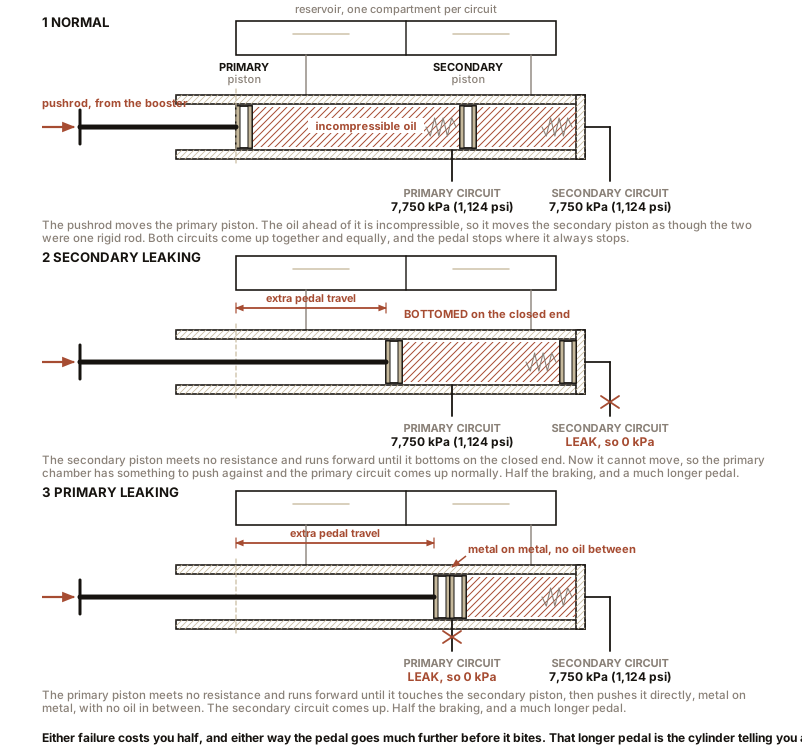
Picture the bore with two pistons in it, one behind the other. The primary piston is the one the pushrod hits. Ahead of it is a chamber feeding one circuit. Ahead of that chamber sits the secondary piston, and ahead of that is a second chamber feeding the other circuit.
In normal operation the primary piston moves, the fluid ahead of it is incompressible, so it pushes the secondary piston, and both circuits pressurise together and equally. The fluid column is the mechanical link, and Chapter 7 is why it works: oil compresses 0.5 percent per 6,900 kPa (1,000 psi), so the two pistons move essentially as one rigid assembly.
Now break one circuit and follow it through.
If the secondary circuit leaks, the secondary piston meets no resistance and is simply pushed forward until it bottoms against the far end of the cylinder. Now it cannot move, so the primary chamber’s fluid has something to push against, and the primary circuit pressurises normally. You have lost half your braking and gained a longer pedal.
If the primary circuit leaks, the primary piston meets no resistance and travels forward until it makes mechanical contact with the secondary piston, and then pushes it directly, rod to piston, with no fluid in between. The secondary circuit pressurises. Again: half the braking, longer pedal.
Either failure costs you half, and either way the pedal tells you. A pedal that suddenly goes much further before biting is the tandem master cylinder announcing that one circuit has gone, and it is the single most important thing a driver can be taught to recognise.
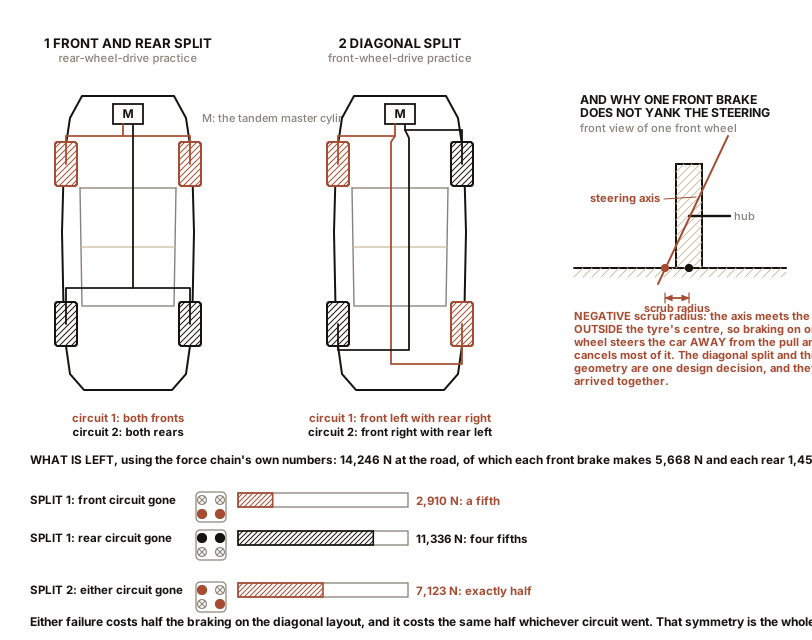
Front/rear split against diagonal split. On a rear-wheel-drive car the traditional arrangement is front circuit and rear circuit. That has an unpleasant asymmetry: the front brakes do 70 to 80 percent of the work, so losing the front circuit leaves you with a fifth of your braking: 2,910 of the 14,246 N we just worked out, which is 0.16 g.
So front-wheel-drive cars almost all use a diagonal split: one circuit is the front left and rear right, the other is the front right and rear left. Lose either circuit and you keep one front brake, so you keep roughly half the braking, whichever circuit failed.
The obvious objection is that braking on one front wheel should yank the steering violently to that side. It does not, much, and the reason is a piece of suspension geometry: front-wheel-drive cars are given a negative scrub radius, which arranges the steering axis so that a braking force on one wheel produces a steering torque that turns the car away from the pull, cancelling most of it. The diagonal split and the negative scrub radius are one design decision, and they arrived together.
Section 5: Two Ways the Fluid Itself Ruins Everything
First, the bubble, and this is Chapter 2’s experiment with your foot instead of your thumb.
Air is compressible and brake fluid is not. So pedal travel that should be moving caliper pistons goes into squashing air instead. Put a number on it.
The whole system’s normal working displacement is small. Caliper pistons move only enough to take up pad clearance and caliper flex, perhaps 0.15 mm (0.006 in) each, so the total fluid the master cylinder actually has to deliver in a firm stop is only 3 to 5 mL.
Now introduce 1 mL of air. Compress it from atmospheric to the working 7,750 kPa (1,124 psi) gauge, which is 7,851 kPa absolute:
1 mL x 101 / 7,851 = 0.013 mLSo 0.987 mL of extra fluid has to be pushed to make room, on a master cylinder bore of 22.2 mm (0.875 in) whose area is 387 mm²:
987 mm3 / 387 mm2  =  2.55 mm of extra master cylinder travel
x 5 (the pedal ratio)  =  12.8 mm  (0.5 in)  of extra pedal travel
Half an inch of extra pedal on a system whose entire useful displacement was 3 to 5 mL. And it is worse than the total suggests, because the compression happens first and at low pressure. At only 1,000 kPa (145 psi) the bubble has already shrunk to 0.092 mL, meaning 90 percent of the lost travel is consumed before the brakes have generated an eighth of their pressure.
Which is exactly the feel: a soft first half of the pedal and a firm second half. That is Chapter 2’s syringe, in a car. Bleeding brakes stops being a ritual and becomes obvious.
Second, and worse, because it happens with no air in the system at all: the fluid boils.
Brake fluid, DOT 3, DOT 4 and DOT 5.1, is a glycol ether. And glycol ethers are hygroscopic: they absorb water out of the air, through the reservoir cap’s vent, through the flexible hoses, and through every seal, continuously, for the life of the fluid. A typical system absorbs enough to reach about 3 percent water by volume in two years.
Water lowers the boiling point, and the specifications quote both figures for exactly this reason:
| Fluid | Dry boiling point | Wet boiling point, at 3.7 percent water |
|---|---|---|
| DOT 3 | 205 °C (401 °F) | 140 °C (284 °F) |
| DOT 4 | 230 °C (446 °F) | 155 °C (311 °F) |
| DOT 5.1 | 260 °C (500 °F) | 180 °C (356 °F) |
| DOT 5, silicone | 260 °C (500 °F) | 180 °C (356 °F) |
Now consider a long descent with heavy braking. The disc reaches 400 to 600 °C (750 to 1,110 °F), the caliper body conducts that heat into the piston, and the fluid sitting in the caliper reaches 150 to 180 °C (300 to 356 °F).
Two-year-old DOT 4 boils at 155 °C. And when it boils, you have created vapour inside an incompressible system. Vapour compresses, magnificently, and Chapter 7 says by how much. So:
The pedal goes to the floor with the brakes in perfect mechanical condition. New pads, new discs, no leaks, nothing worn. That is a species of brake fade no amount of pad quality prevents, and it is why brake fluid is a service item with a date on it rather than a fluid you top up and forget.
DOT 5 is silicone, and it catches people out, so state the differences plainly. It is not hygroscopic, which is its whole selling point, and it does not attack paint. It is not interchangeable with glycol fluid: mixing them produces a gelatinous mess. It is more compressible than glycol fluid, which gives a softer pedal. It aerates readily and is difficult to bleed, because entrained bubbles do not rise out of it quickly. And it does not absorb water, which means any water that does get in stays as free water which pools at the lowest point and corrodes or freezes there, rather than being carried harmlessly in solution. The fluid that will not absorb water has to be kept absolutely dry, which is a harder ask in a road car than changing the fluid every two years.
And why not mineral oil? Because the seals in a brake system are EPDM and styrene-butadiene rubbers, chosen for their temperature resistance, and mineral oil swells them until they jam or extrude. Citroën’s hydropneumatic cars famously use a green mineral fluid called LHM throughout, and they do it by specifying entirely different seal materials in every component. The fluid and the seals are one decision, which is Chapter 9’s point about phosphate esters appearing again.
That is the chain, end to end, and the question on this volume’s cover is now answered. What remains is everything that can go wrong with it.

Bench Degree
Get the degree without the diploma.
Learn the material, not how to pass the exam.