Bench Degree·FLUID POWERchapter

Chapter 17: The Factory Floor
Compressed air is the most expensive utility in most factories, costing seven to eight times what the same delivered energy costs as electricity. And it is used everywhere anyway, for four reasons that are all worth the money.
Walk through any assembly plant, bottling line, packaging hall, bakery or press shop and you will hear the same sound: the hiss of exhausting air, several times a second, from a hundred places at once. There will be a compressor room, a ring main of steel or aluminium pipe running round the building at ceiling height, and a drop with a filter and regulator on it at every station.
Almost none of it is hydraulic, and this chapter is about why, and about what it costs.
Section 1: The Four Reasons Air Wins Here
Speed. A pneumatic cylinder at 1 m/s (39 inches per second) is entirely ordinary, and with shock absorbers at the ends of stroke, 3 m/s (118 inches per second) is achievable. A hydraulic cylinder rarely goes above 0.5 m/s (20 inches per second), because Chapter 8’s velocity limits in the lines and Chapter 7’s stiffness make a fast hydraulic actuator hard to stop. A packaging line indexing thirty times a minute needs the fast one.
Compliance, which means being safe to stand beside. Chapter 7’s whole argument. A pneumatic actuator that traps a limb yields.
Be careful how you say that, though, because the reassuring version is false. A 50 mm (2.0 in) bore cylinder at 620 kPa (90 psi) pushes with:
0.62 N per mm2 x 1,963 mm2 = 1,217 N (274 lb)Two hundred and seventy-four pounds will break bones. A pneumatic actuator is not safe. What it is, is not progressively crushing: the trapped air compresses, so the force does not climb, and a person can often pull free or be pulled free. The same bore hydraulically at 21,000 kPa (3,045 psi) gives 41,200 N (9,260 lb) with no yield whatever, and that is a different category of event. The honest statement is that pneumatics reduces the severity of an accident, not the chance of one, and guarding is still guarding.
Cleanliness. A hydraulic leak in a food plant is a product recall. In a paint shop it is a rework. In a semiconductor fab it is a catastrophe. A pneumatic leak is a hiss. Combine that with oil-free compressors and the FR sets of Chapter 13, and pneumatics is the only sensible choice anywhere product is exposed.
And cost per actuator. A 25 mm (1.0 in) bore pneumatic cylinder is $30, a solenoid valve is $40, and the plumbing is push-fit tube you cut with snips. The hydraulic equivalent needs a power unit, hoses, crimped fittings, a filter, a cooler and a reservoir before the first actuator moves. For a plant with two hundred small actuators, air wins on capital cost before any other argument is made.
Section 2: Sizing, and the Mistake Everybody Makes
Pneumatic sizing has one rule that is different from hydraulics: do not use more than half the cylinder’s theoretical force.
The reason is that a pneumatic actuator has to accelerate its load, and the air pressure behind the piston takes time to build because the air is compressible and the valve and tubing are restrictions. A hydraulic cylinder sized at 90 percent of its theoretical force works. A pneumatic cylinder sized that way is sluggish, arrives late, and stalls if anything is slightly tight. The industry rule of thumb is a load ratio of 50 percent for a moving load and 70 percent for a static clamp.
Work an example. A pick-and-place must move a 2 kg (4.4 lb) part 200 mm (7.9 in) in 0.3 seconds.
acceleration  =  2 x distance / time squared  =  2 x 0.2 / 0.09  =  4.44 m/s2
force to accelerate  =  2 kg x 4.44  =  8.9 N
plus friction and seal drag, call the requirement  20 N
at 50 percent load ratio, theoretical force needed  =  40 N
area at 500 kPa working pressure  =  40 / 0.5  =  80 mm2
bore  =  10 mm  (0.4 in)
And then the mistake: the cylinder is correctly sized, and the machine is slow, and everybody blames the cylinder. The restriction is almost always the valve and the tubing. Air is compressible, so the cylinder cannot move faster than air can be delivered into it and, crucially, exhausted out of it. A cylinder of 10 mm (0.4 in) bore moving 200 mm (7.9 in) in 0.3 seconds needs its air in and out in a third of a second, and a valve with a small flow coefficient or a long run of 4 mm (0.16 in) tube cannot do it.
The practical rule: size the valve and the tube for the speed, and the cylinder for the force. They are separate calculations, and the exhaust path matters as much as the supply path. Fitting a larger valve and shorter, fatter tubing is the fix for a slow pneumatic actuator far more often than fitting a larger cylinder.
Section 3: The Air Consumption Arithmetic, Done Honestly
Now the money, and it needs Chapter 5’s warning about gauge and absolute pressure applied carefully, because getting it wrong here gives an answer that is too small by a factor of seven.
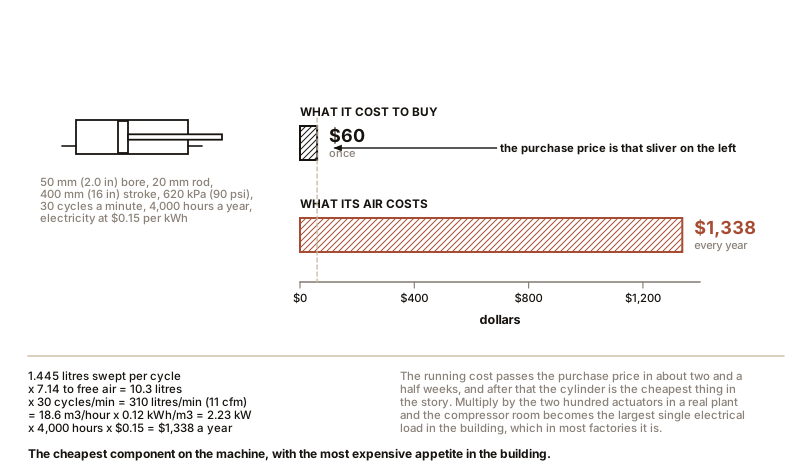
Take a 50 mm (2.0 in) bore cylinder with a 20 mm (0.79 in) rod and a 400 mm (16 in) stroke, running at 620 kPa (90 psi) gauge, cycling 30 times a minute. This is an utterly ordinary machine.
Step one: the swept volumes.
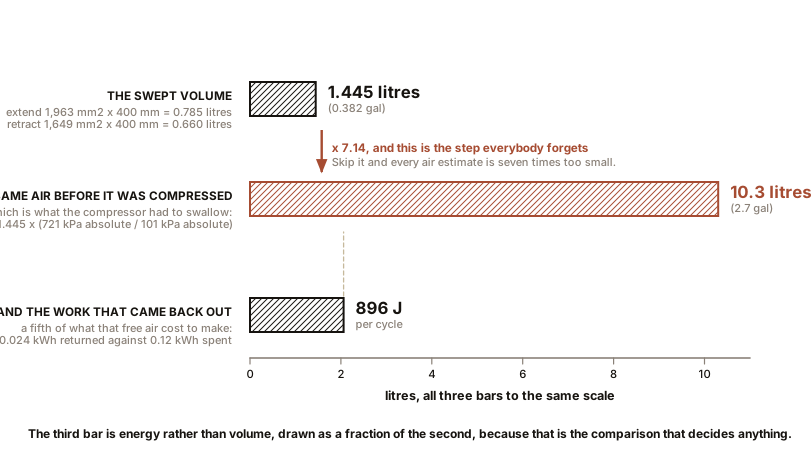
extend:   1,963 mm2 x 400 mm  =  785,000 mm3  =  0.785 litres  (0.207 gal)
retract:  1,649 mm2 x 400 mm  =  660,000 mm3  =  0.660 litres  (0.174 gal)
total per cycle, at line pressure  =  1.445 litres  (0.382 gal)
Step two, and this is the step people skip: convert to free air, meaning the volume that air occupied before it was compressed, because that is what the compressor had to swallow. Use absolute pressures:
1.445 litres x ( 721 kPa absolute / 101 kPa absolute ) = 10.3 litres (2.7 gal)Ten and a third litres of free air per cycle, from a cylinder whose total swept volume is one and a half.
Step three: the rate.
10.3 x 30 = 310 litres/min (11 cfm) of free air, from one cylinderStep four: the electricity. A good industrial compressor with a dryer needs about 0.12 kWh per cubic metre of free air delivered at 700 kPa (102 psi). So:
0.310 m3/min  x  60  =  18.6 m3/hour
18.6  x  0.12  =  2.23 kW
Step five: the bill. At 4,000 running hours a year and $0.15 per kWh:
2.23 kW x 4,000 x 0.15 = $1,338 per yearOne thousand three hundred dollars a year, for one $60 cylinder. Multiply by the two hundred actuators in a real plant and the compressor room becomes the largest single electrical load in the building, which in most factories it is.
Section 4: Where the Factor of Seven Comes From
The “seven to eight times electricity” figure gets quoted constantly and rarely explained. Here is the chain, with each link’s honest efficiency.
Link one: the compressor. The theoretical minimum work to compress a cubic metre of air from 101 kPa (14.7 psi) to 721 kPa (105 psi) absolute, slowly enough to stay at constant temperature, is:
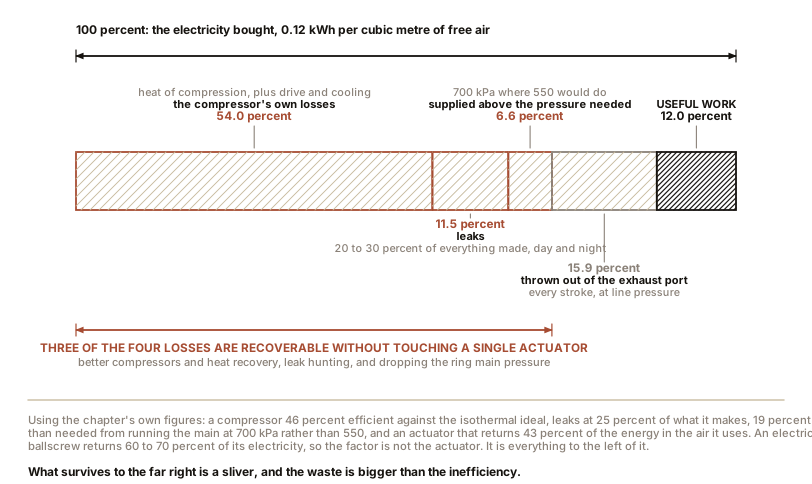
101,000 Pa x 1 m3 x ln(7.14) = 199 kJ = 0.055 kWhReal compressors use about 0.12 kWh, so a compressor is roughly 46 percent efficient against the ideal. That is not bad engineering; it is the unavoidable heat of compression plus motor, drive and cooling losses.
Link two: the actuator. The cylinder above did mechanical work of:
extend:  1,217 N x 0.4 m  =  487 J
retract: 1,022 N x 0.4 m  =  409 J
total  =  896 J per cycle, per 10.3 litres of free air
Which is 87 kJ per cubic metre of free air, or 0.024 kWh. Against the 0.12 kWh it cost to make, the actuator returns 20 percent. The other 80 percent goes out of the exhaust port as pressurised air that is simply thrown away, and Chapter 7 already gave that number: 896 J per litre of compressed air, exhausted every cycle.
So the best case, end to end, is about 20 percent. An electric actuator on a ballscrew converts perhaps 60 to 70 percent of its electricity into mechanical work. That is a factor of three, not seven.
Link three, which supplies the rest of the factor, is the part that is management rather than physics.
Leakage. In an unmanaged compressed air system, 20 to 30 percent of everything the compressor makes leaks out, twenty-four hours a day, whether the plant is running or not. Air leaks are invisible, they are audible only in a quiet building, and they cost nothing to ignore.
Artificial demand. Every actuator fed at 700 kPa (102 psi) when it needs 400 kPa (58 psi) consumes air in proportion to absolute pressure, so it is wasting a third of its air for nothing.
And use as a substitute for a fan or a broom. Open blow-guns for cleaning, open pipes for cooling, and air used to move product are all enormously expensive ways to do a job a 100 W fan would do.
Add those and the practical delivered cost of compressed air reaches the seven or eight times figure honestly. Which produces the single most useful conclusion in this chapter: most of the money in compressed air is recoverable without changing any actuator, because most of it is being lost to leaks, to over-pressure, and to uses air was never appropriate for.
IN PLAIN ENGLISH: Air is expensive because you pay to squeeze it and then throw the squeeze away out of the exhaust port every single stroke. That is unavoidable and it costs about three times what an electric motor would. Then most factories waste two or three times again by leaking it, by supplying it at a higher pressure than anything needs, and by using it to blow dust off things. The waste is bigger than the inefficiency.
ON THE BENCH: Find your own leak rate, in dollars
Parts: your compressor and its gauge; a stopwatch; the tank volume off the sticker. Cost: nothing. Time: 30 minutes, and do it at the end of a working day. Hazards: none. Method: run the compressor up to its cut-out pressure. Switch it off at the wall. Close every tool and every valve you would normally close, but leave the pipework and the drops connected exactly as they are in use. Now time how long the pressure takes to fall by 100 kPa (14.5 psi). The arithmetic: the free air lost is the tank volume times the pressure drop divided by atmospheric pressure. For a 50 litre (13 gal) tank losing 100 kPa (14.5 psi):
50 x 100 / 101 = 49.5 litres of free air lost (13 gal)If that took 10 minutes, the leak rate is 5 litres/min, which is 1.3 gal/min or 0.18 cfm. If it took 30 seconds, it is 99 litres/min, which is 26 gal/min or 3.5 cfm. Then convert it to money:litres/min x 60 / 1,000 x 0.12 kWh/m3 x hours per year x price per kWh. A leak of 99 litres/min (26 gal/min) running 8,760 hours a year at $0.15 costs $937 a year. What you should see: on a domestic setup, minutes to lose 100 kPa (14.5 psi). On a small workshop with a few drops and some quick-release couplings, seconds. The commonest culprits, in order: quick-release couplings, push-fit tube fittings that were disturbed, FRL drain valves left slightly open, and the tank drain itself. Then hunt them. Spray soapy water on every fitting with the system pressurised and watch for bubbles. A cheap ultrasonic leak detector finds them faster and is a genuinely useful $60. And notice how big a hole this is: a single 1 mm (0.04 in) hole at 700 kPa (102 psi) passes about 71 litres/min (2.5 cfm) of free air, which is 0.51 kW of compressor power running continuously, which is about $670 a year. A hole you can barely see costs more per year than the compressor did.
ON THE BENCH: Turn the pressure down and see if anything notices
Parts: the regulator on any pneumatic tool or machine; the tool; the job it normally does. Cost: nothing. Time: 20 minutes. Hazards: do not reduce the pressure on anything whose function is safety-related, such as a clamp holding a workpiece in a press, without understanding the consequence. Reducing air pressure to a clamp reduces clamping force in exact proportion. Method: note the current setting. Reduce it in 50 kPa (7 psi) steps, doing the real job at each step, until the tool or actuator is genuinely no longer adequate. Then set it one step above that. What you should see: most tools and most actuators are being fed 100 to 200 kPa (15 to 29 psi) more than they need, because whoever set the regulator turned it up until the problem went away and then left it. The saving, and it is worth computing: air consumed is proportional to absolute pressure, so dropping from 700 to 550 kPa (102 to 80 psi) gauge takes the absolute pressure from 801 to 651 kPa, which is 19 percent less air for the same stroke. Separately, the compressor itself uses roughly 7 percent less energy for every 100 kPa (14.5 psi) it does not have to produce. And the diagnostic value is greater than the saving. A tool that stops working when the pressure is reduced slightly was operating at its limit, and it will fail on the day the plant’s demand peaks. Finding out how much margin you have is worth more than the electricity.
Section 5: The Safety Items That Are Specific to Air
Two, and they are both about stored energy rather than pressure.
An isolated pneumatic circuit is still a charged pneumatic circuit. Turn off the supply valve to a machine and every cylinder, every reservoir, every length of tube downstream still holds 620 kPa (90 psi). If the machine has an actuator held up by air, closing the supply does not lower it, and opening a fitting will move it. Modern isolation valves for pneumatics are therefore three-port: they close the supply and simultaneously exhaust the downstream circuit to atmosphere. A plain ball valve is not an isolator, and this is written into the machinery safety standards for exactly this reason.
And soft start. A machine that has been exhausted and is then re-pressurised gets full pressure into every cylinder at once, and cylinders that were left in mid-stroke slam to one end. A soft-start valve fills the circuit slowly through a restrictor until the pressure is most of the way up and then opens fully, which prevents that first violent movement. Every well-built pneumatic machine has one immediately after the isolator, and its absence is a common finding on machines assembled in a hurry.
SLOW DOWN. Check Your Understanding: A plant manager is told compressed air costs eight times what electricity does, and proposes replacing all two hundred pneumatic actuators with electric ones. Using this chapter, give the two strongest arguments against doing that, and say what you would do first instead. Answer before reading on.
First argument: the factor of eight is mostly not the actuators. Section 4 breaks it down: the actuator chain is about three times worse than electric, and the rest of the factor is leakage, over-pressure and misuse. Replacing the actuators addresses the smaller half of the problem and leaves the larger half in place, and the plant would still be leaking a quarter of its compressor output because the compressor would still be there for the remaining uses.
Second argument: capital, and the four reasons in Section 1. Two hundred electric actuators with drives, cabling, controllers and cabinets is a very large number, and for each one the questions in Section 1 have to be re-answered. Is it fast enough? An electric actuator matching 3 m/s (118 inches per second) is expensive. Is it clean enough? An electric actuator in a wash-down food area needs sealing that pneumatics gets for nothing. And can a person stand beside it? An electric actuator on a ballscrew is stiff and does not yield, which puts it in the same category as the hydraulic cylinder in Section 1.
What to do first, in order of return on effort: find and fix the leaks, which is Section 4’s experiment and costs a person’s time; reduce the ring main pressure to the lowest the plant tolerates, and fit regulators at the drops that do not have them; eliminate open-blow and cooling uses, which are the most expensive air in the building; fit automatic drains; and only then look at the largest and highest-duty actuators individually, because on a machine cycling continuously the electric conversion genuinely pays and on one cycling twice an hour it never will. The general lesson is that a plant-wide efficiency figure is an average of things with wildly different economics, and averages are a poor basis for a capital decision.
Air is the right answer where speed, cleanliness and compliance matter and force does not. The next chapter is the hydraulic system you already own, operate several times a day, and are more likely to work on yourself than any other machine in this book.

Bench Degree
Get the degree without the diploma.
Learn the material, not how to pass the exam.