Bench Degree·FLUID POWERchapter

Chapter 9: Choosing the Fluid
Oil grade looks like a chemistry decision and is really a temperature decision. And on the air side there is a fact nobody mentions until it has ruined something: a working compressor makes several litres of water a day.
The fluid in a hydraulic system has six jobs, and only the first one is obvious.
Transmit power, which is what the last four chapters have been about.
Lubricate. A pump’s gears, a piston pump’s slippers, a valve spool in its bore: all of these are metal sliding on metal at high load, and the only thing between them is the working fluid. A hydraulic pump is a machine lubricated by the substance it is pumping, which is why the wrong fluid destroys the pump rather than merely performing badly.
Cool. The oil is the coolant, carrying Chapter 8’s heat from wherever it was generated back to the tank.
Seal. Fluid films in the clearances inside a pump and a valve are what stop leakage past them. Thinner fluid, more internal leakage.
Protect. Steel components sitting in a bath of fluid for twenty years must not rust, and additives do that job.
And carry debris to the filter, which is how a system stays clean rather than grinding itself up.
Any fluid that is wrong for one of the six will eventually break the machine even if it is perfect at the other five.
Section 1: Viscosity, and the Number on the Drum
Viscosity is resistance to being sheared. Thick oil has high viscosity; water has low. The working measure is kinematic viscosity, quoted in centistokes, abbreviated cSt, which happens to be square millimetres per second.
The industrial grading is ISO VG, and it is beautifully simple: the grade number is the fluid’s kinematic viscosity in cSt at 40 °C (104 °F). ISO VG 46 is 46 cSt at 40 °C. The common hydraulic grades are VG 22, 32, 46 and 68, and the label on the drum usually reads something like “AW 46”, where AW stands for anti-wear.
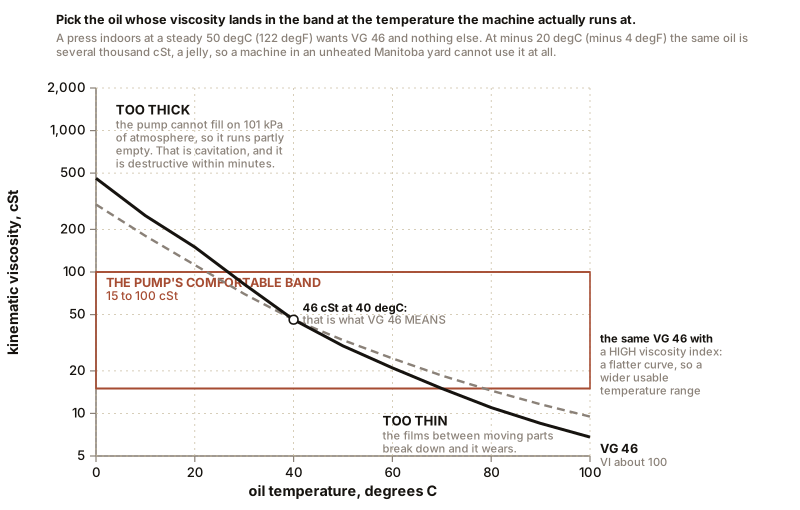
And here is why the number alone tells you almost nothing. Viscosity collapses as temperature rises. A typical VG 46 mineral hydraulic oil looks like this:
| Temperature | Viscosity |
|---|---|
| 0 °C (32 °F) | about 420 cSt |
| 20 °C (68 °F) | about 110 cSt |
| 40 °C (104 °F) | 46 cSt, by definition |
| 60 °C (140 °F) | about 22 cSt |
| 80 °C (176 °F) | about 12 cSt |
| 100 °C (212 °F) | about 6.8 cSt |
A factor of sixty across the range a real machine sees between a January morning and a hard afternoon.
Now put the machine’s requirements next to that. A pump has a viscosity window and both ends of it are hard limits.
Too thin, below roughly 10 cSt, and the fluid films in the clearances break down. Internal leakage rises, so the pump delivers less flow. Metal touches metal, so it wears. This is what a hot machine is suffering from.
Too thick, above roughly 800 to 1,000 cSt, and the pump cannot fill. Remember Chapter 5: the inlet has only atmospheric pressure to push oil into the pump, and thick oil will not flow through a suction line fast enough on that allowance. The pump runs partly empty, which is cavitation, and it is destructive within minutes. This is what a cold machine is suffering from, and it is why heavy plant is idled to warm up rather than worked from cold out of superstition.
The comfortable band for most pumps is 15 to 100 cSt, and vane and piston pumps are fussier than gear pumps.
So the grade choice is: pick the oil whose viscosity lands in the pump’s window at the temperature the machine actually runs at. A press indoors at a steady 50 °C (122 °F) wants VG 46. A machine in an unheated Manitoba yard, starting at minus 20 °C (minus 4 °F), cannot use VG 46 at all, because at that temperature it is a jelly of several thousand cSt.
Section 2: Viscosity Index, Which Is the Flatness of That Curve
The second number on a datasheet, and it is the one that solves the problem above.
Viscosity index, or VI, measures how little the viscosity changes with temperature. A high number means a flat curve.
- Plain mineral hydraulic oil: VI around 95 to 105.
- High-VI or multigrade hydraulic oil, with polymer VI improvers: VI 140 to 200.
- Some synthetic esters go higher still.
A VG 32 oil with a VI of 190 might be 320 cSt at 0 °C (32 °F) instead of 420, and 8 cSt at 100 °C (212 °F) instead of 6, which does not sound dramatic until you realise it is the difference between a machine that works from cold and one that does not.
This is exactly the same idea as multigrade engine oil, and it is the same chemistry doing it: long-chain polymers that coil up when cold and uncoil when hot, propping up the hot viscosity. And it has the same weakness, which datasheets do not advertise: VI improver polymers get chopped up by shear. Pass a high-VI oil through a pump and a servo valve a few million times and the polymer chains break, the VI falls back toward the base oil’s, and the oil quietly loses the property you paid for. This is called shear stability, it is measured by standard tests, and it is a real service consideration in high-pressure systems.
IN PLAIN ENGLISH: Every oil gets thin when hot and thick when cold. The grade number tells you how thick it is at one particular temperature, and that is useless on its own, because your machine is not always at that temperature. The second number tells you how much the oil changes as it heats and cools. Choosing hydraulic oil is choosing a fluid that will still be inside the pump’s happy range on both the coldest morning and the hottest afternoon the machine will ever see.
Section 3: Why Not Water
Water is free, non-flammable, harmless, has twice oil’s specific heat, and a bulk modulus 45 percent higher, which makes it stiffer and therefore better at the one thing Chapter 7 says hydraulics is for. Chapter 3’s entire utility ran on it. So the question deserves a real answer rather than a shrug.
Water lubricates badly, and this is the decisive one. Lubrication at high load is not about being slippery; it is about maintaining a load-bearing film between two surfaces that are trying to touch. Water’s film collapses under pressure and it has no additive chemistry that fixes this the way oil’s does. A gear pump running on plain water wears out its own gear tips in hours.
Water is far too thin. About 1 cSt at 20 °C (68 °F), against oil’s 110. Every clearance inside a pump and a valve was sized for a fluid a hundred times thicker, so a water-filled system leaks internally everywhere at once and cannot build pressure efficiently.
Water rusts steel, and a hydraulic system is mostly steel with precision surfaces on it. Rust is both a leak path and a source of hard abrasive particles.
Water’s temperature range is 0 to 100 °C (32 to 212 °F) and both ends are hard stops. It freezes and bursts the pipes, and it boils, and vapour inside a supposedly incompressible system is the failure Chapter 18 describes in brake fluid.
And water grows things. Bacteria and algae in a warm recirculating water system produce slime that blocks filters and orifices.
Where water is used anyway, and why. Chapter 3’s mains were open-loop, disposable, low-pressure and made of generously sized iron, which sidesteps most of the list. Modern water hydraulics exists as a real product category for food processing, where a leak of oil is a contamination incident, and it works by using ceramic and stainless components with clearances designed for a 1 cSt fluid. And it is the fluid chosen for the robot in Chapter 23, for the single reason that the machine is meant to work beside people and may leak. The trade runs the other way when the failure mode is a person rather than a pump.
Section 4: The Fluids That Are Not Mineral Oil
Four families, each existing for one specific reason.
Fire-resistant fluids, used where a hydraulic leak would meet something hot. Steel mills, foundries, die casting, underground mining, and aircraft. The classification is by water content.
- HFA, a 5 percent oil in 95 percent water emulsion. Very fire resistant, very cheap, poor lubricity, low pressure only. Mining.
- HFB, water in oil, about 40 percent water.
- HFC, water-glycol, typically 35 to 45 percent water. The common industrial choice. Its limitations are all downstream of the water: lower maximum pressure, lower temperature ceiling, and the water evaporates and must be checked and topped up.
- HFD, water-free synthetics, mostly phosphate esters. This is what airliners use, sold under names like Skydrol. Excellent fire resistance, excellent lubricity, very good temperature range, and three real problems: it is expensive, it attacks ordinary nitrile seals and most paint so the whole system must be specified for it, and it is unpleasant stuff to handle.
Biodegradable fluids, used where a leak goes into the environment. Forestry machines, marine deck equipment, lock gates, farm equipment near watercourses. Synthetic esters, called HEES, and vegetable oils, called HETG. They work well; vegetable-based ones oxidise faster and dislike being left to stand.
Automatic transmission fluid and engine oil, which appear in hydraulic systems constantly, sometimes correctly. Many mobile machines specify ATF or a 10W engine oil, and that is a legitimate manufacturer’s choice reflecting a shared reservoir with a transmission. Putting engine oil into a system specified for AW hydraulic oil is not equivalent, mostly because engine oil carries detergents designed to hold combustion soot in suspension, and a detergent that holds particles in suspension is precisely the opposite of what a hydraulic system’s filters want.
And brake fluid, which is a glycol ether and has its own chapter, because the reason it is not mineral oil is one of the more interesting bits of engineering in this book. Chapter 18.
Section 5: Compressed Air Is Wet, and the Numbers Are Larger Than You Expect
Now the other fluid, and the fact that catches out every workshop.
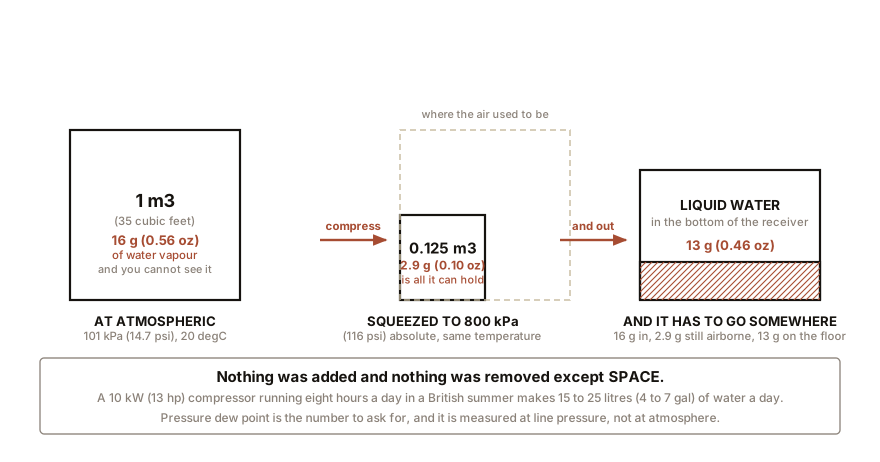
Atmospheric air contains water vapour, and compressing air does not remove it. It concentrates it.
Follow one cubic metre of shop air, drawn in at 25 °C (77 °F) and 70 percent relative humidity. Saturated air at 25 °C holds about 23 g (0.81 oz) of water per cubic metre, so at 70 percent it holds about 16 g (0.56 oz).
Compress it to 800 kPa (116 psi) absolute and its volume falls to one eighth, 0.125 m³ (4.4 ft³). Cool it back to 25 °C (77 °F) in the aftercooler. That eighth of a cubic metre can now hold only 2.9 g (0.10 oz) of vapour. The other 13 g has nowhere to go and condenses into liquid water.
Thirteen grams per cubic metre of air drawn in. Now scale it to a real machine. A modest shop compressor delivering 1,000 litres/min, which is 35 cubic feet per minute of free air, is drawing one cubic metre a minute:
13 g/min x 60 x 8 = 6,240 g = 6.2 litres (1.6 gal) per eight-hour shiftSix litres of water a day out of a small compressor. That water goes somewhere, and the somewhere is your air lines, your tools and your work, unless you deal with it.
What it does: rusts the inside of steel pipework and produces rust flakes that jam valves; washes the lubricant off air tool vanes; ruins spray paint finishes; blows moisture into food and pharmaceutical packaging; and in an unheated building it freezes in the exhaust ports of valves in winter, which is the classic January fault on an outdoor pneumatic installation.
The four things that remove it, in order of cost:
The tank itself, which is the cheapest dehumidifier you own. Air slows down and cools in the receiver, water falls out, and it sits in the bottom. Every receiver has a drain at its lowest point and it is there to be opened. A manual drain opened daily, or better an automatic float or timer drain, is the single highest-value maintenance action in a pneumatic shop.
An aftercooler, a small radiator on the compressor outlet, which removes 60 to 70 percent of the water by cooling the air before it reaches the receiver.
A refrigerated dryer, which chills the air to about 3 °C (37 °F) and drains the condensate, giving a pressure dew point of around 3 °C. That means the air will not condense further unless something downstream gets colder than 3 °C (37 °F), which for an indoor shop is enough.
A desiccant dryer, twin towers of adsorbent that are alternately used and regenerated, reaching a pressure dew point of minus 40 °C (minus 40 °F) and lower. Needed for instrumentation, outdoor lines in freezing climates, and anything touching food or medicine. It costs air to run, because regenerating one tower uses a percentage of the flow.
Pressure dew point is the number to ask for, and it is measured at line pressure, not at atmosphere. A dryer quoted at a dew point of 3 °C (37 °F) at 700 kPa (102 psi) is not giving you 3 °C once the air expands at the tool, and confusing the two is a common specification error.
ON THE BENCH: Measure the water your compressor makes
Parts: any compressor with a tank drain; a measuring jug; a note of the running hours. Cost: nothing. Time: a week of noticing. Hazards: open the drain with the tank pressurised only if the drain is designed for it, standing to one side, wearing eye protection. The blast is loud and carries grit. Safer: depressurise the tank first, then drain. Method: drain the tank completely and note the date. Use the compressor normally for a week. Then drain into the jug and measure. What you should see: on a small hobby compressor used lightly, perhaps 50 to 200 mL. On a shop compressor running most of the day, a litre or more, and it will be rusty brown. Compare it against the arithmetic above using your compressor’s rated free air delivery and its actual run hours. What to notice: the colour. That brown is the inside of your air receiver, and it is going down your air lines and into your tools.
ON THE BENCH: Viscosity, hot and cold, with a funnel
Parts: two different oils, for instance engine oil and sewing-machine or 3-in-1 oil; a small funnel or a plastic bottle with a 3 mm (0.12 in) hole in the cap; a stopwatch; a fridge; a bowl of hot tap water; a measuring cup. Cost: nothing. Time: an hour, mostly waiting for the oil to reach temperature. Hazards: hot water only, not a stove. Oil on a floor is a slip hazard. Method: measure a fixed volume, say 100 mL, and time how long it takes to run through the hole. Do each oil at three temperatures: straight out of the fridge at about 5 °C (41 °F), at room temperature, and after standing in hot tap water at about 55 °C (131 °F). What you should see: for a 15W-40 engine oil, something like 90 seconds cold, 30 seconds at room temperature and 8 seconds hot. A factor of ten across a range of 50 degrees Celsius, 90 degrees Fahrenheit, which is nothing more than a morning turning into an afternoon. What it means: you have just measured, in your kitchen, the reason a hydraulic machine behaves differently at 8 in the morning and 3 in the afternoon. The oil is a different fluid in the two cases. Then repeat with the two oils at the same temperature and you have compared two grades. This is a crude version of a real capillary viscometer, and the physics is identical.
Section 6: The Failure Nobody Photographs
One statistic, quoted throughout the industry: the large majority of hydraulic component failures are caused by contamination rather than by wear or by design. Figures between 70 and 90 percent are cited, and the honest position is that the exact number depends entirely on who is counting and what they call a cause. What is not in dispute is that contamination is the biggest single category, larger than everything else combined.
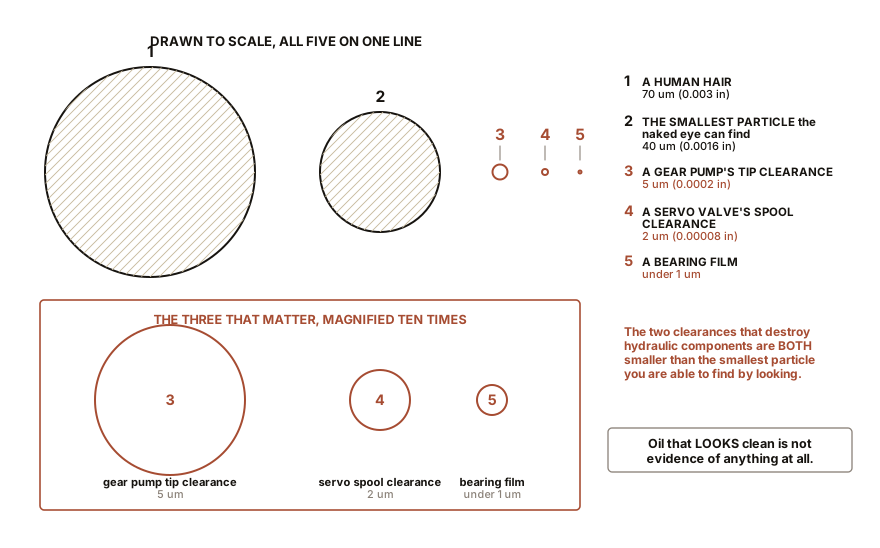
The reason is a matter of scale. Look at the clearances inside the components:
- Gear pump tooth tip to housing: 0.5 to 5 µm (0.00002 to 0.0002 in).
- Piston pump slipper to swashplate: 0.5 to 5 µm.
- Servo valve spool to bore: 1 to 5 µm (0.00004 to 0.0002 in).
- Bearing films: 0.1 to 1 µm, four millionths to forty millionths of an inch.
And the human eye cannot see a particle smaller than about 40 µm (0.0016 in). So the particles that destroy hydraulic components are, without exception, invisible. A tank of oil that looks clean is not evidence of anything.
The measurement standard is ISO 4406, which reports a cleanliness code as three numbers, such as 18/16/13. Each number is a code for how many particles per millilitre exceed 4, 6 and 14 µm, that last being 0.00055 in, respectively, and each step up the scale is a doubling of particle count. A general industrial system wants something like 20/18/15; a servo system wants 16/14/11; a modern piston pump manufacturer will specify a code and void the warranty without it.
Two consequences worth carrying:
New oil out of a drum is not clean enough. Typical new hydraulic oil arrives at around 20/18/15 or worse, having been through storage, handling and a delivery hose. Serious installations filter oil going in to the tank, which surprises people the first time they see it.
And the filter is not there to clean the oil once. It is there to remove, continuously, the particles that the machine generates itself and that get past the seals every day. Chapter 13 is about where in the circuit that filter belongs, which is a more interesting question than it sounds.
SLOW DOWN. Check Your Understanding: A hydraulic machine in an unheated workshop is filled with VG 46 oil. In summer it works perfectly. In January the operator finds it very slow for the first ten minutes, then normal. Somebody suggests changing to VG 22 so it will be fine in the morning. Why might that be the wrong fix, and what is the right question to ask first? Answer before reading on.
Because the machine has two temperatures and one oil, and VG 22 fixes the morning by breaking the afternoon. At minus 5 °C (23 °F), VG 46 is around 1,500 cSt and the pump genuinely cannot fill, which is why the machine is slow: it is not weak, it is short of flow, exactly as Chapter 6 predicts. Switch to VG 22 and the cold start is comfortable. But at the 65 °C (149 °F) the machine reaches by mid-afternoon under load, VG 22 is down around 9 cSt, below the pump’s minimum, and now it is leaking internally, running hot, wearing its own gear tips and getting slower for a completely different reason. The operator has traded a ten-minute nuisance for a shortened pump life, which is much harder to notice.
The right question is what temperature the oil actually reaches, which is a thermometer and twenty minutes, and the answer usually points at one of three real fixes: a high-VI oil of the same grade, which flattens the curve rather than shifting it; a tank heater, which is cheap and is standard on cold-climate plant; or accepting a warm-up period, which is what the manufacturer intended and what the ten minutes already is. Two of those three cost less than an oil change. And notice the general lesson: when a machine misbehaves at one end of its range, the fix that shifts the whole range is nearly always worse than the fix that widens it.
The fluid is chosen. The next four chapters are the hardware that moves it, works with it, controls it and stores it, and they begin with the component that makes the flow.

Bench Degree
Get the degree without the diploma.
Learn the material, not how to pass the exam.