Bench Degree·FLUID POWERchapter

Chapter 8: Power, and Where the Heat Goes
Pressure times flow is power. And every kilopascal of pressure that falls without moving a load becomes heat, in a fluid that holds heat badly and goes round again in twenty seconds.
Two numbers have been kept separate for two chapters. Multiply them and you get the third.
power = pressure x flowIn strict SI that is already right: pascals times cubic metres per second gives watts, with no conversion factor, because a pascal is a newton per square metre and a newton-metre is a joule.
21,000,000 Pa x 0.000167 m3/s = 3,500 WNobody works in those units. Here are the two forms actually used, and they are worth writing inside your toolbox lid.
power in kW  =  bar  x  litres per minute  /  600
power in hp  =  psi  x  gallons per minute /  1714
Take the reference rig: 10,000 kPa (1,450 psi), which is 100 bar, at 10 litres/min (2.6 gal/min).
100 x 10 / 600      =  1.67 kW
1,450 x 2.64 / 1714 =  2.23 hp
And 1.67 kW is 2.24 hp, so the two agree. That is the fluid power leaving the pump. To produce it you need more at the shaft, because the pump is not perfect: a decent gear pump manages about 85 percent overall at full pressure, so the shaft needs about 1.96 kW, and after the electric motor’s own losses you install a 2.2 kW (3.0 hp) motor. That is a real machine, about the size of a beer keg, and it will run a cylinder that pushes with 19,600 N, which is 2,000 kg or 4,410 lb.
Section 1: A Small Pipe Carries a Great Deal of Power
Before the heat, one observation that explains why hydraulics exists at all.
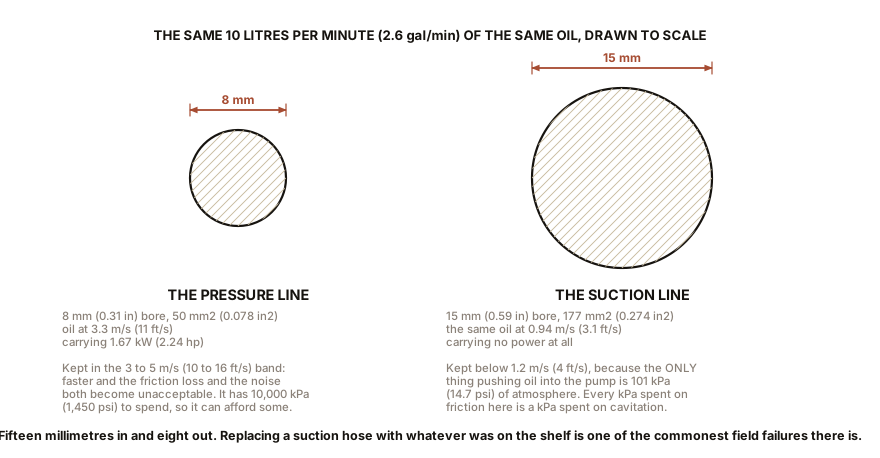
That 1.67 kW is travelling down a pressure line whose bore is 8 mm (0.31 in). Here is where that number comes from. Fluid velocity in a hydraulic pressure line is normally kept in the range 3 to 5 m/s (10 to 16 ft/s), because faster than that the friction loss and the noise both become unacceptable. At 4 m/s (13 ft/s):
area  =  flow / velocity  =  0.000167 / 4  =  0.0000417 m2  =  41.7 mm2
diameter  =  7.3 mm
So a hose you can bend with one hand carries the power of two electric kettles. Scale that up to an excavator at 35,000 kPa (5,000 psi) and 200 litres/min (53 gal/min) and you get 117 kW, which is 157 hp, down a hose of about 32 mm (1.3 in) bore. Nothing else transmits mechanical power at that density through something flexible, and that, not force multiplication, is the real reason heavy machinery is hydraulic.
One counterintuitive consequence: the suction line must be much fatter than the pressure line. Velocity on the inlet side has to be kept down to 0.6 to 1.2 m/s (2 to 4 ft/s), because the inlet has only atmospheric pressure available to push oil into the pump, and any friction loss there subtracts from that meagre allowance. At 1 m/s (3.3 ft/s) the same 10 litres/min needs:
area = 0.000167 / 1 = 167 mm2, diameter = 15 mm (0.59 in)Fifteen millimetres on the inlet and eight on the outlet, for the same oil. A great many field failures are somebody replacing a suction hose with whatever was on the shelf, and Chapter 21’s section on cavitation is the consequence.
Section 2: The Fact That Governs Every Hydraulic Installation
Here it is, in one sentence, and it is the most important sentence in Part III.
Any pressure drop that is not moving a load has turned that power into heat.
Not “wastes it”. Not “reduces efficiency”. Turns it into heat, in the oil, at a specific place, at a rate you can calculate to the watt.
The arithmetic is the same power equation. A restriction with 7,000 kPa (1,015 psi) across it passing 4 litres/min (1.06 gal/min) is dissipating:
70 bar x 4 / 600 = 0.47 kWFour hundred and seventy watts, in a brass fitting the size of a walnut. That is a soldering iron and a half, permanently on, inside your machine.
And the largest case, which happens constantly: a relief valve at full flow. The reference rig at 10,000 kPa (1,450 psi) and 10 litres/min (2.6 gal/min), with the cylinder stalled or the operator’s hand off the lever and the pump still running, puts its entire 1.67 kW into the oil.
Now follow that into a temperature.
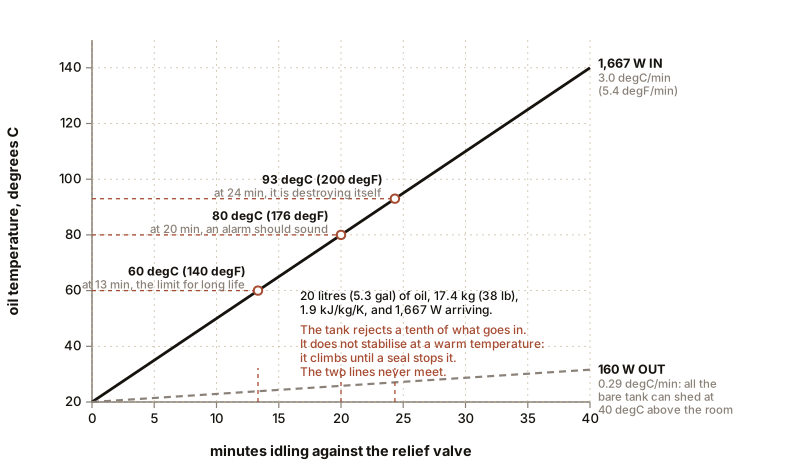
A 20 litre (5.3 gal) reservoir holds about 17.4 kg (38 lb) of oil. Hydraulic oil’s specific heat is roughly 1.9 kJ per kilogram per degree, which is less than half of water’s. So:
temperature rise per second  =  1,667 W  /  ( 17.4 kg x 1,900 J/kg/K )
                             =  0.050 degrees per second
                             =  3.0 degrees C per minute   (5.4 degrees F per minute)
Three degrees a minute. Start at 20 °C (68 °F) and in twenty minutes the oil is at 80 °C (176 °F). In forty minutes it is at 140 °C (284 °F), except that it will not get there, because things will have failed first.
And the tank cannot save you. A 20 litre (5.3 gal) reservoir has roughly 0.4 m² (4.3 ft²) of outside surface. Natural convection and radiation from bare steel to still air removes about 10 W per square metre per degree of temperature difference, so at 40 degrees above ambient the tank sheds:
0.4 x 10 x 40 = 160 WOne hundred and sixty watts out, sixteen hundred and sixty in. The tank is rejecting a tenth of the heat and the rest is accumulating. A machine idling against its relief valve does not stabilise at a warm temperature. It climbs until something stops it, and what usually stops it is a seal.
Section 3: Why 80 Degrees Is the Number Everybody Quotes
Three separate things go wrong as oil gets hot, on three different clocks.
Viscosity falls, immediately and reversibly. Hot oil is thin. Thin oil leaks past clearances inside the pump and the valves, so the pump delivers less flow, so the machine gets slower, so the operator holds the lever longer, so more heat goes in. That is a positive feedback loop and it is why a hot hydraulic machine feels tired. Chapter 9 puts numbers on the viscosity change.
Seals harden and then fail, over hundreds of hours. Nitrile rubber, the commonest hydraulic seal material, is rated to about 100 °C (212 °F) as an absolute limit and lives a long life below 70 °C (158 °F). Between those, its life roughly halves for every 10 degrees Celsius, 18 degrees Fahrenheit, of rise. This is a rate, not a cliff, which is why the damage from an overheated afternoon shows up as leaks three months later.
The oil oxidises, over thousands of hours. Oxidation is a chemical reaction and it obeys the usual rule of thumb: the rate roughly doubles for every 10 °C (18 °F). Oil that would last 10,000 hours at 50 °C (122 °F) lasts about 2,500 hours at 70 °C (158 °F) and about 600 hours at 90 °C (194 °F). Oxidised oil goes dark, smells burnt, forms varnish on valve spools and sludge in the tank, and becomes acidic enough to attack the very seals that were already suffering.
So the working numbers are: keep bulk oil below 60 °C (140 °F) for a long life, treat 80 °C (176 °F) as the point where an alarm should sound, and treat 93 °C (200 °F) as a machine actively destroying itself. Aircraft and racing systems run hotter on purpose with fluids and seals chosen for it, which is a design decision rather than an exception to the rule.
IN PLAIN ENGLISH: A hydraulic system is a bucket of oil going round in circles. Anywhere the oil is squeezed through a gap without pushing anything, the energy it loses appears as warmth. There is not much oil, it does not hold heat well, and it comes back round every twenty seconds, so the warmth adds up fast. Which is why the interesting question about any hydraulic machine is not how much power it makes but where the power it is not using has gone.
Section 4: Where It Actually Goes, in a Real Circuit
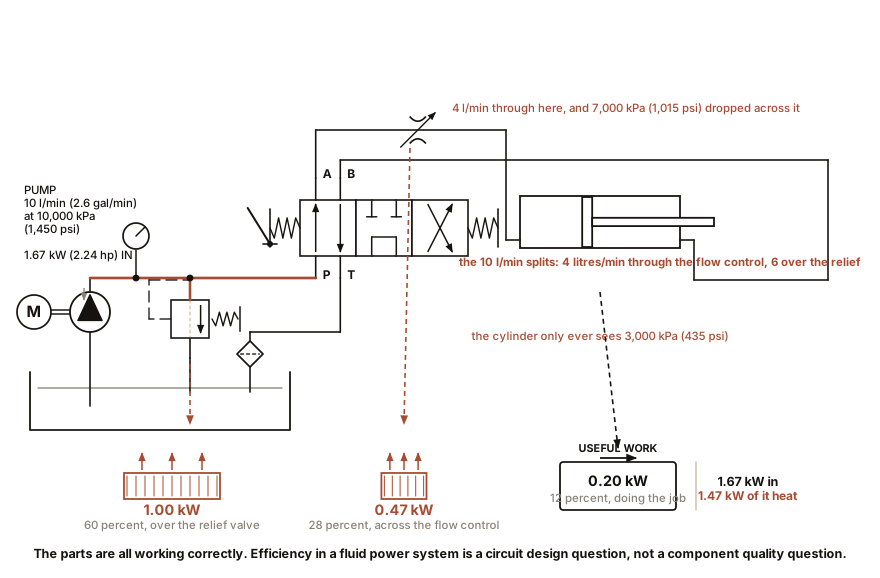
Take the reference rig doing a real job badly, which is how most circuits are built. The cylinder needs to push 5,900 N (1,326 lb), so it needs 3,000 kPa (435 psi). The operator wants it to move at 34 mm/s (1.3 inches per second) rather than 85, so there is a flow control valve set to pass 4 litres/min (1.06 gal/min), and the pump’s other 6 litres/min goes over the relief.
Four numbers, and they must add up.
| Where | Pressure drop | Flow | Power |
|---|---|---|---|
| Relief valve | 10,000 kPa (1,450 psi) | 6 litres/min (1.6 gal/min) | 1.00 kW, all heat |
| Flow control valve | 7,000 kPa (1,015 psi) | 4 litres/min (1.06 gal/min) | 0.47 kW, all heat |
| Cylinder, doing the job | 3,000 kPa (435 psi) | 4 litres/min (1.06 gal/min) | 0.20 kW, useful |
| Total from the pump | 10,000 kPa (1,450 psi) | 10 litres/min (2.6 gal/min) | 1.67 kW |
Twelve percent efficient. A 2.2 kW (3.0 hp) motor is running to deliver 200 W of useful work, and 1.47 kW is going into the oil as heat. That circuit needs a cooler, and the cooler needs to be about 1.5 kW, and the cooler will cost more than the flow control valve that caused the problem.
And the fix is not a bigger cooler. Three real fixes, in increasing order of cost and cleverness:
Meter the pump instead of the line. Use a variable displacement pump that only delivers the 4 litres/min (1.06 gal/min) the job needs, at the 3,300 kPa (479 psi) the job demands. Then the input is 0.22 kW and the efficiency is roughly 90 percent, and the whole heat problem evaporates. Chapter 10.
Unload the pump when nothing is happening. A machine that spends 80 percent of its cycle waiting can dump its flow back to tank at near-zero pressure through an unloading valve, rather than over a relief valve at full pressure. Same flow, a fortieth of the heat.
Vary the motor speed. An electric motor on a variable frequency drive turning a fixed pump slowly is the modern cheap answer, and it is why new industrial hydraulic power units look nothing like ones from 1985.
The general shape of this, and it is worth carrying out of the chapter: in a fluid power system, efficiency is a circuit design question, not a component quality question. You can build a 12 percent machine out of excellent parts, and the parts will all be working correctly.
Section 5: Measure a Pressure Drop Yourself
ON THE BENCH: Watts lost in a garden hose
Parts: a hose-bib pressure gauge, about $12; 10 m (33 ft) of garden hose; another 15 m (50 ft) if you have it; a 10 litres (2.6 gal) bucket; a stopwatch. Cost: $12, or nothing if you did Chapter 3’s experiment. Time: 30 minutes. Hazards: none. Method, and take your time over step two. 1. Screw the gauge on the tap with nothing attached and open the tap fully. Read the static pressure, with no flow. Call it 400 kPa (58 psi). 2. Now fit the gauge between the tap and the hose using a tee, or simply fit the gauge at the tap and the hose downstream of it, and open fully with the hose running into the bucket. Read the pressure while water is flowing, and time the bucket fill. What you should see: the pressure has dropped, typically to 250 to 320 kPa (36 to 46 psi), and the bucket fills in 25 to 35 seconds, so about 20 litres/min (5.3 gal/min). Now compute the loss: you lost 150 kPa (22 psi), which is 1.5 bar, at 20 litres/min:
1.5 x 20 / 600 = 0.05 kW = 50 WFifty watts is being dissipated inside your garden hose as heat, all of it friction against the wall, at all times while the water runs. 3. Then double the hose length. The loss roughly doubles, because friction loss is proportional to length. 4. Then stand on the hose to half-throttle it. The pressure at the tap climbs back toward static because the flow has fallen. The loss is not a property of the hose alone: it depends on the flow through it, roughly as the square. Halve the flow and the loss falls to a quarter. The point: you just measured a hydraulic pressure drop and converted it to watts, using a $12 gauge and a bucket, and every hydraulic troubleshooting procedure in the world is that measurement with better fittings.
ON THE BENCH: Find the cooler on a real machine and read what it is doing
Parts: an infrared thermometer, about $20; access to any working hydraulic machine, which means a farm tractor, a skip lorry, a scissor lift, a workshop press or a piece of plant on a site with a cooperative operator. Cost: $20. Time: 20 minutes. Hazards: hydraulic lines are hot and some are at thousands of kilopascals. Point the thermometer, do not touch anything, and never run a hand along a line. Chapter 21 explains that instruction in detail and it is not a formality. Stay clear of fans and belts. Method: find the reservoir and the cooler, which is a small radiator with a fan, usually near the engine radiator. Measure the oil temperature at the cooler’s inlet and outlet, and the reservoir’s outside skin. What you should see: an inlet-to-outlet drop of 5 to 15 °C (9 to 27 °F) with the machine working. From that and the flow rate you can compute the kilowatts being rejected, using oil’s 1.9 kJ per kilogram per degree and 0.87 kg per litre:
kW rejected = litres per minute x 0.0275 x temperature drop in degrees CAt 60 litres/min (16 gal/min) and a 10 degree drop that is 16.5 kW being thrown away as heat, on a machine whose engine makes perhaps 75 kW. You have just measured the inefficiency of a working machine from the outside, with a thermometer. What to notice: the temperature climbs when the operator is holding a function against its stop, and falls when the machine is moving freely. The heat tracks wasted pressure, exactly as this chapter says.
SLOW DOWN. Check Your Understanding: The garden hose experiment dissipated 50 W into water flowing at 20 litres/min (5.3 gal/min). Work out the temperature rise of that water. Then explain why a hydraulic machine, dissipating a similar wattage per litre, overheats and a garden hose does not. Answer before reading on.
The water’s temperature rise is 0.04 degrees Celsius, which is 0.07 Fahrenheit, and nobody could measure it. Twenty litres a minute is 0.33 kg per second, and water’s specific heat is 4,186 J per kilogram per degree, so 50 W divided by 1,395 W per degree gives four hundredths of a degree.
Three things make the hydraulic case different, and all three multiply. First, oil holds less heat: 1,900 J per kilogram per degree against water’s 4,186, so the same watts give more than twice the temperature rise. Second, there is less of it: a hydraulic system has 20 litres (5.3 gal) total, not an infinite supply from a reservoir on a hill. Third and decisively, it comes back. The 20 litres (5.3 gal) in the tank passes the pump every two minutes and carries its accumulated heat with it, so the temperature rises cumulatively rather than settling. The garden hose is an open system with a fresh supply and the machine is a closed loop, which is the same distinction Chapter 3 drew between the London hydraulic mains and everything since. An open system throws its heat away with the fluid. A closed system has to find somewhere to put it.
You now have the four quantities of the subject and how they multiply: pressure, flow, force, speed, and power and heat as the products. The next chapter chooses what the fluid should actually be made of, and the answer is a temperature decision dressed up as a chemistry decision.

Bench Degree
Get the degree without the diploma.
Learn the material, not how to pass the exam.