Bench Degree·FLUID POWERchapter

Chapter 7: Compressibility, the Only Real Difference
Hydraulics and pneumatics share their law, their symbols, their valves and their arithmetic. They differ in one material property, and this chapter turns that property into a number you can measure with a syringe and a bathroom scale.
Everything you have read so far applies equally to oil and to air. Pascal’s law does not care which fluid it is in. Force is pressure times area either way. Flow over area gives speed either way. The symbols in Chapter 14 are the same symbols.
And yet an excavator is hydraulic and a factory gripper is pneumatic, and neither designer would dream of swapping. The whole of that difference comes from one property, and the property has a name, a unit and a value you can look up.
Section 1: Bulk Modulus, Which Is Stiffness for Fluids
Squeeze a fluid and it gets smaller. How much smaller, for how much squeeze, is its bulk modulus.
bulk modulus  =  pressure increase  /  fractional decrease in volume

K  =  delta-P  /  ( delta-V / V )
Because the bottom of that fraction is a ratio of volumes, it has no units, so the bulk modulus has the units of pressure. A large number means a stiff fluid.
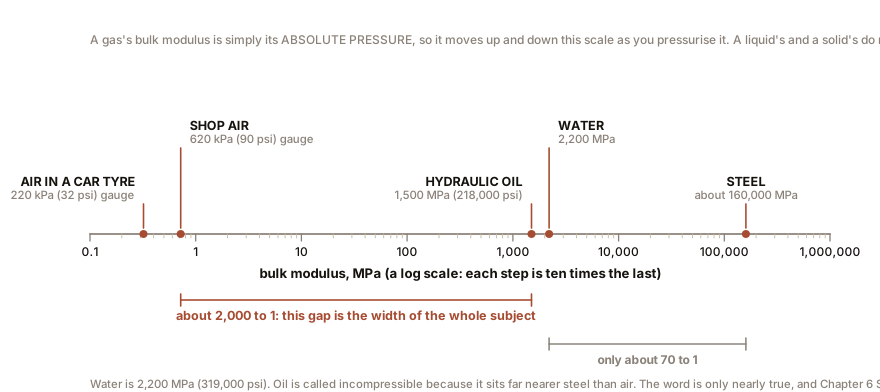
Here are the numbers that matter, and the whole book is in this table.
| Material | Bulk modulus | Volume lost at 21,000 kPa (3,000 psi) |
|---|---|---|
| Steel, for comparison | 160,000 MPa | 0.013 percent |
| Water | 2,200 MPa | 0.95 percent |
| Mineral hydraulic oil | 1,500 to 1,800 MPa | 1.2 to 1.4 percent |
| Air at 620 kPa (90 psi) shop pressure | about 0.72 MPa | not applicable, see below |
Read the oil line first. A hydraulic oil, at a pressure that will take your hand off, gives up about one percent of its volume. That is what “incompressible” means in practice, and it is why the field says it and why the field is slightly lying. The common shop rule is half a percent per 6,900 kPa (1,000 psi), which is the same statement.
Now read the air line, and notice what is strange about it. Air’s bulk modulus is not a material property at all. For a gas, squeezed slowly enough that its temperature does not change:
K = absolute pressureThat is the whole formula. A gas is exactly as stiff as its own pressure. Squeeze it fast enough that the heat has no time to escape, which is the usual case in a real machine, and it is a little stiffer:
K = 1.4 x absolute pressure (for air, squeezed quickly)So workshop air at 620 kPa (90 psi) gauge, which is 721 kPa (105 psi) absolute, has a bulk modulus of about 0.72 MPa slowly or 1.0 MPa quickly. Against oil’s 1,500 MPa, which is 218,000 psi, oil is roughly two thousand times stiffer than shop air.
And there is a second consequence hiding in that formula. Because a gas’s stiffness is its pressure, a pneumatic system gets stiffer as you raise the pressure and softer as you lower it. A cylinder at 800 kPa (116 psi) is noticeably more positive than the same cylinder at 300 kPa (44 psi). Hydraulic oil has no such behaviour: its stiffness is nearly constant, so a hydraulic machine feels the same at any pressure. Air is a spring whose spring rate depends on how hard you are already pressing it.
IN PLAIN ENGLISH: Push on oil and it barely moves. Push on air and it moves a lot, and the more you have already squeezed it the harder it fights back. So oil behaves like a steel rod that can go round corners, and air behaves like a rubber block. Every difference between a hydraulic machine and a pneumatic one comes out of that, and once you know it you can predict most of them yourself.
Section 2: The Same Cylinder, Twice
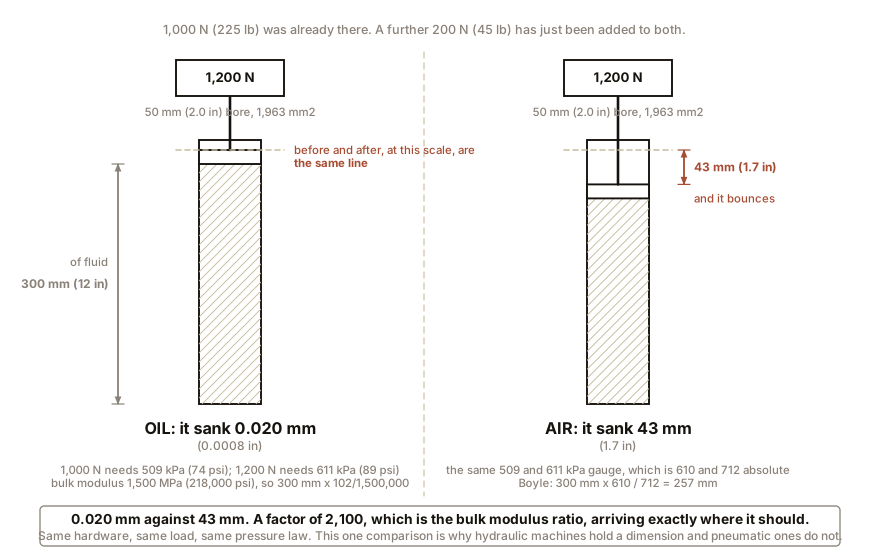
Numbers make this concrete. Take one cylinder, 50 mm (2.0 in) bore, and hold a load on it with a 300 mm (12 in) column of fluid behind the piston. Piston area 1,963 mm² (3.04 in²).
Version one: oil. The cylinder holds a load of 1,000 N, which is 102 kg or 225 lb. Now somebody adds 200 N (45 lb) more, a 20 percent increase. The extra pressure needed is:
200 N / 1,963 mm2 = 0.102 MPa = 102 kPa (14.8 psi)The oil column shortens by its fractional compression:
300 mm x ( 0.102 / 1,500 ) = 0.020 mmTwenty microns: 0.020 mm, or 0.0008 in. The load sank by less than the thickness of a sheet of paper and you would need an instrument to detect it.
Version two: air, at 620 kPa (90 psi) supply. The same 1,000 N load needs 509 kPa (74 psi) gauge, so 610 kPa (88 psi) absolute. Add the same 200 N and it now needs 611 kPa gauge, so 712 kPa absolute. Boyle’s law gives the new column length:
300 mm x ( 610 / 712 ) = 257 mmIt sank 43 mm (1.7 in), for a 20 percent change in load.
Twenty microns against forty-three millimetres. A factor of about 2,100, which is the bulk modulus ratio, arriving exactly where it should. And this single comparison explains, without further argument:
- Why a hydraulic press can hold a dimension while it squeezes, and a pneumatic one cannot.
- Why hydraulic machinery can be position-controlled to a fraction of a millimetre and pneumatic machinery is normally run end to end and stopped by mechanical stops.
- Why an excavator’s boom stays where the operator left it and an air-powered arm sags.
- Why a pneumatic actuator is safe to work beside: it gives. A hand caught in a 620 kPa (90 psi) air cylinder is being pressed by a spring that yields as you push back. A hand caught in a 21,000 kPa (3,000 psi) hydraulic cylinder is being pressed by a machine that does not notice.
Section 3: Oil Is Not Incompressible, and It Matters at Scale
One percent sounds negligible until you multiply it by a real machine.
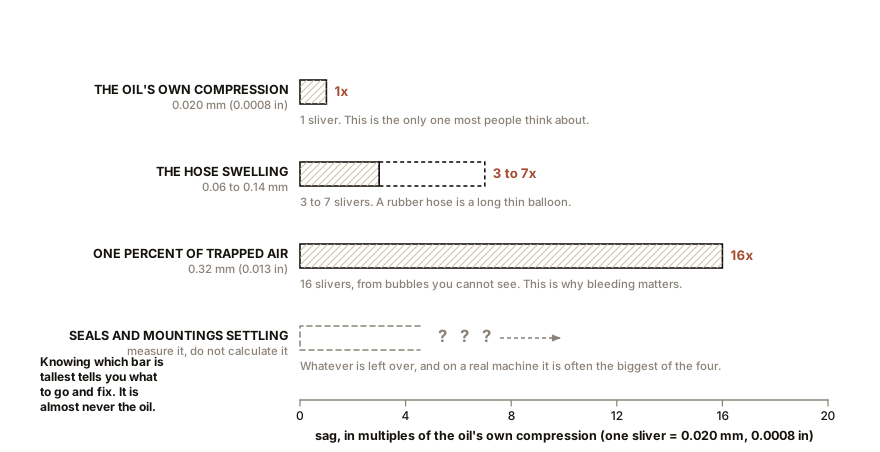
Take 10 m (33 ft) of hose at 13 mm (0.51 in) bore. Its volume is 1.33 litres (0.35 gal). Raise it to 21,000 kPa (3,000 psi) and the oil inside shrinks by 1.4 percent, which is 18.6 mL. Eighteen and a half millilitres must be pumped in before anything at the far end begins to move. At the reference flow of 10 litres/min (2.6 gal/min) that is 0.11 seconds of pure delay, and on a big machine with 30 m (98 ft) of hose it is a third of a second of the operator pulling a lever and nothing happening.
And the hose is worse than the oil. A rubber hose swells under pressure, and the swelling adds volume the pump has to fill. Measured as an effective bulk modulus for the assembly, a rubber hydraulic hose commonly comes out between 200 and 500 MPa, or 29,000 to 73,000 psi, which is three to seven times softer than the oil inside it. So most of the springiness in a hydraulic line is the hose, not the fluid. That is why:
- Brake lines are rigid steel wherever they possibly can be, with a short flexible section only at the moving suspension, and why the flexible section is a braided hose designed for minimum expansion. Chapter 18 returns to this.
- Servo and machine-tool hydraulics use hard tube and keep it short.
- A long hydraulic line has a natural frequency, and a machine can be made to oscillate by a control system that is faster than the oil column it is pushing on. The stiffness of the fluid, times the mass being moved, sets a resonance, and it is a real ceiling on how fast a hydraulic servo can be told to move.
Then there is the third softness, and it is the biggest. Undissolved air, meaning bubbles rather than dissolved gas, is catastrophic for stiffness. Combine one percent by volume of free air, at 1,000 kPa (145 psi) absolute, with 99 percent oil:
1 / K   =   0.99 / 1,500   +   0.01 / 1.0
        =   0.00066        +   0.01
K  =  94 MPa
One percent of bubbles makes the oil sixteen times softer. That is the arithmetic behind Chapter 2’s syringe experiment, behind every brake bleeding procedure ever written, and behind the fact that a hydraulic system’s first symptom of an inlet leak is that it goes spongy rather than that it goes weak.
Notice also that the same sum at 20,000 kPa (2,900 psi) absolute gives 862 MPa, only 1.7 times softer. Air hurts most at low pressure, because a gas’s stiffness is its pressure. So a system feels worst on light loads and firms up on heavy ones, which is exactly the confusing symptom that sends people looking for the wrong fault.
ON THE BENCH: Measure the compressibility of water, and fail
Parts: the 60 mL syringe; bathroom or kitchen scales; a ruler. Cost: nothing. Time: 15 minutes. Hazards: none. Do not use a glass syringe. Method: fill the syringe with 60 mL of water, block the tip firmly with a thumb, stand the syringe on the scales and lean on the plunger until the scales read 11 kg (24 lb), which is a force of 107 N. On the 531 mm² (0.823 in²) plunger that is 202 kPa (29 psi). Measure how far the plunger moved. What you should see: nothing measurable. The predicted movement is:
60 mL x (202 / 2,200,000) = 0.0055 mL, which over 531 mm2 is 0.010 mmTen microns. No ruler in your house can see it, and what you will actually observe is a millimetre or two of seal squash and barrel flex, all of which is the plastic and none of which is the water. Now do it with air. Fill the syringe with 60 mL of air, block the tip, and press until the plunger reaches the 20 mL mark. Read the scales at that moment. What you should see: the scales read close to 11 kg (24 lb) again, because compressing 60 mL of air to 20 mL triples its absolute pressure to about 303 kPa (44 psi), which is 202 kPa (29 psi) on the gauge, and that is the same force. The identical push moved the plunger 75 mm (3.0 in) instead of 0.01 mm. What the experiment is really telling you: the failure is the result. You cannot measure water’s bulk modulus with household tools, and that is the most useful thing this rig will ever tell you.
Section 4: Which Is Why Air Stores Energy and Oil Does Not
Now the second great consequence, and it runs the opposite way from the first.
Energy stored in a squeezed fluid is roughly the pressure times the volume change. A stiff fluid barely changes volume, so it stores almost nothing. A soft fluid changes volume enormously, so it stores a lot.
Work it out for one litre of each.
One litre of oil at 21,000 kPa (3,000 psi). It compressed by 1.4 percent, so 14 mL, and the average pressure during that compression was half the final value:
E = 0.5 x 0.000014 m3 x 21,000,000 Pa = 147 JOne litre of air at 700 kPa (102 psi) gauge, which is 800 kPa (116 psi) absolute, allowed to expand back to atmosphere:
E  =  P1 V1 / 0.4  x  [ 1  -  (100/800)^0.286 ]
   =  800,000 x 0.001 / 0.4  x  0.448
   =  896 J
Air, at a twenty-sixth of the pressure, holds six times the energy per litre. That single comparison is the reason for three things you will meet later:
- An air receiver is a genuine energy store. A workshop compressor fills a tank, switches off, and the tank runs the tools for minutes. Chapter 13.
- A hydraulic accumulator cannot be made of oil. Fill a vessel with oil at 21,000 kPa (3,000 psi) and it stores 147 J per litre, which is nothing. So every practical hydraulic accumulator holds a bladder or piston of nitrogen and stores the energy in the gas. The oil is the messenger and the gas is the battery. Chapter 13 again.
- The dangerous vessel in a workshop is the air one. A 100 litre (26 gal) receiver at 800 kPa (116 psi) absolute holds about 90 kJ, which is the energy of roughly 21 g (0.75 oz) of TNT, and if it fails it releases the lot in milliseconds by throwing pieces of itself. A hydraulic line at 21,000 kPa (3,000 psi) holds far less energy and kills in a completely different way, by injecting a thin jet through skin. Two hazards, two mechanisms, and Chapter 21 treats both properly.
Section 5: The Compliance Is Sometimes the Point
It would be easy to finish this chapter thinking air’s springiness is a defect. It is a design feature, chosen deliberately, in every one of these cases.
Cushioning. A pneumatic cylinder arriving at the end of its stroke at 500 mm/s (20 inches per second) can be stopped by trapping a little air ahead of the piston, which decelerates it smoothly. Hydraulic cylinders need machined cushion features and orifices to do the same job, and they are fussier.
Safety around people. A pneumatic actuator that traps a hand yields. This is not a small consideration: it is the main reason food, packaging and assembly lines are pneumatic even where hydraulics would be cheaper. Chapter 17.
Tolerance of being stalled. Stall an air cylinder and nothing happens: it sits there at supply pressure, warm at worst. Stall a hydraulic cylinder and the whole pump flow goes over the relief valve as heat, which Chapter 8 shows is a serious event.
Compliance in contact. A gripper that must hold an egg, or a sander that must follow a curved surface, needs an actuator that gives. A stiff actuator pushing on an uncertain surface either misses it or crushes it.
And energy stored where it is needed. An impact wrench, a riveter, a nail gun and a jackhammer all work by releasing stored pneumatic energy suddenly. The compressibility is the working principle, not a tolerated flaw.
ON THE BENCH: How much of a hose is hose
Parts: 10 m (33 ft) of ordinary garden hose; a hose-end blanking cap or a bolt and clip; the 60 mL syringe; a hose-bib pressure gauge, about $12; a tee fitting. Cost: about $15. Time: 30 minutes. Hazards: stay under 300 kPa (44 psi). A garden hose is rated far above this, but a hose that lets go while you are holding a syringe will soak you. Method: fill the hose completely with water, cap the far end, and fit the gauge and syringe at the near end through a tee. Note the gauge reading, then inject water from the syringe in 5 mL steps, recording the pressure each time. Plot pressure against millilitres injected. What you should see: something like 20 to 50 mL to reach 200 kPa (29 psi), and a roughly straight line. Now compare with the prediction. The hose holds about 1.3 litres (0.34 gal), and compressing that water to 200 kPa (29 psi) should take:
1,300 mL x (200 / 2,200,000) = 0.12 mLA tenth of a millilitre predicted, and thirty measured. The other 29.9 mL went into swelling the hose. The fluid is not the soft part of your system. The container is, and that is the single most useful thing to know when a machine feels vague and the oil is fine. Better, if you have one: repeat with a short length of copper or steel tube. The volume needed drops by an order of magnitude and the line becomes recognisably stiff.
SLOW DOWN. Check Your Understanding: Hydraulic oil compresses about 1.4 percent at 21,000 kPa (3,000 psi). A pump has to deliver that compression volume before anything moves, and gets it back when the pressure is released. Does that stored-and-returned volume make a hydraulic system more efficient, less efficient, or neither? Answer before reading on, and think about what happens at the end of each cycle.
Neither, in a system that decompresses gently, and distinctly worse in a system that does not. The energy put into compressing the oil is genuinely elastic and genuinely returned, exactly like a spring, so in principle nothing is lost. What ruins it is how the pressure is released. In most circuits the end of a cycle means opening a directional valve, and the compressed oil in the line dumps its 147 J per litre straight through a valve orifice into the tank, where every joule becomes heat. It is small, but it happens every cycle, and on a fast press cycling once per second with 5 litres (1.3 gal) of pressurised line volume it is 735 W of pure decompression loss. The stiffer the fluid, the less energy is wasted this way, which is one of the few places where oil’s high bulk modulus is an efficiency argument rather than a control argument. It is also why high-cycle presses use decompression valves that let the pressure down through a controlled path, and why the same trick is impossible on the air side: a pneumatic system throws away all of its 896 J per litre every single time it exhausts, which is why Chapter 17 finds compressed air so expensive.
Compressibility explains what the two fluids do differently. The next chapter explains the thing they have most brutally in common: wherever pressure falls without moving a load, the missing energy becomes heat, and it has to go somewhere.

Bench Degree
Get the degree without the diploma.
Learn the material, not how to pass the exam.