Bench Degree·FLUID POWERchapter

Chapter 4: The Firms That Made It Ordinary
Between the London hydraulic mains shutting down and a teenager operating a thirty-tonne excavator with two joysticks, somebody had to make high-pressure hydraulics cheap, sealed and reliable. That work has names on it.
Walk onto any construction site and count the hydraulic joints. A mid-size excavator has something like sixty of them, every one holding 35 MPa (5,000 psi), most of them moving, all of them outdoors, in grit, in winter, operated by someone who has never opened a valve body and should never need to.
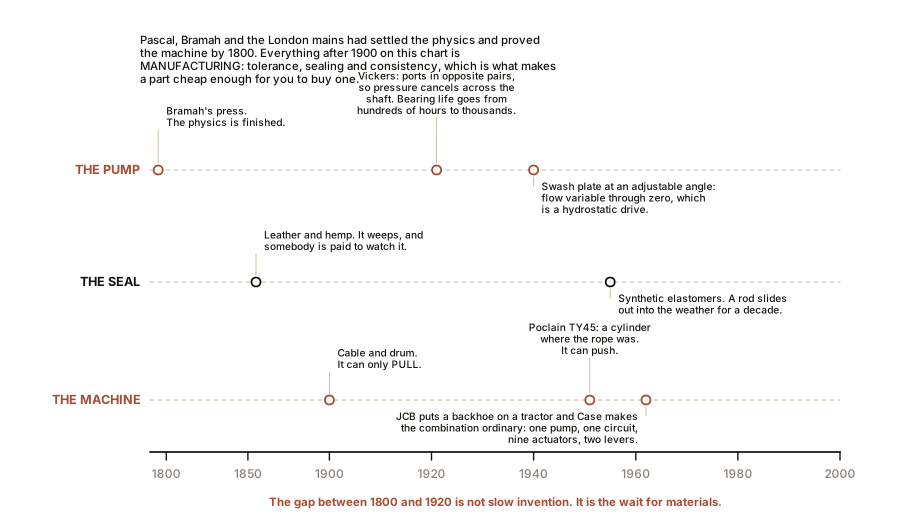
That machine is not an invention. It is an industry. The physics was finished by about 1800 and Bramah’s press in Chapter 2 proves it. What took another century and a half was the boring part, which is the hard part: seals that survive, oil that does not varnish, castings that do not weep, and a pump that will run at 21 MPa (3,000 psi) for ten thousand hours without an attendant.
This chapter is the firms that did that. Not as a corporate history, and not as an advertisement, but because you cannot understand why a modern circuit is shaped the way it is without knowing which problem each part of it was invented to solve.
Section 1: Harry Vickers and the Problem of the Pump
The London mains of Chapter 3 used steam-driven reciprocating pumps: big, slow, and fine when they lived in a pumping station with a man watching them. Put one on a vehicle and it is hopeless. It pulses, it is heavy, and its output cannot be varied without throttling.
Harry Vickers founded his company in 1921 in Detroit, and the reason his name is on half the hydraulics ever built is a sequence of unglamorous fixes.
The balanced vane pump. A vane pump has a slotted rotor spinning inside a ring, with vanes flung outward to sweep chambers. The early ones took their pressure load on one side of the shaft, which loaded the bearings hard and killed them. Vickers put the inlet and outlet ports in diametrically opposite pairs, so the pressure load on one side is cancelled by the load on the other and the shaft carries almost none of it. Bearing life went from hundreds of hours to thousands. The same trick is in the power steering pump on a great many cars still being built.
Pressure-compensated control. A fixed pump moves the same volume every revolution whether the machine wants it or not, and the surplus has to be dumped over a relief valve, where it becomes heat. Chapter 8 does the arithmetic and it is brutal. A pressure-compensated pump senses its own outlet pressure and destrokes itself as pressure rises, so it delivers only the flow the machine is using. This is why a modern excavator can idle with everything held still and not boil its tank.
And, less famously, the paperwork. Vickers published Industrial Hydraulics and the Mobile Hydraulics Manual, and generations of technicians learned the subject from them. A firm that teaches the trade ends up defining the trade, which is worth noticing in a book with this one’s argument.
IN PLAIN ENGLISH: The three problems with putting hydraulics on a machine instead of in a building are that the pump wears out, the oil gets hot, and the seals leak. Almost every famous name in this chapter got famous by fixing one of those three.
Section 2: The Aircraft Made Everyone Serious
The Second World War did to hydraulics what it did to radio. Retractable undercarriage, flaps, gun turrets and brakes all wanted force at a distance with no room for linkages, and aircraft do not tolerate failure or weight.
Sundstrand and the axial piston pump belong here. A swash plate at an adjustable angle drives a ring of pistons in a rotating barrel; change the plate angle and you change the displacement continuously, through zero, and out the other side into reverse flow. That last part is what makes a hydrostatic transmission possible: an infinitely variable drive with no gears, which is why a skid-steer loader can spin on the spot and why a combine harvester has no clutch. Chapter 15 builds the circuit.
Denison, Racine, Oilgear and Parker all made their reputations in the same period on the same three problems. Parker had begun in 1918 with a pneumatic brake and became, through fifty years of acquisitions, the firm that sells the fitting on the end of nearly every hose.
The lasting inheritance from aviation is not a component, it is an attitude: redundancy, and the assumption that a hose will eventually burst. Chapter 18’s split brake circuits and Chapter 20’s dual and triple aircraft systems are both aviation habits that came down into everything else.
Section 3: Caterpillar, and the Machine That Changed Shape
Until the 1940s an excavator was a cable machine. A diesel engine turned drums, drums wound wire rope, and rope dragged a bucket. It worked, and a good operator could do fine work with it, but the mechanism could only ever pull. It could not push, it could not hold a precise position against a load, and every function needed its own drum, clutch and brake.
Hydraulics can push. That single fact rebuilt the machine.
The first fully hydraulic excavator is generally credited to Poclain in France, whose TY45 of 1951 put a hydraulic cylinder where the rope had been. Poclain went on to make the radial piston motor its own speciality: pistons pushing outward against a cam ring, which produces enormous torque at very low speed and can drive a wheel directly with no gearbox at all.
Caterpillar came to hydraulics from the other direction: it already owned the earthmoving world with cable and mechanical machines, and had the most to lose. Its response is instructive. Rather than buy hydraulics in, Caterpillar built the components itself, and the reason is Chapter 21’s reason: on a machine that costs more per day in downtime than the machine costs to rent, the failure of a $40 seal is not a $40 problem. Controlling the whole chain was the only way to control the reliability of it.
J.I. Case is the other name every operator says, and the machine it is famous for is the backhoe loader. Case did not invent it; JCB in England put the first proper backhoe on a tractor in 1953 and built a company on it. What Case did was make the combination ordinary: a loader at one end, a backhoe at the other, one small diesel, one hydraulic system doing both jobs through a valve bank the operator works with two levers.
Notice what that machine really is. It is a single power source and a single fluid circuit feeding eight or nine actuators that are never all wanted at once, sequenced by a human hand. That is exactly the argument for fluid power over any alternative, and Chapter 16’s excavator is the same argument at four times the size.
Section 4: What They Actually Perfected
It is easy to read a list of company names as a list of inventions. The truthful version is duller and more useful. What these firms perfected was tolerance, sealing and consistency, and each of those is a manufacturing problem rather than a physics one.
| The problem | Roughly when it was solved | Why it mattered |
|---|---|---|
| Shaft loads that ate bearings | 1920s, balanced pumps | Pump life in thousands of hours, not hundreds |
| Continuously variable flow | 1930s to 1940s, swash plate pumps | Hydrostatic drive, and no wasted flow to dump |
| Seals that survive motion and grit | 1950s onward, synthetic elastomers | A cylinder that lives outdoors for a decade |
| Oil that does not varnish or foam | 1950s onward, additive packages | Chapter 9’s whole argument |
| Fittings that do not weep | Continuous, and standardised | Sixty joints per machine, all dry |
| One circuit, many actuators | 1950s, sectional valve banks | The backhoe, the excavator, the loader |
The seal is the one people underestimate. A hydraulic cylinder rod slides out into the weather and back into the oil, thousands of times a day, carrying whatever it has picked up, and it must not leak in either direction. That is a harder requirement than the pressure is. Chapter 21 is about what happens when it fails, and Chapter 9 is about the fluid that has to keep it alive.
ON THE BENCH: Read the plate on a real machine
Parts: a machine. A tractor, a mini digger, a scissor lift, a tail lift on a lorry, a car with the bonnet up. Permission from whoever owns it, and a torch (flashlight). Cost: nothing. Time: 20 minutes. Hazards: engine off, key out, boom down and resting on the ground before you put a hand anywhere near a hose. Never run a hand along a hose looking for a leak, for the reason in Chapter 22. Method: find the pump and read what is cast or stamped on it. Find the maker’s name, and the numbers next to it. Then follow one hose from the pump and see how far you can get before you lose it. What you should see: a name from this chapter, or a firm that bought one. A displacement in cc/rev, and a pressure rating in bar or psi. Multiply displacement by engine speed and you have the flow the whole machine works with, which is the number Chapter 6 says sets every speed on it. Record: maker, displacement, pressure rating, and how many actuators you can count. Divide the flow by the actuators and you will see immediately why they cannot all move at once.
Section 5: Why This Is in a Book About Doing It Yourself
Because the parts are on the shelf, and they are on the shelf because of this chapter.
A hydraulic cylinder that holds 20 MPa (2,900 psi) costs about $60. A gear pump costs about $80. A sectional valve bank with three spools costs about $200. Those prices exist because a century of firms competed on tolerance and sealing until high-pressure hydraulics became a commodity, and the practical consequence for you is that a serious hydraulic bench is within reach of a hobby budget in a way that a serious machine shop is not.
The rest of this volume assumes that. Chapters 5 to 9 are the physics you need to choose those parts correctly. Chapters 10 to 14 are the parts themselves. Everything from Chapter 15 on is machines that were built by the firms in this chapter, taken apart.

Bench Degree
Get the degree without the diploma.
Learn the material, not how to pass the exam.