Bench Degree·FLUID POWERchapter

Chapter 5: Pressure, Force and Area
One equation, rearranged three ways, does most of the work in this subject. This chapter makes it automatic in both unit systems, and then uses it to predict what a twenty-dollar bottle jack will do before you touch the handle.
There is one equation at the centre of fluid power and it has three letters in it.
P  =  F / A          pressure  =  force divided by area
F  =  P x A          force     =  pressure times area
A  =  F / P          area      =  force divided by pressure
Those are the same statement written three ways, and which one you reach for depends on which two numbers you know. Pump end: you know force and area, so you get pressure. Actuator end: you know pressure and area, so you get force. That is the entire structure of a hydraulic calculation, and everything else in this book decorates it.
The trouble is never the algebra. The trouble is units, and units in this field are a genuine mess because two systems and three different metric conventions are all in daily use. So this chapter does the tedious part properly once.
Section 1: The Units, and the Two Conversions Worth Memorising
Pressure is force per area, so every pressure unit is some force divided by some area.
- The pascal (Pa) is one newton per square metre. It is the SI unit and it is uselessly small: atmospheric pressure is about 101,000 Pa. So nobody uses it bare.
- The kilopascal (kPa), a thousand pascals, is the working unit in most of the world. Atmospheric pressure is 101 kPa (14.7 psi). Car tyres run about 220 kPa (32 psi).
- The megapascal (MPa), a million pascals, is what hydraulic engineers use because hydraulic pressures are large. 21 MPa is 21,000 kPa (3,000 psi).
- The bar is 100 kPa exactly, chosen because it is very close to one atmosphere. Europe’s fluid power industry speaks in bar almost exclusively.
- Pounds per square inch (psi) is force in pounds over area in square inches, and it is the unit of every American hydraulic system, every tyre gauge sold in the United States, and most of the world’s aviation.
Two conversions, and if you learn nothing else numeric from this book learn these.
1 MPa  =  1,000 kPa  =  10 bar  =  145 psi
1 psi  =  6.895 kPa  =  0.06895 bar
And one gift, which is the reason engineers work in MPa. One megapascal is exactly one newton per square millimetre. So:
force in newtons = pressure in MPa x area in mm2No conversion factor. None. A 50 mm (2.0 in) bore cylinder has an area of 1,963 mm² (3.04 in²), so at 10 MPa it makes 19,630 N of push. Multiply and you are done.
Imperial has the identical gift. A pound per square inch times an area in square inches gives pounds of force:
force in pounds = psi x area in in2That same cylinder is 3.04 in² and 10 MPa is 1,450 psi, so it makes 4,408 lb. Which is 19,610 N, and the two answers agree, as they must. Each system is trivial inside itself and the mess is only at the border. Work in one, convert at the end.
Areas, since every calculation starts with one. A round piston’s area is:
A = 0.7854 x diameter x diameterin whatever length unit you fed it, squared. That 0.7854 is pi over four, and it is worth knowing by feel: a circle has 78.5 percent of the area of the square it fits inside.
The single biggest source of error in this subject is that area goes as the square of the diameter. A 100 mm (4 in) cylinder is not twice as strong as a 50 mm (2 in) one. It is four times as strong. Anyone who has ever fitted a bigger cylinder and been surprised has met this.
IN PLAIN ENGLISH: Pressure is how hard a fluid is pushing on every square millimetre of whatever contains it. Force is what you get when you collect that push over an area. So a fluid at a given pressure will produce any force you like, if you give it enough surface to push on. That is the entire business.
Section 2: Gauge, Absolute, and the Error That Follows
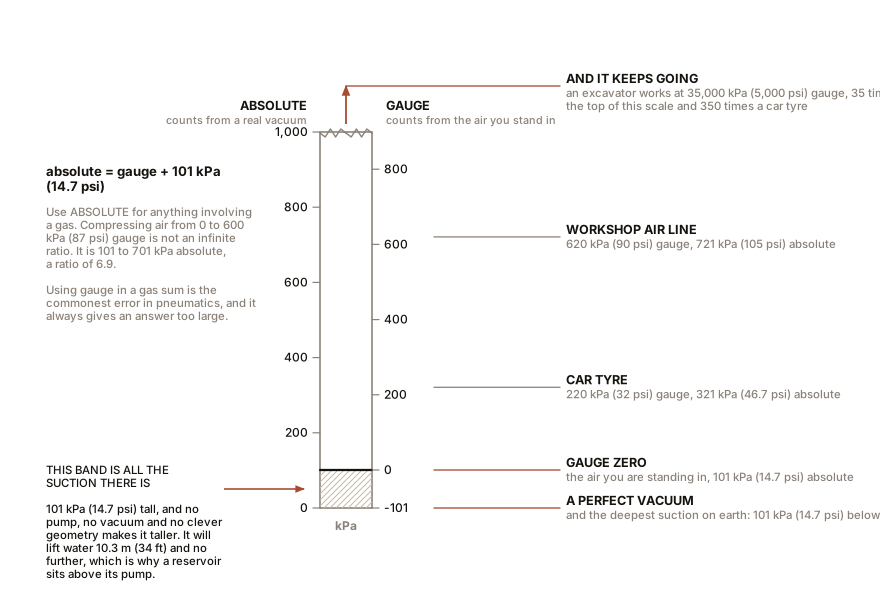
Every pressure gauge in your house reads zero when it is doing nothing, sitting on the bench in the open air. But the air is pressing on it at 101 kPa (14.7 psi). So the gauge is not reading pressure. It is reading pressure above atmospheric, which is called gauge pressure and written kPa(g) or psig.
Absolute pressure counts from a genuine vacuum. It is gauge pressure plus atmospheric:
absolute = gauge + 101 kPa (or gauge + 14.7 psi)A tyre at 220 kPa (32 psi) on the gauge holds 321 kPa (46.7 psi) absolute.
Most of the time gauge pressure is what you want and the distinction does not matter. Two places it matters enormously.
The first is any calculation involving a gas. Boyle’s law, the compressibility arithmetic of Chapter 7, and every air-consumption sum in Chapter 17 use absolute pressure, because a gas does not know where your gauge’s zero is. Compress air from 0 to 600 kPa (87 psi) on the gauge and you have not compressed it by an infinite factor. You have gone from 101 to 701 kPa absolute, which is 14.7 to 102 psi, a ratio of 6.9. Using gauge pressure in a gas calculation is the commonest arithmetic error in pneumatics and it always gives an answer that is too large.
The second is anything to do with suction. There is a floor. The lowest absolute pressure is zero, so the deepest suction available anywhere on earth is 101 kPa (14.7 psi) below atmospheric, and no pump, no vacuum, no engine manifold and no clever geometry beats it. A pump does not suck fluid up a pipe; atmospheric pressure pushes fluid up into a space the pump has emptied, and that push is limited to about 101 kPa (14.7 psi), which will raise a column of water 10.3 m (34 ft) and no further. This is why every hydraulic reservoir sits above its pump if the designer had any choice, and it is why Chapter 21’s section on cavitation is a story about the inlet side rather than the pressure side.
Section 3: Pressure Has No Direction
Take a fluid at rest and pick a point in it. The pressure at that point is the same in every direction. Up, down, sideways, and at 37 degrees to anything you like.
This is not a convenient approximation. It follows from what a fluid is: a fluid at rest cannot support a shearing force, because if it could it would be a solid. If the pressure on one face of an imaginary tiny cube in the fluid were greater than on another, the cube would have a net sideways push on it and would move, and then the fluid would not be at rest. So at rest, all faces are equal.
Which is why a hydraulic hose can be any shape at all. The pressure does not travel along the hose like a bullet, needing a straight line. It exists everywhere in the fluid, and it presses on the inside of every bend just as hard as on the straights. Route it round three corners and through a hole in the chassis and it delivers the same pressure at the far end.
It is also why a fluid always finds the weak spot. Pressure presses on the corroded fitting, on the nicked hose, on the cracked casting, on the seal you did not replace, with exactly the same enthusiasm as on the parts you are proud of.
ON THE BENCH: Pressure in every direction, and depth is all that matters
Parts: a 2 litre (0.53 gal) plastic bottle, a pin or fine nail, tape, a sink. Cost: nothing. Time: 10 minutes. Hazards: none. Method: punch four small holes around the bottle at exactly the same height, roughly 50 mm (2 in) up from the base, spaced evenly around it. Tape over them. Fill the bottle, stand it in a sink, and pull the tape off. What you should see: four jets of the same length, coming out horizontally in four directions. Then punch a fifth hole at the same height in the bottom and repeat: it squirts downward with the same vigour. Depth sets the pressure; direction is irrelevant. Then the second part. Punch three holes in a vertical line, 50 mm, 150 mm and 250 mm (2 in, 6 in and 10 in) up from the base. Fill and release. The bottom jet goes furthest, the top one barely dribbles, and the difference is entirely the depth of water above each hole. What it tells you: pressure in a static fluid is a function of depth alone. Chapter 3’s accumulator tower and your own household water pressure are the same fact.
Section 4: Head, and Why the Pipe’s Width Is Irrelevant
The pressure at the bottom of a column of fluid is:
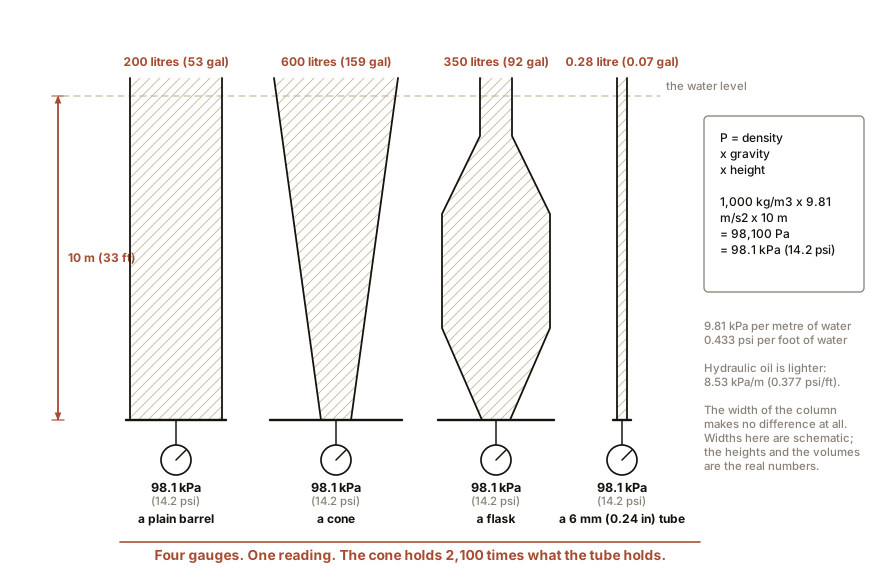
P = density x gravity x heightFor water, the density is 1,000 kg per cubic metre, which is 62.4 lb per cubic foot, and gravity is 9.81 m/s², so:
9.81 kPa per metre of water, or 0.433 psi per foot of waterLearn one of those two. Ten metres of water is 98.1 kPa (14.2 psi), which is almost exactly one atmosphere, and that coincidence is the tidiest number in the subject. In imperial, a hundred feet of water is 43.3 psi (299 kPa).
Hydraulic oil is lighter, about 870 kg per cubic metre, so it gives 8.53 kPa per metre (0.377 psi per foot).
Mercury is 13.6 times denser than water, giving 133 kPa per metre, which is why 760 mm (30 in) of mercury balances the atmosphere and why barometers were made of the stuff.
The width of the column makes no difference whatever. A pipe of 6 mm (0.24 in) bore filled with water to a height of 10 m (33 ft) has 98.1 kPa (14.2 psi) at the bottom. So does a swimming pool of the same depth. This is Chapter 2’s hydrostatic paradox, and it is the fact that makes a header tank in a loft work, and it is why the water pressure in your house is set by the height of the reservoir on the hill and not by the size of the main.
ON THE BENCH: Measure your own lung pressure, and calibrate your intuition for kPa
Parts: 3 m (10 ft) of clear vinyl tubing, 6 to 10 mm (0.25 to 0.4 in) bore, about $4; tape; a tape measure; water with a drop of food colouring. Cost: about $4. Time: 15 minutes. Hazards: do not blow so hard you make yourself dizzy, and do not inhale. Have someone else read the tube. Method: tape the tube up a door frame in a long U, with both ends open and about a metre of coloured water in the bend. The two water levels sit equal. Now blow gently into one end and hold it, and have someone measure the difference in height between the two levels. What you should see: a healthy adult blowing hard will shift the levels 800 to 1,500 mm (31 to 59 in) apart, which at 9.81 kPa per metre is 8 to 15 kPa, or 1.1 to 2.1 psi. What you have learned: you can generate about 12 kPa (1.7 psi) with your lungs. A car tyre is twenty times that. A workshop air line at 620 kPa (90 psi) is fifty times that. An excavator at 35,000 kPa (5,000 psi) is nearly three thousand times that. Now the numbers in the rest of this book have a scale attached to them, anchored to something you produced yourself. Better, if you have one: a cheap digital manometer sold for gas appliance testing reads in these units directly and will confirm the tube to within a few percent.
Section 5: Predict a Bottle Jack, Then Measure It
Now put the equation to work on a real machine, and this is the experiment of the chapter.
A two-tonne hydraulic bottle jack costs about $25. Take it apart far enough to measure two diameters, which on most of them means unscrewing the filler plug and looking, or simply measuring the exposed ram and the small pump plunger under the handle socket.
Typical numbers on a small jack:
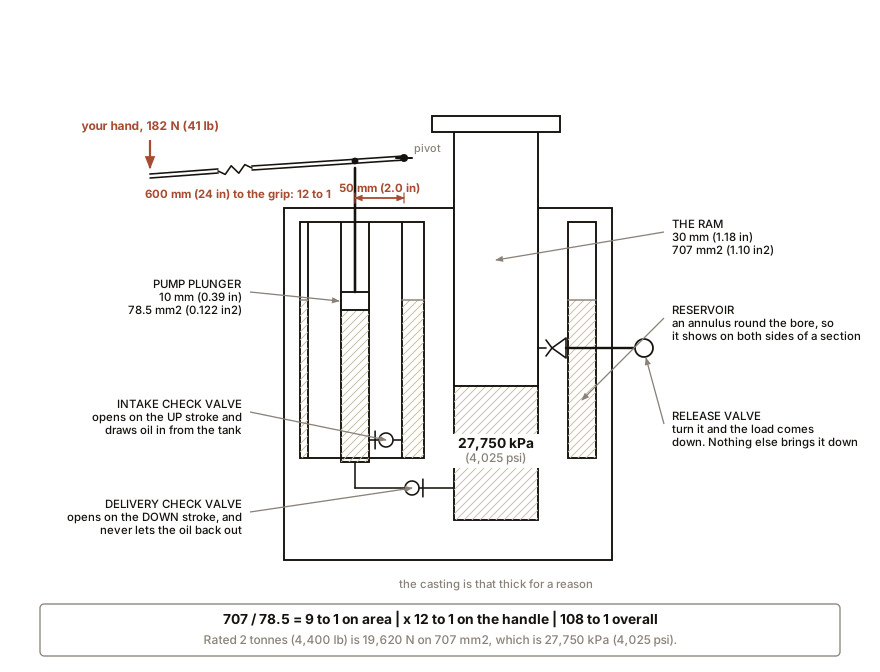
- Ram diameter 30 mm (1.18 in), so ram area is 707 mm² (1.10 in²).
- Pump plunger diameter 10 mm (0.39 in), so plunger area is 78.5 mm² (0.122 in²).
- Handle lever ratio about 12 to 1, measured from the pivot to the plunger and from the pivot to your hand.
The area ratio is 707 divided by 78.5, which is 9.0. Multiply by the 12 to 1 handle and the total mechanical advantage from your hand to the load is 108 to 1.
So to lift the jack’s rated two tonnes, which is 19,620 N, or 2,000 kg, or 4,410 lb:
pressure at the ram  =  19,620 N / 707 mm2  =  27.75 MPa  =  27,750 kPa  (4,025 psi)
force at the plunger =  27.75 x 78.5        =  2,180 N
force at your hand   =  2,180 / 12          =  182 N,  which is 19 kg or 41 lb
Forty-one pounds of pull on a handle, and two tonnes goes up. That is the whole of Chapter 1 in a steel casting.
Two things worth noticing in those numbers. The first is that the pressure inside a cheap jack from a discount shop is 27,750 kPa (4,025 psi), which is genuine high-pressure hydraulics and is why the casting is so thick. The second is the stroke: each full pump stroke of 20 mm (0.79 in) moves 1.57 mL, which raises the 707 mm² ram by 2.2 mm (0.087 in), so a 150 mm (6 in) lift takes about 68 strokes.
ON THE BENCH: Predict the handle force on a bottle jack, then measure it
Parts: a 2 tonne bottle jack, about $25; digital luggage scale or a fish scale reading to 50 kg (110 lb), about $10; vernier caliper or a steel rule; a car with a known corner weight, or any known heavy load. Cost: about $35, and both tools are worth owning. Time: 45 minutes. Hazards, and these are real. Never get under a car held up by a jack. A jack is a lifting device and not a supporting device; use axle stands the moment the wheel is off the ground. Chock the other wheels. Lift on a jacking point, on level ground, with the handbrake on. A bottle jack loaded off-centre can slide out sideways with considerable violence. Method: find the corner weight of your car. The kerb weight is on the door pillar sticker or in the manual, and a front corner of a front-engined car carries roughly 30 percent of the total. For a 1,500 kg (3,300 lb) car call it 450 kg (990 lb). Measure the ram and plunger diameters and the handle ratio. Compute the expected handle force. Write the prediction down before you lift. Then hook the luggage scale onto the handle end, lift the corner slowly and steadily, and read the scale. The prediction, worked: 450 kg is 4,415 N. On 707 mm² (1.10 in²) that is 6.24 MPa, which is 6,240 kPa (905 psi). On the 78.5 mm² (0.122 in²) plunger that is 490 N, and through a 12 to 1 handle it is 41 N, which is 4.2 kg (9.2 lb) on the scale. What you should see: a reading within about 20 percent of your prediction, and reading high. The gap is real and it has three named causes: seal friction in the ram, seal friction in the plunger, and the fact that the handle pivot is not frictionless. Twenty percent of loss in a hand jack is normal and it is the honest overall efficiency of the machine. If it reads far high: you probably mismeasured the handle ratio, which is the easiest of the three numbers to get wrong. Measure from the pivot pin, not from the end of the socket.
SLOW DOWN. Check Your Understanding: The jack above needs 27,750 kPa (4,025 psi) to lift its rated two tonnes. Suppose you want a jack that lifts twenty tonnes with the same handle effort. The obvious move is to make the ram ten times the area, so 7,070 mm² (11.0 in²), a ram about 95 mm (3.7 in) across. What has that done to the machine, and why do real twenty-tonne bottle jacks not look like that? Answer first.
It has made the jack ten times slower, and that is the part people forget. The pump plunger still displaces 1.57 mL per stroke, and that volume is now spread over ten times the ram area, so each stroke raises the load by 0.22 mm (0.009 in) instead of 2.2 mm. A 150 mm (6 in) lift now takes 680 strokes, which is roughly twenty minutes of pumping. Stroke is the currency and you just spent tenfold. So real high-tonnage jacks do something else: they keep the pressure high and make the plunger bigger, accepting a heavier handle force, and they often use a two-stage pump that moves a large volume at low pressure to take up the slack quickly and then switches to a small volume at high pressure for the lift. Watch a workshop trolley jack carefully and you can hear it change over. When a fluid machine seems to offer you a free multiplication, look for what it took out of the stroke.
You can now compute a force from a pressure and an area, in either unit system, and you have done it on a real machine and been right. What that does not tell you is how fast anything moves. Nothing in this chapter mentioned time. Chapter 6 is about the other half, and about the confusion that separating them clears up.

Bench Degree
Get the degree without the diploma.
Learn the material, not how to pass the exam.