Bench Degree·PLASMAchapter

Chapter 12: Confinement, and Why Fusion Is Hard
Getting a plasma to a hundred million degrees was solved decades ago. The difficulty is somewhere else entirely, and it is three specific places: turbulence, wall materials and tritium.
There is no bench experiment in this chapter, and it is worth saying so at the front rather than letting a reader hunt for one.
A fusion plasma needs an ion temperature of about 10 keV, which by Chapter 4’s conversion is 116 million K. It needs to be held clear of any wall for seconds at a time by superconducting magnets at 20 K, cooled by a liquid helium plant the size of a house. It needs vacuum three orders of magnitude better than a hand pump reaches. And it needs tritium, which is radioactive, does not exist in nature in usable quantities, and which no private person may hold.
So this chapter explains and does not attempt. What it gives you instead is the ability to read a fusion announcement and know exactly what has and has not been claimed, which is a genuinely useful skill and one most commentary lacks.
One honest exception, named so you are not misled by omission. There is one fusion device that amateurs do build, the Farnsworth-Hirsch fusor: a wire grid at 30 to 50 kV in a vacuum chamber of deuterium, which produces real fusion and real neutrons. At those voltages it is also a working X-ray source and a neutron source in a domestic room, and Chapter 16 explains why both matter. It cannot produce net energy and never could, for reasons in Section 2. This book will not walk you into building one.
ON THE BENCH: Build the twist out of a garden hose
Parts: 2 m (about 6 ft) of garden hose or clear tubing. A marker pen. Tape. Cost: nothing. Time: 15 minutes. Hazards: none. Method: lay the hose out straight and draw a line along it that spirals slowly around the outside, going all the way round perhaps three times over its length. Then bend the hose into a ring and tape the ends together so the spiral joins up. Set the ring flat on the table. What you should see: follow the line with a finger. It does not stay at the top or the bottom or the outside. It goes over the top, round the outer edge, under the bottom, round the inner edge nearest the hole, and back over the top. One trip round the ring takes it through every part of the cross-section. What it is: the rotational transform, the single non-obvious idea in magnetic confinement. Chapter 11’s puzzle was that a particle in a bent field drifts up or down according to its charge, so charge separates and the plasma is pushed out. A particle following the line you just traced drifts up while it is near the bottom and down while it is near the top, and the two cancel. Every tokamak and every stellarator exists to produce that line, and they differ only in how.
Section 1: What Fusion Actually Requires
Two nuclei fuse when they get close enough for the strong nuclear force to grab them, and both are positive, so they repel fiercely on the way in. The only practical way to overcome that in bulk is heat. Which fuel you pick decides how much of it you need, and there is one clear winner. Deuterium plus tritium, both isotopes of hydrogen, has the lowest barrier and by far the largest reaction probability at reachable temperatures. It releases 17.6 MeV per reaction and its rate peaks around 65 keV, so a plasma at 10 to 20 keV already works well. Every serious near-term machine uses it.
And it hands 14.1 MeV of that 17.6 to a neutron, which is 80 per cent of the energy leaving in a particle that carries no charge, is therefore untouched by any magnetic field, and flies straight out through the plasma into the wall. The remaining 3.5 MeV goes to a helium nucleus, which is charged, stays trapped, and is what keeps the plasma hot once the reaction sustains itself.
Hold on to that split, because most of this chapter’s difficulty is in the 80 per cent. The neutron is simultaneously how the machine collects its energy, how it makes its own fuel, and how it destroys itself.
Section 2: The Trade, Stated Plainly
In 1955 John Lawson worked out what a fusion plasma has to achieve. It is usually presented as a formidable inequality. It is a statement that you need three things at once and can trade them against each other.
Density, because reactions happen when nuclei meet and meeting depends on crowding. Temperature, because they must be moving fast enough to fuse when they do meet. And time, because the plasma must hold its heat long enough that more comes out than went in. The relevant quantity is the energy confinement time: how long the plasma would take to lose its heat if you stopped supplying it.
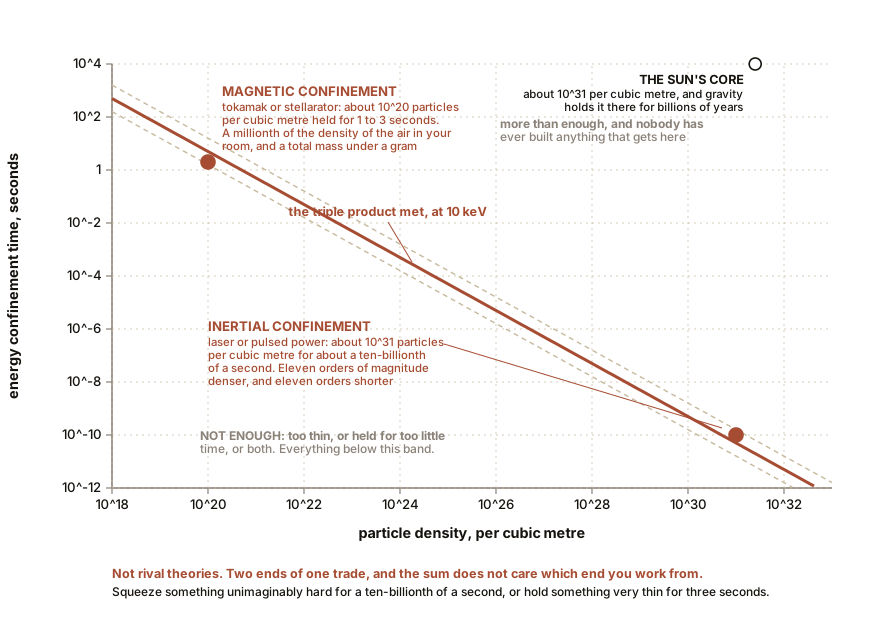
Multiply the three and you get the triple product, which must exceed something in the region of 5 × 10²¹, with density in particles per cubic metre, temperature in keV and time in seconds.
The interesting thing is how differently that can be satisfied.
| Route | Density, per m³ | Temperature | Confinement time |
|---|---|---|---|
| Magnetic (tokamak, stellarator) | about 10²⁰ | 10 keV | 1 to 3 s |
| Inertial (laser or pulsed power) | about 10³¹ | 10 keV | about 10⁻¹⁰ s |
Eleven orders of magnitude apart in density and eleven the other way in time, meeting at the same product. That table is the entire strategic landscape of fusion research in six numbers.
One detail in the top row deserves a pause. 10²⁰ particles per cubic metre is about a millionth of the density of the air in your room. A tokamak plasma is a better vacuum than most vacuum chambers. It is not a dense fireball but an extremely thin, extremely hot gossamer whose total mass at any moment is a fraction of a gram (a hundredth of an ounce or less), which is why it can be stopped by a wall without wrecking the building and why it cannot run away.
IN PLAIN ENGLISH: Fusion has three dials: how crowded, how hot, and how long you can hold it. The product of the three must clear a certain number and it does not matter how. Squeeze something unimaginably hard for a ten-billionth of a second, or hold something very thin for three seconds. Both are valid answers to the same sum, and the two great families of fusion machine are those two answers.
ON THE BENCH: Do the Lawson arithmetic yourself
Parts: paper, pencil and a calculator. That is genuinely all, and the point is that the gatekeeping arithmetic of a twenty-billion-dollar machine fits on one sheet. Cost: nothing. Time: 30 minutes. Hazards: none. Method: the target is a triple product of 5 × 10²¹. Find the missing quantity in each case.
One: a tokamak holds 10²⁰ particles per cubic metre at 10 keV. What confinement time does it need? Five seconds. Compare that with the few tenths of a second the best machines reach at reactor-relevant conditions, and you have located the gap.
Two: a laser capsule reaches 10³¹ particles per cubic metre at 10 keV. What time does it need? About 50 picoseconds. Now check that against the physical size: a capsule 2 mm (0.08 in) across whose material is flying apart at hundreds of kilometres per second stays together for roughly that long by itself. Inertial confinement is not a clever way of holding the plasma. It is the observation that at that density you do not need to.
Section 3: The Machines
The tokamak. A doughnut-shaped vessel. Coils wrapped round it the short way produce a strong field running the long way round. That alone gives no twist; the twist comes from driving a very large current through the plasma itself, whose own field circles the plasma column, and the sum of the two is the spiral of the garden hose.
Two weaknesses follow from getting the twist that way. The plasma current is driven like a transformer secondary, so it depends on a changing flux and cannot go on forever: a tokamak is naturally pulsed, and steady operation needs additional current drive that costs power. And a plasma carrying a huge current can lose it suddenly. That is a disruption: the current terminates in milliseconds, the stored energy lands somewhere, and the collapsing field accelerates runaway electrons to tens of MeV that can drill through the vessel wall.
The concept came from Soviet work in the 1950s. The settling moment was 1968, when the T-3 machine in Moscow reported electron temperatures around 1 keV, an order of magnitude better than anything in the West, and was not believed until a British team took their laser scattering equipment to Moscow the next year and confirmed it. Every large fusion machine built since is a tokamak or a reaction to one.
ITER, under construction in southern France by seven partners representing more than half the world’s population, is the culmination: a plasma 6.2 m (20 ft) from the machine’s centre to the plasma’s, a 5.3 T field, 15 MA of plasma current, and a design goal of 500 MW of fusion power from 50 MW of heating for several hundred seconds. Cost estimates run from about 20 billion euros to over $60 billion depending on what is counted, and the width of that range is itself the finding. Schedules have slipped repeatedly; the current plan puts first plasma in the mid 2030s.
The stellarator. Put all the twist in the external coils and drive no current through the plasma at all. This was the original idea, proposed by Lyman Spitzer at Princeton in 1951 before the tokamak existed. It is inherently steady-state, has no plasma current to disrupt, and is intrinsically the more stable concept.
And it lost for forty years because nobody could build the coils, whose field shape is genuinely three-dimensional and cannot be worked out by hand. Wendelstein 7-X in Germany is what it looks like when it is done: fifty superconducting coils, each a different shape, none planar, assembled over a decade, running plasmas for minutes with 1.3 GJ injected in a single eight-minute discharge in 2023. It is not a power plant and is not meant to be. It is the demonstration that the harder geometry works.
Inertial confinement. Do not hold the plasma at all. Compress a millimetre-scale capsule of fuel so violently that it fuses before it can fly apart, using its own inertia as the only confinement. At the National Ignition Facility, 192 laser beams deliver about 2 MJ in a few nanoseconds into a small gold cylinder, which converts it to X-rays, which compress the capsule inside. On 13 December 2022 that facility produced 3.15 MJ of fusion energy from 2.05 MJ of laser energy, the first laboratory fusion reaction to release more than was delivered to it. The Lasers volume, recommended and never required, covers the machine in its Chapter 14.
And the number the headlines omitted: the facility draws roughly 300 MJ from the grid to make that 2 MJ of laser light. The shot was a genuine and important physics milestone and it was not a step toward a power station, because NIF was not built to be one.
And the rest, briefly: field-reversed configurations, magnetic mirrors, magnetised target fusion, and the sheared-flow-stabilised Z-pinch, which is Chapter 11’s pinch with a fix for the sausage instability. Over seven billion dollars of private money is now in the field across some forty companies. Not one of them, and not one government machine, has ever produced net electricity, and any account leaving that sentence out is selling something.
SLOW DOWN. Check Your Understanding: A machine reaches Q equals 1, meaning fusion power out equals heating power in. That sounds like the finish line. A power plant needs Q of about 20 to 40. Where does the factor of thirty go? Follow one joule from the wall socket before reading on.
Q of 1 is measured at the plasma, not at the meter.
Heating a plasma is inefficient. Neutral beams and radio-frequency systems deliver something like 30 to 40 per cent of the electricity they consume into the plasma, so three joules from the grid become one joule of heat.
The heat that comes out has to be converted back. Fusion power arrives mostly as fast neutrons, is captured as heat in a blanket, and drives a steam turbine at 35 to 40 per cent, like any thermal station. One joule of fusion becomes 0.4 joules of electricity.
And the plant has a large appetite of its own. Cryogenics for the magnets, vacuum pumps, coolant pumps, the tritium plant, controls and buildings. At ITER’s scale that recirculating load is well over 100 MW, continuously, whether or not the plasma is burning.
Multiply the chain and at Q of 1 the plant consumes roughly ten times what it generates. Break-even at the meter needs Q of 5 to 10 before you have paid for anything, and 20 to 40 before there is a business. Which is why ITER’s Q of 10 is a scientific target and not a commercial one, and why “we achieved break-even” always needs the follow-up question: measured where?
Section 4: Where the Difficulty Actually Lives
Temperature is not the hard part. It has been reached routinely since the 1990s. These three are.
Turbulence
Take the theory of how a magnetised plasma loses heat by simple collisions, apply it to a tokamak, and you predict a confinement time roughly a hundred times better than any machine achieves. The plasma leaks far faster than collisions can explain, and always has.
The reason is turbulence. Drift waves grow into eddies a few ion gyration radii across, which by Chapter 11’s numbers is a few millimetres, and those eddies carry heat and particles across the field far more effectively than collisions do. It is the same category of problem as the drag on an aircraft wing, and it is unsolved in the same way: it needs the largest computers in the world to simulate and it does not reduce to a formula.
So confinement in a new machine is predicted not from theory but from empirical scaling laws fitted to a database of every tokamak ever operated. ITER’s performance projection rests on such a fit. That is a respectable way to design a machine and it is not first-principles physics, and the distinction matters when somebody extrapolates.
Two facts show how empirical this field is. In 1982 a team at the ASDEX machine found that above a certain heating power the plasma spontaneously formed a thin barrier at its edge and confinement roughly doubled. Nobody predicted it, every reactor design since assumes it, and after forty years the theory of why is still argued over. It is called H-mode, and it comes with a bill: the edge barrier periodically breaks down and dumps megajoules onto the wall in under a millisecond, in bursts called edge-localised modes, which are among the most serious unsolved engineering problems in the field.
Wall materials
The neutron is the problem, and there is no shielding it from the inside.
Start with heat. A tokamak steers its exhaust plasma onto a component called the divertor, designed to take about 10 MW/m² continuously. A rocket nozzle throat is in the same range and the surface of the sun radiates about 63 MW/m². A rocket nozzle runs for minutes. This has to run for years. The material of choice is tungsten, because it melts at 3,422 °C (6,192 °F), and even tungsten erodes, and eroded tungsten atoms entering the plasma radiate energy away very efficiently, cooling the plasma you were keeping hot.
Then the damage. A 14 MeV neutron knocks atoms clean out of the lattice, and the dose is counted in displacements per atom. A power plant’s first wall would accumulate somewhere between 20 and 100 over its life, meaning every atom displaced dozens of times. Those neutrons also transmute the metal, and one product is helium, which does not dissolve, so it gathers into bubbles and embrittles the structure.
And here is the honest gap: no material has ever been tested to those conditions, because there is no 14 MeV neutron source with enough flux to do it. Fission reactors have been used as substitutes and produce a different spectrum making far less helium per displacement, so the results do not transfer cleanly. A dedicated facility has been designed and proposed for decades and never built. This is the clearest example in the subject of a claim that cannot be settled with existing apparatus, and it should be stated that way.
Tritium
This one gets the least attention and may be the most binding.
Tritium has a half-life of 12.3 years, so it does not survive in nature. The entire civil world stock is something like 25 kg (55 lb), essentially all of it a by-product of Canadian heavy-water fission reactors, and it is declining as those retire. A single 1 GW fusion station would burn something like 55 kg (120 lb) a year. Twice the world supply, annually, per plant.
So every plant must make its own, and there is one way: surround the plasma with lithium and let the neutrons convert it, a neutron striking lithium-6 producing tritium and helium. That is what the breeding blanket is for, and it makes the blanket a fuel factory rather than a heat exchanger.
And the arithmetic is uncomfortably tight. Each reaction consumes one tritium and produces one neutron, so each neutron must yield slightly more than one tritium after allowing for neutrons absorbed by the structure or lost through ports. Since one neutron cannot directly make more than one tritium, the blanket must multiply neutrons using beryllium or lead. Designs target a breeding ratio of 1.05 to 1.15, and there is very little margin in that.
Add three practical difficulties. Only a few per cent of injected tritium fuses on each pass, so the fuel cycle must process ten to a hundred times what it burns, meaning kilograms circulating daily. Tritium is hydrogen, so it permeates metals and soaks into every wall. And it must be accounted for gram by gram to a regulator’s satisfaction.
No breeding blanket has ever been operated in a fusion machine. ITER will test small modules and will not breed its own fuel; it will consume a significant fraction of the world stock. Until a blanket has demonstrated a breeding ratio above one while producing usable heat, the fuel cycle of fusion power is an engineering plan rather than a demonstrated capability.
Section 5: What This Chapter Established
The requirement is a product, not a quantity, and the same target is hit by a thin plasma held for seconds or a dense one held for a ten-billionth of a second. The twist is the idea: a ring of field lines leaks its plasma in under a millisecond unless the lines spiral, and a tokamak makes the spiral with a plasma current while a stellarator makes it with the shape of its coils.
Temperature was never the hard part. The plasma leaks by turbulence nobody can calculate from first principles; the wall must survive a neutron flux no facility can reproduce for testing; and the fuel must be manufactured inside the machine by a component that has never been built.
And the question to ask of any announcement is where the measurement was taken. Fusion power at the plasma, laser energy at the target and electricity at the meter are three quantities differing by factors of tens, and headlines quote the most flattering one. The Nuclear Power volume, recommended and never required, takes the fission side and the reactor engineering in proper detail.
Next: the same physics at a scale where it has run for four and a half billion years without a wall. The sun, the aurora explained rather than photographed, and why a shortwave radio reaches another continent at midnight and not at noon.

Bench Degree
Get the degree without the diploma.
Learn the material, not how to pass the exam.