Bench Degree·PLASMAchapter
Chapter 11: Plasma and Magnetic Fields
A charged particle in a magnetic field is a bead threaded on a wire. It slides freely along and it will not come off sideways. Almost everything the sun does, and everything a fusion reactor is trying to do, follows from that one sentence.
Bring a strong magnet up to the side of a running fluorescent tube, or to your jar with a glow discharge in it.
The glow moves. It bulges, shifts to one side, sometimes splits or spirals, and it snaps back the instant you take the magnet away. Nothing is touching it. Now do the same to a candle flame with the magnet held well clear of the wax. Nothing whatever happens. Neutral gas does not care about a magnetic field, and that is the largest single behavioural gap between a plasma and a gas.
ON THE BENCH: Bend a discharge with a magnet
Parts: the jar, hand pump, current-limited supply and ballast resistor. A neodymium disc magnet, 20 mm (0.8 in) or larger. A working fluorescent tube as a second target. A phone camera. Cost: about $8 for the magnet. Time: 40 minutes. Hazards: high voltage, Chapter 16 in full. Hold the magnet on a wooden or plastic stick so your hand stays outside the exclusion zone. Neodymium magnets pinch hard, shatter when they slam together, and ruin cards, drives and pacemakers. Method: strike a stable glow at a few Torr and photograph it undisturbed. Then bring the magnet slowly toward the side of the jar at several orientations, photographing each, and repeat with the pole reversed. Then do the same alongside a lit fluorescent tube. What you should see: the glow displaces to one side, and reversing the magnet reverses the direction it goes, which tells you the force depends on the sign of the charge and the direction of motion rather than on field strength alone. At some orientations the column constricts and brightens; at others it broadens. The variation worth doing, carefully: repeat Chapter 8’s car-battery arc with the magnet nearby on a wooden stick, safety glasses on. The arc will visibly blow sideways. Welders call this magnetic arc blow, and it is one of the standard causes of an unexplained bad weld.
Section 1: Free Along, Trapped Across
The force a magnetic field puts on a moving charge has one strange property, and everything follows from it. The force is always at right angles both to the field and to the particle’s motion.
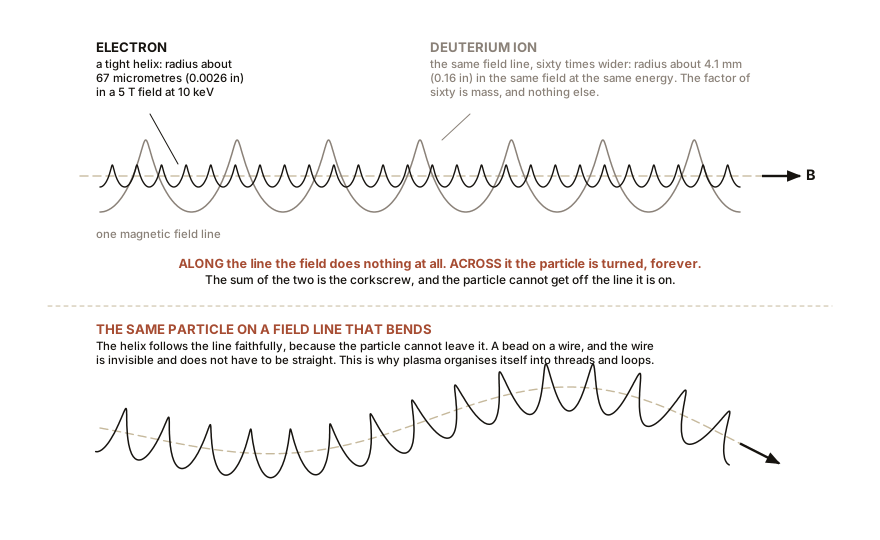
A particle moving straight along a field line has no motion across the field, so there is no force. It carries on exactly as if the field were not there. Along a field line, a magnetic field does nothing.
A particle moving across a field line feels a force at right angles to its travel, and a force at right angles to travel does not speed a thing up or slow it down; it turns it. Since the force stays at right angles as the particle turns, it keeps curving forever. It goes in a circle.
A real particle has some of each. The motion along the field is untouched, the motion across it is bent into a circle, and the sum is a helix: the particle corkscrews along the field line. So a charged particle is free to travel along a field line and cannot get off it. It is a bead on a wire, and the wire is invisible and does not have to be straight.
The radius of the circle shrinks as the field strengthens and grows as the particle speeds up. In the Earth’s surface field of 50 µT a modestly energetic electron circles with a radius of about 68 mm (2.7 in); in a fusion machine at 5 T the same electron at ten thousand times the energy circles in about 67 µm (0.0026 in).
And a heavy particle circles far wider than a light one at the same energy. In that same 5 T field a deuterium ion at 10 keV has a radius of about 4.1 mm (0.16 in), sixty times the electron’s. That factor of sixty is why some machines can magnetise the electrons and deliberately leave the ions unmagnetised, which is exactly the trick a Hall thruster uses in Chapter 14.
IN PLAIN ENGLISH: Think of a bead on a knitting needle. It slides up and down as freely as you like and cannot leave the needle sideways. A magnetic field does that to every charged particle in a plasma, and the needles are the field lines. Which is why a field can hold a plasma in from the sides and cannot stop it running out the ends.
Section 2: Which Is Why Plasma Looks Stringy
Look at any photograph of the sun’s edge, or of the aurora, and the same thing is obvious: plasma organises itself into threads, loops, arches and curtains. That is not decoration. It is the direct visible consequence of Section 1.
Heat travels along a field line easily and across it badly, because conduction depends on fast particles carrying energy and a fast particle can go anywhere along a field line and essentially nowhere across one. So a bundle of field lines is thermally insulated from the bundle beside it: one tube of plasma can be a million degrees while its neighbour is cool. What you see in the sun’s corona is not gas arranged in arches; it is field lines made visible by the plasma trapped on them.
Section 3: A Field Can Push
Here is the part that surprises people, and it turns a magnetic field from a guide into a machine. A magnetic field exerts pressure. Not on a wall and not through a piece of iron, but on whatever plasma is in it, sideways, like a gas, and the amount is set by field strength alone:
magnetic pressure = B squared / ( 2 × µ0 )with B in tesla and the answer in pascals. It also pulls along its own length, like a stretched elastic band, which is why field lines resist bending and snap back when released. The numbers are startling:
| Field | Where you meet it | Magnetic pressure |
|---|---|---|
| 50 µT | Earth’s surface field | 0.001 Pa, negligible |
| 0.25 T | inside a sunspot | 25 kPa (3.6 psi) |
| 0.5 T | the face of a neodymium magnet | 100 kPa (14.5 psi) |
| 5.3 T | ITER’s field on the plasma axis | 11 MPa (1,600 psi) |
| 12 T | peak field at ITER’s coils | 57 MPa (8,300 psi) |
| 20 T | high-temperature superconducting coils | 159 MPa (23,000 psi) |
Read the third row and then look at a fridge magnet differently. The face of a strong neodymium magnet carries a magnetic pressure of about one atmosphere, which is why a suction cup and a magnet of the same size hold about the same weight. And read the last row against a materials handbook: structural steel yields around 250 to 350 MPa (36,000 to 51,000 psi), so a 20 T coil pushes on its own supports with the better part of a tenth of that, continuously, for the machine’s whole life. The magnets in a fusion reactor are a structural problem before they are an electrical one, and that reappears in the next chapter as a cost.
ON THE BENCH: Measure a magnetic pressure with a kitchen scale
Parts: a neodymium disc magnet of known diameter. A flat steel plate. A luggage or fishing spring scale reading to 20 kg (44 lb). A ruler. Cost: nothing beyond the magnet. Time: 20 minutes. Hazards: these magnets pinch. Keep fingers out from between magnet and steel. Method: stick the magnet flat to the steel, hook the spring scale to it and pull straight out, recording the highest reading before it releases. Divide that force by the magnet’s face area. What you should see: for a 20 mm (0.8 in) disc releasing at about 5 kg (11 lb), the force is 49 N over 0.000314 square metres (0.49 square inches), or about 156 kPa (23 psi). Working backwards through the formula, that implies a field at the face of roughly 0.6 T, which is what a magnet of that grade should give. What it proves: you have measured a magnetic field with a spring scale. The pressure is not an analogy. It is the actual mechanical thing the field does, and it is the same quantity resisted by steel in a fusion machine and by the sun’s own weight in a sunspot.
Section 4: When the Plasma Grips the Field
So far the field has been fixed and the plasma has responded to it. Now the other direction, which is where the subject gets its own name. You cannot change the field inside a good conductor quickly, because any attempt induces a current that opposes the change. Try to push a magnet into a copper ring and the ring fights you. A plasma is such a good conductor, and usually so large, that the effect is close to total. The field cannot slip through the plasma, and the plasma cannot slip across the field. The usual phrase is that the field is frozen in.
That single condition, plus ordinary fluid mechanics, is magnetohydrodynamics, and it can be stated without an equation: the plasma moves and drags the field with it, and the field pushes and pulls and moves the plasma. Two materials that cannot pass through each other, each able to shove the other.
Three consequences you will meet everywhere:
Fields get wound up and amplified. A plasma that churns while carrying a field stretches and twists its field lines, and stretching one strengthens it. That is how the sun and the Earth generate their own magnetic fields out of motion, and it is called a dynamo.
Field lines can be plucked. They have tension and the plasma has mass, so a disturbance travels along one as a wave, exactly as along a guitar string. These are Alfvén waves, named for Hannes Alfvén, who worked out most of this subject and was disbelieved for decades before receiving a Nobel Prize for it. In the solar corona they travel at something like 1,000 km/s (620 miles/s).
And when the freezing fails, it fails violently. Where oppositely directed field lines are pressed together in a thin layer the approximation breaks down, the lines break and rejoin, and the energy stored in the bent field is released in seconds. That is magnetic reconnection, the engine of a solar flare, of a substorm in Earth’s magnetotail, and of the sudden collapses that spoil a fusion plasma.
Section 5: The Pinch, and Why It Was Not That Easy
Now a specific and historically important arrangement.
Run a large current straight down a column of plasma. That current makes its own field, circling the column, and Section 3’s magnetic pressure does the rest: a current sitting in its own field is squeezed by it. The column contracts. That is the pinch, a plasma compressing itself with no apparatus beyond two electrodes and a capacitor bank, and in the early 1950s it looked like the answer to fusion. Britain, the United States and the Soviet Union all built pinch machines, and the British ZETA was announced in 1958 as having achieved thermonuclear neutrons and then had to withdraw the claim.
The pinch fails, and the reason is mechanical enough to see.
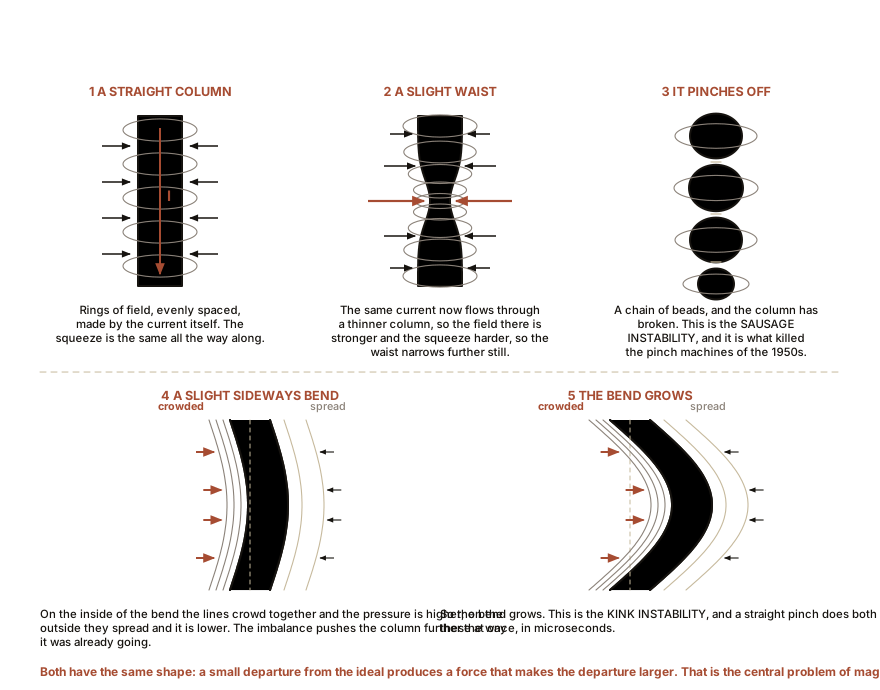
Suppose the column develops a slight narrowing. The current is unchanged but is now flowing through a thinner column, so the field circling that spot is stronger, so the squeeze there is harder, so the narrow spot narrows further. It pinches off into beads and the column breaks. That is the sausage instability.
Or suppose it develops a slight sideways bend. On the inside of the bend the field lines crowd together and the pressure is higher; on the outside they spread and it is lower. The imbalance pushes the column further the way it was already going. The bend grows. That is the kink instability.
Both have the same shape: a small departure from the ideal produces a force that makes the departure larger. Once you see that pattern you have seen the central problem of magnetic confinement, and you will meet it again in the next chapter wearing a dozen different names.
SLOW DOWN. Check Your Understanding: A magnetic field holds a plasma in from the sides and does nothing along the field lines, so a straight magnetic tube leaks out both ends. The obvious fix is to bend the tube into a ring so that it has no ends. That is exactly what a tokamak is, and it is not sufficient. Bending the tube introduces a brand new problem. What is it? Think about the geometry of a ring of field lines before reading on.
When you bend a tube into a ring, the field on the inside becomes stronger than the field on the outside, because the same field lines are squeezed into a shorter circumference near the hole and spread out further away from it. Every particle is now in a field that varies across its own orbit.
A particle in a non-uniform field does not circle neatly. Its orbit is tighter on the strong side, so it does not close, and it creeps sideways. And the direction it creeps depends on the sign of its charge, so ions drift one way and electrons the other. Charge separates, ions collecting at the top of the ring and electrons at the bottom, and that separation makes an electric field across the plasma which, crossed with the magnetic field, pushes everything straight out toward the wall. A simple ring loses its plasma in well under a millisecond.
The fix is to twist. Make the field lines spiral around the ring as they go round it, so that every line spends part of its length near the top and part near the bottom. A particle following such a line drifts up on one side and down on the other, and the two cancel. That twist is the rotational transform, it is the single non-obvious idea in magnetic confinement, and the two great families of fusion machine are two ways of producing it. That is where the next chapter starts.
Section 6: The Sun’s Surface, Read Off the Physics
Everything above is visible in a telescope with a proper solar filter, and now it can be read rather than merely admired.
The granulation is a shifting pattern of bright cells about 1,000 km (620 miles) across, each lasting ten or twenty minutes: convection cells, hot plasma rising in the bright middle and sinking in the dark lanes between. Ordinary boiling, at continental scale.
The sunspots. A sunspot is where a bundle of magnetic field has pushed up through the surface. Inside it the field is 0.1 to 0.3 T, which by Section 3’s table carries a magnetic pressure of tens of kilopascals, comparable to the gas pressure of the photosphere itself. So the field wins locally, holding the bundle open and stopping convection dead, because convection means plasma crossing field lines and plasma will not cross field lines. Cut off the convection and you cut off the heat from below. The spot cools to about 4,000 K against the surrounding 5,800 K, and a region two thousand degrees cooler than its surroundings looks black beside them. A sunspot is not dark. It is merely less bright than the most brilliant thing in the sky.
The coronal loops are Section 2’s threads, arches standing 100,000 km (60,000 miles) off the surface along the field lines connecting one magnetic region to another, and the flares are those lines twisted together until Section 4’s freezing fails. Chapter 13 follows what leaves.
Section 7: What This Chapter Established
A charged particle slides freely along a field line and cannot cross one, which is why plasma is threaded, filamentary and thermally striped, and why a field holds it in sideways but not lengthwise. A magnetic field has a pressure, its strength squared over twice a constant, measured in tens of megapascals in serious machines. Plasma and field are stuck to each other, which is magnetohydrodynamics, and it gives you dynamos, waves along field lines, and violent release when the sticking fails.
And a plasma squeezed by its own current squeezes itself to pieces, because every small departure from the ideal generates a force that enlarges it. That sentence is the whole reason the next chapter exists.
Next: the two ways of building the twist, the plain trade that says what a fusion plasma must achieve, and the honest accounting of where the difficulty actually lives, which is not the temperature.

Bench Degree
Get the degree without the diploma.
Learn the material, not how to pass the exam.