Bench Degree·SOLAR POWERchapter

Chapter 12: Batteries, and Whether They Pay
A battery has to buy a kilowatt-hour cheap and sell it dear, and the margin it needs is somewhere between fourteen and twenty-three cents. If your tariff does not offer that spread, no amount of good engineering will make the sums work, and this chapter is about being willing to say so.
Before any economics, one measurement, because it is the number every battery calculation depends on and almost nobody checks it.
Take a battery, a charger and a load, and put an energy meter on each side. Charge the battery from empty to full and record the energy in. Discharge it back to empty through the load and record the energy out. Divide.
That ratio is round-trip efficiency, and here is roughly what you will find:
| Energy in | Energy out | Round trip | |
|---|---|---|---|
| Lead-acid, at the battery terminals | 1.00 kWh | 0.82 kWh | 82 percent |
| Lithium iron phosphate, at the terminals | 1.00 kWh | 0.96 kWh | 96 percent |
| Either one, measured at the AC socket | 1.00 kWh | 0.85 or 0.88 kWh | 85 or 88 percent |
The last row is the one that matters and the first two are the ones that get quoted. A lithium iron phosphate cell really is 96 percent efficient. By the time the energy has been through a charger on the way in and an inverter on the way out, each about 96 percent efficient in its own right, the useful figure has fallen to 88 percent. Every kilowatt-hour that goes into storage loses about an eighth of itself, and a system design that assumed 96 percent will be 8 percent short of its promises.
ON THE BENCH: Measure round-trip efficiency properly
Parts: a 12 V battery, lead-acid or lithium iron phosphate; a charger for it; two plug-in AC energy meters at about $15 each, or one meter used twice; a resistive load such as a 12 V halogen bulb or a heating element; a shunt-based DC energy meter, about $20, if you want the battery-terminal figure as well. Cost: about $50 beyond the battery. Time: two days for a lead-acid battery, one for lithium, most of it waiting. Hazards: flooded lead-acid batteries vent hydrogen while charging, which is explosive at four percent in air. Charge outdoors or in a ventilated space, no sparks, no smoking. Any battery will deliver hundreds of amps into a short. Fuse the load lead close to the positive terminal and remove watches and rings. Do not discharge a lithium iron phosphate pack below the voltage its own management board allows, and do not charge one below 0 °C (32 °F). Method: discharge to the manufacturer’s recommended cut-off first, so you start from a known state. Put the AC meter on the charger’s plug and charge to full, recording kilowatt-hours in. Then discharge through the load, via the inverter if you want the socket-to-socket figure, recording kilowatt-hours out. Divide out by in. What you should see: 85 to 89 percent socket to socket for lithium iron phosphate, 70 to 78 percent for lead-acid. Both lower than the datasheet, and the datasheet was not lying, because it quoted the cell and you measured the system. Then repeat at a different discharge rate. Halve the load and run it twice as long. Lithium will give almost the same answer. Lead-acid will give a noticeably better one, and Section 2 explains why. The number to write on the battery in marker pen: your measured socket-to-socket round trip. Every economic calculation in this chapter uses it, and using the datasheet figure instead will make a bad investment look adequate.
Section 1: Off-Grid Is a Different Machine
Before pricing anything, a distinction that gets blurred constantly.
A grid-tied system with a battery has two sources of energy and the battery is an optimisation. If the battery is empty, the house runs from the grid. If the battery fails, the house runs from the grid. The battery’s job is to move energy in time so it is worth more, and its value is the price difference between the hours it moves it between.
An off-grid system has one source and the battery is load-bearing. If the battery is empty at 3 a.m. in January, the house is dark. There is no fallback, no grid, and no forgiveness. The battery is not an optimisation; it is the thing that makes the system a system.
These lead to completely different sizing rules, and using one on the other is the most common and most expensive mistake in this field.
A grid-tied battery is sized by the daily cycle. How much surplus does the array produce at midday, and how much does the house consume in the evening? Store the smaller of the two. Anything larger sits idle most days and earns nothing.
An off-grid battery is sized by the worst stretch of weather. Not by the average day. By four grey days in December in a row, which is what actually happens, and which the average conceals completely.
Work the off-grid case for the site in this book, at 40 degrees north, and be honest about what comes out.
A modest, deliberately efficient household using 8 kWh a day, with propane cooking and no electric heating. January insolation is 2.7 peak sun hours and the system’s performance ratio is 0.816, so the array required to break even in an average January day is:
8 / (2.7 x 0.816) = 3.6 kW
Which sounds affordable, and is a trap, because an average January day is not the design case. The design case is the run of days that are worse than average, and standard off-grid practice is to size the array 1.5 to 2 times the break-even figure and still carry a generator for December. So 6 kW of modules for a house using 8 kWh a day, against 7 kW for a grid-tied house using 25.
Then the battery. Three days of autonomy at 8 kWh a day is 24 kWh of usable energy. Lithium iron phosphate allows about 90 percent depth of discharge, so:
24 / 0.90 = 27 kWh of nominal capacity
27 x $195 per kWh = $5,265 in cells and racks alone
And three days is not much. Anyone who has lived off grid will tell you that a week of low cloud happens, and that the honest answer is a generator rather than a bigger battery, because a battery sized for a once-a-year event is idle for the other 360 days.
Which is the real reason almost every off-grid system in the world has a generator in a shed. Not as a failure of the solar design, but because the last 5 percent of the load is the most expensive 5 percent by a very large factor, and a $900 generator burning fuel for forty hours a year is cheaper than $10,000 of battery that is empty when you need it anyway.
IN PLAIN ENGLISH: A grid-connected battery is a convenience: it saves you money by using your own solar in the evening instead of buying from the utility. An off-grid battery is a life-support system: if it runs out you have no electricity at all. The first can be small and still be useful. The second has to be sized for the worst week of the year, which makes it very large and very expensive, and almost everybody who does it ends up buying a generator as well.
Section 2: The Four Numbers That Set a Battery’s Real Cost
Nameplate capacity tells you almost nothing. Four other figures decide what a battery actually delivers over its life.
Depth of discharge. How much of the nameplate you are allowed to use. Lead-acid tolerates 50 percent routinely and is destroyed quickly by more. Lithium iron phosphate allows 80 to 90 percent. A 10 kWh lead-acid bank and a 10 kWh lithium bank are a 5 kWh battery and a 9 kWh battery.
Round-trip efficiency, measured socket to socket as in the first box. 85 to 88 percent for lithium, 70 to 78 percent for lead-acid.
Cycle life, quoted as the number of charge and discharge cycles before capacity falls to 80 percent of new, at a stated depth of discharge. This figure is quoted optimistically by everybody and it depends heavily on temperature and on how deeply each cycle goes.
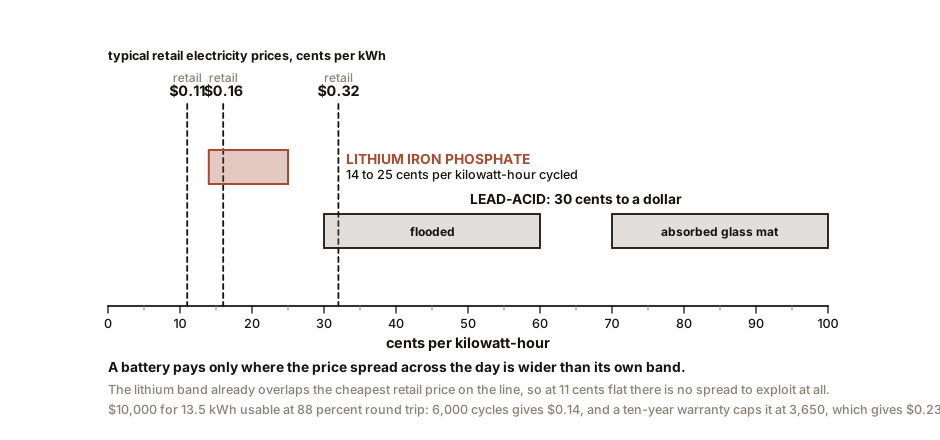
Calendar life, which is the one people forget. A cell degrades with time whether it is cycled or not. A battery rated for 6,000 cycles that carries a ten-year warranty will be replaced at 3,650 cycles, because one cycle a day is what a solar battery does, and the warranty runs out first.
Combine them and you get the number that actually matters, which is cost per kilowatt-hour delivered over the battery’s life.
For a 15 kWh lithium iron phosphate system installed at $10,000, with 13.5 kWh usable and 88 percent round trip:
at 6,000 cycles: 13.5 x 6,000 x 0.88 = 71,280 kWh delivered, so $0.14 per kWh
at 3,650 cycles: 13.5 x 3,650 x 0.88 = 43,362 kWh delivered, so $0.23 per kWh
Now the same arithmetic for a lead-acid bank, and it is brutal.
A 48 V 200 Ah absorbed-glass-mat bank is 9.6 kWh nominal, 4.8 kWh usable at 50 percent depth of discharge, about $1,900, and good for perhaps 500 cycles at that depth with 80 percent round trip:
4.8 x 500 x 0.80 = 1,920 kWh delivered, so $0.99 per kWh
A dollar a kilowatt-hour. That is four to seven times the price of grid electricity almost anywhere. Lead-acid storage does not pay for grid-connected energy shifting under any tariff on earth, and it never did; it is a technology for off-grid situations where the alternative is no electricity, and for engine starting, where its ability to deliver enormous current briefly is unmatched.
Here is the comparison in full, and it is the table to photograph before visiting a supplier.
| Flooded lead-acid | AGM lead-acid | Lithium iron phosphate | |
|---|---|---|---|
| Usable depth of discharge | 50 percent | 50 percent | 80 to 90 percent |
| Cycles at that depth | 800 to 1,500 | 400 to 600 | 4,000 to 8,000 |
| Round trip, socket to socket | 72 to 78 percent | 70 to 76 percent | 85 to 89 percent |
| Energy per unit mass | 30 to 40 Wh/kg | 30 to 40 Wh/kg | 90 to 160 Wh/kg |
| Price per nominal kWh | $100 to $150 | $180 to $220 | $150 to $250 |
| Cost per kWh delivered over life | $0.30 to $0.60 | $0.70 to $1.00 | $0.14 to $0.25 |
| Charge acceptance when nearly full | poor, tapers badly | poor | excellent |
| Maintenance | water top-up, equalising | none | none |
| Behaviour in the cold | capacity falls, charging is fine | same | must not be charged below freezing |
| Behaviour when abused | gasses, sulphates, dies quietly | same | management board disconnects |
Two rows deserve a sentence each.
Charge acceptance when nearly full is why lead-acid and solar are a poor match. A lead-acid battery above about 80 percent state of charge will only accept a trickle, so the last fifth takes hours, and on a short winter day the sun sets before the battery is full. Cumulatively it never quite gets there, and a chronically undercharged lead-acid battery sulphates and dies. Lithium iron phosphate takes full current to nearly 100 percent, which on a four-hour winter day is the difference between a full battery and a failing one.
And the cold row is a genuine hazard rather than a specification. Charging a lithium iron phosphate cell below 0 °C (32 °F) plates metallic lithium onto the anode, permanently and cumulatively, and eventually causes an internal short. Any pack sold for solar use has a management board that refuses to charge when cold, and a pack in an unheated garage at 40 degrees north will refuse to charge on winter mornings, which surprises owners every year. Self-heating packs exist and cost more.
Section 3: The One Rule That Decides It
Everything above collapses into a single test, and it is worth stating as plainly as possible.
A battery pays only if the gap between what a stored kilowatt-hour is worth and what the same kilowatt-hour would have been worth unstored is larger than the battery’s cost per kilowatt-hour cycled.
For lithium iron phosphate today, that threshold is 14 to 25 cents per kilowatt-hour. If your tariff does not offer a spread wider than that, the battery loses money on every cycle, and it loses it faster the harder you work it.
Now run four real cases against that test.
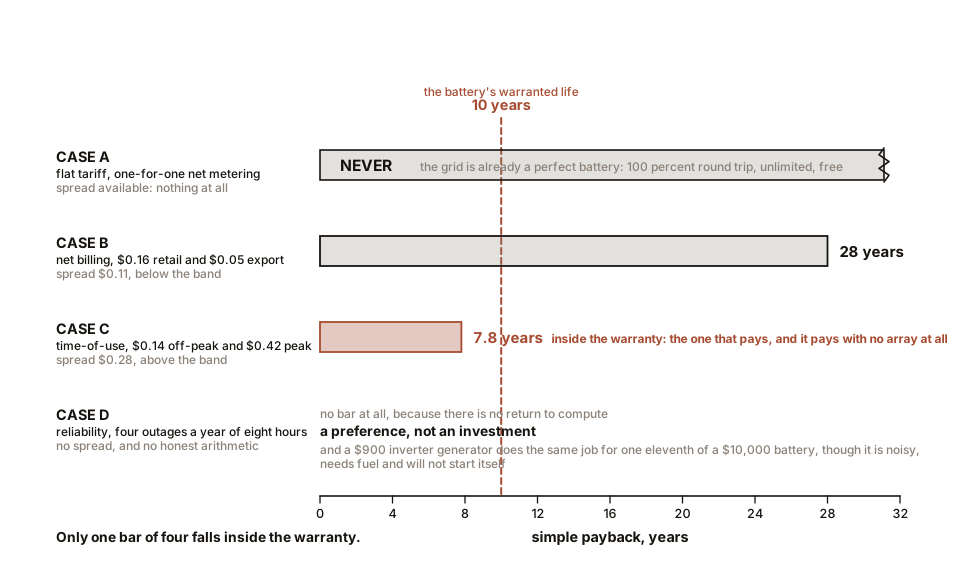
Case A: flat tariff, one-for-one net metering. Retail $0.16 both ways, exports credited at full retail. The grid is already a perfect battery, at 100 percent round-trip efficiency, with infinite capacity, for free. A physical battery can only lose to that: it charges with energy worth $0.16 and returns 88 percent of it, worth $0.14, having cost $0.14 to $0.23 per kilowatt-hour to do so. Spread available: zero. Answer: no, and no version of the arithmetic rescues it.
Case B: net billing, low export credit. Retail $0.16, export credit $0.05, flat across the day. The battery converts export-rate energy into retail-rate energy, so the spread is $0.11.
spread $0.11, battery cost per kWh cycled $0.14 to $0.23
The spread is smaller than the cost. Answer: no.
Work it as a payback anyway, to see how bad: a 13.5 kWh battery cycling
daily shifts about 10 kWh of useful energy a day, worth
10 x 0.88 x 0.11 = $0.97 a day, or $354 a year, against
$10,000 installed. Twenty-eight years, on a ten-year
warranty. This is the commonest real-world case and the answer
is no.
Case C: time-of-use tariff with a real peak. Off-peak $0.14 overnight, peak $0.42 from four until nine in the evening. Now the spread is $0.28, comfortably above the battery’s cost.
charge 15.3 kWh off-peak: 15.3 x 0.14 = $2.14
deliver 13.5 kWh at peak: 13.5 x 0.42 = $5.67 avoided
net $3.53 a day, or $1,288 a year against $10,000 installed
Under eight years, and the battery is inside its warranted cycle count. Answer: probably yes, and notice that in this case the battery pays even with no solar array at all. It is arbitraging the tariff, not storing sunshine. That is worth sitting with for a moment, because it reveals what a battery actually is.
Case D: reliability. Four outages a year, eight hours each. The battery keeps the fridge, the lights, the internet and the furnace fan alive for 32 hours a year.
This one has no arithmetic, and pretending otherwise is dishonest. What is eight hours of light worth? It depends entirely on whether there is a medical device in the house, whether the outages come in winter, whether there is a freezer full of food, and how much the household hates candles. What can be said is the comparison: a 3 kW inverter generator is about $900, needs fuel and a safe place to run, makes noise, and will not start automatically. A battery is silent, automatic, indoors, and eleven times the price.
If backup is the reason, buy the generator and be honest that it is the cheaper answer. If silence and automation are worth $9,000 to the household, that is a legitimate preference and not an error. It is simply not an investment, and it should not be presented as one.
ON THE BENCH: Find out what a battery of yours can really hold
Parts: a lead-acid battery you already own, ideally an old one; a lithium iron phosphate battery if you have one; a 12 V load you can vary, such as several halogen bulbs you can switch in and out; a shunt-based DC energy meter, about $20; a clock. Cost: about $20. Time: a weekend. Hazards: as the first box. Fuse everything. Do not take lead-acid below 10.5 V or lithium below the voltage its board allows. Method: fully charge, then discharge at a slow rate, about one twentieth of the nameplate amp-hours, and record the amp-hours delivered before the cut-off voltage. Recharge fully. Then discharge again at four times that current and record again. What you should see: a lead-acid battery delivering close to its nameplate at the slow rate and 20 to 30 percent less at the fast rate. A lithium iron phosphate battery delivering nearly the same figure at both. Why this matters more than it looks: a “100 amp-hour” lead-acid battery is 100 amp-hours at a twenty-hour discharge rate, which is the industry’s convention and is stated in tiny print. Discharge it in five hours and it is an 80 amp-hour battery. Discharge it in one hour and it is a 50 amp-hour battery. An off-grid design that assumed the nameplate will run out of power on the evening it is most needed, which is a cold one, because capacity falls with temperature too. On an old battery: expect the result to be shocking. A five-year-old lead-acid bank frequently measures at half its nameplate, and the owner has no idea, because a voltmeter on a resting battery tells you almost nothing about its capacity. The only way to know a battery’s capacity is to take the energy out and count it.
Section 4: What to Do Instead, Usually
Since Case B is the commonest situation and its answer is no, it is worth saying what does work, because “no” on its own is not useful advice.
Shift the load rather than the energy. A kilowatt-hour consumed at noon under net billing is worth $0.16 instead of $0.05, and moving it costs nothing but a timer. Dishwasher, washing machine, pool pump, water heater, and the car all run perfectly well at midday. A $12 mechanical timer on a water heater does the same economic job as several hundred dollars of battery, at 100 percent round-trip efficiency, and it never wears out.
Use a heat pump water heater as the battery. A tank of hot water is thermal storage at roughly $0.02 per kilowatt-hour of capacity, it holds its charge for a day or two, and it covers what is often the single largest deferrable load in a house. It is a worse battery in every respect except price, where it wins by a factor of fifty.
Buy the battery you need rather than the battery on offer. Under Case B, a small battery covering the evening peak alone may clear the threshold where a large one does not, because the marginal kilowatt-hour of capacity in a large pack cycles less often and therefore earns less. Capacity that does not cycle daily earns nothing and costs the same.
And wait, if you can. Storage prices have been falling steadily and the threshold of 14 to 25 cents has been coming down with them. A decision that is marginally negative today may be clearly positive in five years, and unlike the array, a battery can be added at any time. Nothing about installing an array now prevents adding storage later, provided the inverter chosen is storage-capable or can be paired with one, which is a question worth asking at purchase and costs nothing to ask.
SLOW DOWN. Check Your Understanding: A household on a flat tariff with one-for-one net metering, where Case A says a battery cannot pay, is told by their utility that net metering will be replaced by net billing in three years. They are quoted $10,000 for a battery now. Should they buy it now, in three years, or not at all? And what changes your answer? Think it through before reading on.
Not now, and probably not in three years either, but the reasoning has a twist in it.
Not now is easy: for three years the battery would earn nothing at all, because the grid is still a perfect free store. Three years of a ten-year warranty burned for zero return, and three years of calendar degradation on the cells.
In three years takes the Case B arithmetic and it comes out at twenty-eight years, so still no, unless one of two things happens. Either the new tariff has a real time-of-use peak in it, which converts the situation from Case B into Case C and flips the answer entirely, or the price of storage falls enough over those three years to bring the cost per kilowatt-hour cycled below the tariff spread. Both are plausible. Neither is knowable now.
Which points at the actual answer: the decision should be deferred, and deferring it is free. Nothing about installing solar today forecloses a battery later. Meanwhile the household should do the things that cost nothing and pay under every tariff, which are the load-shifting habits of Section 4.
And here is the twist worth keeping. The question that decides this is not about batteries at all. It is what the new tariff’s peak rate will be, and that number is set by a regulator, published in advance, and available for free. The most valuable piece of engineering work in a storage decision is reading a tariff schedule, which is not what anyone expects to hear at the end of a chapter about lithium.
Chapter 13 takes everything from Chapters 4 to 12 and designs a real array for a real roof, from nameplate to delivered kilowatt-hours, with the arithmetic shown at every step.

Bench Degree
Get the degree without the diploma.
Learn the material, not how to pass the exam.