Bench Degree·SOLAR POWERchapter

Chapter 11: Inverters and the Grid
An inverter has to produce a sine wave that matches, within a fraction of a degree, the phase of a grid it has no control over. Then, in a blackout, it has to switch itself off, which is exactly what the owner did not expect it to do.
Buy the cheapest 12 V inverter you can find, about $25 for a 300 W unit, and a good one, about $70. Run each into a 100 W incandescent bulb.
Both light the bulb. Now measure what each is actually doing, and the two things worth measuring are the shape of the output and the efficiency of the conversion.
For the shape you need to look at the waveform, and looking at a mains-voltage waveform with a bench scope is a genuinely dangerous thing to do casually. The safe method is to step the voltage down first. Take an ordinary wall-wart transformer that produces 12 V AC from mains, and run it backwards: feed its low-voltage side into the scope while its mains side is plugged into the inverter. You now have a galvanically isolated, ten-to-one attenuated copy of the waveform, and nothing on your bench is at mains potential.
Here is what you will see.
The good inverter produces a sine wave, smooth, symmetrical, and visually indistinguishable from what comes out of the wall.
The cheap one produces a staircase. Three levels: a positive plateau, a gap at zero, a negative plateau, another gap. It is called a modified square wave, or by its marketing name, a modified sine wave, and it is neither modified nor a sine. Total harmonic distortion is 30 to 45 percent against under 3 percent for a real sine wave.
ON THE BENCH: Look at an inverter’s output, safely
Parts: a cheap 300 W 12 V inverter, about $25; a pure sine inverter of similar rating, about $70; a 12 V car battery or bench supply; a 12 V AC wall transformer, about $8, used in reverse as an isolating step-down; a USB oscilloscope, about $50, or a borrowed bench scope; a 100 W incandescent bulb in a fitting; a plug-in energy meter, about $15. Cost: about $170 for the lot, and every piece is reusable. Hazards: this box involves mains-voltage output from the inverters, and it is the most dangerous experiment in this book. Never connect an oscilloscope directly to an inverter’s output. Most bench scopes have their probe ground bonded to earth, and connecting that to a live conductor produces a short circuit through the scope. Use the reversed transformer, keep the mains side inside an enclosed fitting, and treat the inverter’s output exactly as you would a wall socket. Method: with the transformer’s mains side fed from the inverter and its low-voltage side on the scope, capture the waveform of each inverter. Then measure efficiency: DC volts and DC amps going in, and real AC watts coming out on the plug-in energy meter, into the bulb. What you should see: a staircase from one and a sine from the other. On efficiency, expect the cheap unit at 82 to 88 percent and the good one at 90 to 94 percent, both into a resistive load. The result that will confuse you, and should: put a cheap non-true-RMS multimeter on the staircase output and it will read a voltage well away from 120 or 230 V, sometimes 15 percent off. The meter is not broken; it is calibrated on the assumption that the waveform is a sine, and this one is not. That single observation explains most of the arguments about inverter output voltage on the internet, and it is why you measure power with a wattmeter rather than by multiplying two meter readings. Then try a load with a motor in it, a small fan or a mains drill. On the staircase inverter it will run hotter and noisier than on the sine unit, because the harmonics produce currents that heat the windings and do no useful work.
Section 1: What a Grid-Tie Inverter Has to Do
A standalone inverter has an easy job: make a sine wave, any phase, any moment, nobody is watching.
A grid-tie inverter has a much harder one. It has to inject current into a network already energised by generators hundreds of kilometres away, and to do that it must match the grid’s voltage, its frequency and its phase, continuously, as all three drift.
Get the phase wrong by a few degrees and instead of exporting power the inverter exchanges reactive current with the grid, heating everything and delivering nothing. Get it badly wrong and it is short-circuiting the grid through its own output stage.
So the sequence is always the same.
Measure the grid first. The inverter watches the incoming waveform and locks a phase-locked loop to it. It does this before it produces anything.
Then push, gently, in phase. Current is injected slightly ahead of the grid voltage’s own drive, so power flows outward. The amount of current is the control variable: more current, more export.
And keep watching. Frequency wanders as generation and load balance across a continent. The inverter follows it, all day, thousands of times a second.
This is called grid-following operation, and it has one profound implication: the inverter cannot run without a grid to follow. Remove the reference and it has nothing to lock to and nothing to define what a volt or a cycle is. That is not a design shortcut. It is Section 2’s subject, and it is the single most misunderstood fact about domestic solar.
IN PLAIN ENGLISH: Joining a grid is like joining a crowd of people already pushing a heavy roundabout. To help, you have to run alongside at exactly their speed and push at exactly the moment they do. Push at the wrong moment and you are fighting them. And if the crowd goes home, there is nothing to run alongside, so you stop too.
Section 2: Anti-Islanding, and the Backup That Is Not There
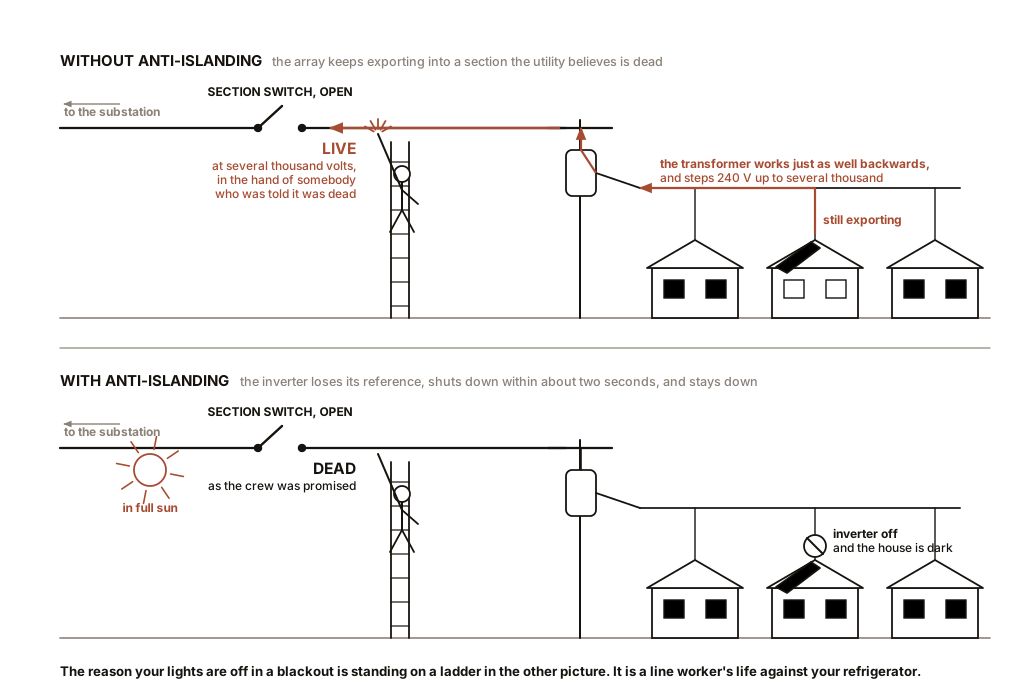
Every grid-tie inverter is required by code to shut down within about two seconds of losing the grid, and to stay down until the grid returns and remains stable for several minutes. The requirement is called anti-islanding, and in North America it comes from IEEE 1547 and the safety standard UL 1741. Other countries have their own equivalents.
The reason is a line worker.
When the utility de-energises a line to work on it, they expect it dead. If a house on that line kept exporting into it, a section of the network would remain live, an island fed by rooftop solar, at full voltage, with nothing indicating it. The distribution transformer that steps 240 V down to the house works just as well in reverse, so a few kilowatts of solar on the low-voltage side can put several thousand volts on the wires a crew is about to handle.
So inverters detect the loss and stop. The detection is a combination of passive and active methods: watching for voltage outside roughly 88 to 110 percent of nominal, frequency outside a narrow window, and a rate of frequency change that indicates the grid’s inertia has vanished. Active methods go further and deliberately perturb the output slightly, watching whether the grid pushes back.
Here is the consequence nobody is told at the point of sale. In a blackout, on a brilliant sunny day, with a roof full of working panels, a standard grid-tied solar system produces nothing at all. The lights are off, the array is in full sun, and the inverter has switched itself off by design, correctly, because it cannot tell the difference between a utility outage and a crew working on the line.
People find this genuinely outrageous, and it is worth being clear that it is not a defect and not a conspiracy. It is a line worker’s life against your refrigerator.
What it takes to have backup is a different machine, and it costs more.
A hybrid inverter with an automatic transfer switch disconnects the house from the grid at the point of supply, then runs as a grid-forming inverter, defining its own voltage and frequency for the isolated house. Because the house is now genuinely disconnected, no power can reach the utility’s wires, and the crew is safe. This needs a battery in almost all cases, because the array’s output varies second by second and something has to absorb the mismatch.
A daytime-only backup outlet is the cheap middle option that some inverters offer: a single socket, live only while the sun shines, limited to a kilowatt or two, with no battery. It will run a fridge and charge phones in daylight and nothing at night. If backup is the reason for buying solar, this is worth knowing about, because it is a few hundred dollars rather than ten thousand.
And a generator remains the cheapest backup power there is, by a wide margin. A 3 kW inverter generator is about $900. Chapter 12 makes this comparison properly, because it is the honest baseline against which every battery quotation should be judged.
Section 3: Efficiency, and Where It Goes
A modern grid-tie inverter is a remarkably good machine. Peak efficiency around 97.6 percent, and a weighted figure across realistic operating conditions around 97.0 percent.
But the efficiency is not flat, and the shape of the curve matters for sizing.
| Load, as a fraction of the inverter’s rating | Efficiency |
|---|---|
| 5 percent | about 90 percent |
| 10 percent | about 95 percent |
| 20 percent | about 96.5 percent |
| 30 to 60 percent | 97.4 to 97.6 percent |
| 100 percent | about 97.2 percent |
It is poor at very low load and best around a third to a half. The reason is that some of the inverter’s own consumption is fixed: the control electronics, the gate drivers, the cooling fan, the monitoring radio. At 200 W of throughput a fixed 15 W overhead is 7.5 percent; at 4,000 W it is 0.4 percent.
Which gives the first reason inverters are deliberately smaller than the arrays they serve. An oversized inverter spends most of its life at the bad end of its own efficiency curve, because a solar array spends most of its hours well below its peak output.
ON THE BENCH: Measure a real inverter’s efficiency curve
Parts: access to a working grid-tied system, yours or a willing neighbour’s; a DC clamp meter, about $90; a multimeter; the inverter’s own monitoring readout or a plug-in energy meter on a microinverter branch. Cost: about $90, and a DC clamp meter earns its keep for the rest of this book. Time: one clear day, sampled every half hour, plus one overcast day for the low end of the curve. Hazards: do not open anything. A clamp meter reads current without contact, which is exactly why this is the safe way to measure a live DC string. Clamp around one conductor only, never both, or the two currents cancel and you read zero. Do not touch the conductors, do not unplug anything, and if the DC wiring is not accessible without opening an enclosure, stop and use the inverter’s own DC readings instead. Method: for each sample, record DC string voltage, DC string current, and AC power out. DC in is volts times amps, summed across strings. Efficiency is AC out divided by DC in. Take samples from first light through to dusk so you span the load range. What you should see: efficiency of 90 percent or less in the first and last half hour of the day, climbing above 96 percent by mid-morning and sitting at 97 percent or so through the middle of the day. Plot efficiency against the fraction of the inverter’s rating being delivered and you will have reproduced the manufacturer’s own curve from a graph nobody gave you. What to look for beyond the curve: the DC voltage at each sample. On a cold clear morning it will be high, and on a hot afternoon low, and the difference across one day will be forty or fifty volts on a string of eight. That is Chapter 9’s temperature coefficient, measured on a roof, without touching the roof. If the numbers do not add up at all: many inverters report AC power averaged over a few minutes while your clamp reading is instantaneous. Take both readings at the same moment on a cloudless day, when nothing is changing fast.
Section 4: Why the Inverter Is Undersized, and What Clipping Costs
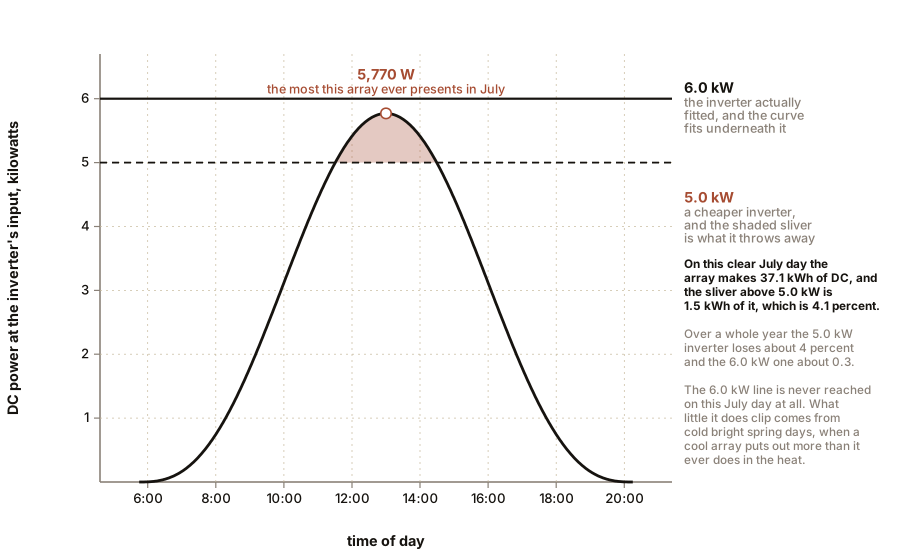
The array in this book is 7.04 kW of modules feeding a 6.0 kW inverter. That ratio, 1.17, is called the DC to AC ratio, and typical installations run between 1.15 and 1.35. Installations at 1.0 are unusual and installations below 1.0 are essentially never seen.
Which looks like deliberately buying too little inverter. It is, and here is the arithmetic that justifies it.
The array almost never reaches its nameplate. Chapter 9 already established why: at the moment of peak irradiance the panels are hot, and the temperature loss is at its worst exactly then. Work the number for a July noon with the array at 63 °C (145 °F):
7,040 x (1 - 0.0034 x 38) = 6,130 W at the modules
x 0.98 soiling x 0.98 mismatch x 0.98 wiring = 5,770 W at the inverter's input
5,770 W into a 6,000 W inverter, at the single sunniest moment of the year. The inverter is not undersized at all; the array’s nameplate was simply never going to appear at its terminals.
When the DC input does exceed what the inverter can pass, the inverter clips: it moves its operating point deliberately off the maximum power point, up the voltage side of the curve, until the array delivers only what the inverter can handle. The excess is not dissipated anywhere. It is never generated, exactly as in Chapter 7’s direct-to-battery case.
Now cost it. Compare the 6.0 kW inverter at $1,250 against a 5.0 kW inverter at $1,000, on this array producing 9,400 kWh a year.
| 6.0 kW inverter | 5.0 kW inverter | |
|---|---|---|
| DC to AC ratio | 1.17 | 1.41 |
| Estimated clipping loss | about 0.3 percent | about 4 percent |
| Energy lost per year | 28 kWh | 376 kWh |
| Cost | $1,250 | $1,000 |
The bigger inverter costs $250 more and recovers 348 kWh a year. Whether that is worth it depends entirely on what a kilowatt-hour is worth to you:
at $0.16/kWh: 348 x 0.16 = $56 a year, so $250 pays back in 4.5 years
at $0.05/kWh: 348 x 0.05 = $17 a year, so $250 pays back in 14.7 years
At full retail value the bigger inverter is an easy yes. At a low export credit it is a clear no, because the extra energy it recovers is mostly midday surplus that gets exported at whatever the utility feels like paying.
That is the shape of every economic question in this book, and it is worth naming now: the hardware arithmetic gives you kilowatt-hours, and only your tariff turns kilowatt-hours into an answer. Anyone who quotes you a payback period without asking what your utility pays for exports is guessing.
Three further points on sizing, because they change the answer.
A flat production profile tolerates a higher ratio. An array split east and west produces a broad plateau rather than a sharp midday peak, so it clips much less for a given ratio, and 1.4 or higher can be sensible. A single south-facing plane peaks hard and clips sooner.
Degradation argues for oversizing the array. Chapter 14’s 0.5 percent a year means the array is 12 percent weaker at year 25. A ratio of 1.25 today is a ratio of 1.10 in twenty-five years, and the clipping that annoys you in year one has quietly gone away by year fifteen.
And clipping is not always a loss. Under a tariff that pays little for midday export and much for evening supply, clipping midday surplus you could not have sold costs nothing at all, and a cheaper smaller inverter is straightforwardly better.
Section 5: What the Grid Pays, and Why It Is Not One Number
The arrangements under which a utility accounts for exported solar fall into three families, and everything about a system’s economics follows from which one you are in.
Net metering, one for one. The meter runs backwards. A kilowatt-hour you export at noon cancels a kilowatt-hour you import at night, at full retail price. This is the best possible arrangement for the owner, it makes the grid a perfect free battery, and it is being withdrawn nearly everywhere as solar penetration rises, because it recovers none of the fixed cost of the network.
Net billing, or export at avoided cost. You are paid separately, at a lower rate, for what you export, and you pay full retail for what you import. Typical export credits run from 20 to 40 percent of the retail rate. This is where most new installations now sit, and it changes everything, because it makes self-consumption valuable and therefore makes batteries interesting for the first time.
Feed-in tariff. A fixed price per exported kilowatt-hour, set by policy and usually guaranteed for a term. Generous in the 2000s, mostly reduced or closed since.
The number you actually need for any payback calculation is not the retail rate. It is:
value per kWh = (self-consumed fraction x retail rate)
              + (exported fraction x export rate)
Work it for this array producing 9,400 kWh a year, on a house that happens to use 40 percent of it directly:
(0.40 x $0.16) + (0.60 x $0.05) = $0.064 + $0.030 = $0.094 per kWh
9,400 x 0.094 = $883 a year
Against the same array under one-for-one net metering:
9,400 x 0.16 = $1,504 a year
The same hardware, the same roof, the same sunshine, and a difference of 70 percent in what it earns, decided entirely by a regulatory choice made in a building you have never visited. Chapter 13 works the full economics and this is the term that dominates it.
SLOW DOWN. Check Your Understanding: A household moves from one-for-one net metering to net billing with a low export credit. Nothing about the roof changes. Their installer suggests they should now consider adding more panels, on the grounds that the array is producing less value than it used to. Is that reasoning sound? Answer before reading on.
No, and it has the sign backwards.
Under net billing, the valuable kilowatt-hours are the ones the household consumes itself, at $0.16, and the cheap ones are the ones it exports, at $0.05. Adding panels adds production at midday, when the house is already exporting a surplus. Every extra panel produces almost entirely export-rate energy, so its value per watt is a third of what the original array earned, and its payback is three times as long.
The move under net billing is the opposite: make more of the existing production self-consumed. Shift the dishwasher, the laundry and the water heating to the middle of the day. Pre-cool the house before the afternoon. Charge the car at noon rather than at midnight. Each of those converts a $0.05 kilowatt-hour into a $0.16 one, costs nothing, and improves the return on the array already installed.
And notice the deeper point, which Chapter 12 builds on. A tariff change turns a generation problem into a timing problem. Under net metering, timing is worthless because the grid stores for free. Under net billing, timing is where all the remaining value is, and a device that moves energy from noon to evening suddenly has something to sell. That device is a battery, and whether it is worth its price is the next chapter.
Chapter 12 puts a number on the battery, including the case where the number says do not buy one.

Bench Degree
Get the degree without the diploma.
Learn the material, not how to pass the exam.