Bench Degree·WIND POWERchapter
Chapter 3: Electricity, and the Long Gap
In 1888 a millionaire in Cleveland built the biggest wind machine in the world and lit his house with it. Three years later a schoolteacher in Denmark built a much smaller one and understood it. The schoolteacher’s design is the one you see today.
The first two people to generate electricity from wind did it within four years of each other, on different continents, for different reasons, and one of them was doing science.
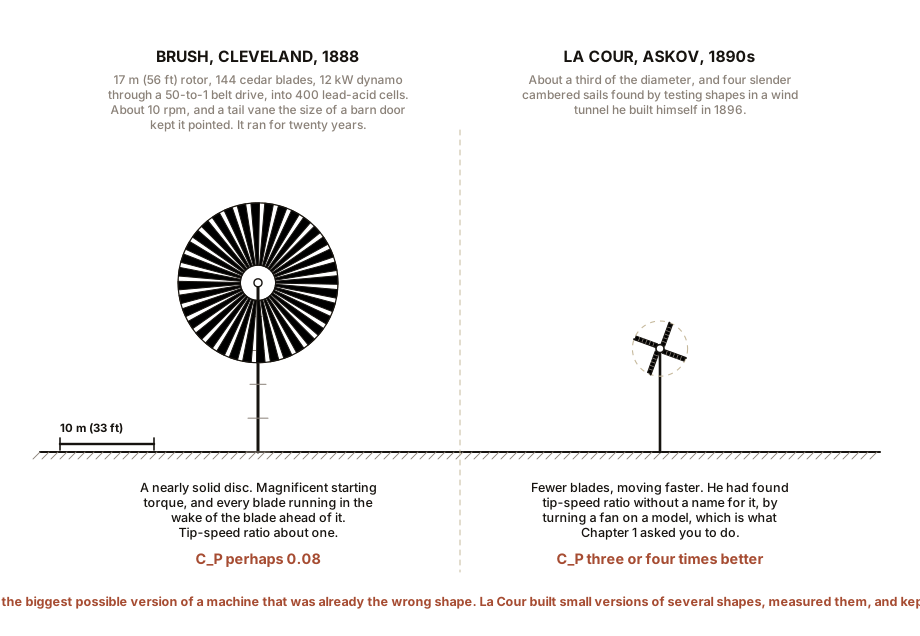
Charles Francis Brush was an American electrical engineer and industrialist who had already made a fortune from arc lighting. Over the winter of 1887 and 1888, in the grounds of his mansion on Euclid Avenue in Cleveland, Ohio, he erected a machine of a scale nobody attempted again for fifty years. The rotor was 17 m (56 ft) across and carried 144 blades of cedar. It stood on a tower about 18 m (60 ft) high, and a tail vane the size of a barn door kept it pointed. Through a step-up belt drive of about fifty to one it turned a dynamo rated at 12 kW, charging a cellar full of over four hundred lead-acid cells that supplied the house and Brush’s laboratory. It ran for about twenty years.
And it was, in the terms this book has already established, a bad machine. Not because it failed, because it worked, but because of what it had to be to work. Chapter 1’s equation says the power in the wind through that rotor at 10 m/s (22 mph) is a little over 139 kW. The dynamo was rated at 12 kW, and it rarely saw its rating. Somewhere between the wind and the wire, well over ninety percent of the available power was lost.
The reason is in the blade count. 144 blades on a 17 m (56 ft) rotor is a nearly solid disc, which by Chapter 2’s argument gives magnificent starting torque and takes very little energy. The rotor turned at about 10 rpm and needed that fifty-to-one belt drive to make the dynamo useful, and every one of those blades spent its life in the disturbed wake of the blade ahead of it. Brush built a farm windmill the size of a house and hung a dynamo on it. It was the obvious thing to do in 1888 and it was the wrong thing to do, and nobody could have said why yet.
Section 1: The Schoolteacher Who Built a Wind Tunnel
Poul la Cour taught at the Askov Folk High School in Jutland, Denmark. He was a meteorologist and telegraph engineer by training, and from 1891 the Danish government funded him to investigate wind electricity for rural use. His first machine at Askov generated in that year.
What makes la Cour the more important figure is what he did next. He built a wind tunnel at Askov, in 1896 and 1897, and used it to test sail shapes systematically. This was among the earliest wind tunnels anywhere and it was built to answer a specific engineering question rather than to demonstrate a principle.
His conclusion, arrived at from measurement, was the one that governs the whole subject: fewer blades, moving faster, work better than many blades moving slowly. He settled on four sails of high aspect ratio, shaped with camber, running at a tip speed several times the wind speed. He had found tip-speed ratio without a name for it, and he had found it by turning a fan on a model, which is exactly what Chapter 1 asked you to do.
La Cour also solved the storage problem in a way that reads as startlingly modern. Wind is intermittent, batteries in 1900 were expensive and short-lived, and he wanted steady light. So he used the electricity to electrolyse water, stored the hydrogen, and burned it in gas lamps to light the school. He ran on hydrogen for some years. Several windows were reportedly blown out along the way, which is what happens when you store hydrogen in 1900.
He published a journal, Tidsskrift for Vindelektricitet, from 1904, and he trained a generation of Danish “wind electricians”. By the end of the First World War something like a hundred and twenty Danish rural utilities were running wind turbines, totalling on the order of 3 MW. Denmark’s twenty-first-century position in this industry starts with a schoolteacher and a wind tunnel in a village in Jutland, and the continuity is real rather than sentimental: the firms that dominate the modern market are descended from the same workshops.
IN PLAIN ENGLISH: Brush built the biggest possible version of a machine that was already the wrong shape. La Cour built small versions of several shapes, measured them, and kept the best one. The second method is slower, cheaper, and it is the only one that ever finds anything out.
Section 2: Betz, and the Result Nobody Needed Yet
In 1919, at the Aerodynamische Versuchsanstalt in Göttingen, Albert Betz published a short paper with a long German title, in a journal about turbine engineering. Its content is the subject of Chapter 5 and its result is the number this book keeps promising: no wind machine of any design can extract more than 16/27, or 59.3 percent, of the power passing through its swept area.
Consider the timing. In 1919 the largest wind machine ever built was Brush’s, it had been dismantled about eleven years earlier, and the world’s total installed wind generating capacity was a few megawatts of small Danish units. Betz solved a design problem for an industry that did not exist. He did it with conservation of mass and conservation of momentum and no knowledge of any specific rotor, which is why the answer applies to rotors nobody had thought of yet, including the ones in Chapter 8 that are still being marketed as exceptions.
There is a priority question here and this book will not pretend otherwise. Frederick W. Lanchester, the English engineer, published an equivalent result in 1915, four years before Betz. Nikolai Zhukovsky in Russia derived it independently and published in 1920. The German-language literature calls it the Betz limit, the Russian literature has called it the Zhukovsky limit, and a fair share of the modern academic literature now writes Lanchester-Betz-Joukowsky limit and means all three.
The reason this book calls it the Betz limit is not priority. It is that Betz’s treatment is the one that propagated, the one that got taught, and the one whose argument a reader can follow in an afternoon. This series is about understanding rather than about being first, and the argument is the artefact worth honouring. Betz was also the earlier candidate for this volume’s cover, which went to la Cour instead, and the front matter says why. A name attached to a result is a convention and not a verdict, and you should know that.
Section 3: The Machine That Proved It Could Be Big
Nothing much happened for two decades. Then in 1941, on a ridge called Grandpa’s Knob near Rutland, Vermont, the Smith-Putnam turbine started up.
The numbers are startling for the date. 1.25 MW rated. Two blades, downwind of the tower, on a rotor 53.3 m (175 ft) in diameter. The blades were stainless steel over a steel spar and each weighed about 8 tonnes (18,000 lb). The hub could teeter and the blades could pitch. It fed into the Central Vermont Public Service grid. It was, by a factor of a hundred in power, the largest wind turbine that had ever existed, and its rating was not exceeded by anything until 1979.
It ran intermittently through the war, accumulating about 1,100 hours of generation, mostly hampered by a main bearing failure that took two years to repair because of wartime material shortages. On 26 March 1945 a blade broke off at the root and was thrown some 230 m (750 ft). Nobody was hurt. The crack that caused it had been found earlier and had not been repaired, again because of shortages.
The project was abandoned as uneconomic, and the economics were genuine: the estimated cost of production was about twice what the utility paid for conventional power. But read the failure correctly, because it is not a failure of wind power. It is a fatigue failure in a two-blade steel rotor with a known crack, which is a materials and inspection failure, and Chapter 17 is about why that class of failure still dominates. Smith-Putnam proved that megawatt-scale wind works. It also proved that the blade is the hard part, and both lessons were correct.
Section 4: Gedser, and the Design That Won
The machine that actually determined what a modern turbine looks like was built in Denmark by a former student of la Cour’s.
Johannes Juul built a 200 kW turbine at Gedser, on the southern tip of Falster, commissioned in 1957. Its specification reads like a description of every turbine you have ever seen:
- Three blades. Not one, not two.
- Upwind of the tower, not downwind.
- Rotor 24 m (79 ft), on a concrete tower.
- Fixed blades, designed to stall as the wind rose, so the machine limited its own power with no moving control surfaces at all.
- Tip brakes that flew out on centrifugal force if the rotor overspeeded.
- An asynchronous AC induction generator, connected directly to the grid, which locks the rotor to a nearly constant speed.
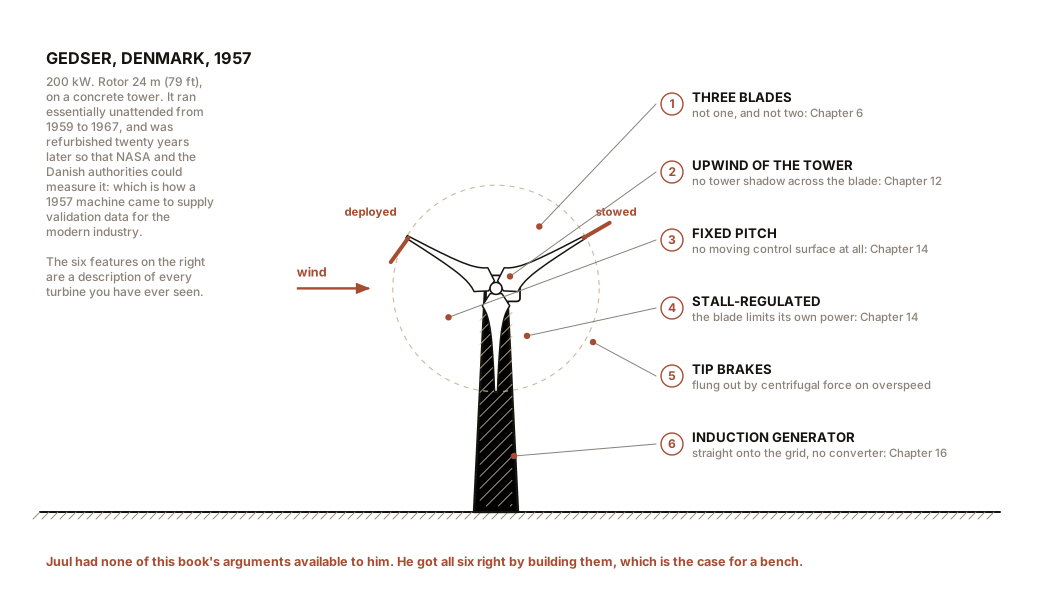
That combination became known as the Danish concept, and it ran at Gedser essentially unattended from 1959 to 1967. It was refurbished and run again in the late 1970s so that NASA and the Danish authorities could measure it, which is how a 1957 machine ended up supplying validation data for the modern industry.
Every element of Juul’s list is a decision this book will justify from physics. Three blades is Chapter 6. Upwind is Chapter 9. Stall regulation is Chapter 14. The induction generator is Chapter 16. Juul arrived at all of them by building and running the thing, twenty years before anyone could compute them.
SLOW DOWN. Check Your Understanding: Juul’s Gedser machine had fixed blades that could not be pitched, and it was connected to the grid through an induction generator that held the rotor at nearly constant speed. Both of those look like limitations. Name the one thing that combination gave him that a modern variable-speed pitch-controlled machine has to work hard to get back. Think before reading on.
Grid stiffness, and specifically inertia. A directly connected induction generator is electromagnetically coupled to the grid’s frequency. If the grid frequency dips, that machine’s rotor, and all of the kinetic energy stored in it, resists the dip automatically, with no controller, no software and no delay. It contributes inertia for free, exactly as a coal plant’s turbine does.
A modern turbine is connected through a power electronic converter, which deliberately decouples the rotor speed from the grid frequency so that the rotor can chase the optimum tip-speed ratio and harvest more energy. That decoupling is why modern machines produce more electricity, and it is also why they contribute no natural inertia and have to be programmed to fake it. Chapter 16 is about the consequences, one of which was a national blackout. Juul’s “limitation” was a property that a grid engineer in 2019 would have paid a great deal of money for.
Section 5: The Oil Shock, and California’s Expensive Education
In October 1973 the price of oil quadrupled, and governments that had shown no interest in wind for thirty years abruptly funded it.
The American response was large, federal and mostly wrong. NASA’s Lewis Research Center ran the Mod-0 through Mod-5 series for the Department of Energy from 1975. The machines were big, they were mostly two-bladed, and they were plagued by fatigue cracking, gearbox failures and control problems. Mod-5B, erected on Oahu in 1987, had a 97.5 m (320 ft) rotor and was rated at 3.2 MW, the largest in the world at the time. The programme produced excellent research data and no commercial product.
The Danish response was small, private and mostly right. Blacksmiths, agricultural machinery firms and one schoolteacher’s homebuilt turbine of 1975 evolved into Vestas, Nordtank, Bonus and Micon. They built machines of 22 kW, then 55 kW, then 150 kW, on Juul’s pattern, and they iterated. From 1979 the Risø national laboratory ran a certification and test scheme that a turbine had to pass before it could be sold with a subsidy. A slow, dull, incremental programme with a mandatory test regime beat a well-funded ambitious one, and it beat it decisively.
Then California. Federal tax credits of 25 percent stacked on state credits of 25 percent, from 1981, produced a wind rush in three passes: Altamont, Tehachapi and San Gorgonio. Roughly seventeen thousand turbines went up in the state by the mid-1980s, a large fraction of them imported from Denmark and a large fraction of the rest badly engineered.
Altamont Pass taught the industry four lessons and it is worth knowing all four.
One, tax credits paid on installation buy installations, not electricity. Machines were erected that barely ran, because the credit was earned on the capital. When the credits lapsed in 1985 the installation rate collapsed overnight.
Two, a lattice tower is a bird perch. Altamont sits on a golden eagle and red-tailed hawk migration corridor, and thousands of small, fast, closely spaced turbines on open lattice towers produced raptor mortality that became the defining environmental objection to wind power for a generation. Chapter 17 gives the numbers in their proper context, which is less damning than the reputation and not nothing.
Three, small and numerous is worse than large and few, for birds, for maintenance and for output. Repowering Altamont from the mid-2000s onward replaced thousands of 100 kW machines with a small number of megawatt machines on tubular towers, and monitored raptor mortality fell by well over half while output rose.
Four, and this is the one that generalises: the machines that survived were the ones that had been tested to destruction before they were sold. The Danish certification scheme was an inconvenience that turned into a competitive advantage, because a turbine that runs for twenty years is worth several that run for three.
ON THE BENCH: Repeat la Cour’s experiment
This is the single most historically loaded measurement in the book and it takes an afternoon. La Cour did it in 1896 with a purpose-built tunnel. You will do it with a box fan and worse instruments, and you will get the same answer, which is the point.
Parts: your hobby motor and hub; enough card or 3 mm (0.12 in) plywood to make blades; a box fan; a multimeter; a fixed load resistor of about 100 ohms; a photo tachometer or a phone’s slow-motion camera. Cost: a few dollars of card. Time: two to three hours if you make all the rotors. Hazards: the fan. Balance every rotor before running it.
Method: build one hub and a set of interchangeable blades so you can run the same generator, at the same distance from the same fan, with: 1. Sixteen flat blades filling most of the disc, which is Brush. 2. Four cambered blades of high aspect ratio, which is la Cour. 3. Three cambered blades, which is Juul.
For each, record the voltage into the fixed resistor and the rotational speed.
What you should see: the sixteen-blade rotor turns slowly and produces the least power. The four-blade and three-blade rotors turn several times faster and produce several times the power, with the three-blade version usually a little ahead of the four. You have reproduced, in one afternoon, the finding that took the industry from 1888 to 1957 to accept.
If it does not work: if the three-blade rotor will not start, hold the fan closer or give the rotor a flick. Poor starting is the correct behaviour and Chapter 6 explains it.
Better, if you have one: a small vane anemometer in the fan stream lets you compute tip-speed ratio for each rotor, and you will find that the good ones are running at four to six and the bad one at about one. That single number is Chapter 6.
ON THE BENCH: Store it as hydrogen, the way la Cour did
La Cour’s answer to intermittency in 1900 was to electrolyse water and burn the hydrogen for light. You can reproduce the first half of that safely, at a scale of millilitres, and it makes the storage problem physical in a way no chart does.
Parts: your model turbine and motor; a box fan; a small jar; two stainless steel or graphite electrodes, which can be pencil leads or stainless machine screws; a teaspoon of washing soda or baking soda in 200 mL of water; two small test tubes or narrow glass jars to invert over the electrodes; a multimeter. Cost: under $10. Time: an hour. Hazards: hydrogen and oxygen are being made in the same jar and the mixture is explosive. Work in millilitres only, keep every flame and spark well away, do the whole thing outdoors or by an open window, and never cap or seal a collection tube. Do not use table salt as the electrolyte, because chloride solutions release chlorine gas. Use soda.
Method: 1. Wire the turbine’s output straight to the electrodes. No battery, no rectifier. 2. Invert a water-filled test tube over each electrode so it collects the gas coming off that electrode. 3. Run the fan on low and time how long it takes to collect 5 mL of gas at the negative electrode. Record the voltage while it runs. 4. Run the fan on high and time the same 5 mL again.
What you should see: bubbles at both electrodes, roughly twice as fast at the negative one because water splits into two parts hydrogen to one part oxygen. And on the high fan setting, gas collecting several times faster, which is Chapter 1’s cube law measured in millilitres of hydrogen.
Then the part that is the actual lesson. Note the voltage. Electrolysis of water needs about 1.23 V in principle and about 1.6 to 2.0 V in a real cell, and below that threshold nothing happens at all no matter how long you wait. So a light wind produces a voltage below the threshold and produces no hydrogen whatsoever, not merely less. La Cour’s storage had a cut-in speed of its own, and every storage technology since has had some equivalent, which is why Chapter 16’s grid problem is harder than it looks.
If it does not work: if nothing bubbles, the motor is not making enough voltage. Gear it up, hold the fan closer, or wire two motors in series. If only one electrode bubbles, one connection is bad.
Section 6: What Held It Up for Fifty Years
Between Brush in 1888 and Gedser in 1957 there is essentially nothing, and the gap deserves an explanation because it is not a gap in physics.
Betz’s answer existed from 1919 and nobody needed it. The theory was thirty-eight years ahead of a machine worth applying it to.
The blades were the barrier. Wood laminates rot and delaminate, steel fatigues under a load cycle that repeats once per revolution for twenty years, and aluminium fatigues faster. Smith-Putnam threw a steel blade. The industry did not become viable until glass-reinforced plastic, borrowed from boatbuilding in the 1950s and 1960s, gave a material that is light, formable into an airfoil, and fatigue-tolerant. Chapter 11 makes the case that the modern turbine is a materials achievement wearing an aerodynamic costume.
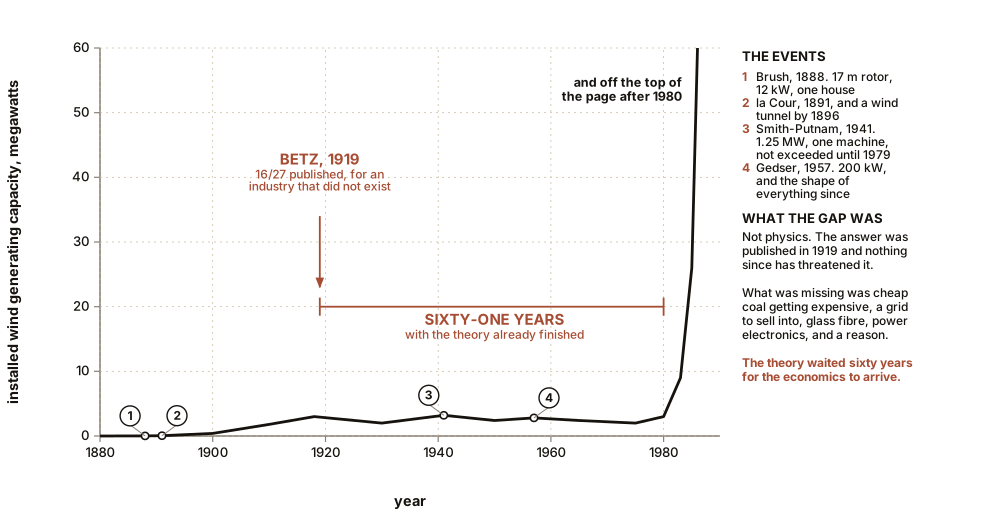
And the competition was cheap. Coal and then oil delivered energy on demand, at a price that no wind machine could approach, into a grid that had been built around the assumption of dispatchable plant. Wind did not lose an argument about physics. It lost on price, for seventy years, and the thing that changed was the price.
Chapter 4 stops the history and starts the physics, with the question that Brush’s 144 cedar blades could not answer: what exactly is a blade doing to the air, and why does doing it with fewer blades work better?

Bench Degree
Get the degree without the diploma.
Learn the material, not how to pass the exam.