Bench Degree·WIND POWERchapter
Chapter 14: Pitch, Stall, and the Storm
A stalled blade and a feathered blade both hold the output flat above rated. One of them does it while pushing on the tower with everything it has, and that difference decided the design of every large machine in the world.
Chapter 13 established what the controller holds constant in each of its four regions, and Region 3 is the one that matters here: above the rated wind speed of 10.5 m/s (23 mph) the output is pegged at 3 MW while the wind’s own power keeps climbing toward 91 MW. This chapter is about the two ways a rotor can be made to do that, and about what happens at the top of the curve when it stops doing it at all.
Both ways work and both are in service. The thing that separates them is not efficiency and it is not the quality of the power regulation. It is thrust, and Chapter 12 showed that thrust is what sizes the tower and the concrete under it.
Section 1: Pitch Against Stall, the Two Philosophies
There are exactly two ways to make a rotor limit its own power in Region 3, and both are in service.
Passive stall regulation, the Danish concept. The blades are bolted on at a fixed angle. They are twisted and shaped so that as the wind rises, the inflow angle of Chapter 4 rises, the angle of attack rises with it, and the blade progressively stalls from the root outward. Stall reduces lift and the power self-limits. Nothing moves. There is no pitch bearing, no pitch drive, no accumulator and nothing in the hub to fail.
The costs are substantial and all of them are consequences of the same thing, which is that you cannot adjust it.
- Power flattens imprecisely, with a hump above rated on some machines and a sag on others, and it varies with air density so a cold winter day overloads the generator.
- Stall is noisy and violently unsteady, so Region 3 loads are high and rough.
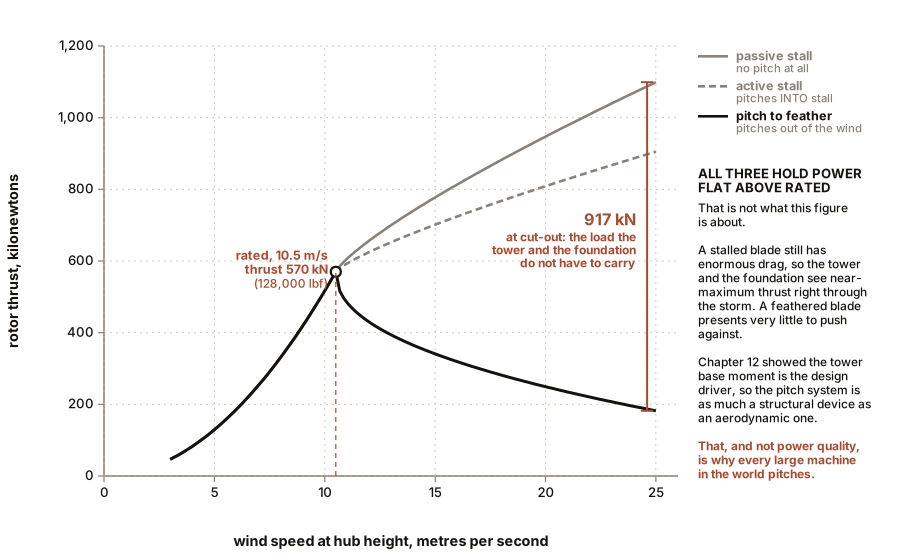
- Thrust stays high. A stalled blade still has enormous drag, so the tower and foundation see near-maximum thrust right through the storm.
- It requires a nearly constant rotor speed, so it needs a directly connected induction generator, which forgoes the variable-speed harvest of Chapter 13 Section 2.
- Stopping the machine needs tip brakes, because there is no way to feather.
Active pitch to feather. Each blade rotates about its own axis to reduce the angle of attack, shedding lift smoothly and continuously. This is what every large machine now does. It gives precise power regulation, a smooth flat Region 3, and, crucially, thrust falls sharply as the wind rises, because a feathered blade presents very little to push against. Chapter 12 showed the tower base moment is the design driver, so the pitch system is as much a structural device as an aerodynamic one.
Active stall, the third option, which is a genuine engineering position and not a compromise. The blade pitches in the opposite direction, deeper into stall, to limit power. Compared with pitch to feather it gives a flatter power curve at high wind, it responds better to gusts because a stalled blade’s lift is insensitive to small inflow changes, and it needs less pitch travel. It keeps thrust high, so it is used mainly on medium machines where thrust is not the binding constraint.
| Passive stall | Active stall | Pitch to feather | |
|---|---|---|---|
| Moving parts in hub | none | pitch drives | pitch drives |
| Power regulation | approximate | very flat | flat |
| Thrust above rated | high | high | low |
| Gust response | rough | good | fair |
| Needs variable speed | no | no | benefits greatly |
| Used on | machines up to a few hundred kW | mid-size | all large machines |
Section 2: The Storm, and the Answer to the Visitor’s Question
Cut-out is not one number, it is a hysteresis loop with a memory, and it is the part of the control system that is most often misunderstood.
The machine cuts out on a sustained average, not on a gust. The usual rule is a ten-minute average above 25 m/s (56 mph), or a shorter average above a higher threshold, so that a single gust does not shut down a machine unnecessarily.
And it restarts at a lower speed than it stopped at. Typically the wind must fall back to around 20 m/s (45 mph), and stay there for several minutes, before the machine resumes. That gap is deliberate. Without it a machine sitting at 25 m/s (56 mph) in gusty conditions would cut out, restart, cut out and restart repeatedly, and every one of those cycles is a large transient load on the drivetrain and a switching event on the grid. Hysteresis exists to prevent chattering, and it is the same reason a thermostat has a deadband.
A shutdown, step by step, and it happens in seconds. The controller commands all three blades to feather at the maximum pitch rate, 5 to 10 degrees per second, so 90 degrees of travel in 9 to 18 seconds. Aerodynamic torque collapses. The generator is disconnected from the grid, cleanly if there is time and by opening a contactor if there is not. The rotor coasts down. Below a threshold speed the mechanical brake is applied and the rotor is parked, usually with the yaw system left free or deliberately turned so the rotor faces the wind with feathered blades, because that is the lowest-load attitude.
And the answer to the question every visitor asks. They see turbines stopped in the strongest wind of the year and conclude somebody is throwing money away. The reasons, in order of importance, are all in this book already.
One, the loads. Thrust goes as the square of wind speed. At 25 m/s (56 mph) the thrust on the rotor is roughly thirteen times what it is at 7 m/s (16 mph), even before turbulence, and the tower and foundation were designed for a defined extreme rather than for an unbounded one. The machine is not saving its dignity, it is staying inside its structural envelope.
Two, the fatigue. Chapter 9’s tenth-power rule means the hours spent in a storm at high load consume design life at an extraordinary rate. An hour of generating in a gale can cost more blade life than a month of ordinary running.
Three, the energy is not there. A handful of hours a year above cut-out, carrying well under one percent of the annual energy. The machine is declining a rounding error at enormous risk.
And a genuine modern refinement, which softens the answer. Newer machines increasingly use storm control, or high-wind ride-through, instead of a hard cut-out. Rather than stopping at 25 m/s (56 mph), the controller progressively de-rates, pitching further and reducing output along a ramp as the wind climbs from 25 to perhaps 30 or 35 m/s (56 to 67 or 78 mph), staying connected at reduced power. It gains a fraction of a percent of annual energy, which is nearly nothing, and it is worth doing for a reason that has nothing to do with energy: it avoids an entire wind farm disconnecting simultaneously as a storm front crosses it, which is a grid event of hundreds of megawatts appearing and disappearing in minutes. Chapter 16 explains why the grid operator cares much more about that than the owner cares about the energy.
ON THE BENCH: Feather a blade and watch Region 3 happen
Section 1 says a machine limits its power by twisting its blades, and that there is an angle at which the output goes to nothing. Both are half an hour’s work.
Parts: a hub that grips the blade roots by friction rather than glue, so a wine cork with three tight radial slots, or three blades held in short lengths of tight-fitting silicone tube; three identical blades; your motor; a box fan; a multimeter and a fixed resistor; a small protractor cut from card that you can hold against the hub to set each blade’s angle repeatably. Cost: nothing beyond what you have. Time: 40 minutes. Hazards: the fan, and a friction-held blade that can fly out. Set the angles with the fan off, every time, and make sure the grip is genuinely tight before switching on.
Method: 1. Set all three blades to the same angle. Start at the angle that Chapter 6’s rotor used, whatever gave you best output, and call it zero. 2. Run the fan at a fixed setting and record power into the resistor. 3. Stop the fan. Twist all three blades toward feather, meaning edge-on to the wind, by 10 degrees. Run and record. 4. Repeat in 10-degree steps out to 90 degrees. 5. Then go the other way from zero, toward stall, meaning flatter to the wind, in 10-degree steps out to 45.
What you should see: a peak near your starting angle, output falling away on both sides of it, and output going essentially to zero somewhere near 80 to 90 degrees of feather while the rotor barely turns at all. That last condition is exactly what a real turbine does in a storm.
And the asymmetry is the lesson. Going toward feather, the rotor speeds up first and then slows, and it becomes quiet. Going toward stall, it slows immediately and gets noticeably noisier and rougher, and you may hear the pitch of the sound change as the flow separates. Feathering is smooth and stalling is violent, which is the whole content of Section 1’s table, felt through a cork.
If it does not work: if the blades slip in the fan stream, the friction fit is too loose and you have found a real hazard rather than a failed experiment. Stop and fix it. If output never peaks, your starting angle was already too far toward feather; go the other way first to find the peak, then re-zero.
Better, if you have one: repeat the whole sweep at two fan speeds. The angle that gives peak power will be nearly the same at both, and the angle needed to hold a fixed output will be larger at the higher speed. That second fact is Region 3’s pitch schedule, measured, and it is what the controller in a real machine is computing every few milliseconds.
Chapter 15 turns all of this on a much smaller machine, on a much shorter tower, in much worse wind, and reaches a conclusion most of this industry’s advertising would rather you did not reach.

Bench Degree
Get the degree without the diploma.
Learn the material, not how to pass the exam.