Bench Degree·WIND POWERchapter

Chapter 15: Small Wind, and Why It Usually Disappoints
A monitoring programme once instrumented twenty-six building-mounted turbines for a year. The median one ran at under one percent of its nameplate, and several consumed more electricity in their inverters than their rotors ever generated. This chapter is about why that result was predictable from Chapter 1.
Everything in this book so far has been an argument for wind power. This chapter is the argument against most of the wind power you can personally buy, and it is made with the same physics.
The book owes you this. A volume that explains the cube law and the Betz limit and the shear profile, and then declines to apply them to the machine a reader might actually be sold, has not finished its job. So: apply them. The conclusion, at most addresses, is no. And there is a clearly definable set of situations where the conclusion is a confident yes, and this chapter draws that line rather than gesturing at it.
Section 1: The Three Things That Kill It, All Established Already
One: the cube law, applied at the wrong height.
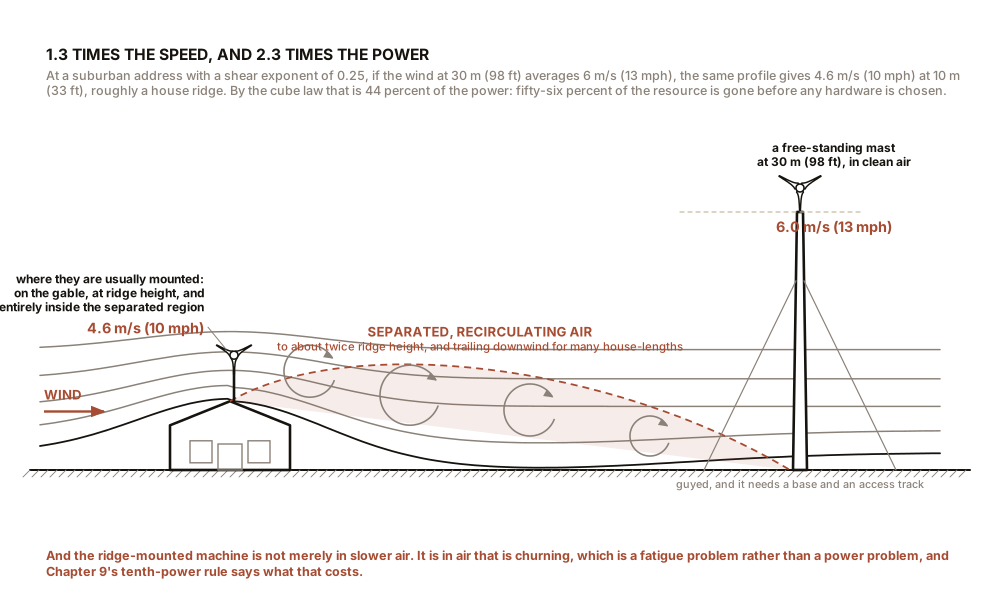
Chapter 9’s shear profile says wind speed rises with height, steeply near the ground. At a suburban address with a shear exponent of 0.25, if the wind at 30 m (98 ft) averages 6 m/s (13 mph), then at 10 m (33 ft), roughly a house ridge, the same profile gives
6 × (10/30)^0.25 = 6 × 0.760 = 4.6 m/s4.6 m/s, or 10 mph. And by the cube law the power
available at the ridge is 0.760³, which is 44
percent of what is available at 30 m (98 ft). Fifty-six
percent of the resource is gone before any hardware is chosen,
and this is a calculation the reader can now do in one line.
Two: turbulence, which is worse than the slowing.
Chapter 9 put turbulence intensity beside a building at 30 to 50 percent, against 10 to 14 percent in the open. The disturbed region above an obstacle extends roughly twice the obstacle’s height upward and as much as twenty times its height downwind. A house 8 m (26 ft) to the ridge therefore sits at the bottom of a churning zone reaching to about 16 m (52 ft), and a turbine bolted to the gable is inside it by definition.
Turbulence costs a small amount of energy, because a rotor in shifty air spends its time chasing a direction it never finds. What it mainly costs is the machine. Chapter 9’s tenth-power fatigue rule applies to a 3 m (10 ft) rotor exactly as it applies to a 110 m (361 ft) one, and a machine certified to a 12 or 14 percent turbulence class and installed in 40 percent turbulence is out of certification and will show it.
Three: vibration into the building, which is a category of problem the physics does not warn you about.
A rotor bolted to a house is a source of alternating force bolted to a resonator that people sleep inside. Chapter 12’s tower has its natural frequency deliberately placed to miss 1P and 3P. A house has dozens of natural frequencies and nobody placed any of them. Building-mounted turbines have produced complaints about audible hum in bedrooms and, in some cases, damage to render and mortar, and the mechanism is straightforward structural transmission rather than anything mysterious.
IN PLAIN ENGLISH: The wind at roof level is slower than the wind twenty metres higher, and because power goes as the cube of speed, a bit slower means much weaker. It is also chopped up by the building itself, which wears the machine out fast and shakes the house. Those three things happen before you have chosen a turbine, and no turbine fixes any of them.
Section 2: The Tower You Would Actually Need
Everything in Section 1 has one fix and it is not a better rotor.
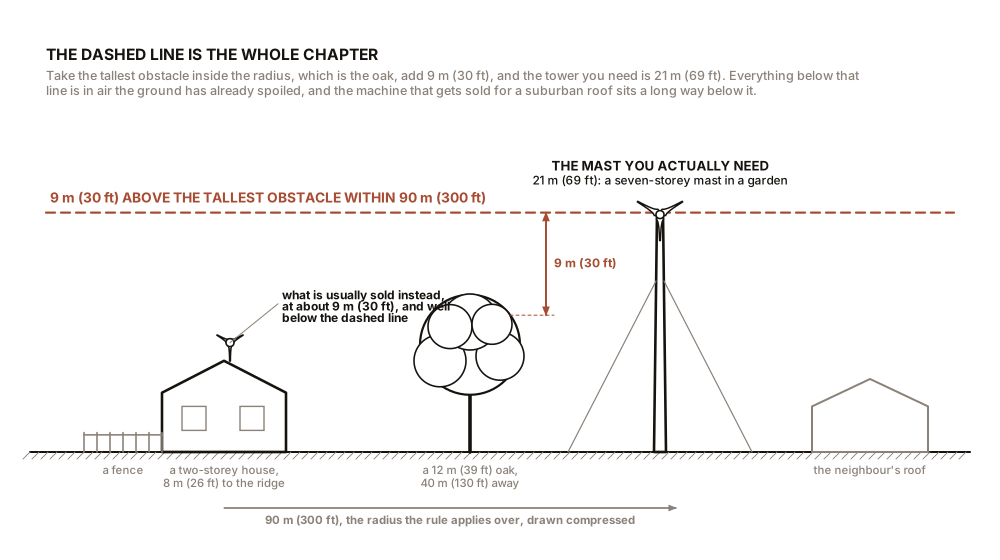
The standard siting guidance for small wind, as published by national energy agencies in several countries, is that the rotor should sit at least 9 m (30 ft) above anything within about 90 m (300 ft), and some versions of the guidance extend that radius to 150 m (500 ft). The rule is crude and it is roughly right, because it is a restatement of Section 1’s disturbed-zone geometry.
Apply it to an ordinary address. A two-storey house is 8 m (26 ft) to the ridge. There is a 12 m (39 ft) oak 40 m (130 ft) away. Take the tallest obstacle inside the radius, which is the oak, add 9 m (30 ft), and the tower you need is 21 m (69 ft), which is a seven-storey mast in a garden.
That mast is the project. It needs a foundation, guy anchors or a monopole base, a planning application, setbacks from boundaries, a lightning earth, a means of lowering the machine for service, and in most jurisdictions a qualified installer for the grid tie. On typical small-wind installations the turbine is the minority of the cost. The tower, the civils, the electrical work and the permits are the majority.
And here is the sentence that decides most cases. If you cannot or will not put up a mast of that height, then you do not have a wind site, and no product decision changes that. The commonest error in small wind is not buying the wrong turbine. It is buying a turbine at all when the honest answer was a mast you were never going to erect.
Section 3: How a Nameplate Misleads, and the Two Numbers to Demand
Small wind has a specific and avoidable pathology in how it is specified, and Chapter 13 already gave you the tool to see through it.
A rated power on its own is nearly meaningless, because the rated wind speed is a free choice. A manufacturer with a given rotor can print almost any number on the label by declaring a high enough rated speed. Two machines with identical rotors can honestly be marketed as “1.5 kW” and “3 kW”, the second having simply nominated a rated wind speed a quarter higher.
Chapter 13’s arithmetic shows it. Output at rated goes as the cube of the rated speed, so a 26 percent increase in the nominated rated speed doubles the nameplate with no change whatever to the machine. And rated speeds in small-wind literature run anywhere from 9 to 14 m/s (20 to 31 mph), a range that spans a factor of nearly four in claimable power.
So the nameplate is not the specification. Two other numbers are.
One: the swept area. For a horizontal machine that
is πr²; for a vertical machine it is height times width.
This is the only number that is a property of the machine rather
than a decision about the machine, and Chapter 1’s equation
says it is proportional to output. Compare machines on swept area and
the marketing collapses immediately.
Two: the Rated Annual Energy at a stated annual average wind speed. The certification standards written for this class of machine, in the United States the AWEA small wind standard administered by the Small Wind Certification Council, and internationally IEC 61400-12, exist precisely to close the nameplate loophole. They fix the rated power measurement at 11 m/s (25 mph) and, far more usefully, they require publication of the annual energy the machine would produce at a site with a 5 m/s (11 mph) annual average.
That single figure is what you are buying. It is in kilowatt-hours per year. It can be divided by your electricity price to give an annual saving, and divided into the installed cost to give a payback. Ask for it by name, and treat its absence as an answer. A manufacturer who will quote a peak power but not a certified annual energy at a stated average wind speed has told you which of the two numbers flatters the product.
Section 4: The Comparison, Done Fairly
Here is the arithmetic the rest of this chapter has been building toward. One budget, three sites, two technologies, and the assumptions stated so you can substitute your own.
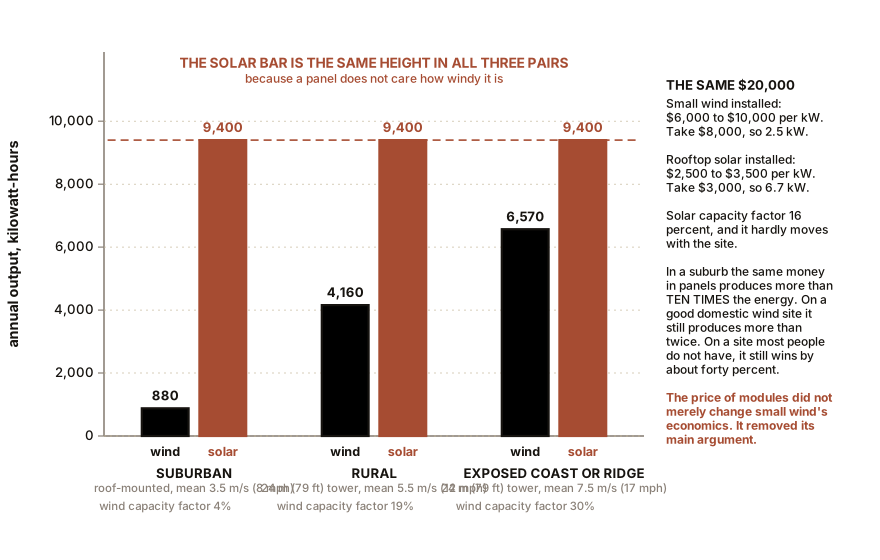
Assumptions, all of them arguable and all of them stated. Installed small wind in the 2 to 10 kW class costs $6,000 to $10,000 per kilowatt; take $8,000. Installed residential solar costs $2,500 to $3,500 per kilowatt of panel; take $3,000. Utility-scale onshore wind, for perspective, costs $1,300 to $1,700 per kilowatt. Solar capacity factor for a fixed unshaded roof at mid latitudes is 14 to 18 percent; take 16 percent.
A budget of $20,000 therefore buys 2.5 kW of small wind, or 6.7 kW of solar.
| Site | Wind capacity factor | Wind, kWh per year | Solar, kWh per year |
|---|---|---|---|
| Suburban, roof-mounted, mean 3.5 m/s (8 mph) | 4% | 880 | 9,400 |
| Rural, 24 m (79 ft) tower, mean 5.5 m/s (12 mph) | 19% | 4,160 | 9,400 |
| Exposed coast or ridge, 24 m (79 ft) tower, mean 7.5 m/s (17 mph) | 30% | 6,570 | 9,400 |
Read the first row and then stop reading. In a suburb, the same money in solar panels produces more than ten times the energy, with nothing that turns, nothing on a mast, no planning objection, no annual service, and no neighbour.
Read the second row, which is a genuinely good wind site by domestic standards. Solar still produces more than twice as much for the same money.
Read the third row, which is a site most people do not have. Solar still wins, by about 40 percent, and it wins again on the things not in the table: no moving parts, no tower, a twenty-five-year product warranty as standard, and installers on every high street.
This book will not pretend that comparison is close, because it is not. The collapse in the price of photovoltaic modules over the last fifteen years did not merely change the small wind market’s economics, it removed its main argument. Small wind was the right answer for a remote homestead in 1930 and for a rural property in 1990, and for most of the situations where it used to be right, the answer is now solar.
Section 5: When Small Wind Genuinely Wins, and It Does
The chapter has been unkind and now it has to be exact, because there is a real answer here and vagueness would be a different kind of dishonesty.
Small wind wins when four conditions hold together. Not two of them, not three. Four.
One: the site has real wind, meaning an annual mean of at least 5.5 to 6 m/s (12 to 13 mph) at the hub height you will actually build. Not at the airport twenty miles away, and not at 50 m (164 ft) when your mast will be 12 m (39 ft). Measured, at your height, for a year, and corrected against a long-term reference as Chapter 10 described.
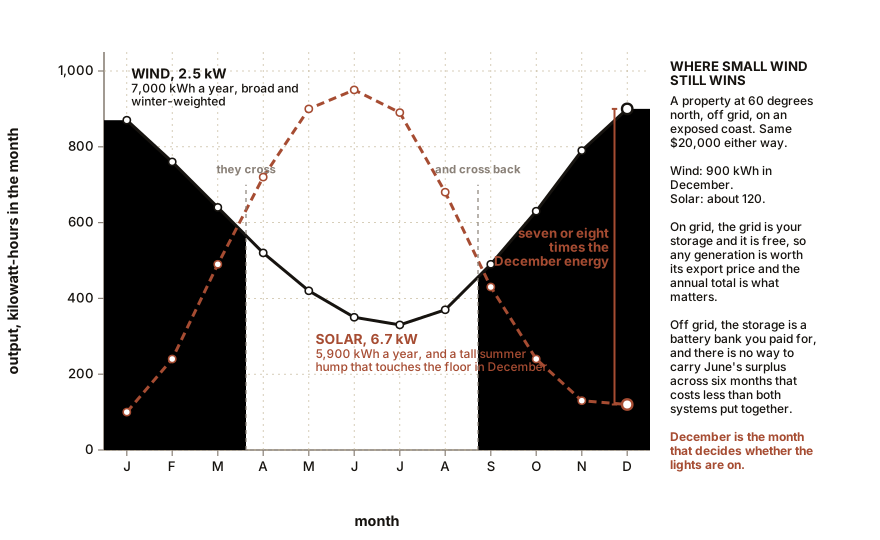
Two: you are off-grid, or the grid connection is genuinely expensive. The reason this matters is not romantic. On-grid, the grid is your storage and it is free, so any generation is worth its export price. Off-grid, your storage is a battery bank you paid for, and the value of a kilowatt-hour arriving in December is completely different from one arriving in June, because the June one has nowhere to go.
Three: you are far enough from the equator that solar has a winter problem. This is the condition that actually decides it, and it is decided by latitude.
Four: the load exists in winter. A holiday cabin used in July does not qualify. A house that needs heating and lights from November to February does.
Here is the arithmetic for a site where all four hold. A property at 60 degrees north, off grid, on an exposed coast, mean wind 8 m/s (18 mph) at a 15 m (49 ft) hub. Same $20,000, so 2.5 kW of wind or 6.7 kW of solar.
- Wind: capacity factor about 32 percent, so 7,000 kWh a year. And a temperate maritime wind resource is winter-weighted, so December delivers something like 12 to 15 percent of the annual total, call it 900 kWh in December.
- Solar: at 60 degrees north the annual capacity factor falls to about 10 percent, so 5,900 kWh a year, which is still respectable. But at that latitude a fixed array delivers 1 to 3 percent of its annual output in December, which is about 120 kWh in the month.
Seven or eight times the December energy, from the wind, at the same price. And December is the month that decides whether the lights are on, because there is no way to carry June’s surplus across six months that costs less than both systems put together.
That is the case for small wind, and it is a strong one. Note how narrow it is, and note that every term in it is a term this book gave you: a shear profile, a mean wind speed, a capacity factor, and a load that happens at a particular time of year.
Where else it genuinely works, by the same logic: telecommunications repeaters and navigation aids on exposed high ground, research stations at high latitude, boats and offshore buoys where the resource is excellent and the alternative is a diesel, and mechanical water pumping, which is not electrical at all and where Chapter 2’s Aermotor pattern is still competitive, still manufactured, and still needs no inverter, no battery and no electrician.
ON THE BENCH: Assess your own site, and be willing to fail it
Parts: the hand anemometer and broom handle from Chapter 9’s turbulence survey; a tape measure; a notebook; a year, or one honest month. Cost: $30 if you already have the anemometer. Time: an afternoon for the survey, a month for the logging. Hazards: nothing, and specifically do not climb anything. Every measurement in this box is taken from the ground on purpose.
Method, and there are four steps and no shortcuts.
Step 1: find the tallest obstacle within 90 m (300 ft) of your candidate mast position. Measure or estimate its height by pacing off a distance and using a protractor and a piece of string, or by counting brick courses. Add 9 m (30 ft). Write down the tower height you actually need, and write down honestly whether you would build it.
Step 2: measure your shear exponent. Log wind speed at two heights on the same spot, 1 m and 2.5 m (3 ft and 8 ft) is enough, for at least an hour on a steady day. Compute α from the ratio of the two averages: α is the logarithm of the speed ratio divided by the logarithm of the height ratio.
Step 3: extrapolate to your hub height and to a reference. Using your α, project your measured speed up to the tower height from Step 1. Then check yourself: find the nearest airport’s published long-term annual mean wind speed and its anemometer height, project that to your hub height too, and see whether the two estimates are within thirty percent of each other. If they are not, believe the airport, because it has thirty years of data and you have an hour.
Step 4: log for a month. One reading every ten minutes if you have a logger, or six a day at set times if you do not. Bin the results and compute the mean.
What you should see: in most suburban gardens, a mean at ground level of 2 to 3.5 m/s (4.5 to 8 mph), a required tower height of 18 to 25 m (59 to 82 ft), and an extrapolated hub-height mean below the 5.5 m/s (12 mph) threshold of Section 5. That is a failed site, it is the commonest result, and finding it out for $30 rather than for $20,000 is the single most valuable thing this book can do for you.
If it does not work: if your numbers come out marginal, they are marginal, and the correct response is a year of proper logging rather than optimism. Nobody has ever regretted measuring for longer.
ON THE BENCH: Compute the annual yield yourself, bin by bin
This is the calculation that a salesman will do for you and that you should never accept second-hand. It is one afternoon in a spreadsheet and it is the same method used to finance a wind farm.
Parts: your wind speed log from the previous box, or a Weibull distribution assumed from your mean; a published power curve for the machine you are considering, in kilowatts against wind speed, which the manufacturer must supply; a spreadsheet. Cost: nothing. Time: two hours. Hazards: none, unless you count finding out.
Method: 1. Make a column of wind speeds in 1 m/s (2.2 mph) steps from 0 to 25 m/s (0 to 56 mph). 2. Next to it, the number of hours per year at each speed. From your own log, that is the count in each bin scaled up to 8,760 hours. If you have only a mean, use a Weibull with shape factor 2 and scale parameter equal to your mean divided by 0.886. 3. Next to that, the machine’s output at each speed, read straight off the published power curve. Zero below cut-in and zero above cut-out. 4. Multiply the two columns. Sum the result. That is your annual energy in kilowatt-hours. 5. Divide it by the nameplate times 8,760 and you have your own capacity factor.
What you should see: a number considerably lower than the one on the brochure, and a distribution of contributions that is worth staring at. The bins that contribute most are not the windiest and not the commonest, they are the ones in between, and for a small machine at an ordinary site the top contributing bin is usually only 1 or 2 m/s (2 to 4 mph) above the site mean.
And do one more column. Multiply your annual energy by your electricity price. Divide the installed cost by that. That is your payback in years, computed by you, with no discount rate and no maintenance and no inverter replacement, so treat it as an optimistic bound rather than an estimate. If the optimistic bound is longer than the machine’s design life, the answer is no and you now know it for certain.
Section 6: What To Do Instead, Ranked
Since the chapter has spent itself saying no, it owes an ordered list of yeses. This is the ranking by cost per kilowatt-hour saved or generated at a typical domestic address, best first.
One: do not use it. Air sealing, loft insulation and a hot water tank jacket return energy at a cost per kilowatt-hour that no generating technology approaches, often paying back in months. A negawatt is cheaper than a watt and always has been. If a house is heated by resistance electricity or by oil, a heat pump is the next item and it multiplies each kilowatt-hour by three or four, which no rotor of any shape can do; the Refrigeration volume of this series is recommended if you want to know why that multiplication is legitimate and not a violation of anything.
Two: solar photovoltaic, at almost any address at almost any latitude below about 55 degrees, for the reasons of Section 4.
Three: solar thermal for hot water, at some addresses, on a shorter payback than photovoltaic in high-hot-water households.
Four: small wind, if and only if all four of Section 5’s conditions hold. Then it is not merely acceptable, it is the right answer and there is no substitute.
Five: a rooftop turbine. Almost never. The situation in which it is correct is a genuinely exposed site with no ground available and a building tall enough to clear its own turbulence, which in practice means a tall building rather than a house, and even then the vibration path into the structure is a serious engineering problem rather than a fitting problem.
SLOW DOWN. Check Your Understanding: A neighbour shows you a 400 W small turbine on a 6 m (20 ft) pole, bought for $600, and reports proudly that on windy days he watches his meter and it is definitely generating. He asks whether he should buy three more. What is the one measurement that settles it, and what is the answer likely to be? Think before answering.
The measurement is his total annual energy, in kilowatt-hours, taken over a full year from a dedicated meter, not observed on windy afternoons. And the likely answer is that the machine produces somewhere between 50 and 250 kWh a year, worth $10 to $50, on a $600 purchase.
The reason he is not wrong about what he saw is the reason this is worth a box. On a windy day at 8 m/s (18 mph) that turbine may genuinely produce close to its rated 400 W, and watching a meter run backwards is a real observation of a real event. What he has measured is the machine’s best hour. What decides the purchase is the machine’s average hour, and at a 6 m (20 ft) hub in a garden those two differ by a factor of twenty or more.
This is the same error as quoting a rated power instead of an annual yield, and it is the same error as reading a resource figure as a yield figure in Chapter 10, and it is the same error as comparing capacity factors across different specific powers in Chapter 13. All four are one mistake wearing different clothes: confusing an instantaneous quantity with an integral over a year.
And the reason it is so persistent is that the instantaneous quantity is the one you can see. Nobody can watch an annual yield. You can only compute it, from a distribution and a power curve, which is exactly what the second bench box in this chapter asked you to do. The whole discipline of wind resource assessment exists because the visible number and the useful number are different numbers.
Chapter 16 goes back up to the utility scale and asks what happens when a great many of these machines are connected to the same grid, which turns out to be a harder problem than any of the aerodynamics.

Bench Degree
Get the degree without the diploma.
Learn the material, not how to pass the exam.